



What Is a Lease Agreement?
A lease agreement is a written contract that conveys to a tenant the exclusive right to occupy real property for a fixed term, in exchange for rent paid to the landlord on an agreed schedule. In legal terms it creates a leasehold estate, meaning the tenant holds a possessory interest in the property that is enforceable against third parties, including the landlord. That distinguishes a lease from a license, which only grants permission to enter and can be revoked at any time.
Every state recognizes residential leases under a combination of common-law principles and statutory landlord-tenant codes. Roughly half the states have adopted some version of the Uniform Residential Landlord and Tenant Act (URLTA), which standardizes core protections such as the implied warranty of habitability, restrictions on retaliation, and limits on security deposits. The other half rely on their own code, which typically follows similar principles but with different numbers (notice periods, deposit caps, late-fee maximums).
A lease that complies with state law is binding regardless of whether either party reads it closely. Courts hold tenants to the rent obligation and hold landlords to the warranty of habitability and to whatever express promises appear in the document. The single most common source of tenant-landlord disputes is silence: the lease did not address pets, late fees, guest policies, or who pays for water, and the parties disagreed after move-in. A complete lease prevents most of those disputes by stating the answer in writing before either side has a reason to argue.
Lease vs. rental agreement
The two terms are often used interchangeably, but in practice they describe different arrangements. A lease runs for a fixed term (usually six or twelve months) and locks in the rent and other terms for the duration. A rental agreement is a periodic tenancy, almost always month-to-month, that renews automatically each cycle until either party terminates with the notice required by state law. A landlord who wants stable occupancy and predictable income uses a lease. A landlord who needs the flexibility to reset rent, change rules, or remove a tenant on short notice uses a rental agreement.
When a written lease is required
The Statute of Frauds, adopted in some form by all 50 states, requires any lease with a term longer than one year to be in writing. A verbal one-year lease is enforceable in 49 states (Louisiana follows civil-law tradition and reaches the same outcome through different rules). Even where verbal is permitted, evidentiary problems make written leases the only practical option: without writing, the parties have no shared record of rent, deposit, term length, utilities, or any rule the landlord wants to enforce.
Conveys a Possessory Interest
Tenant has the legal right to exclude others, including the landlord
Sets Terms in Writing
Rent, deposit, term, rules, and disclosures all in one document
Enforceable in Court
Either party can recover under the lease if the other party breaches
Types of Lease Agreements
Different rental situations require different types of lease agreements. From standard residential leases to commercial property rentals, we offer templates for every scenario. Browse by category to find the right agreement for your needs.
Residential Lease Templates
Standard Residential Lease
Fixed-term rental agreement, typically one year
Month-to-Month Lease
Flexible rental with no fixed end date
Week-to-Week Lease
Short fixed-interval rental
One-Page Lease
Simplified short-form residential lease
Condominium Lease
Lease for individual condo units
Vacation Rental Agreement
Short-term rental for 1-31 days
Vacation Short-Term Rental
Airbnb / VRBO-style short-term rental
Room Rental Agreement
Rent out a single room in your property
Roommate Agreement
Define shared living responsibilities
College Roommate Agreement
Student housing roommate rules
Family Member Lease
Leasing to family with documented terms
Rent-to-Own Agreement
Rental with option to purchase
Commercial Lease Templates
Commercial Lease Agreement
Office, retail, or industrial space lease
Office Lease
Dedicated office-space lease
Warehouse Lease
Industrial / storage warehouse lease
Retail Lease
Restaurant / retail storefront lease
Coworking Lease
Shared-workspace membership agreement
Studio Lease
Artist / photographer studio lease
Kitchen Lease
Commissary / commercial kitchen rental
Party Venue Lease
Event-venue rental
Venue / Event Space Lease
Wedding and event venue lease
Flex Space Lease
Multi-use flex industrial lease
Booth / Salon Lease
Salon chair or booth rental
Massage Therapist Lease
Treatment-room rental for therapists
Lease-to-Own Commercial
Commercial rent-to-own lease
Gross Commercial Lease
Landlord-pays-expenses commercial lease
Modified Gross Lease
Shared-expense commercial lease
Triple-Net (NNN) Lease
Tenant pays all operating costs
Percentage Lease
Rent tied to tenant sales volume
Storage Unit Lease
Self-storage unit rental
Commercial Sublease
Commercial tenant subleasing space
Commercial Office Sublease
Office sublease for commercial tenants
Commercial Lease Addendum
Modify a signed commercial lease
Commercial Renewal Addendum
Extend commercial lease term
Commercial Extension Addendum
Extend commercial lease expiration
Commercial Termination
End a commercial lease
Commercial Early Termination
End a commercial lease before term
Sublease & Roommate Templates
Addendum Templates
Lease Addendum
Modify an existing lease with an attached addendum
Bed Bug Addendum
Disclose bed-bug history
Crime / Drug-Free Addendum
Prohibit criminal activity on premises
Extension Addendum
Extend lease beyond original term
Improvements & Modifications Addendum
Permit tenant alterations
Military Clause Addendum
Early termination for military relocation
Mold Disclosure Addendum
Disclose mold history
Month-to-Month Addendum
Convert lease to month-to-month
Pet Addendum
Add pet terms to an existing lease
Rent Increase Addendum
Document a lease rent increase
Smoking Policy Addendum
Define smoking restrictions
Swimming Pool Addendum
Pool-use rules and liability
Lead Paint Disclosure
Federal lead-paint disclosure for pre-1978 homes
Rent Change Addendum
Alternate rent-change form
Improvements Addendum (alt)
Alternate improvements form
Crime/Drug-Free (alt)
Alternate crime/drug-free form
Amendment Templates
Lease Amendment
Formally change specific terms of a signed lease
Add / Remove Tenant Amendment
Add or remove a tenant mid-lease
Rent Forgiveness Amendment
Document forgiven rent obligations
Rent Forgiveness (alt)
Alternate rent-forgiveness form
Lease Amendment (general)
General-purpose lease amendment
Add / Remove Tenant (alt)
Alternate add/remove-tenant form
Lifecycle & Assignment Templates
Lease Assignment
Transfer the lease to a new tenant
Lease Assignment (alt)
Alternate lease-assignment form
Landlord Consent to Assignment
Landlord approval for a lease assignment
Lease Renewal
Extend the lease for another term
Lease Renewal (alt)
Alternate lease-renewal form
Lease Extension
Extend the current lease
Non-Renewal Notice
Notify tenant of non-renewal
Lease Addendum (general)
General-purpose addendum
Termination Notice
Notice to terminate the lease
Early Termination
End a lease before the term
Personal Guarantee
Co-signer guarantee for rent
Release of Guarantee
Release a co-signer's obligation
Estoppel Certificate
Tenant statement of lease status
Notices & Tenant Communication
Rent Increase Notice
Notify tenant of rent change
Notice of Current Rent Balance
Communicate outstanding balance
Rent Balance Notice (alt)
Alternate rent-balance notice
Landlord Notice to Enter
Notify tenant of planned entry
Landlord Repair Notice
Notify tenant of planned repairs
Security Deposit Return Letter
Itemize deposit return
Security Deposit Receipt
Receipt for deposit paid
Specialty Leases
Equipment Lease
Rent tools, machinery, or equipment
Land Lease
Lease undeveloped land or lots
Farm Lease
Agricultural land lease
Pasture Lease
Livestock pasture rental
Hunting Lease
Seasonal hunting-land access
Photo Booth Rental Contract
Photo-booth event rental
Parking Space Lease
Rent out a parking space
Parking Space Lease (alt)
Alternate parking-space form
How to Write a Lease Agreement
A residential lease has eight working parts. Every state requires the first six. The seventh (disclosures) varies by state and federal preemption rules. The eighth (signature and delivery) determines whether the lease is enforceable at all. Work through them in order. Every clause should be specific enough that a stranger reading the lease six months later can answer the question “what did the parties agree to?” without picking up the phone.
Identify the Parties
Use full legal names. For a corporate or LLC landlord, use the registered entity name as it appears with the Secretary of State, plus the agent for service of process. For a sole-proprietor landlord, the personal name is sufficient but a current mailing address (not a P.O. box in California, Florida, and several other states) is required for service of notices. Every adult occupant should be named as a tenant. Adults who live in the unit but are not on the lease have no contractual obligation, which means the landlord cannot pursue them for unpaid rent or damages. If a guarantor is signing, name the guarantor and have them sign a separate guaranty addendum so the obligation does not lapse with the tenancy.
Describe the Property
State the full street address with unit number, the assessor parcel number where available, and a one-line description of what is included (single-family home, garden apartment with assigned parking space #14, third-floor walk-up). List every appliance and fixture the landlord is providing (refrigerator, range, washer/dryer in unit, dishwasher) so the tenant cannot later claim items were missing at move-in. If common areas (yard, basement storage, shared laundry) are part of the leasehold, name them. If they are not, exclude them explicitly to prevent a claim that the landlord interfered with the tenant's use.
Define the Lease Term
State the start date and the end date in calendar form. Specify what happens at the end of the term: month-to-month holdover at the same rent (the default in most states), automatic renewal for another year unless either party gives written notice, or a hard expiration that requires a new lease. If the lease holds over to month-to-month, identify the notice period required to terminate (30 days in most states, 60 in California for tenancies over a year, 20 in Washington). Holdover at the end of a fixed term without a written agreement creates ambiguity that no party benefits from.
Set Rent and Payment Terms
State the monthly rent in dollars, the day it is due (typically the 1st), and the address or payment platform where the tenant pays. Define the grace period (commonly five days) and the late fee. Late fees must be reasonable: California caps them at the actual cost of collection, Texas caps them at 12 percent of one month's rent for properties of four units or fewer, and several states (New Jersey, Maine) require a five-day grace period before any fee can apply. Specify the consequence of a returned check (typically the dishonored-check fee allowed by state law plus the late fee). State who pays which utility (water, gas, electric, internet, trash) and whether the landlord submeters or the tenant pays the utility company directly.
Security Deposit Details
State the deposit amount, the date it is due (almost always before move-in), and the account where it will be held. Several states require deposits to be kept in a separate account (Florida, Maryland, Massachusetts) and a few require the account to bear interest payable to the tenant (Massachusetts, Connecticut, New York for buildings of six or more units, Maryland for terms over six months). Itemize what the deposit can be used for at move-out: unpaid rent, damages beyond ordinary wear and tear, cleaning costs above what a clean unit normally requires. Wear and tear (faded paint, worn carpet from normal use) cannot be deducted in any state. State the deadline by which the landlord will return the deposit and the itemized statement of any deductions. Deadlines range from 14 days (Vermont) to 60 days (Maryland, Arkansas).
Establish Rules and Policies
Address pets (allowed types, weight limits, pet deposit, monthly pet rent), smoking (most insurance carriers now require a no-smoking clause), guests (length of stay before a visitor becomes an unauthorized occupant), noise (quiet hours), parking (assigned spaces, visitor parking limits), subletting (prohibited, allowed with consent, allowed without consent), maintenance (who handles HVAC filters, lawn care, snow removal), and alterations (paint, mounting hardware, fixtures). Two restrictions matter: clauses that exclude service animals violate the Fair Housing Act regardless of any pet policy; and clauses that ban a category of guest based on a protected class are void.
Include Required Disclosures
Federal law requires the lead-based paint disclosure (24 C.F.R. § 35.92) for any unit built before 1978, including the EPA pamphlet and a tenant signature acknowledging receipt. State-required disclosures are extensive and vary widely. California requires a Megan's Law database notice, a bed-bug history form, demolition notices, and shared-meter disclosures. Maryland requires a mold notice and lead-paint registration certificate. Texas requires special-flood-hazard and parking-rule notices. Washington requires a mold information packet. Failure to deliver a required disclosure does not void the lease but exposes the landlord to statutory damages, attorney fees, and in some cases the right of the tenant to terminate without penalty.
Sign and Distribute
Both parties sign and date the lease. Each tenant should sign separately (not as a single group). The landlord, or an authorized agent for a corporate landlord, signs in their individual or representative capacity. Two adult witnesses are not required by any state for a residential lease but improve the lease's evidentiary weight in court. Notarization is not required unless the lease will be recorded against title. Deliver an executed copy to every party (paper or PDF) on the day of signing. The fully signed lease is the operative version for any future dispute.
Key Components of a Lease Agreement
A comprehensive lease agreement should include the following essential elements to ensure clarity and legal enforceability. Missing any of these components could lead to disputes or make the agreement difficult to enforce.
| Component | Description |
|---|---|
| Party Information | Full names and addresses of landlord and all tenants |
| Property Description | Complete address and description of the rental unit |
| Lease Term | Start date, end date, and type (fixed or month-to-month) |
| Rent Details | Amount, due date, payment methods, and late fees |
| Security Deposit | Amount, holding conditions, and return procedures |
| Utilities | Which party is responsible for each utility |
| Maintenance | Responsibilities for repairs and upkeep |
| Rules & Policies | Pets, smoking, guests, noise, and subletting |
| Entry Rights | Notice requirements for landlord entry |
| Termination | Conditions and notice requirements for ending the lease |
| Disclosures | Lead paint, mold, and other required disclosures |
| Signatures | Dated signatures from all parties |
Legal Requirements for Lease Agreements
Three layers of law govern every residential lease in the United States: federal statutes that apply uniformly, state landlord-tenant codes that set the operating rules, and local ordinances that can add (but never subtract) protections. A clause that conflicts with any layer is unenforceable to the extent of the conflict, even if both parties signed.
Federal floor
Three federal statutes apply to every residential lease regardless of state. The Fair Housing Act (42 U.S.C. § 3601) prohibits discrimination based on race, color, national origin, religion, sex, familial status, or disability. The Lead-Based Paint Hazard Reduction Act requires the lead-paint disclosure for any unit built before 1978. The Servicemembers Civil Relief Act (50 U.S.C. § 3955) lets active-duty military terminate a lease early on PCS orders or deployment of 90 days or more, with 30 days' written notice and copies of orders.
Implied warranty of habitability
Every state except Arkansas recognizes an implied warranty that the landlord will deliver the unit in a condition fit for human habitation and maintain it in that condition for the duration of the lease. The warranty cannot be waived in the lease, even with the tenant's consent. It typically requires functioning heat, hot and cold water, electricity, plumbing, weatherproof structure, and freedom from infestation. A landlord's breach gives the tenant three remedies in most states: repair-and-deduct (pay for the repair, subtract from rent), rent withholding (escrow rent until the repair is made), or constructive eviction (vacate the unit and treat the lease as terminated).
Anti-retaliation rules
Every state with a comprehensive landlord-tenant code prohibits the landlord from raising rent, reducing services, or terminating a tenancy in retaliation for a tenant exercising a legal right. Protected actions include reporting code violations, joining a tenant union, pursuing a habitability claim, and complaining about discrimination. Most states create a rebuttable presumption of retaliation if the landlord acts within six months (180 days in California, 90 days in Florida) of the tenant's protected activity. The remedy is reinstatement of the tenancy plus statutory damages.
State-by-state variation
The largest practical differences among states are in the numbers, not the principles. The table below shows the core variables a landlord or tenant should confirm before signing.
- Security deposit cap: ranges from no statutory limit (Texas, Florida, Georgia, Illinois) to one month (California for unfurnished after July 2024, Massachusetts, Hawaii) to two months (New Jersey, Virginia, Pennsylvania for the first year)
- Deposit return deadline: 14 days (Vermont) to 60 days (Maryland, Arkansas), with 30 days the most common period
- Entry notice: 24 hours in most states, 48 hours in Washington and Wisconsin, two days in Oregon, no statute in Arkansas and Pennsylvania (default to a reasonable-notice common-law standard)
- Late fee limits: capped at the actual cost of collection (California), 12% of monthly rent (Texas), $50 or 5% of rent (Maine), or set as a flat reasonable amount in case law (most states)
- Notice to terminate month-to-month: 30 days in most states, 60 days in California for tenancies over a year, 20 days in Washington, 7 days in some other states for week-to-week
- Required disclosures beyond federal: California (Megan's Law, bed bugs), Maryland (mold, lead-paint registration), Texas (parking, flood hazard), New York (sprinklers, bedbugs), Washington (mold packet)
Local ordinances
Cities can add protections on top of the state floor. Rent stabilization exists in San Francisco, Oakland, Los Angeles, New York City, Newark, and several others. Just-cause eviction ordinances in Seattle, Portland, and several California cities limit the grounds on which a landlord can refuse to renew a tenancy. Local source-of-income protections (Section 8 voucher non-discrimination) apply in roughly 100 jurisdictions including New York City, Cook County, and Washington State statewide. Always check local rules before drafting.
Sample Lease Agreement
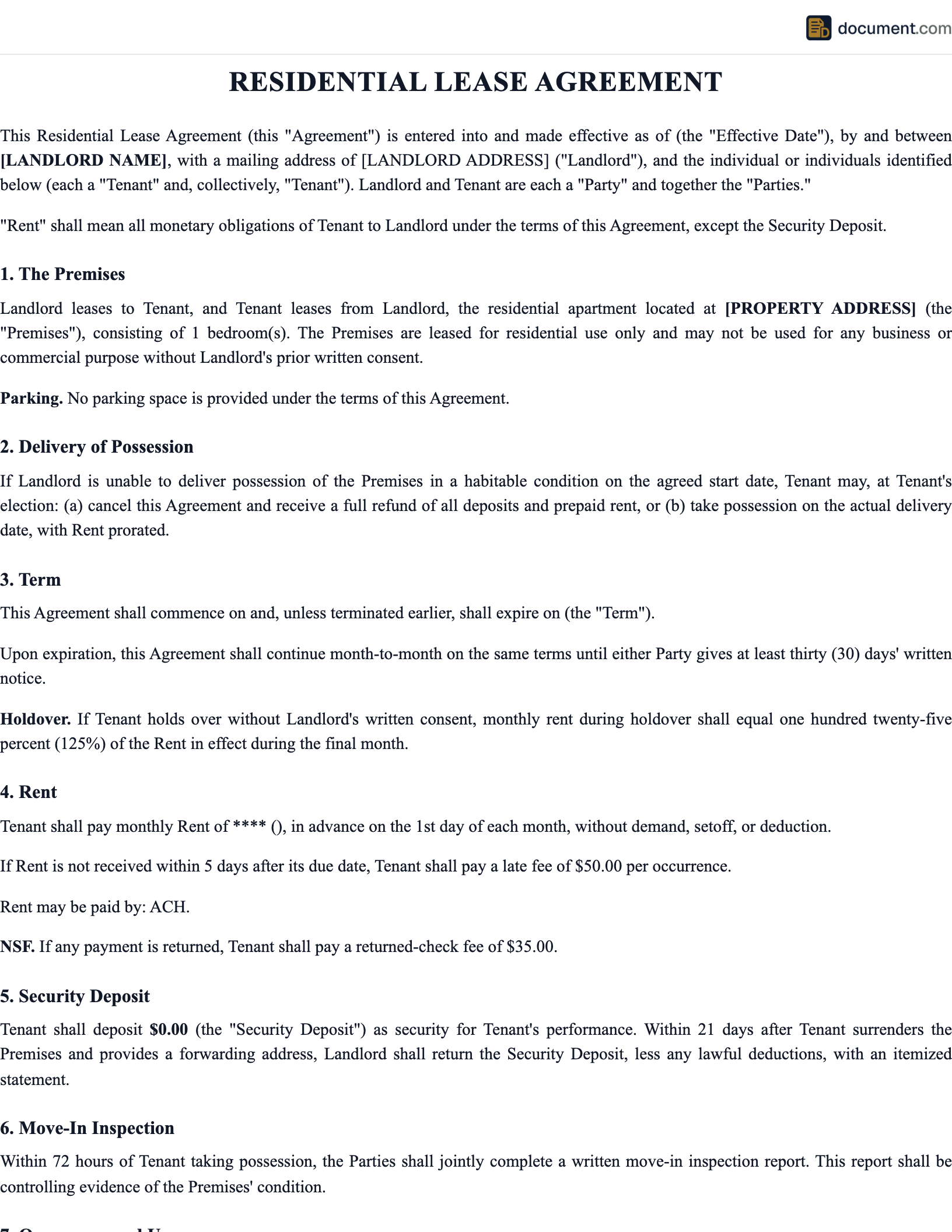
Below is a preview of our standard residential lease agreement template. This sample demonstrates the format and sections included in our attorney-reviewed documents. Your customized lease will be tailored to your state's requirements and your specific rental situation.
RESIDENTIAL LEASE AGREEMENT
Standard Fixed-Term Lease
This Residential Lease Agreement ("Agreement") is entered into as of[Date], by and between:
LANDLORD:
Name: [Landlord Name]
Address: [Landlord Address]
TENANT:
Name: [Tenant Name]
Address: [Current Address]
1. PREMISES
The Landlord agrees to rent to the Tenant the property located at[Property Address](the "Premises"), for use as a private residence only.
2. TERM
The lease term shall begin on [Start Date]and end on [End Date].
3. RENT
The Tenant agrees to pay $[Amount]per month, due on the [Day]of each month...
Frequently Asked Questions
Find answers to common questions about lease agreements, landlord-tenant law, and our document creation process.
Create your Lease Agreement in under 10 minutes.
Answer a few questions and download a compliant, attorney-drafted document ready for your state.