



What Is a Week-to-Week Lease Agreement?
A week-to-week lease agreement is a type of periodic tenancythat automatically renews every seven days until either the landlord or the tenant terminates it with proper written notice. Unlike a fixed-term lease — which binds both parties to a set duration, typically 6 or 12 months — a weekly lease creates a rolling series of short rental periods, each one lasting exactly one week from the designated start day. This structure gives both parties maximum flexibility: the tenant can leave on short notice without breaking a lease, and the landlord can adjust terms, raise rent, or reclaim the property at the end of any weekly period.
In legal terms, a week-to-week lease is one of several forms of periodic tenancy recognized by state landlord-tenant law. The other common forms are month-to-month tenancies and year-to-year tenancies. What distinguishes them is the length of the rental period and the notice required to terminate. A weekly tenancy renews every 7 days and typically requires 7 days' notice, while a monthly tenancy renews every 30 days and usually requires 30 days' notice. All periodic tenancies share one key characteristic: they continue indefinitely until one party gives the other proper notice that they intend to end the arrangement. There is no fixed end date built into the agreement.
A week-to-week tenancy is distinct from an at-will tenancy, which has no defined rental period and can be terminated by either party at any time (subject to reasonable notice requirements that vary by state). It is also distinct from a tenancy at sufferance, which arises when a tenant remains in possession after their lease has expired without the landlord's consent. A weekly lease is a deliberate, voluntary arrangement with clearly defined terms — it simply uses a shorter renewal cycle than most residential leases.
The automatic renewal mechanismis the defining feature of a weekly lease. At the end of each 7-day period, the lease renews on the same terms without either party needing to take any action. The tenant continues occupying the property, pays the next week's rent, and a new weekly tenancy period begins. This cycle continues until one party delivers written notice of termination in compliance with the notice period required by state law — typically 7 days before the start of the next rental period. Once valid notice is given, the tenancy ends at the conclusion of the current or next complete weekly period, depending on the state.
Despite their short-term nature, week-to-week tenants are fully protected by state and federal landlord-tenant laws. The implied warranty of habitability, security deposit regulations, anti-retaliation provisions, Fair Housing Act protections, and the requirement for judicial eviction proceedings all apply regardless of the lease duration. A landlord cannot bypass these protections simply because the tenancy renews weekly. Our attorney-reviewed templates ensure your weekly lease meets all state-specific legal requirements while providing the flexibility that makes weekly arrangements attractive to both parties.
7-Day Renewal
Automatically renews every week with short notice to terminate — no long-term commitment
Full Legal Protection
Same tenant rights as any lease — habitability, deposit rules, anti-discrimination, judicial eviction
Weekly Payments
Clear weekly rent terms, deposit rules, late fees, and payment schedules customized for your state
Week-to-Week Lease Form Preview
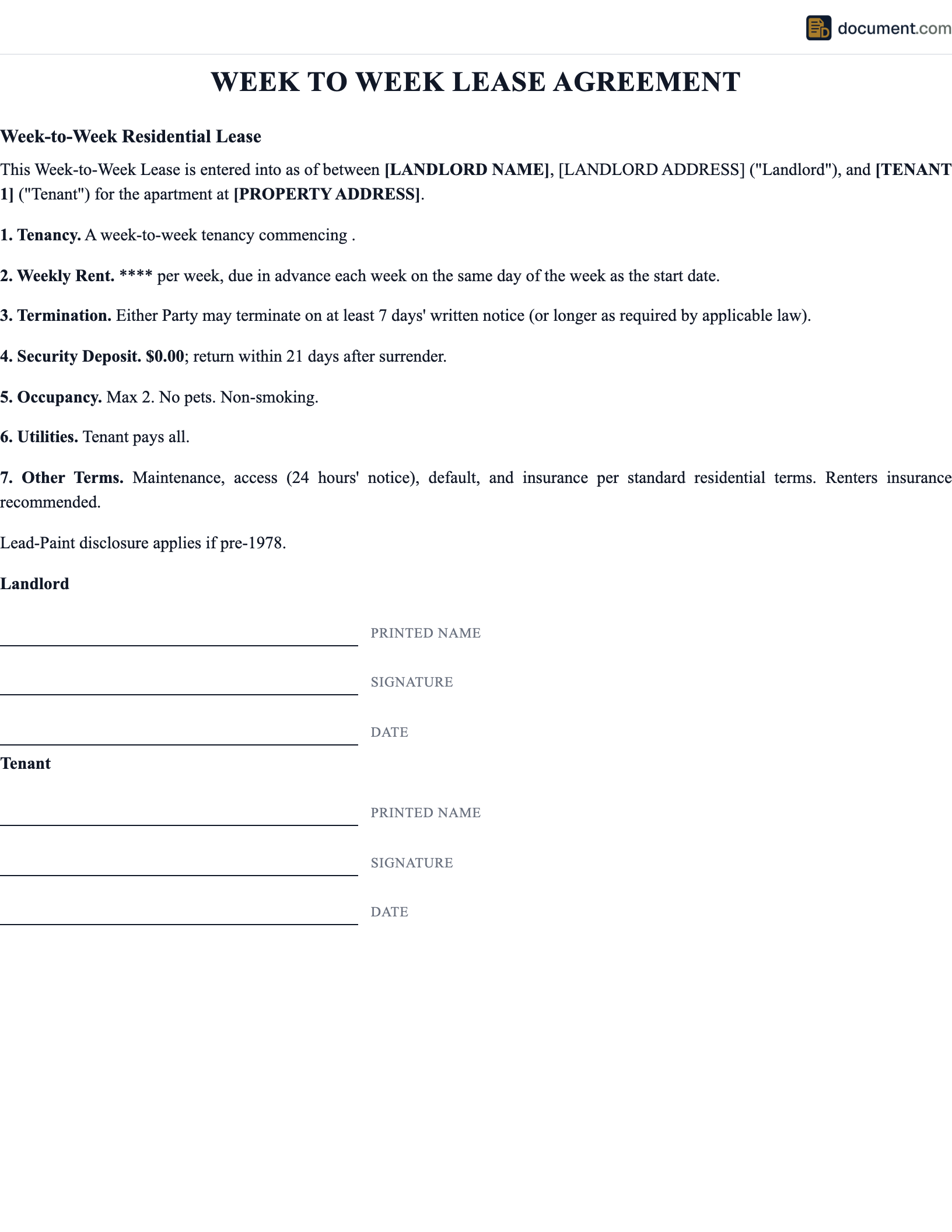
Below is a visual preview of the sections and fields included in a standard week-to-week lease agreement. This mockup illustrates the structure and level of detail our forms provide. Your completed document will be fully formatted, professionally styled, and customized for your state's landlord-tenant requirements.
Week-to-Week Lease Agreement
Short-Term Weekly Rental Contract
Section 1: Parties
Section 2: Rental Property
Section 3: Weekly Rent & Payment
Section 4: Security Deposit
Section 5: Notice & Termination
Section 6: Signatures
Landlord Signature
Tenant Signature
Week-to-Week Lease Agreement by State
Weekly lease notice periods, security deposit limits, and short-term rental regulations vary significantly by state. Some states require only 7 days' notice to terminate a weekly tenancy, while others mandate longer periods. Security deposit caps range from one week's rent to two months' rent depending on the jurisdiction. Select your state below for a week-to-week lease that complies with your state's specific requirements.
When to Use a Week-to-Week Lease
A week-to-week lease is the right choice when the duration of the tenancy is uncertain, when one or both parties need the ability to end the arrangement on short notice, or when the housing need is inherently temporary. Weekly leases bridge the gap between nightly hotel stays and standard monthly or annual leases — they provide more legal structure and tenant protection than a hotel booking while avoiding the long-term commitment of a conventional lease.
While weekly leases typically command a per-month premium of 15% to 30% over equivalent monthly leases, they eliminate the financial risk of breaking a long-term lease early. For a tenant who might otherwise pay a two-month early termination penalty on a 12-month lease, the weekly premium is often the more economical choice. For landlords, the higher weekly rate compensates for increased turnover costs, more frequent cleaning and maintenance, and the administrative overhead of managing shorter tenancies.
Weekly leases are especially common in markets with high transient populations — military base communities, healthcare hub cities, college towns during summer months, resort and hospitality regions, and disaster-recovery zones. In these markets, the demand for flexible short-term housing is high enough that landlords can operate furnished weekly rental units as a viable business model.
Common Use Cases
Traveling Nurses & Healthcare Workers
Healthcare professionals on 8- to 13-week travel assignments need housing that aligns with contract durations without committing to a full-year lease in an unfamiliar city
Military PCS Transitions
Service members and their families often need interim housing during permanent change of station moves while waiting for on-base housing or closing on a home purchase
Airbnb & Short-Term Rental Alternatives
Extended-stay tenants who want a more affordable, legally structured alternative to nightly vacation rental platforms with tenant protections and predictable costs
Corporate Relocation Housing
Employees on temporary assignments, training rotations, or project-based relocations who need furnished housing near a worksite for weeks at a time
Disaster Relief & Emergency Housing
Individuals and families displaced by natural disasters, fires, or floods who need safe temporary housing while repairs are completed or permanent relocation is arranged
Transitional & Halfway House Arrangements
Supportive housing programs that use weekly leases to provide structured, short-term accommodations for individuals transitioning from rehabilitation, incarceration, or homelessness
Seasonal Resort & Hospitality Workers
Ski resorts, beach towns, and national park communities that employ seasonal staff need flexible housing that matches the length of the tourist season
Student & Intern Housing
College students between semesters, summer interns, and clinical rotation students who need housing for a defined short period that does not align with standard lease terms
Furnished Extended-Stay Rentals
Landlords who operate furnished units similar to extended-stay hotels benefit from weekly lease structures that allow rapid turnover and premium weekly rates
Construction & Trades Crews
Contractors and skilled tradespeople working on job sites away from home who need nearby housing for the duration of a project, often just a few weeks
Weekly vs Monthly vs Fixed-Term Leases
Choosing the right lease type depends on how long you plan to stay, how much flexibility you need, and what you are willing to pay for that flexibility. The three most common residential lease structures — week-to-week, month-to-month, and fixed-term — each offer a different balance of cost, commitment, and control.
Week-to-Week Lease
Advantages
- - Maximum flexibility — leave with just 7 days' notice
- - No early termination penalties or lease-break fees
- - Ideal for uncertain timelines and temporary needs
- - Often includes furnished units with utilities
- - Lower move-in cost (one week's rent + deposit)
Disadvantages
- - Higher per-month cost (15-30% premium)
- - Landlord can raise rent weekly with notice
- - Less housing stability — landlord can terminate with 7 days' notice
- - Fewer units available on weekly terms
- - Higher turnover means more frequent moving
Best for: Traveling professionals, military PCS transitions, disaster relief, corporate relocations, seasonal workers, and anyone who needs housing for an uncertain period of less than 3 months.
Month-to-Month Lease
Advantages
- - Good flexibility with 30 days' notice to terminate
- - More widely available than weekly leases
- - Lower per-month cost than weekly leases
- - Common after fixed-term leases expire
- - Standard rent payment schedule aligns with paychecks
Disadvantages
- - 30-day notice required — less nimble than weekly
- - Landlord can raise rent monthly with notice
- - Still costs more per month than a fixed-term lease
- - Landlord can terminate with 30-60 days' notice
- - May require first + last month's rent at move-in
Best for: Tenants who plan to stay several months but want to avoid a 12-month commitment, post-lease-expiration holdovers, and landlords who want ongoing flexibility to adjust terms.
Fixed-Term Lease (6-12 Months)
Advantages
- - Lowest per-month rent — no flexibility premium
- - Rent is locked in for the entire term
- - Maximum housing stability — landlord cannot terminate early
- - Most units on the market offer fixed-term leases
- - Predictable costs for budgeting
Disadvantages
- - Early termination penalty (typically 1-2 months' rent)
- - Locked in even if circumstances change
- - Higher move-in cost (first + last + deposit)
- - Must negotiate or re-sign at lease end
- - Less flexibility for relocations or life changes
Best for: Tenants who plan to stay at least 6-12 months, families seeking housing stability, and anyone who wants the lowest possible monthly rent with no risk of rent increases during the lease term.
How to Create a Week-to-Week Lease Agreement
Creating a valid week-to-week lease requires careful attention to your state's landlord-tenant laws, clear language about rent and termination terms, and proper disclosures. Follow these steps to create a comprehensive weekly lease that protects both the landlord and the tenant.
Identify the Parties and Property
Start by documenting the full legal names of the landlord (or property management company) and all tenants who will occupy the property. Include the complete address of the rental property, unit number, and a brief description of the premises — including whether the unit is furnished, the number of bedrooms and bathrooms, and any included parking or storage spaces. If the landlord uses a property manager or management company, include their contact information as the point of contact for maintenance requests and notices.
Set Weekly Rent and Payment Terms
Specify the exact weekly rent amount, the day of the week rent is due, all accepted payment methods, and any grace period before a late fee applies. State the late fee amount and ensure it complies with your state's limits — some states cap late fees at a percentage of rent or require a minimum grace period. Clarify what happens if the tenant pays with a check that bounces (returned check fees). If the unit is furnished and utilities are included in the rent, state that explicitly so there is no ambiguity.
Define the Security Deposit
State the security deposit amount and confirm it does not exceed your state's statutory maximum. Describe how the deposit will be held (some states require a separate escrow account or interest-bearing account), the conditions under which deductions may be made (unpaid rent, damage beyond normal wear and tear), and the timeline for returning the deposit after move-out. Include the landlord's obligation to provide an itemized statement of deductions, as required by most states.
Establish Notice and Termination Rules
Clearly state the notice period required for either party to terminate the lease — typically 7 days for a weekly tenancy, but verify your state's requirement. Specify acceptable delivery methods for notice (personal delivery, certified mail, posted on the door) and when the notice takes effect relative to the next rental period. Address what happens if the tenant remains in possession after the termination date without the landlord's consent (holdover tenancy provisions).
Include Required Disclosures and House Rules
Add all state-mandated disclosures — including the federal lead-based paint disclosure for properties built before 1978, mold disclosures, bedbug history, flood zone information, and any known material defects. Include house rules covering quiet hours, smoking policy, pet restrictions, parking assignments, guest policies, and common area usage. For furnished units, attach a detailed inventory of all furniture, appliances, and household items with their condition at move-in. Both parties should sign the inventory to prevent disputes at move-out.
Tip:Take date-stamped photos of the unit's condition at move-in and attach them to the lease as an exhibit. This simple step prevents the majority of security deposit disputes.
Sign and Distribute Copies
Both the landlord and tenant should sign and date the lease agreement. Provide each party with a complete copy of the signed lease, including all attachments, disclosures, and the furnished-items inventory. Some states require the landlord to provide the tenant with a copy of the signed lease within a specified number of days. Keep your copy in a safe place — you will need it if any dispute arises during the tenancy or at move-out.
Key Weekly Lease Provisions
A well-drafted week-to-week lease agreement should address all of the following provisions to protect both the landlord and tenant. Each provision is critical for preventing disputes, ensuring legal compliance, and establishing clear expectations for the tenancy.
| Provision | Description |
|---|---|
| Weekly Rent | The dollar amount due each week, the specific day rent is due (e.g., every Monday), all accepted payment methods (check, electronic transfer, money order), any grace period before a late fee applies, and the late fee amount |
| Security Deposit | The deposit amount collected at move-in (must not exceed your state's cap), how and where the deposit is held, conditions that allow deductions (unpaid rent, damage beyond normal wear and tear), the landlord's obligation to provide an itemized deduction statement, and the state-mandated return timeline |
| Notice to Terminate | The number of days' written notice required by either party to end the tenancy (typically 7 days), acceptable delivery methods (personal service, certified mail), and when the notice period begins relative to the next rent-due date |
| Furnished Items Inventory | A detailed list of all furniture, appliances, cookware, linens, and other items provided with the unit, their condition at move-in, and the tenant's liability for damage or loss beyond normal wear and tear |
| Utilities & Services | A clear breakdown of which utilities are included in the weekly rent (electricity, gas, water, internet, cable) and which are the tenant's responsibility to set up and pay separately |
| Guest & Occupancy Policy | Maximum occupancy limits, rules about overnight guests (how many nights per week a guest may stay before being considered an unauthorized occupant), and any visitor registration requirements |
| Maintenance & Repairs | Which party is responsible for routine maintenance versus major repairs, the procedure for submitting maintenance requests, the landlord's response time for emergency and non-emergency repairs, and the tenant's duty to report problems promptly |
| House Rules | Quiet hours, smoking and vaping policy, pet restrictions (breed, weight, pet deposit), parking assignments, trash and recycling procedures, common area usage, and any rules specific to the property |
| State Disclosures | All legally required disclosures including lead-based paint (pre-1978 properties), mold, bedbug history, sex offender registry, flood zone designation, and any known material defects in the property |
Security Deposit Rules for Weekly Leases
Security deposit rules for week-to-week leases follow the same state statutes that apply to any residential tenancy — there is no separate deposit regime for weekly rentals. However, the practical application of deposit rules can differ because weekly rent amounts and the way states calculate deposit caps vary.
Most states calculate the maximum security deposit as a multiple of "one month's rent." For a weekly lease, this means multiplying the weekly rent by approximately 4.33 to determine the monthly equivalent, then applying the state's cap. For example, if the weekly rent is $450 and the state caps deposits at one month's rent, the maximum deposit would be approximately $1,950. Some states have no statutory cap on security deposits, while others cap them as low as one month's rent.
Deposit Caps by State
States vary widely in how much a landlord can collect. Many states cap the security deposit at one month's rent (e.g., California for unfurnished units, Montana, and Hawaii). Others allow up to two months' rent (e.g., New York, Virginia, and Maryland) or three months' rent (e.g., Pennsylvania, Connecticut). Several states — including Ohio, Illinois, and Wyoming — have no statutory cap at all, meaning the landlord can collect whatever amount they deem appropriate.
Return Timelines
After the tenant vacates, the landlord must return the security deposit — minus any lawful deductions — within the state's mandated timeframe. This ranges from 14 days (e.g., Arizona, Hawaii) to 60 days (e.g., Alabama) depending on the jurisdiction. The landlord must also provide an itemized written statement listing each deduction and the amount. Failure to return the deposit on time or provide a proper accounting can expose the landlord to penalties of double or triple the deposit amount in many states.
Allowable Deductions
Landlords may only deduct from the security deposit for specific reasons allowed by state law — most commonly unpaid rent, the cost of repairing damage beyond normal wear and tear, and cleaning costs to restore the unit to the condition it was in at move-in (beyond reasonable cleaning). Landlords cannotdeduct for normal wear and tear, which includes minor scuff marks, small nail holes, faded paint, and carpet wear consistent with the length of the tenancy. Documenting the unit's condition at move-in with photos and a written checklist is the best way to prevent deposit disputes.
Legal Requirements for Weekly Leases
Week-to-week leases are subject to the same body of landlord-tenant law that governs all residential tenancies in your state. Understanding these legal requirements ensures that both landlords and tenants meet their obligations and avoid potential liability.
Written Agreement
While oral leases for periods of one year or less are technically enforceable under the Statute of Frauds in most states, a written lease is strongly recommended for weekly tenancies. A written agreement documents the agreed-upon terms, serves as the vehicle for required disclosures, and provides critical evidence if a dispute goes to court. Several states require landlords who rent more than a certain number of units to use written leases regardless of the tenancy duration.
Required Disclosures
Federal law requires a lead-based paint disclosure for all residential properties built before 1978. Beyond that, state requirements vary but may include mold disclosures, bedbug history, sex offender registry information, flood zone designation, asbestos presence, radon test results, code violation history, and any known material defects. Our templates include all disclosures required by your state.
Implied Warranty of Habitability
Every residential landlord has a legal obligation to maintain the rental property in a habitable condition regardless of the lease duration. This means functioning plumbing, heating, electrical systems, hot and cold running water, weatherproofing, and structural integrity. It also includes working smoke detectors, secure locks, and freedom from pest infestations. A weekly lease does not reduce or waive this obligation in any state.
Fair Housing Compliance
The federal Fair Housing Act prohibits discrimination in housing based on race, color, national origin, religion, sex, familial status, and disability. Many states and municipalities add additional protected classes such as sexual orientation, gender identity, source of income, and veteran status. These protections apply fully to weekly rentals — a landlord cannot use the short-term nature of a weekly lease to circumvent fair housing obligations.
Important: In some jurisdictions, very short-term rentals (typically under 30 consecutive days) may be classified as transient lodging rather than a residential tenancy and subject to different regulations, including hotel/motel taxes and business licensing requirements. A week-to-week lease that extends beyond 30 days is generally treated as a residential tenancy in all states, but check your local rules if the initial term may be shorter than one month.
Notice to Terminate a Weekly Lease
One of the defining features of a week-to-week lease is the short notice period required to terminate. In most states, either the landlord or tenant must provide at least 7 days' written notice before the end of a weekly rental period to terminate the tenancy. The notice must be delivered in writing — verbal notice alone is not sufficient in virtually any jurisdiction, even if the other party agrees.
Important Notice Requirements
Notice must be given in writing and delivered before the start of the next rental period. Some states require notice to be delivered by specific methods such as personal delivery, certified mail, or posting on the door. In jurisdictions with just-cause eviction laws, landlords may be required to state a valid reason for non-renewal even for periodic tenancies. Always check your state's specific requirements for proper notice content and delivery method.
- Standard Notice: 7 days before the next rental period in most states
- Written Form: Notice must be in writing for legal enforceability — verbal notice is not sufficient
- Delivery Method: Personal delivery, certified mail, or as specified by your state's statute
- Effective Date: Notice takes effect at the end of the next complete rental period following the notice period
- Deposit Return: The security deposit must be returned within the state's mandated timeframe after the tenant vacates
- Holdover Tenant: If a tenant remains after receiving valid notice, the landlord must file a formal eviction action — self-help eviction is illegal
Sample Week-to-Week Lease Agreement
Below is a preview of our week-to-week lease agreement template. Your customized document will include all provisions, disclosures, and legal language required by your state's landlord-tenant laws, along with a furnished-items inventory if applicable.
WEEK-TO-WEEK LEASE AGREEMENT
Short-Term Weekly Rental Contract
This Week-to-Week Lease Agreement is entered into on[Date]between:
LANDLORD:
Name: [Landlord Name]
Address: [Landlord Address]
TENANT(S):
Name: [Tenant Name(s)]
Current Address: [Tenant Address]
1. RENTAL PROPERTY
Address: [Property Address]
Unit Type: [Furnished / Unfurnished]
2. WEEKLY RENT
Weekly Rent: $[Amount] Due every: [Day]
3. SECURITY DEPOSIT
$[Amount]— to be returned within [Days] days of move-out
4. NOTICE TO TERMINATE
Either party may terminate this agreement by providing [7]days' written notice.
Frequently Asked Questions
Find answers to common questions about week-to-week lease agreements, weekly rental terms, tenant rights, security deposits, and termination procedures.
Official Resources
Use these official federal resources for guidance on landlord-tenant law, fair housing, and tenant rights applicable to weekly rentals.
HUD — Tenant Rights & Resources
Federal tenant rights, fair housing, and rental assistance
CFPB — Housing Resources
Consumer Financial Protection Bureau rental guidance
FTC — Fair Housing Act
Federal fair housing protections and anti-discrimination laws
Nolo — State Landlord-Tenant Law Charts
Side-by-side comparison of landlord-tenant laws by state
Create your Week To Week Lease Agreement in under 10 minutes.
Answer a few questions and download a compliant, attorney-drafted document ready for your state.