



What Is a Residential Lease Agreement?
A residential lease agreement is a legally binding contract between a landlord (or property manager) and a tenant that outlines the terms and conditions for renting a residential property. It establishes the rights and responsibilities of both parties, specifies the rent amount and payment schedule, and sets rules for the use and maintenance of the property.
Every state has landlord-tenant laws that govern residential leases, covering topics such as security deposit limits, required disclosures, entry notice requirements, habitability standards, and eviction procedures. A well-drafted lease agreement protects both the landlord's property investment and the tenant's right to quiet enjoyment of their home.
Whether you're renting out a single-family home, an apartment, a condo, or a townhouse, a residential lease agreement is essential for establishing clear expectations and providing legal protection for both parties. Our templates are customized to comply with each state's specific landlord-tenant laws and required disclosures.
Legally Binding
Enforceable contract covering rent, deposits, and responsibilities
State Compliant
Meets your state's landlord-tenant law requirements
All Property Types
Houses, apartments, condos, townhomes, and duplexes
Residential Lease Agreement by State
Landlord-tenant laws vary dramatically from state to state. Security deposit limits, required disclosures, notice periods, and tenant protections differ significantly. Select your state below for a lease agreement that complies with your state's specific requirements.
Fixed-Term vs. Periodic Leases
The two most common types of residential leases are fixed-term leases and periodic (month-to-month) tenancies. Each has advantages and implications for both landlords and tenants.
A fixed-term lease runs for a set period (typically 12 months) and locks in the rent amount, terms, and conditions for the entire duration. Neither party can change the terms or terminate early without cause or penalty. A periodic lease (usually month-to-month) automatically renews each period and can be terminated by either party with proper notice, typically 30 days. This offers more flexibility but less stability for both parties.
Lease Duration Options
Fixed-Term Lease
Standard 12-month lease with a set start and end date, guaranteed rent amount, and renewal options
Month-to-Month Lease
Periodic tenancy that auto-renews each month, offering flexibility for both landlord and tenant
Short-Term Lease
Leases under 6 months for temporary housing, corporate relocations, or seasonal rentals
Rent-to-Own Lease
Lease-option agreement where a portion of rent is credited toward a future home purchase
Room Rental Agreement
Lease for a single room in a shared house or apartment, with shared common areas
Vacation Rental Agreement
Short-term rental for vacation or holiday stays, often with different regulatory requirements
Furnished Rental Lease
Includes inventory of furnishings and appliances provided by the landlord
Multi-Family Lease
Lease for units in duplexes, triplexes, or apartment complexes with shared building rules
Key Lease Provisions
A thorough residential lease agreement should address all of the following provisions. Missing any of these can lead to disputes and potential legal issues.
| Provision | Description |
|---|---|
| Rent Amount & Due Date | Monthly rent, payment due date, accepted payment methods, and where to pay |
| Security Deposit | Amount, how it will be held, conditions for deductions, and return timeline |
| Late Fees | Grace period (if any), late fee amount, and when fees begin accruing |
| Utilities | Which utilities are included in rent and which are the tenant's responsibility |
| Maintenance & Repairs | Landlord vs. tenant responsibilities, how to submit repair requests |
| Pet Policy | Whether pets are allowed, pet deposit or monthly pet rent, breed/size restrictions |
| Entry Notice | How much advance notice the landlord must give before entering the unit |
| Subletting | Whether subletting is allowed and under what conditions |
| Termination & Renewal | Notice period for non-renewal, auto-renewal terms, early termination options |
Security Deposit Rules by State
Security deposit regulations are among the most commonly litigated areas of landlord-tenant law. Every state has rules governing how much a landlord can charge, how the deposit must be held, what deductions are allowed, and when it must be returned.
Common Security Deposit Mistakes
Failing to provide an itemized deduction list, not returning the deposit within the required timeframe, commingling deposit funds with personal accounts, and charging for normal wear and tear are the most common landlord mistakes. Violations can result in penalties of 2-3x the deposit amount in many states.
- Deposit Limits: Range from 1 month's rent (NY, KS) to no limit (OH, MS, MO) depending on the state
- Separate Account: Many states require deposits to be held in a separate escrow or trust account
- Interest: Some states (MA, CT, MD, NJ, NY) require landlords to pay interest on security deposits
- Return Timeline: Ranges from 14 days (HI, LA) to 60 days (AL) after the tenant vacates
- Itemized Statement: Nearly every state requires an itemized list of deductions when returning the deposit
- Allowable Deductions: Unpaid rent, damage beyond normal wear and tear, and cleaning costs (if specified in lease)
Sample Residential Lease Agreement
Below is a preview of our residential lease agreement template. Your customized document will include all provisions and disclosures required by your state's landlord-tenant laws.
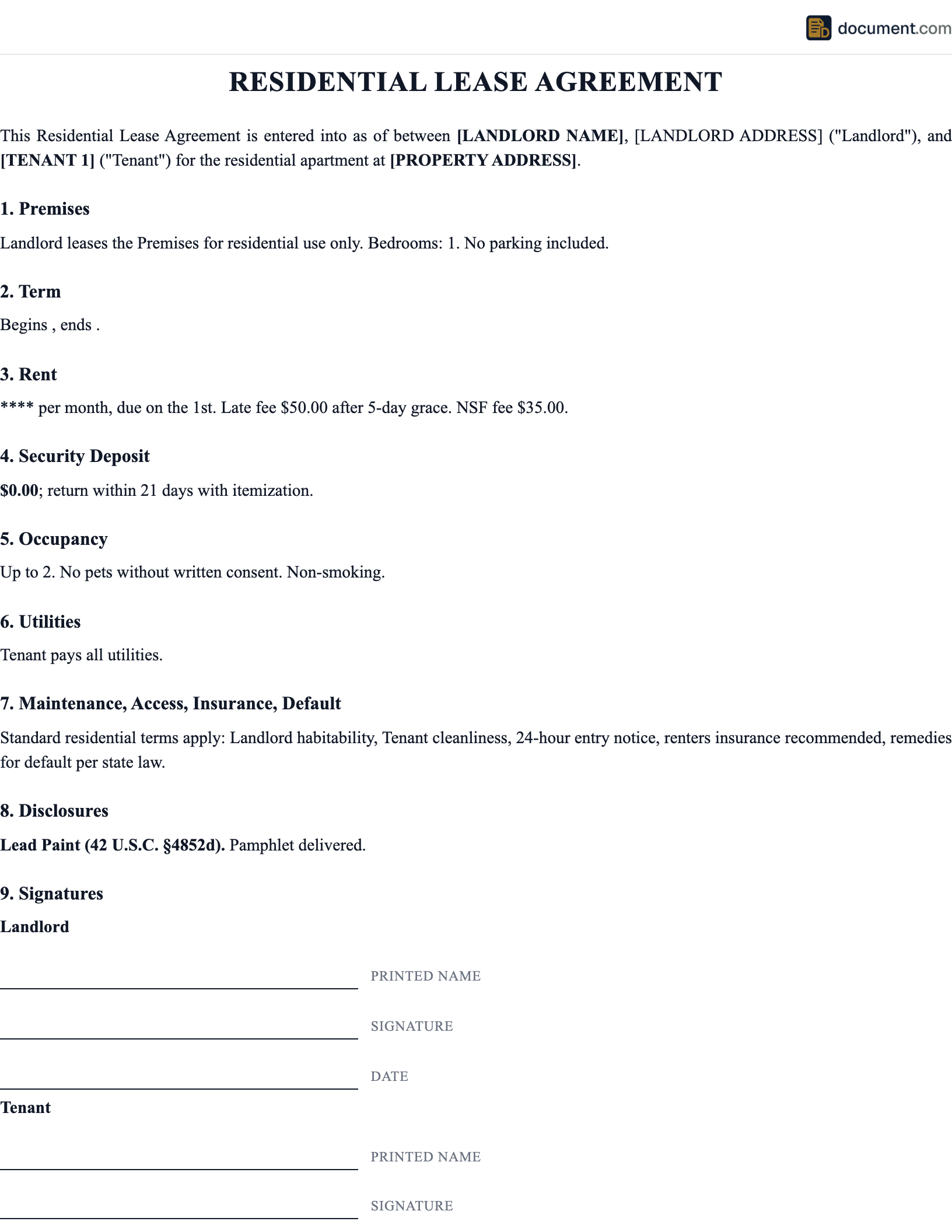
RESIDENTIAL LEASE AGREEMENT
Standard Fixed-Term Rental Contract
This Residential Lease Agreement is entered into on[Date]between:
LANDLORD:
Name: [Landlord Name]
Address: [Landlord Address]
TENANT(S):
Name: [Tenant Name(s)]
Current Address: [Tenant Address]
1. PROPERTY
Address: [Rental Property Address]
Type: [House / Apartment / Condo]
2. LEASE TERM
Start Date: [Start] End Date: [End]
3. RENT
Monthly Rent: $[Amount] Due on the [1st] of each month
4. SECURITY DEPOSIT
$[Amount]— to be returned within [Days] days of move-out
Frequently Asked Questions
Find answers to common questions about residential lease agreements, landlord-tenant law, and rental property management.
Official Resources
Use these official federal resources for guidance on landlord-tenant law, fair housing, and tenant rights.
HUD — Tenant Rights & Resources
Federal tenant rights, fair housing, and rental assistance
CFPB — Housing Resources
Consumer Financial Protection Bureau rental guidance
FTC — Fair Housing Act
Federal fair housing protections and anti-discrimination laws
EPA — Lead Paint Disclosure Requirements
Federal lead-based paint disclosure rules for pre-1978 housing
Nolo — State Landlord-Tenant Law Charts
Side-by-side comparison of landlord-tenant laws by state
HUD — File a Fair Housing Complaint
Report housing discrimination or landlord fair housing violations
Create your Residential Lease Agreement in under 10 minutes.
Answer a few questions and download a compliant, attorney-drafted document ready for your state.