



What Is an Eviction Notice?
An eviction notice (also called a notice to quit, notice to vacate, or three-day notice) is a written pre-litigation demand that the tenant cure a default, pay overdue rent, or surrender possession of the premises within a statutory window. It is the procedural predicate to an unlawful detainer action under each state's landlord-tenant code (California Code of Civil Procedure §§ 1161-1179a, Texas Property Code §§ 24.001-24.011, Florida Statute § 83.56, New York RPAPL §§ 711-768). Without a properly drafted and properly served notice, the eviction case is dismissed at the first court appearance and the landlord must restart from notice. The notice itself does not authorize possession; only a court-issued writ of possession (writ of restitution in some states) executed by the sheriff or marshal authorizes a lockout.
Three layers of law govern every eviction. Federal law sets the floor: the Fair Housing Act (42 U.S.C. §§ 3601-3619) prohibits eviction motivated by race, color, national origin, religion, sex (including sexual orientation and gender identity per HUD's Bostock implementation), familial status, or disability; the Servicemembers Civil Relief Act (50 U.S.C. § 3951) protects active-duty servicemembers from eviction without a court order for properties under a rent ceiling set annually by HUD ($9,812 monthly rent in 2025). State landlord-tenant codes set the notice periods, the cure rights, the service rules, and the unlawful detainer procedure. Local ordinances layer on additional protections in just-cause jurisdictions (Seattle SMC 22.206, Los Angeles RSO, Oakland Just Cause for Eviction Ordinance, New York City RSL § 26-403, San Francisco Rent Ordinance) that limit the grounds on which a landlord may refuse to renew or terminate.
Pay-or-quit vs cure-or-quit vs unconditional quit
Three categories cover almost every eviction. A pay-or-quit notice applies to non-payment of rent and demands the exact amount owed within the statutory cure window: 3 days in California (CCP § 1161(2)), Texas (Prop. Code § 24.005), Arizona (ARS § 33-1368), and Nevada (NRS § 40.253); 5 days in Illinois (735 ILCS 5/9-209), Kentucky (KRS § 383.660), and Wisconsin (Stat. § 704.17); 7 days in Georgia (O.C.G.A. § 44-7-50), Michigan (MCL § 600.5714), and Massachusetts (G.L. ch. 186 § 12); 14 days in New York (RPL § 235-e following the 2019 HSTPA reforms). Most states bar inclusion of late fees, utilities, or damages in the demand; only the rent itself is recoverable under a pay-or-quit, and overstating the amount is fatal. A cure-or-quit notice applies to curable lease violations (unauthorized pet, unauthorized occupant, noise, unapproved alteration) and runs 7 to 30 days. An unconditional quit notice applies to non-curable causes (illegal drug activity, violent crime on the premises, repeated material breaches, substantial property damage) and demands vacatur with no opportunity to remedy. California allows 3-day unconditional quit for drug or weapons activity (CCP § 1161(4)); Florida allows 7-day unconditional quit under § 83.56(2)(a) for non-curable lease violations.
Service rules (personal, posting, mail) per state
Service is the most common point of failure. California CCP § 1162 ranks methods strictly: personal service first; if the tenant cannot be found, substituted service on a person of suitable age at the residence or workplace plus mailing; only if neither personal nor substitute service works may the landlord post on a conspicuous place at the property and mail. Florida Statute § 83.56(4) accepts personal delivery, leaving with a person residing at the premises if the tenant is absent, or posting on the premises if no person resides there. Texas Property Code § 24.005(f) accepts personal delivery, posting on the inside of the main entry door, or certified mail return receipt requested. New York RPAPL § 735 requires personal delivery with two prior good-faith attempts before substitute or conspicuous-place service is permitted. Improper service requires the landlord to reissue and re-serve, restarting the cure clock and delaying the case by weeks. The landlord or process server must complete a proof-of-service declaration recording date, time, address, person served, and method.
Statutory waiting periods 3-day to 60-day by state
Notice periods range across a wide spectrum. For non-payment, California, Texas, Arizona, and Nevada use 3 days; Illinois, Kentucky, and Wisconsin use 5 days; Georgia and Michigan use 7 days; Washington uses 14 days under RCW § 59.12.030 (raised from 3 days by the 2019 reform); New York uses 14 days under the 2019 Housing Stability and Tenant Protection Act; New Jersey uses 30 days for non-disorderly tenants under N.J.S.A. § 2A:18-61.2. Month-to-month no-cause termination is 30 days in most states, 60 days in California for tenancies of one year or more (Civ. Code § 1946.1), 60 days in Delaware under 25 Del. C. § 5106, 90 days in Hawaii under HRS § 521-71, and 60 days in Washington under RCW § 59.18.200. Just-cause jurisdictions (the entire state of California after AB 1482, plus Seattle, Portland, New York City, Newark, Oakland, San Francisco, and Los Angeles) restrict the grounds on which a landlord may serve a no-cause termination at all and may require relocation assistance for no-fault terminations.
Wrongful eviction and self-help prohibitions
Self-help eviction (changing locks, removing belongings, shutting off utilities, removing doors or windows, intimidating the tenant into leaving) is illegal in every state. California Civil Code § 789.3 imposes liability of $100 per day of utility disconnection plus actual damages and reasonable attorney fees, with a $250 statutory minimum per separate violation. Florida Statute § 83.67 sets statutory damages at three months of rent or actual damages, whichever is greater, plus attorney fees. New York RPAPL § 853 awards treble damages for forcible entry. Texas Property Code § 92.0081 prohibits removal of doors and windows, shut-off of utilities by the landlord, and removal of personal property except under a court-issued writ. The CDC eviction moratorium (September 2020 to August 2021, struck down in Alabama Association of Realtors v. HHS, 594 U.S. 758 (2021)) added an additional layer of federal exposure for non-compliant landlords during the pandemic; some state moratoriums (California AB 832, New York COVID-19 Emergency Eviction and Foreclosure Prevention Act) ran on independent timelines and continued into 2022.
Pay or Quit
For non-payment of rent. Tenant must pay in full or vacate within the statutory cure period (3 to 14 days)
Cure or Quit
For curable lease violations. Tenant must remedy the breach or vacate within the statutory cure period (typically 7 to 30 days)
Unconditional Quit
For non-curable causes (illegal drug or weapons activity, repeated material breach, substantial property damage). Tenant must vacate with no opportunity to cure
Types of Eviction Notices
Select the notice type that fits your situation. Each links to a state-specific template that complies with your jurisdiction's notice-period and service requirements.
Pay-or-Quit Notices (by Day Count)
Alternatives to Formal Eviction
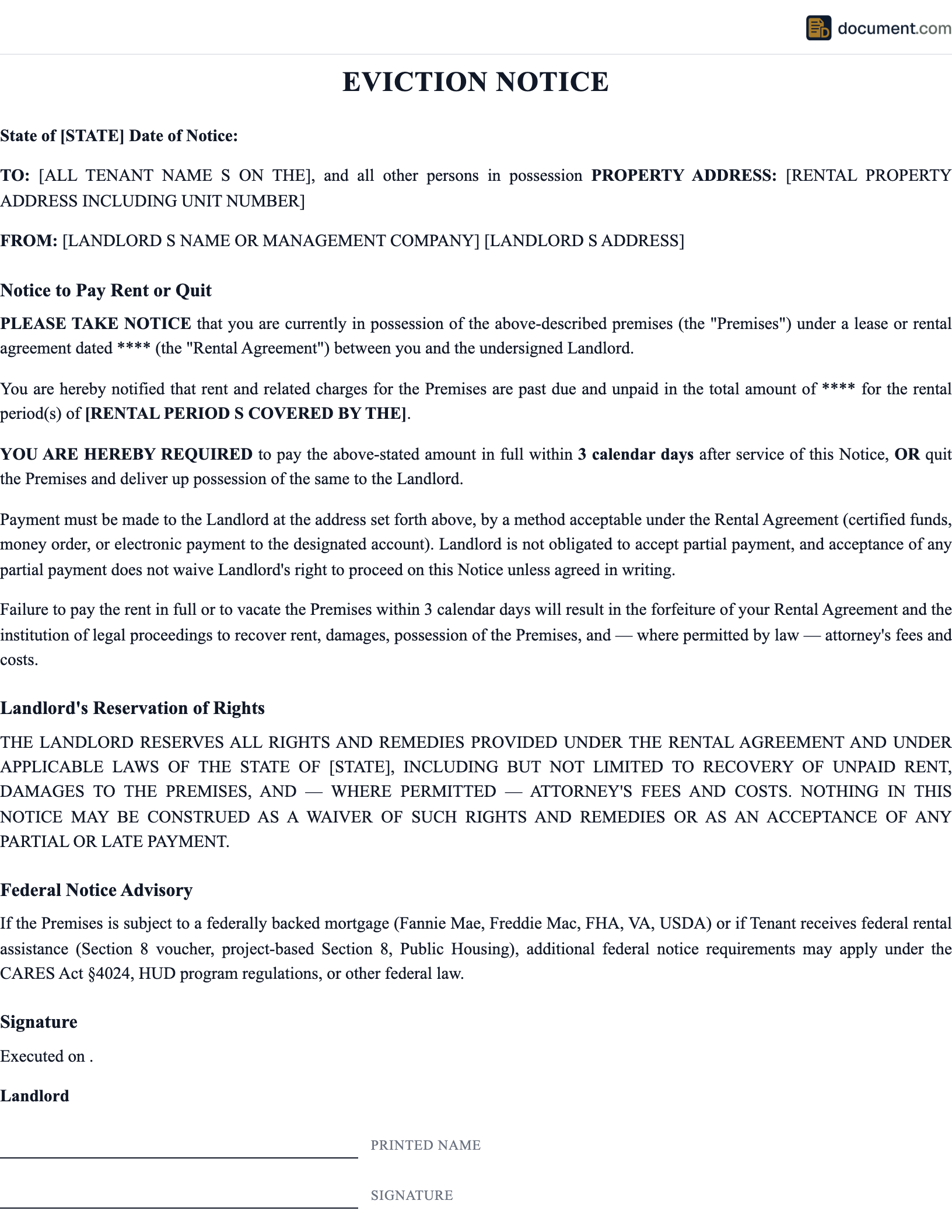
Eviction Notice Form Preview
The notice template includes the five fields a court will check at the unlawful detainer hearing: property address with unit number, tenant identification including the “and all other occupants” phrase necessary to bind unnamed roommates, the notice type and statutory cure period, the cause stated with specificity (exact dollar amount for non-payment or precise description of the lease violation), and the proof-of-service block. Your customized notice is tailored to the state's notice period (3 to 14 days for non-payment, longer for cure-or-quit) and the service rules under California CCP § 1162, Florida § 83.56(4), Texas Prop. Code § 24.005(f), New York RPAPL § 735, or the controlling state statute.
NOTICE TO QUIT / EVICTION NOTICE
Landlord Notice to Tenant
PROPERTY INFORMATION
Property Address: [Street, City, State, ZIP]
Unit / Apt #: [Unit Number]
TENANT INFORMATION
Tenant Name(s): [Full Legal Names]
And all other occupants in possession
NOTICE TYPE
[ ] Pay or Quit [ ] Cure or Quit [ ] Unconditional Quit
Notice Period: [Days] days
REASON FOR NOTICE
Amount Due: $[Amount]
Violation Description: [Details of Violation]
SERVICE / DELIVERY
Date Served: [Date]
Method of Service: [ ] Personal [ ] Posting [ ] Certified Mail
Landlord Signature: [Signature]
How to Write an Eviction Notice
An eviction notice has eight working parts. Defects in any one are fatal: courts dismiss unlawful detainer cases for the wrong notice type, the wrong notice period, an overstated amount, missing statutory language, improper service, or premature filing before the cure period expires. The landlord then must serve a corrected notice and start the clock again, delaying possession by weeks or months. Work through each step in order, document the work in writing, and verify the controlling state statute before service.
Identify the Correct Notice Type
Pay-or-quit applies to non-payment of rent (California CCP § 1161(2), Florida § 83.56(3), Texas Prop. Code § 24.005). Cure-or-quit applies to curable lease violations (California CCP § 1161(3), Florida § 83.56(2)(b)). Unconditional quit applies to non-curable causes: illegal drug or weapons activity (California CCP § 1161(4)), substantial damage, repeated material breach, or assault on the landlord or other tenants. Mixing causes in a single notice is generally fatal; serve separate notices for each ground unless your state explicitly permits combined notices. Re-filing under the wrong notice type wastes the cure period and delays possession by 2 to 6 weeks.
Verify the Required Notice Period
Pay-or-quit periods: 3 days in California, Texas, Arizona, Nevada; 5 days in Illinois, Kentucky, Wisconsin; 7 days in Georgia, Michigan, Massachusetts; 10 days in Washington (RCW § 59.12.030); 14 days in New York and Vermont; 30 days in New Jersey for non-disorderly conduct (N.J.S.A. § 2A:18-61.2). Cure-or-quit periods: 3 days California (CCP § 1161(3)), 7 days Florida (§ 83.56(2)(b)), 10 days for material noncompliance under the Uniform Residential Landlord and Tenant Act (URLTA § 4.201). Local just-cause ordinances often lengthen the period: Oakland requires 30 days for many curable violations, San Francisco requires 30 days for nuisance allegations, Los Angeles RSO requires 3 days plus enhanced notice content.
Include All Required Information
Every notice requires: full property address with unit number; the tenant's legal name with the phrase “and all other occupants in possession” (necessary to bind unnamed roommates and subtenants); the cause stated with specificity (exact dollar amount and rental period for non-payment, the lease provision and conduct for cure-or-quit); the cure window or vacate demand; the date by which compliance is required (calendar date, not “X days from service”); the landlord or authorized agent's name, address, and phone; and the date of the notice. California CCP § 1161.2 requires additional language for residential pay-or-quit notices, including the address where rent may be paid and the hours payment will be accepted. New York RPL § 235-e requires an itemized statement of the amount claimed.
Specify the Exact Amount Owed (Pay or Quit)
Pay-or-quit notices must demand only rent. California (CCP § 1161(2)) and most states prohibit inclusion of late fees, utility charges, NSF fees, or damages. Overstating the amount even by a few dollars is fatal: the tenant has the right to tender exactly the stated rent and avoid eviction, and an inflated demand makes that tender impossible. California courts strictly enforce this rule; Levitz Furniture Co. v. Wingtip Communications (Cal. App. 2001) and a long line of cases dismiss notices that include any non-rent charge. For partial payments, demand only the unpaid balance. Florida Statute § 83.56(3) similarly limits the demand to rent. If the lease defines additional charges as “additional rent,” some states (Texas, Maryland) allow inclusion under that label, but the cleanest practice is rent only.
Review Fair Housing Compliance
The Fair Housing Act (42 U.S.C. §§ 3601-3619) and parallel state statutes prohibit eviction motivated by race, color, national origin, religion, sex (including sexual orientation and gender identity per HUD's Bostock implementation), familial status, or disability. Selective enforcement is itself evidence of discrimination: prior tolerance of the same conduct by tenants outside the protected class undercuts the eviction. Disability-related conduct triggers an interactive-process duty under 24 C.F.R. § 100.204; the landlord must consider reasonable accommodations (assistance animal exception to a no-pet policy, schedule adjustment for a tenant with a mental health disability) before proceeding. Many states and cities add protected classes: source of income (Section 8 voucher non-discrimination in roughly 100 jurisdictions including New York City, Cook County, Washington State, all of California after AB 1865), age, marital status, or veteran status.
Serve the Notice Using a Legal Method
Each state ranks acceptable methods. California CCP § 1162: personal service first, then substitute on a person of suitable age plus mailing, then post-and-mail only if the first two fail. Florida Statute § 83.56(4): personal delivery, leaving with a person residing at the premises, or posting if no person resides. Texas Property Code § 24.005(f): personal delivery, posting on the inside of the main entry door, or certified mail return receipt. New York RPAPL § 735: personal delivery with two prior good-faith attempts before substitute or conspicuous-place service. The server (any adult competent to testify, not the landlord personally in many states) records the date, time, address, person served if any, and method on a written proof-of-service declaration. The landlord retains the original notice and the proof of service for filing with the unlawful detainer complaint.
Document Everything and Keep Copies
Retain the original signed notice, the proof of service, certified mail receipts and tracking, and time-stamped photographs of any posting. The unlawful detainer complaint must attach the notice as an exhibit, and at trial the landlord (or process server) must authenticate the proof of service. Where service was by post-and-mail, photograph the notice on the door with date and time visible, and keep the certified mail green card and tracking record. Build a tenant file with the lease, all amendments, payment history with dates and amounts, prior cure notices and the tenant's response, photographs of any property damage, written complaints from other tenants, and police reports for any criminal-activity allegations. The strength of the documentation determines whether the eviction trial takes one hearing or several.
Wait for the Notice Period to Expire
The cure period begins the day after service in most states. California excludes the day of service and the final day if it falls on a weekend or holiday (CCP § 12); Texas counts calendar days from service. If the tenant cures (pays the exact rent demanded, removes the unauthorized occupant, restores the property) within the cure window, the notice is satisfied and the tenancy continues. If the tenant tenders a partial payment, several states treat acceptance as a waiver of the breach for that month, restarting the clock; refuse partial payment in writing if you intend to proceed. After the cure period expires without compliance, file the unlawful detainer complaint with the appropriate trial court (Superior Court in California, JP Court in Texas, County Court in Florida, Civil Court Housing Part in New York City). Self-help (lockouts, utility shut-offs, removing belongings) is illegal in every state and exposes the landlord to statutory damages: $100 per day plus actual damages and attorney fees in California (Civ. Code § 789.3), three months of rent in Florida (§ 83.67), treble damages in New York (RPAPL § 853).
Key Components of an Eviction Notice
Twelve elements are necessary for a notice to survive challenge at the unlawful detainer hearing. The first six identify the property, parties, cause, cure period, deadline, and compliance required (the substantive content under California CCP § 1161, Florida § 83.56, Texas Prop. Code § 24.005, and parallel statutes). The next four document the amount owed (for pay-or-quit), the dates of preparation and service, the calendar deadline for compliance, and the landlord's signature. The last two anchor the proof of service that lets the court confirm proper delivery under the controlling state service statute. Defects in any one produce dismissal and a restart of the entire timeline.
| Component | Description |
|---|---|
| Property Address | Full street address including unit/apartment number of the rental property |
| Tenant Name(s) | Full legal names of all tenants on the lease, plus "and all other occupants" |
| Landlord Name | Full legal name of the landlord or property management company |
| Notice Type | Pay or quit, cure or quit, or unconditional quit. The notice type must be clearly identified to satisfy the controlling state statute |
| Notice Period | Number of days the tenant has to comply, per state law (3-30 days) |
| Reason for Eviction | Specific description of the violation: unpaid rent amount, lease term broken, or cause |
| Amount Owed | Exact dollar amount of unpaid rent (for pay or quit notices only) |
| Compliance Instructions | Clear statement of what the tenant must do: pay, cure, or vacate by the deadline |
| Date of Notice | Date the notice was prepared and the date it was served to the tenant |
| Deadline Date | The specific calendar date by which the tenant must comply or vacate |
| Landlord Signature | Original signature of the landlord or authorized property manager |
| Proof of Service | Documentation of how and when the notice was delivered to the tenant |
Legal Requirements for Eviction Notices
Eviction is the most procedurally exacting area of landlord-tenant law. Three layers of authority apply: federal statutes (Fair Housing Act 42 U.S.C. §§ 3601-3619, Servicemembers Civil Relief Act 50 U.S.C. § 3951, the now-vacated CDC moratorium under Public Health Service Act § 361), state landlord-tenant codes (the Uniform Residential Landlord and Tenant Act adopted in modified form by 21 states, plus the unique codes of California, New York, Texas, Florida, and others), and local ordinances (just-cause regimes in Seattle, Portland, Oakland, San Francisco, Los Angeles, New York City, and the entire state of California after AB 1482; rent stabilization in roughly 200 jurisdictions; right-to-counsel programs in 17 cities). Defective notices are the leading cause of dismissal at the unlawful detainer hearing.
Anti-self-help statutes (CCP § 1159 and analogs)
Self-help eviction is illegal in every state. California Code of Civil Procedure § 1159 makes forcible entry and detainer a tort actionable in damages. California Civil Code § 789.3 imposes statutory liability of $100 per day plus actual damages and reasonable attorney fees, with a $250 minimum, for utility shut-offs intended to evict. Florida Statute § 83.67 sets damages at three months of rent or actual damages, whichever is greater, plus attorney fees. New York RPAPL § 853 awards treble damages for forcible entry. Texas Property Code § 92.0081 prohibits removal of doors or windows, utility shut-off, and removal of personal property without a court order. Only a sheriff or marshal acting under a writ of possession may remove a tenant.
Notice period requirements by state
- 3-day non-payment notice states: California (CCP § 1161(2)), Texas (Prop. Code § 24.005), Arizona (ARS § 33-1368), Nevada (NRS § 40.253), Utah (Utah Code § 78B-6-802). Florida uses 3 days under § 83.56(3) but excludes weekends and holidays.
- 5-day non-payment notice states: Illinois (735 ILCS 5/9-209), Kentucky (KRS § 383.660 in URLTA jurisdictions), Wisconsin (Stat. § 704.17(2)), Iowa (Iowa Code § 562A.27).
- 7-14 day non-payment notice states: Georgia 7 days (O.C.G.A. § 44-7-50), Michigan 7 days (MCL § 600.5714), Massachusetts 14 days (G.L. ch. 186 § 12), Washington 14 days (RCW § 59.12.030 as amended in 2019), New York 14 days (RPL § 235-e under the 2019 HSTPA), Vermont 14 days (9 V.S.A. § 4467).
- 30-day non-payment and no-cause states: New Jersey 30 days for non-disorderly conduct (N.J.S.A. § 2A:18-61.2). Most states use 30 days for no-cause termination of a month-to-month tenancy. California requires 60 days for tenancies of one year or more (Civ. Code § 1946.1). Hawaii requires 45 days (HRS § 521-71). Delaware requires 60 days (25 Del. C. § 5106).
- Just-cause local ordinances: California statewide (AB 1482 codified at Civ. Code § 1946.2), Seattle SMC 22.206, Portland Code 30.01.085, Oakland Just Cause for Eviction Ordinance, San Francisco Rent Ordinance § 37.9, Los Angeles RSO LAMC § 151.09, New York City RSL § 26-403. These ordinances limit the grounds for non-renewal and may require relocation assistance for no-fault terminations.
URLTA notice schedule
The Uniform Residential Landlord and Tenant Act (1972, amended 2015) sets default notice periods adopted in 21 states with state-specific variations: 14 days for non-payment of rent (URLTA § 4.201), 14/30 days for material noncompliance with cure rights (URLTA § 4.201), 60 days notice for non-renewal of a periodic tenancy of less than one month, and immediate notice for illegal activity. Adopting states include Alaska, Arizona, Connecticut, Florida (modified), Iowa, Kansas, Kentucky, Mississippi, Montana, Nebraska, New Mexico, Oregon, Rhode Island, South Carolina, Tennessee, Virginia, and Washington. Each state codifies different specific notice periods, which is why URLTA functions as a model rather than a uniform rule.
Proper service methods
California CCP § 1162 ranks methods strictly: personal service first; substitute service on a person of suitable age at the residence or workplace plus mailing if personal service is not reasonably possible; only if both fail may the landlord post on a conspicuous place and mail. Florida Statute § 83.56(4) accepts personal delivery, leaving with a person residing at the premises if the tenant is absent, or posting if no person resides at the premises. Texas Property Code § 24.005(f) accepts personal delivery, posting on the inside of the main entry door, or certified mail return receipt. New York RPAPL § 735 requires personal delivery with two prior good-faith attempts before substitute or conspicuous-place service. The proof-of-service declaration must be signed by the server (typically not the landlord personally) and recite date, time, address, person served, and method.
Fair Housing Act compliance
The Fair Housing Act (42 U.S.C. §§ 3601-3619) prohibits eviction motivated by race, color, national origin, religion, sex (including sexual orientation and gender identity per HUD's Bostock implementation, 86 Fed. Reg. 7037 (Jan. 25, 2021)), familial status, or disability. Selective enforcement (acting on a violation by one tenant while ignoring the same violation by another in a protected class) is itself prima facie evidence of discrimination. Disability-related conduct triggers an interactive-process duty under 24 C.F.R. § 100.204; the landlord must consider reasonable accommodations (assistance animal exception to a no-pet policy, schedule adjustment for a tenant with mental health disability) before proceeding with eviction. HUD enforcement runs through 24 C.F.R. Parts 100 and 103. Remedies under 42 U.S.C. § 3613 include actual damages, punitive damages, injunctive relief, and attorney fees.
Anti-retaliation rules
Every state with a comprehensive landlord-tenant code prohibits retaliatory eviction. California Civil Code § 1942.5 creates a rebuttable presumption of retaliation for any termination, rent increase, or service reduction within 180 days of a tenant's protected activity (reporting a code violation, joining a tenant union, pursuing a habitability claim). Florida Statute § 83.64 sets a similar window of 1 year following a protected complaint. New York RPL § 223-b creates a 1-year presumption following a written complaint to a government agency about habitability or services. Texas Property Code § 92.331 sets a 6-month presumption following a good-faith complaint or filing. Remedies typically include reinstatement, statutory damages (one month's rent in California, treble damages in New York), and attorney fees.
Sample Eviction Notice
The pay-or-quit notice below shows the standard format used in California (CCP § 1161(2)), Texas (Prop. Code § 24.005), Florida (§ 83.56(3)), and most other states for non-payment of rent. The notice period field is filled with the statutory window (3 days in CA/TX/AZ/NV, 5 days in IL/KY/WI, 7 days in GA/MI/MA, 14 days in NY/WA/VT). Your customized notice includes the state-mandated language for the payment address and acceptance hours (California CCP § 1161.2), the itemized statement of amount claimed (New York RPL § 235-e), and the proof-of-service block that authenticates delivery under the controlling state service rule.
NOTICE TO PAY RENT OR QUIT
[3/5/7/14]-Day Notice for Non-Payment of Rent
TO: [TENANT NAME(S)] and all other occupants in possession of the premises located at:
Property Address:
[Street Address, Unit #, City, State, ZIP]
YOU ARE HEREBY NOTIFIED that rent in the amount of $[AMOUNT] for the period of [MONTH/YEAR] is past due and payable.
Within [NUMBER] days after service of this notice, you are required to either pay the full amount of rent stated above or quit and deliver possession of the premises to the undersigned landlord.
If you fail to pay the rent or vacate the premises within the specified period, legal proceedings will be instituted against you to recover possession, unpaid rent, court costs, and any other amounts allowed by law.
Landlord Signature
Printed Name: _______________
Date: _______________
Proof of Service
Method: _______________
Date Served: _______________
Frequently Asked Questions
Common questions on the difference between a notice and an eviction, statutory notice periods by state, written-notice requirements, the three notice categories, service rules under California CCP § 1162 and parallel statutes, Fair Housing Act compliance, the CDC moratorium history, and the unlawful detainer timeline.
Official Resources
Federal agencies, state legal aid programs, and tenant-rights resources for eviction procedure, Fair Housing Act enforcement under 24 C.F.R. Parts 100 and 103, Servicemembers Civil Relief Act protections, and emergency rental assistance.
HUD Rental Assistance
Federal housing assistance programs and tenant rights resources
CFPB Help for Renters
Consumer protection resources for tenants facing eviction
HUD Fair Housing
Fair Housing Act enforcement, complaints, and protected classes
Legal Services Corporation
Find free legal aid for tenants facing eviction
Nolo Eviction Resources
State-by-state eviction notice requirements and procedures
National Low Income Housing Coalition
Emergency rental assistance programs and housing policy resources
Create your Eviction Notice in under 10 minutes.
Answer a few questions and download a compliant, attorney-drafted document ready for your state.