



What Is a Late Rent Notice?
A late rent notice is a formal written communication from a landlord to a tenant notifying them that their rent payment has not been received by the due date and that late fees may be applied in accordance with the lease agreement. It serves as both a reminder and a documentation tool — creating a paper trail that demonstrates the landlord's efforts to collect rent before escalating to more formal legal proceedings such as a pay or quit notice or eviction.
The timing of a late rent notice depends on the grace period specified in the lease agreement or required by state law. Many states mandate a grace period (typically 3 to 15 days) before rent is considered late and before late fees can be assessed. For example, Connecticut provides a 9-day grace period, Maine requires 15 days, and New Jersey requires 5 days. States without a mandatory grace period (like Texas and North Carolina) allow landlords to consider rent late immediately after the due date, unless the lease provides otherwise. Understanding your state's grace period rules is essential to avoid charging premature late fees, which can be challenged in court.
Late rent notices serve a critical role in the landlord's escalation process. The typical progression begins with an informal reminder (email or text), followed by a formal late rent notice after the grace period, then a pay or quit notice (the legal prerequisite for eviction), and finally an eviction lawsuit if the tenant fails to comply. Each step in this escalation creates documentation that courts look for when evaluating eviction cases. A landlord who can demonstrate a consistent, well-documented pattern of communication is in a much stronger legal position than one who jumps directly to eviction.
Late fee regulations vary significantly by state. Many states limit late fees to a "reasonable" amount, typically interpreted as 5-10% of the monthly rent. Some states set specific dollar caps or percentage limits. Regardless of your state's rules, late fees must be specified in the lease agreement to be enforceable — you generally cannot charge a late fee that was not agreed to in writing. Courts may also refuse to enforce late fees deemed unconscionable or punitive, even if they are written into the lease.
Courtesy Reminder
Professional notification that rent is past due with current balance and late fees owed
Demand for Payment
Clear statement of the total amount due including rent, late fees, and any other charges
Pre-Eviction Step
Documents good-faith effort to collect before escalating to formal pay or quit notice
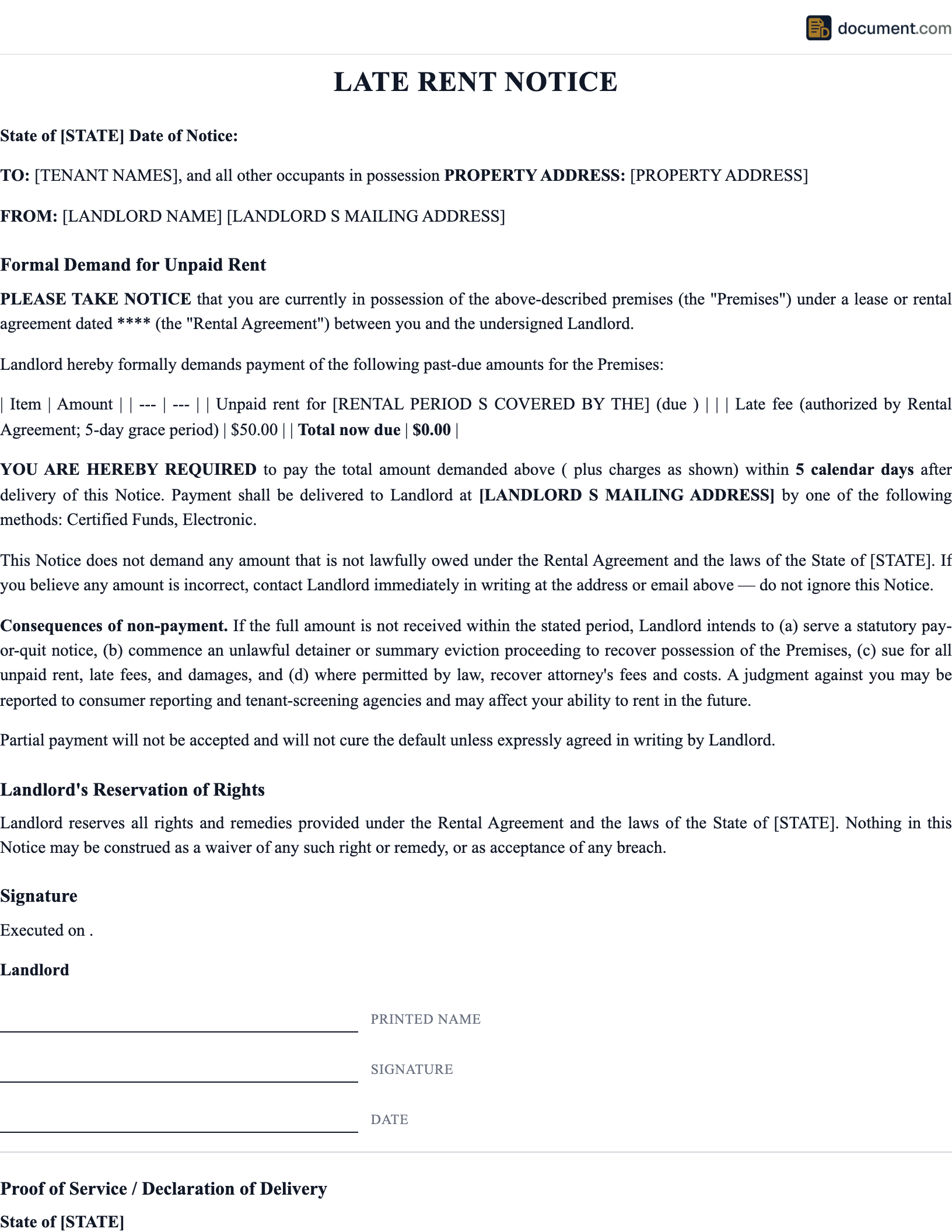
Late Rent Notice Form Preview
Our template includes all fields needed for a professional late rent notice with state-specific late fee compliance.
NOTICE OF LATE RENT PAYMENT
Past Due Rent Reminder
TENANT & PROPERTY
Tenant: [Name]
Property: [Address]
Unit: [Unit #]
PAYMENT DETAILS
Rent Due Date: [Date]
Monthly Rent: $[Amount]
Late Fee: $[Amount]
Total Due: $[Amount]
PAYMENT INSTRUCTIONS
Pay To: [Name/Address]
Accepted Methods: [Check, Online, etc.]
LANDLORD
Signature: [Signature]
Date: [Date]
How to Write a Late Rent Notice
Follow these steps to create an effective and professional late rent notice that encourages payment while documenting your collection efforts.
Verify the Grace Period Has Expired
Before sending a late rent notice, confirm that the applicable grace period has passed. Check your lease agreement and state law for the grace period length. Sending a notice before the grace period expires can undermine your credibility and, in some cases, expose you to legal challenges from the tenant.
Calculate the Exact Amount Owed
Calculate the total amount due including base rent, any applicable late fees as specified in the lease, and any other outstanding charges. Be precise — overstating the amount owed can invalidate the notice in some jurisdictions. Only include late fees that are authorized by your lease and compliant with state law limits.
Use a Professional, Non-Threatening Tone
Write the notice in a firm but professional manner. Avoid aggressive or threatening language. The purpose is to communicate that rent is overdue and needs to be paid, not to intimidate the tenant. A professional tone is more effective and creates a better impression if the document is later presented in court. Reference the specific lease provision that establishes the rent due date and late fee amount.
Include Payment Instructions
Make it easy for the tenant to pay by including clear payment instructions — where to send payment, acceptable payment methods (check, online portal, bank transfer, money order), and the full amount needed to bring the account current. If you have an online payment portal, include the URL. Reducing friction in the payment process increases the likelihood of prompt payment.
State the Consequences of Non-Payment
Clearly explain what will happen if rent remains unpaid. This typically includes continued accrual of late fees, a formal pay or quit notice, and potential eviction proceedings. Do not make threats you cannot legally follow through on. Simply state the factual next steps in the collection process. This information motivates payment while also documenting that the tenant was warned.
Deliver the Notice and Keep Records
Deliver the notice through a documented method — certified mail, email with read receipt, or personal delivery with signed acknowledgment. Keep a copy of the notice, the delivery confirmation, and any response from the tenant. This documentation is essential if the situation escalates to formal eviction proceedings and you need to demonstrate your collection efforts to the court.
Key Components of a Late Rent Notice
An effective late rent notice should contain all of the following elements.
| Component | Description |
|---|---|
| Date of Notice | The date the notice is prepared and sent |
| Tenant Name | Full legal name of the tenant(s) responsible for rent |
| Property Address | Full address of the rental unit including apartment number |
| Rent Due Date | The original date rent was due as specified in the lease |
| Rent Amount | The monthly rent amount that has not been paid |
| Late Fee Amount | The late fee assessed per the lease agreement and state law |
| Total Amount Due | Sum of unpaid rent plus late fees and any other authorized charges |
| Payment Deadline | Date by which the total amount must be received |
| Payment Methods | Accepted payment methods and where to submit payment |
| Consequences Warning | Statement of next steps if payment is not received (pay or quit, eviction) |
| Lease Reference | Reference to the lease provision governing late fees and rent due dates |
| Landlord Signature | Signature of landlord or authorized property manager |
Legal Requirements for Late Rent Notices
While late rent notices are generally less regulated than formal eviction notices, there are important legal considerations landlords must follow to avoid liability.
Important: Grace Periods Are Mandatory in Some States
Several states require mandatory grace periods before rent is considered late: Connecticut (9 days), Delaware (5 days), Maine (15 days), New Jersey (5 days), New York (5 days), and Oregon (4 days). Charging a late fee or sending a late rent notice before the grace period expires can expose landlords to legal claims and may be considered a violation of state consumer protection laws.
Late Fee Regulations
- Must Be in Lease: Late fees are only enforceable if they are clearly specified in the written lease agreement with the exact amount or calculation method
- Reasonable Amount: Courts generally cap late fees at 5-10% of monthly rent — fees deemed excessive may be struck down as unconscionable penalties
- State Caps: Some states set specific limits — New York caps at $50 or 5% for rent-stabilized units; Maine caps at 4% of monthly rent
- No Compounding: Most states prohibit charging daily late fees that compound indefinitely — the fee is typically a one-time charge per late payment
Documentation Best Practices
Maintaining thorough records of all late rent communications is essential for landlords. Courts expect to see evidence that the landlord made reasonable efforts to collect rent before pursuing eviction. Keep copies of all notices sent, delivery confirmations, tenant responses, and payment records. A well-documented collection timeline strengthens your position if formal proceedings become necessary and demonstrates good faith to the court.
Sample Late Rent Notice
Below is a sample late rent notice. Your document will include state-specific grace period and late fee compliance.
NOTICE OF LATE RENT PAYMENT
Date: [Date]
Dear [Tenant Name],
This notice is to inform you that as of the date of this letter, your rent payment for the property at [Property Address] has not been received. Your monthly rent of $[Amount] was due on [Due Date].
Balance Due:
Rent: $[Amount]
Late Fee (per lease Section [X]): $[Amount]
Total Due: $[Total]
Please submit payment immediately using one of the accepted methods outlined in your lease. If payment is not received within [X] days, further action may be taken including a formal pay or quit notice as required by [State] law.
If you have already submitted payment, please disregard this notice and contact our office to confirm receipt.
Sincerely,
Landlord/Manager Signature
Name: _______________ Phone: _______________
Frequently Asked Questions
Find answers to common questions about late rent notices, grace periods, and late fee limits.
Official Resources
Use these trusted resources for additional information about rent collection, late fee regulations, and tenant rights.
Related Landlord Documents
These related documents support the rent collection process.
Pay or Quit Notice
Formal legal notice — next step after late rent notice
Eviction Notice
Full eviction notice template for all violation types
Lease Agreement
Comprehensive residential lease with late fee provisions
Rent Increase Notice
Formal notice of rent increase with state compliance
Lease Amendment
Modify lease terms including payment schedules
Lease Termination Letter
End a lease with proper notice and documentation
Create your Late Rent Notice in under 10 minutes.
Answer a few questions and download a compliant, attorney-drafted document ready for your state.