



What Is a Lease Amendment?
A lease amendment is a legal document that modifies one or more specific terms of an existing lease agreement while keeping the rest of the lease intact. It is one of the most practical tools in landlord-tenant relationships because it allows both parties to adapt the rental arrangement to changing circumstances without having to draft an entirely new lease. Whether the change involves adjusting the rent, adding a new roommate, permitting a pet, or modifying parking arrangements, a lease amendment provides a formal, written record of the agreed-upon changes.
It is critical to understand that a lease amendment requires the mutual consent of all parties to the original lease. A landlord cannot unilaterally amend a lease during a fixed term, and neither can a tenant. This mutual agreement requirement stems from basic contract law — a lease is a binding contract, and all modifications to binding contracts require consideration (something of value exchanged) and the agreement of all parties. Amendments that are signed under duress, obtained through fraud, or made without adequate consideration may be voidable in court.
The distinction between an amendment and an addendum is important but often misunderstood. An amendment changes existing provisions — for example, modifying the rent from $1,500 to $1,600 per month. An addendum adds entirely new provisions that were not in the original lease — for example, adding detailed pet rules to a lease that did not previously address pets. In practice, many documents titled "addendum" actually function as amendments because they modify existing terms while also adding new ones. Regardless of the label, the legal effect is the same: both must be signed by all parties and become part of the binding lease agreement.
When considering whether to use an amendment versus drafting a new lease, the general rule is that amendments work well for one to three specific changes. If the modifications are extensive — affecting rent, term, occupants, pet policies, and maintenance responsibilities simultaneously — it may be clearer and less error-prone to execute a new lease entirely. Multiple amendments to a single lease can create confusion about which terms are current, especially if later amendments contradict earlier ones.
Rent Changes
Adjust rent amount, payment schedule, or accepted payment methods mid-lease
Occupant Changes
Add or remove roommates, update authorized occupant lists, adjust responsibilities
Term Modifications
Extend or shorten the lease term, change renewal terms, or modify end date
Lease Amendment by State
Lease amendments must follow the same statutory formalities as the original lease — rent-change notices, witness requirements, and e-signature rules vary by state. Select your state for a compliant amendment template.
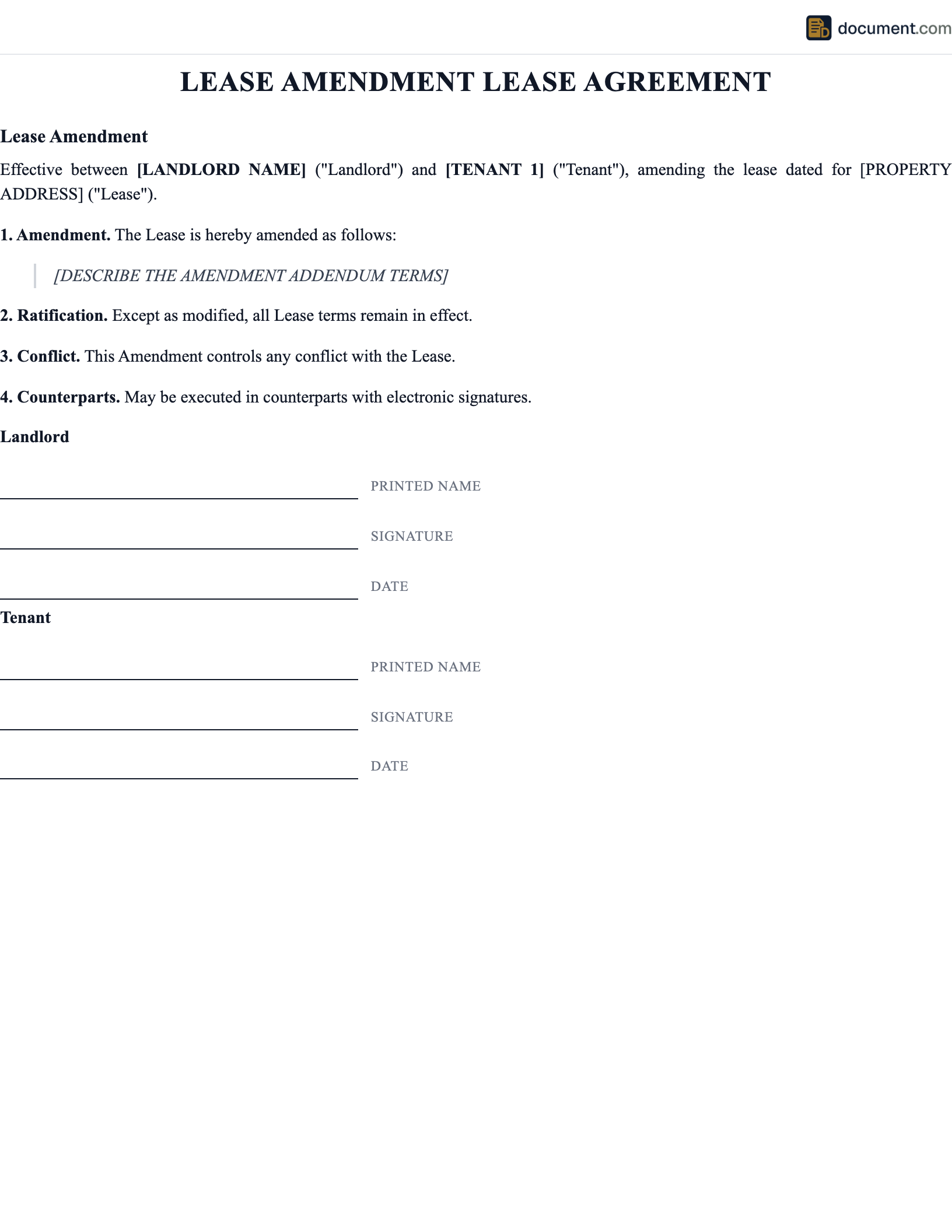
Lease Amendment Form Preview
Our template covers all essential elements for a valid lease amendment referencing your original lease agreement.
LEASE AMENDMENT
Modification to Residential Lease Agreement
ORIGINAL LEASE
Lease Date: [Date]
Property: [Address]
PARTIES
Landlord: [Name]
Tenant(s): [Names]
AMENDMENTS
Section Modified: [Section #]
Current Language: [Original Text]
Amended Language: [New Text]
Effective Date: [Date]
SIGNATURES
Landlord: [Signature] Date: [Date]
Tenant: [Signature] Date: [Date]
How to Write a Lease Amendment
Follow these steps to create a clear, enforceable lease amendment that protects both parties.
Identify the Specific Changes Needed
Before drafting the amendment, clearly identify which specific lease provisions need to be modified. Locate the exact section numbers and current language in the original lease. Be precise about what is changing — vague or ambiguous amendments create disputes. If multiple changes are needed, list each one separately with its own section reference.
Discuss and Agree on Terms
Both landlord and tenant should discuss and agree on all proposed changes before the amendment is drafted. This negotiation phase is where both parties can raise concerns, suggest alternatives, and reach a mutually acceptable agreement. Document the agreed terms in writing even at this stage to avoid misunderstandings during the formal drafting process.
Reference the Original Lease
The amendment must clearly reference the original lease by date, parties, and property address. Include language such as "This Amendment modifies the Residential Lease Agreement dated [Date] between [Landlord] and [Tenant] for the property located at [Address]." This creates an unambiguous connection between the amendment and the lease it modifies.
State the Changes Clearly
For each modification, state the original provision (quoting it or referencing the section number), then state the new language that replaces it. Use clear, unambiguous wording. For example: "Section 3 (Monthly Rent) is hereby amended as follows: The monthly rent shall be $1,600 per month, effective [Date], replacing the previous amount of $1,500 per month."
Include a Conflict Resolution Clause
Add a provision stating that if any conflict exists between this amendment and the original lease, the terms of the amendment shall prevail. Also include a statement that all other terms and conditions of the original lease remain in full force and effect except as specifically modified by this amendment.
Specify the Effective Date
Clearly state when the amended terms take effect. This could be the date of signing, a future date, or retroactive to a past date if both parties agree. For rent changes, the effective date should typically be the first of a month to simplify accounting. Ensure both parties understand and agree to the effective date.
Obtain All Required Signatures
All parties to the original lease must sign the amendment — the landlord and every tenant listed on the lease. If one tenant refuses to sign, the amendment cannot take effect (since all parties must agree). Each signer should date their signature. Distribute signed copies to all parties for their records. The amendment should be stored with the original lease.
Key Components of a Lease Amendment
A properly drafted lease amendment includes these essential elements.
| Component | Description |
|---|---|
| Amendment Title | Clearly labeled as "Lease Amendment" or "Amendment to Lease Agreement" |
| Original Lease Reference | Date and identification of the original lease being modified |
| Property Address | Full address of the rental property including unit number |
| Landlord Name | Full legal name of the property owner or management company |
| Tenant Name(s) | Full legal names of all tenants on the lease |
| Specific Changes | Detailed description of each term being modified, with original and new language |
| Effective Date | When the amended terms take effect |
| Conflict Clause | Statement that amendment prevails over conflicting original terms |
| Continuation Clause | Statement that all other original lease terms remain in effect |
| All Party Signatures | Dated signatures of landlord and all tenants on the lease |
Legal Requirements for Lease Amendments
Lease amendments must comply with contract law principles and state-specific landlord-tenant regulations.
Important: Mutual Consent Required
Neither party can unilaterally amend a lease during the lease term. Both the landlord and all tenants must agree to and sign the amendment. A landlord who attempts to change lease terms without tenant consent (e.g., by simply sending a letter announcing new rules) has not created a valid amendment — the original terms remain in effect. Similarly, a tenant cannot modify lease obligations without the landlord's written agreement.
Writing Requirements
- Written Form: Lease amendments should always be in writing — verbal modifications are difficult to enforce and may be barred by the Statute of Frauds for leases over one year
- Consideration: Amendments should include consideration (something of value exchanged) to be enforceable — this can be as simple as "mutual promises" or a specific benefit to each party
- Signatures: All parties to the original lease must sign — if one tenant refuses, the amendment cannot take effect for any party
- Compliance: Amended terms must comply with all applicable state and local laws — you cannot amend a lease to include terms that violate fair housing, habitability, or other statutory requirements
Amendment vs Addendum vs New Lease
Choose the right instrument for your situation. Use an amendment when modifying existing terms of the lease. Use an addendum when adding entirely new provisions (like a pet policy or parking agreement) that were not in the original lease. Draft a new lease when the changes are so extensive that the original lease no longer reflects the actual arrangement. In practice, many documents combine amendment and addendum functions, and the legal effect is the same as long as all parties sign.
Sample Lease Amendment
Below is a sample lease amendment for a rent change. Your document will be customized to your specific modifications.
AMENDMENT TO RESIDENTIAL LEASE AGREEMENT
This Amendment is made on [Date] to the Residential Lease Agreement dated [Original Date] between [Landlord] ("Landlord") and [Tenant] ("Tenant") for the property located at [Address].
AMENDMENT:
1. Section [X] (Monthly Rent) is amended as follows: Effective [Date], the monthly rent shall be $[New Amount] per month, replacing the previous amount of $[Old Amount] per month.
2. In the event of conflict between this Amendment and the original Lease, this Amendment shall control.
3. All other terms of the original Lease remain in full force and effect.
Landlord Signature
Date: _______________
Tenant Signature
Date: _______________
Frequently Asked Questions
Find answers to common questions about lease amendments, addendums, and contract modifications.
Official Resources
Use these resources for additional information about modifying lease agreements.
Related Rental Documents
These documents complement or may be used alongside a lease amendment.
Lease Agreement
Complete residential lease agreement template
Pet Addendum
Add pet permissions with deposit and rules
Lease Renewal
Renew your lease with updated terms
Rent Increase Notice
Formal rent increase notification
Lease Termination Letter
End a lease with proper notice
Eviction Notice
Formal notice to quit for lease violations
Create your Lease Amendment Lease Agreement in under 10 minutes.
Answer a few questions and download a compliant, attorney-drafted document ready for your state.