



What Is a Lease Renewal Agreement?
A lease renewal agreement is a legal document that extends the landlord-tenant relationship beyond the original lease term by establishing a new rental period with updated or continued terms. Unlike a lease extension (which simply pushes the end date forward while keeping all terms unchanged), a renewal agreement allows both parties to renegotiate key conditions such as rent amount, lease duration, maintenance responsibilities, and other provisions. It creates a formal record that the tenancy will continue, providing stability and legal clarity for both the landlord and tenant.
The renewal process is a critical juncture in any tenancy. For landlords, it represents an opportunity to adjust rent to market rates, update lease terms to reflect current laws, and retain quality tenants without the costs associated with vacancy and turnover — which industry estimates place at $1,000 to $5,000 or more per unit when accounting for marketing, cleaning, repairs, and lost rent. For tenants, a renewal provides housing stability, the ability to negotiate favorable terms from a position of established trust, and the avoidance of moving costs that average $1,700 to $4,300 for a local move.
When a lease expires without a renewal agreement in place, the outcome depends on the lease terms and state law. Many leases include automatic renewal clauses (also called evergreen clauses) that renew the lease for another term — often one year — unless one party provides written notice of non-renewal within a specified window. If there is no automatic renewal clause and the tenant continues to pay rent and the landlord accepts it, the tenancy typically converts to a month-to-month arrangement under the same terms as the expired lease. This holdover tenancy provides less stability for both parties, as either can terminate with relatively short notice (usually 30 days).
It is important to distinguish between a lease renewal and creating an entirely new lease. A renewal agreement is typically a shorter document that references the original lease, specifies the new term dates, identifies any changed terms, and confirms that all other terms of the original lease remain in effect. A new lease, by contrast, is a complete standalone document. Renewals are simpler and faster to execute, but if significant changes are being made, starting with a new lease may provide greater clarity and reduce the risk of conflicting provisions between the original lease and the renewal.
Lease Renewal
New term with opportunity to update rent, rules, and other lease conditions
Lease Extension
Extends the end date while keeping all original terms exactly the same
Month-to-Month
Automatic conversion when lease expires without renewal — less stability for both parties
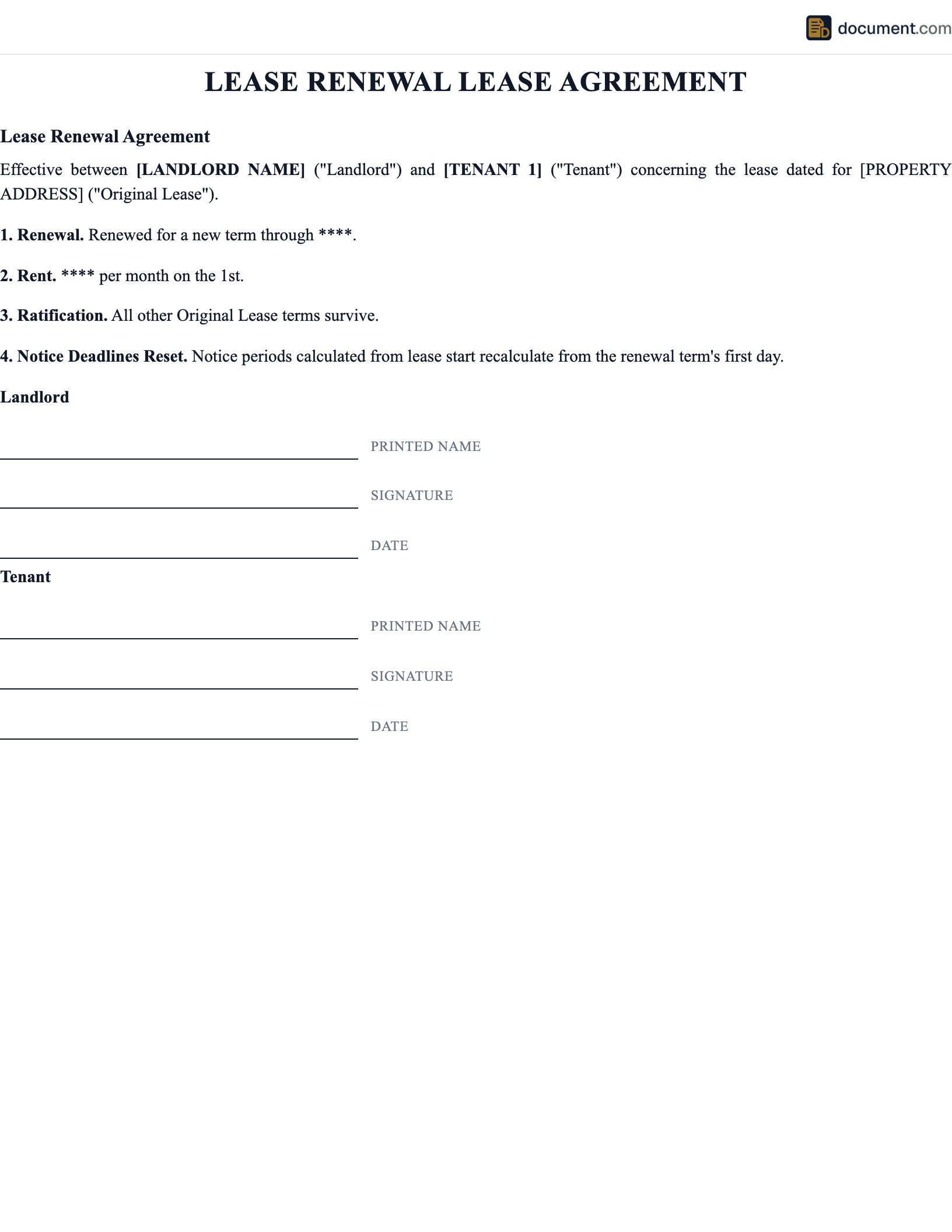
Lease Renewal Agreement Form Preview
Our lease renewal template covers all the essential elements for a valid renewal agreement. Your customized document will reference your original lease and include any updated terms.
LEASE RENEWAL AGREEMENT
Residential Lease Renewal
ORIGINAL LEASE REFERENCE
Original Lease Date: [Date]
Property Address: [Address]
Current Lease Expiration: [Date]
PARTIES
Landlord: [Full Name]
Tenant(s): [Full Names]
RENEWAL TERMS
New Lease Start Date: [Date]
New Lease End Date: [Date]
New Monthly Rent: $[Amount]
Security Deposit Change: [If Any]
SIGNATURES
Landlord: [Signature] Date: [Date]
Tenant: [Signature] Date: [Date]
How to Renew a Lease
Renewing a lease involves several steps that protect both landlord and tenant interests. Following a structured process ensures a smooth transition to the new term.
Review the Current Lease
Start by reviewing the current lease agreement, paying close attention to the expiration date, any automatic renewal clauses, the required notice period for non-renewal, and any terms that either party wants to change. If the lease has an auto-renewal clause, note the opt-out deadline to avoid being locked into another term before negotiations are complete.
Research Market Rates
Both landlords and tenants benefit from understanding current market conditions. Landlords should research comparable rents in the area to set a fair renewal rate. Tenants should do the same research to negotiate effectively. Consider factors like property condition, amenities, location desirability, and vacancy rates. A rent increase of 3-5% annually is generally considered reasonable in most markets without rent control.
Initiate Renewal Discussion
Begin renewal discussions 60-90 days before the lease expires. Landlords should send a renewal offer letter outlining the proposed new terms, including any rent adjustment. Tenants who want to stay should proactively communicate their interest and any concerns or requests. Early communication demonstrates good faith and provides time for productive negotiation.
Negotiate Updated Terms
This is the opportunity to address any issues from the current tenancy and adjust terms for the new period. Common negotiation points include rent amount, lease duration (tenants may prefer shorter terms for flexibility; landlords prefer longer terms for stability), pet policies, parking arrangements, maintenance responsibilities, and unit improvements. Be willing to compromise — for example, accepting a slightly higher rent in exchange for an upgraded appliance.
Draft the Renewal Agreement
Prepare a written renewal agreement that clearly references the original lease, specifies the new lease term dates, lists all changed terms (especially the new rent amount), and states that all other terms of the original lease remain in effect unless specifically modified. Both the landlord and tenant should review the document carefully before signing.
Sign and Distribute Copies
Both the landlord and all tenants listed on the lease must sign the renewal agreement. Each party should receive a fully executed copy for their records. The renewal should be signed before the current lease expires to avoid any gap in the formal agreement. If there is a rent increase, ensure proper advance notice was given per state requirements before the increase takes effect.
Key Components of a Lease Renewal
A complete lease renewal agreement includes specific elements to ensure enforceability and clarity for both parties.
| Component | Description |
|---|---|
| Original Lease Reference | Date and identification of the original lease being renewed |
| Landlord Name | Full legal name of the property owner or management company |
| Tenant Name(s) | Full legal names of all tenants on the renewed lease |
| Property Address | Full address of the rental property including unit number |
| New Lease Term | Start and end dates of the renewed lease period |
| Rent Amount | New monthly rent amount and due date for the renewal term |
| Security Deposit | Whether the deposit remains the same, increases, or is adjusted |
| Modified Terms | List of any terms that have changed from the original lease |
| Unchanged Terms | Statement that all other original lease terms remain in effect |
| Signatures | Signatures and dates from both landlord and all tenants |
Legal Requirements for Lease Renewals
Lease renewal requirements vary by state and are influenced by rent control ordinances, automatic renewal regulations, and anti-discrimination laws.
Important: Automatic Renewal Disclosures
Several states require landlords to provide specific notice to tenants about automatic renewal clauses before they take effect. For example, New York requires landlords of buildings with 4+ units to provide 15-90 days advance notice that the lease will automatically renew. Failure to provide this notice may render the automatic renewal unenforceable and convert the tenancy to month-to-month.
Rent Increase Requirements
- Advance Notice: Most states require 30-60 days written notice before a rent increase takes effect — this notice must be provided before the renewal is signed in many jurisdictions
- Rent Control: In rent-controlled areas, increases are limited to percentages set by local rent boards — typically 2-8% annually in cities like New York, San Francisco, and Los Angeles
- State Rent Caps: California (AB 1482), Oregon, and other states cap annual increases at a percentage plus CPI — exceeding these caps is void even in a signed renewal
- Fair Housing: Rent increases cannot be discriminatory — landlords must apply increases consistently across tenants regardless of protected class
Holdover Tenancy Rules
When a tenant remains after the lease expires without signing a renewal, state law determines the legal treatment. Most states consider the tenant a month-to-month tenant if the landlord continues to accept rent. However, the specific terms that carry over, the notice required to end the holdover tenancy, and whether the landlord can charge increased rent vary by state. Some states automatically apply the original lease terms to the holdover period; others allow landlords to impose new conditions with proper notice.
Month-to-Month Conversion
If neither party signs a renewal and the lease does not auto-renew, the tenancy often converts to month-to-month. This arrangement provides flexibility but less security — either party can typically terminate with 30 days notice. For landlords, month-to-month tenancies allow for quicker rent adjustments but create uncertainty. For tenants, they offer flexibility but the risk of a short-notice rent increase or termination. Formalizing the arrangement through a renewal is almost always preferable for both parties.
Sample Lease Renewal Agreement
Below is a sample lease renewal agreement. Your customized document will include state-specific provisions and reference your original lease terms.
LEASE RENEWAL AGREEMENT
This Lease Renewal Agreement ("Renewal") is entered into on [Date] by and between [Landlord Name]("Landlord") and [Tenant Name(s)]("Tenant").
WHEREAS, the parties entered into a Residential Lease Agreement dated [Original Date] for the property located at [Property Address];
WHEREAS, the current lease term expires on [Expiration Date] and both parties wish to continue the tenancy;
NOW, THEREFORE, the parties agree as follows:
1. RENEWED TERM:
The lease is renewed from [Start Date] through [End Date].
2. MONTHLY RENT:
The new monthly rent shall be $[Amount], due on the [Day] of each month.
3. MODIFIED TERMS:
[List any changed terms, or state "No other terms are modified."]
4. CONTINUATION:
All other terms of the original Lease Agreement remain in full force and effect.
Landlord Signature
Date: _______________
Tenant Signature
Date: _______________
Frequently Asked Questions
Find answers to common questions about lease renewals, extensions, rent increases, and holdover tenancy.
Official Resources
Use these trusted resources for additional information about lease renewals and tenant rights.
HUD Rental Assistance
Federal resources on tenant rights and rental assistance
CFPB Housing Resources
Consumer protection guides for renters and homeowners
Nolo — Lease Renewal Guide
Legal guide to renewing and extending residential leases
USA.gov — Landlord-Tenant
Federal guide to landlord-tenant rights and disputes
Related Rental Documents
You may need these additional documents alongside your lease renewal.
Lease Agreement
Complete new residential lease agreement
Rent Increase Notice
Formal notice of rent increase with proper advance notice
Lease Amendment
Modify specific terms during the current lease period
Lease Termination Letter
Formally end a lease instead of renewing
Pet Addendum
Add pet permissions to your renewal agreement
Late Rent Notice
Formal past due rent notification template
Create your Lease Renewal Lease Agreement in under 10 minutes.
Answer a few questions and download a compliant, attorney-drafted document ready for your state.