
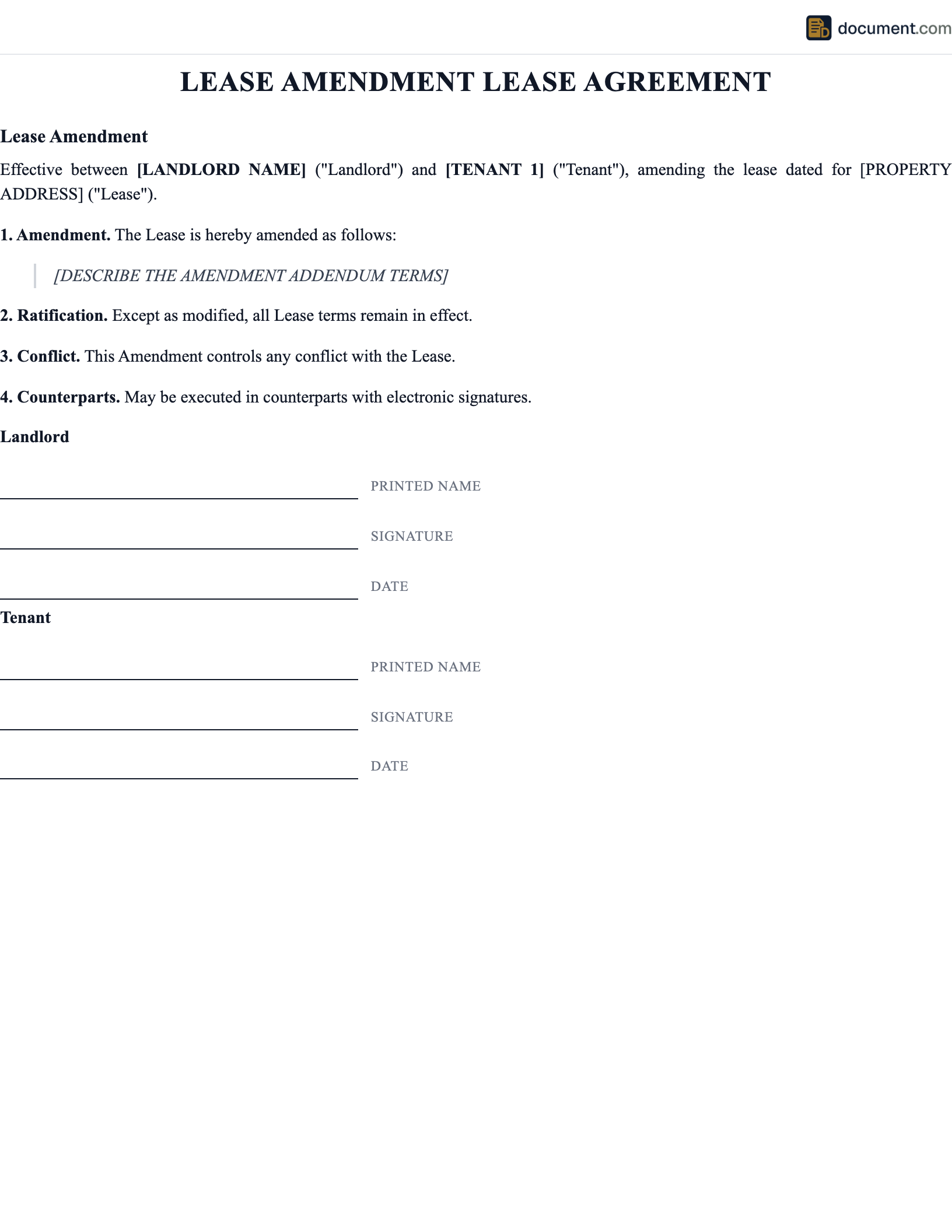



California Lease Amendment Overview
A lease amendment in California modifies specific terms of an existing rental agreement while keeping the remainder of the lease intact. California's landlord-tenant law is governed by the California Civil Code § 1940-1954.06 and the Tenant Protection Act (AB 1482), which establishes the legal framework for how residential leases can be created, modified, and terminated in the state. California has AB 1482 capping rent increases at 5% + CPI (max 10%) for most properties 15+ years old. Many cities have additional local rent ordinances. Just-cause eviction protections limit landlord remedies if tenants refuse amendments.
The fundamental principle governing lease amendments in California is mutual consent. A lease is a binding contract under California law, and any modification requires the agreement of all parties to the original agreement. During a fixed-term lease, neither the landlord nor the tenant can unilaterally alter the terms — both must affirmatively consent to every change. For month-to-month tenancies, the landlord can propose changes with 30-60 days written notice before the next rental period begins. If the tenant does not agree to the proposed changes, the landlord's remedy is to terminate the periodic tenancy with proper notice rather than to impose the amendment unilaterally.
California's rental market is shaped by the state's economic conditions, population trends, and housing supply. AB 1482 caps increases at 5% + CPI statewide. LA RSO caps at 3-8%, SF ties to CPI. Rent amendments to controlled units must comply with state and local limits. A rent increase exceeding the applicable cap is void. Common reasons for lease amendments in California include rent adjustments as market conditions change, adding or removing tenants when household composition shifts, modifying pet policies when circumstances change, updating parking arrangements, and changing utility responsibilities. Each type of amendment must comply with California law and be documented properly to be enforceable.
Yes (AB 1482)
Rent Control
30-60 days
Notice for Changes
Written
Amendment Required
1 month (eff. 2024)
Deposit Limit
California Legal Requirements for Lease Amendments
Writing Requirement
California's Statute of Frauds requires contracts relating to interests in real property to be in writing if the lease term exceeds one year. Amendments to written leases should also be documented in writing to be enforceable in California courts. The parol evidence rule generally prevents oral modifications from contradicting written lease terms. Even for short-term leases where the writing requirement may not technically apply, a written amendment is strongly recommended to avoid evidentiary problems. California courts have consistently held that written evidence of lease modifications is far more reliable than testimony about verbal agreements.
Mutual Consent and Consideration
Under California contract law, a valid lease amendment requires both mutual consent and adequate consideration. Consideration means something of value is exchanged between the parties — for example, the landlord agrees to allow a pet (benefit to tenant) in exchange for the tenant paying a pet deposit and monthly pet rent (benefit to landlord). California courts recognize that mutual modifications — where each party gives up or gains something — provide adequate consideration. An amendment signed under duress, obtained through fraud, or without adequate consideration may be voidable in California courts.
Notice Requirements for Periodic Tenancies
For month-to-month tenancies, California requires at least 30-60 days written notice before implementing material changes to the rental arrangement. The notice must be delivered before the start of the next rental period and should clearly describe the proposed changes, the new terms replacing the old ones, and the effective date. California law typically permits notice by personal delivery, mail, or other methods reasonably calculated to provide actual notice. Certified mail or hand delivery with a signed acknowledgment provides the strongest evidence of compliance.
Recording Requirements
Most residential leases in California are not recorded with the county recorder, so amendments typically do not need to be recorded either. However, if the original lease was recorded — which is more common for commercial leases or long-term ground leases — the amendment should also be recorded to maintain a complete public record and provide constructive notice to third parties including subsequent purchasers and lienholders.
How to Amend a Lease in California
Amending a lease in California requires careful attention to state legal requirements. Both parties should approach the process as a negotiation, understanding that neither side can compel the other to accept changes during a fixed-term lease.
Identify the Terms to Modify
Review the original lease and identify exactly which provisions need to change. Reference specific section numbers or clauses. In California, common amendments include rent adjustments, adding or removing tenants, pet policy changes, parking modifications, and utility responsibility updates.
Draft the Amendment Document
Reference the original lease by date, property address, and all parties. Clearly state the old language and replacement language. Include the effective date and a clause confirming all other terms remain unchanged. California law does not prescribe a specific format, but precision is essential for enforceability.
Obtain All Required Signatures
All parties to the original lease must sign — the landlord (or authorized property manager) and every tenant named on the lease. If any tenant fails to sign, the amendment may not be enforceable against them. Date all signatures to establish when the agreement was executed.
Distribute Copies and Maintain Records
Provide a fully signed copy to each party. Attach the amendment to the original lease for a complete record. Retain copies for the duration of the tenancy and a reasonable period afterward, particularly for any security deposit adjustments required under California law.
Common Lease Amendment Scenarios in California
Rent Adjustment Amendment
AB 1482 caps increases at 5% + CPI statewide. LA RSO caps at 3-8%, SF ties to CPI. Rent amendments to controlled units must comply with state and local limits. A rent increase exceeding the applicable cap is void. A lease amendment in California can change the rent to any amount the parties agree upon, subject to applicable rent control limits. During a fixed-term lease, any rent change requires the tenant's written consent. For month-to-month tenancies, the landlord can propose a rent increase with 30-60 days notice. Major California cities including Los Angeles, San Francisco, San Diego, San Jose, Sacramento see frequent rent amendments as market conditions change. The amendment should specify the new monthly rent amount, the effective date, the payment method, and whether the security deposit will be adjusted to reflect the new rental rate.
Adding a Pet Policy
When adding a pet to a previously no-pet lease in California, the amendment should specify the type, breed, weight, and number of pets allowed, any pet deposit amount (which may be subject to the 1 month (eff. 2024) deposit cap), monthly pet rent if applicable, the tenant's liability for pet-related damage beyond normal wear and tear, and vaccination and licensing requirements. Under the Fair Housing Act, emotional support animals and service animals are not classified as pets, and landlords cannot charge pet deposits or pet rent for them regardless of any lease amendment provisions.
Parking and Storage Modifications
Parking amendments are common in California apartment complexes and multi-family rental properties, particularly in urban areas like Los Angeles, San Francisco, San Diego. The amendment should identify the specific parking space number or location, any monthly fee, rules about vehicle type and condition, guest parking provisions, and towing policies for unauthorized use. California law generally treats parking space assignments as part of the lease agreement, and unauthorized changes can constitute a lease violation.
Utility Responsibility Changes
An amendment changing utility responsibilities should identify which utilities are being transferred (electricity, gas, water, sewer, trash, internet), the effective date, instructions for setting up accounts with California providers such as PG&E, SoCal Edison, SDG&E, LADWP, and consequences if a utility account falls into arrears. California may have specific rules about utility cost allocation, giving the parties flexibility to allocate responsibilities through an amendment.
Adding or Removing a Tenant
Adding or removing a tenant is one of the most common reasons for a lease amendment in California. When adding a tenant, the amendment should include their full legal name, date of birth, confirmation of joint and several liability under California law, and explicit agreement to abide by all existing lease terms. The landlord may require the new tenant to pass screening (background check, credit check, income verification). When removing a departing tenant, the amendment should address how the departing tenant's share of the security deposit is handled, formally release them from future obligations as of a specific date, and confirm that remaining tenants assume full responsibility for all lease obligations going forward.
How Amendments Affect Security Deposits in California
California limits security deposits to 1 month (eff. 2024). When a lease amendment changes the rent, the landlord may adjust the security deposit within the statutory cap. The amendment should specify whether additional deposit is required, the payment deadline, and how the additional amount will be handled at the end of the tenancy. California requires landlords to return the security deposit within 21 days of the tenant vacating, along with an itemized statement of any deductions. As of 2024 (AB 12), most landlords are limited to 1 month's rent for deposits. Return within 21 days required. California mandates pre-move-out inspections and detailed deduction rules.
If an amendment adds provisions that could result in deposit deductions — such as pet damage clauses, alteration permissions, or new maintenance responsibilities — the amendment should cross-reference the deposit provisions of the original lease and clearly define what constitutes deductible damage versus normal wear and tear under California law. California's penalty for wrongful withholding of the security deposit includes statutory damages plus penalties, making careful documentation through amendments especially important for landlord compliance.
California Deposit Adjustment Tip
When amending a lease in California, document any security deposit adjustments in the same amendment document. Maintain detailed records showing the original deposit amount, any additional deposits collected via amendments, and the total deposit held at any given time. California's 21 days return deadline applies to the entire deposit amount regardless of when each portion was collected during the tenancy.
Official California Resources
Consult these official resources for California landlord-tenant law and lease amendment guidance.
California Lease Amendment FAQ
Common questions about modifying a lease agreement in California under state landlord-tenant law.
Create Your California Lease Amendment
Answer a few questions and download your California-compliant amendment in minutes.
Get Started FreeNo account required. Free to create and preview.