



What Is a General Lease Addendum?
A general lease addendum is a signed supplement to an existing lease that adds new terms, conditions, or disclosures not included in the original document. The addendum identifies the original lease by date and parties, states the new provision with the same precision as a lease clause, and confirms that all other lease terms continue in full force. Both parties sign and the addendum attaches to the original lease as a permanent part of the agreement. Once executed, it is enforceable as a contract modification and binds both parties to the new terms on the effective date.
Common subjects include pet and assistance-animal terms, smoking and cannabis policies, parking allocations, bed bug and mold disclosures (state-required in New York City under Administrative Code §27-2018.1, San Francisco Health Code §581, and Texas Property Code §92.260), lead-based paint disclosure (federal 24 CFR §35.92 for pre-1978 housing), satellite dish installation under FCC Order 96-328, and crime-free housing provisions. Many of these are mandated by federal or state law and must be attached at lease signing; others are introduced mid-term when a new situation arises and the parties consent to address it through an addendum rather than a full lease amendment.
The Statute of Frauds (California Civil Code §1624, New York Gen. Oblig. Law §5-703, Texas Bus. & Com. Code §26.01, equivalents in 49 states) requires that any leasehold modification affecting obligations exceeding one year be in writing. Oral side agreements about pets, parking, smoking, or any other lease subject are generally unenforceable, which is the practical reason addendums exist. The integration clause in the original lease, combined with the parol evidence rule, bars admission of prior or contemporaneous oral agreements to vary the lease terms; only a signed writing modifies the deal.
Addendum vs. Amendment vs. Rider
An addendum adds new terms not previously addressed. An amendment changes existing terms (such as modifying rent or extending the term). A rider is functionally identical to an addendum and is the term commonly used in commercial leases and insurance contexts. The substantive distinction matters most for consideration: amendments mid-term typically require new consideration to be enforceable as contract modifications, whereas addendums attached at signing or shortly thereafter generally require none. A mid-term amendment that raises rent without a corresponding landlord concession (lease extension, deposit reduction, waiver of an existing claim) faces consideration challenges in some jurisdictions.
Integration Clauses and the Parol Evidence Rule
Most leases include an integration (or merger) clause stating that the lease constitutes the entire agreement and supersedes all prior negotiations and understandings. California Code of Civil Procedure §1856 and analogous statutes elsewhere codify the parol evidence rule, which bars admission of extrinsic evidence to contradict an integrated written agreement. Once an addendum is signed it becomes part of the integrated agreement, and any prior or contemporaneous oral discussions on the addendum's subject are merged into it. Side letters, email exchanges, and undocumented promises that contradict the addendum are unenforceable. The addendum should reaffirm the integration clause expressly to foreclose later challenges.
New Provisions
Adds terms not present in the original lease
Mutual Consent
Both signatures required; unilateral imposition fails
Lease Integration
Becomes part of the integrated agreement
Form Preview
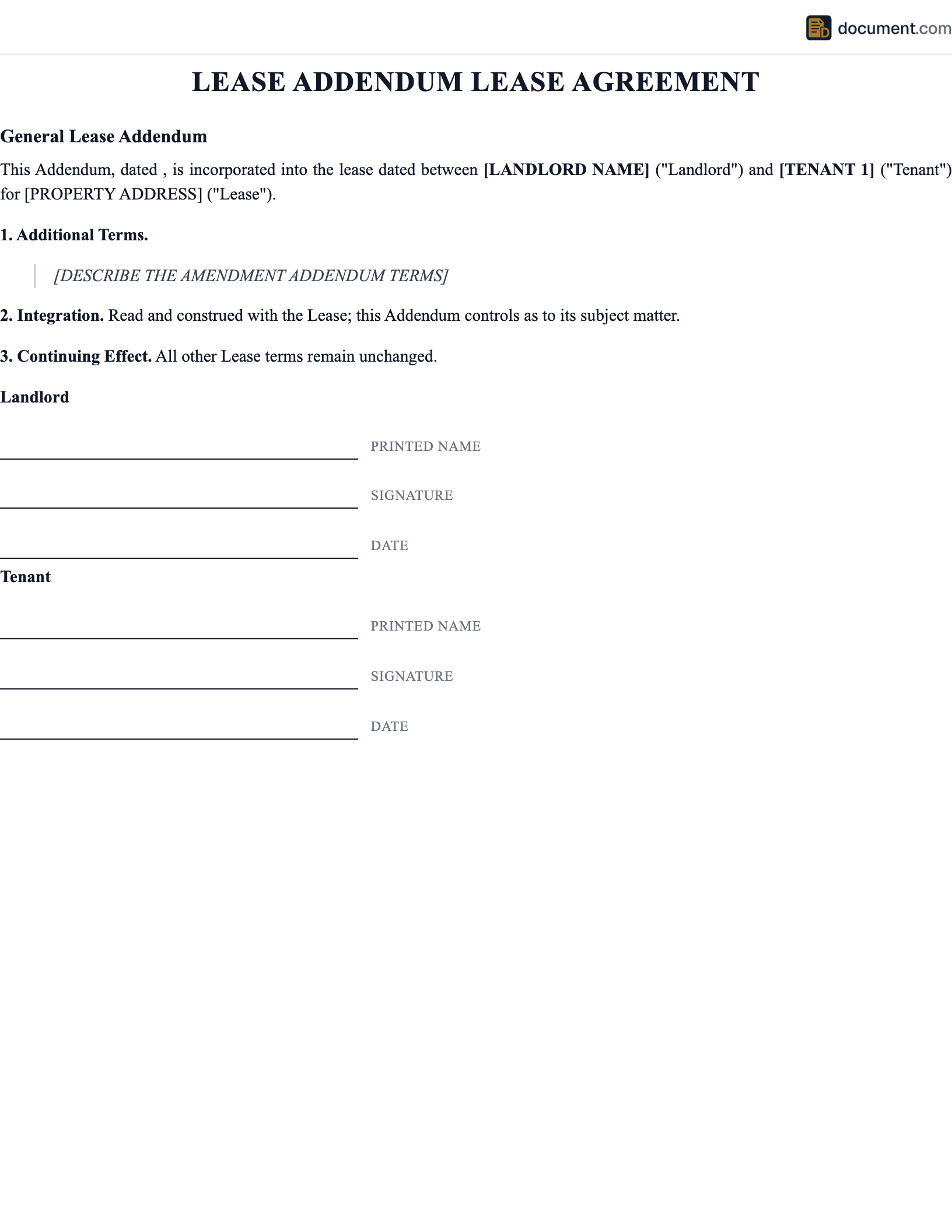
Below is a preview of the General Lease Addendum template. Your customized document will include all provisions for your specific situation.
LEASE ADDENDUM
Supplemental Lease Provisions
This document is entered into on [Date] between the parties identified below:
LANDLORD:
Name: [Landlord Name]
TENANT:
Name: [Tenant Name]
How to Use This Document
Drafting precision matters because the addendum becomes part of the integrated agreement. Vague language invites construction against the drafter under the contra proferentem rule, particularly when the landlord drafted both the original lease and the addendum.
Resolving Conflicts Among Multiple Addendums
When a lease accumulates several addendums (pet, smoking, crime-free, parking, bed bug disclosure, mold disclosure, lead-based paint disclosure), each must reference the original lease and include a conflict clause stating that on its specific subject the addendum supersedes any inconsistent original-lease provision while leaving the rest of the lease in force. If two addendums on overlapping subjects conflict with each other, the later-executed addendum controls under the standard contract construction rule. For tenancies that accumulate four or more addendums, the cleanest approach is to restate the lease at the next renewal with all addendums incorporated, and to attach a schedule listing the prior superseded documents.
Identify the Need
Determine the subject: pet, smoking, parking, bed bug disclosure (NYC, SF, TX statutory), mold (state-required in CA, IN, MD), lead-based paint (federal 24 CFR §35.92 for pre-1978), satellite dish (FCC Order 96-328), crime-free, or property modification.
Draft Clear Terms
Reference the original lease by date, parties, and property address. State the new provision with the precision of a lease clause. Include an integration clause and a conflict-resolution clause confirming the addendum supersedes inconsistent original-lease terms on its specific subject.
Review With Both Parties
Share the draft and allow the other party time to review. Coerced signatures (pressure to sign immediately, threats of eviction) create duress defenses that void the addendum.
Execute and Attach
Both parties sign with the effective date. Attach to the original lease as an exhibit. Provide copies to all parties. Refusal to sign means the addendum has no legal effect; the prior lease terms continue unchanged.
Key Components
Each element below carries specific evidentiary weight. Skipping any one creates either a parol-evidence problem or a Statute of Frauds defect.
Federal and State-Required Disclosures
Several addendums are required by federal or state law and must be attached at lease signing or before move-in. Federal lead-based paint disclosure under 42 USC §4852d and 24 CFR §35.92 applies to housing built before 1978, with $19,507 per-violation civil penalties. New York City bed bug disclosure under Administrative Code §27-2018.1 requires the prior year's infestation history at lease signing. San Francisco Health Code §581 imposes a similar requirement. Texas Property Code §92.260 requires bed bug disclosure with the lease. California mandates mold disclosure under Health & Safety Code §26147. Failure to attach these required addendums creates statutory liability and may void enforcement of related lease terms.
| Component | Description |
|---|---|
| Original Lease Reference | Date, parties, and property address of the existing lease |
| Addendum Purpose | Clear statement of what the addendum addresses |
| New Provisions | Detailed terms being added to the lease |
| Effective Date | When the new provisions take effect |
| Conflict Resolution | Which document controls if there is a conflict |
| Signatures | Both landlord and tenant signatures with dates |
Frequently Asked Questions
Find answers to common questions about the General Lease Addendum.
Resources
Create your Lease Addendum Lease Agreement in under 10 minutes.
Answer a few questions and download a compliant, attorney-drafted document ready for your state.