
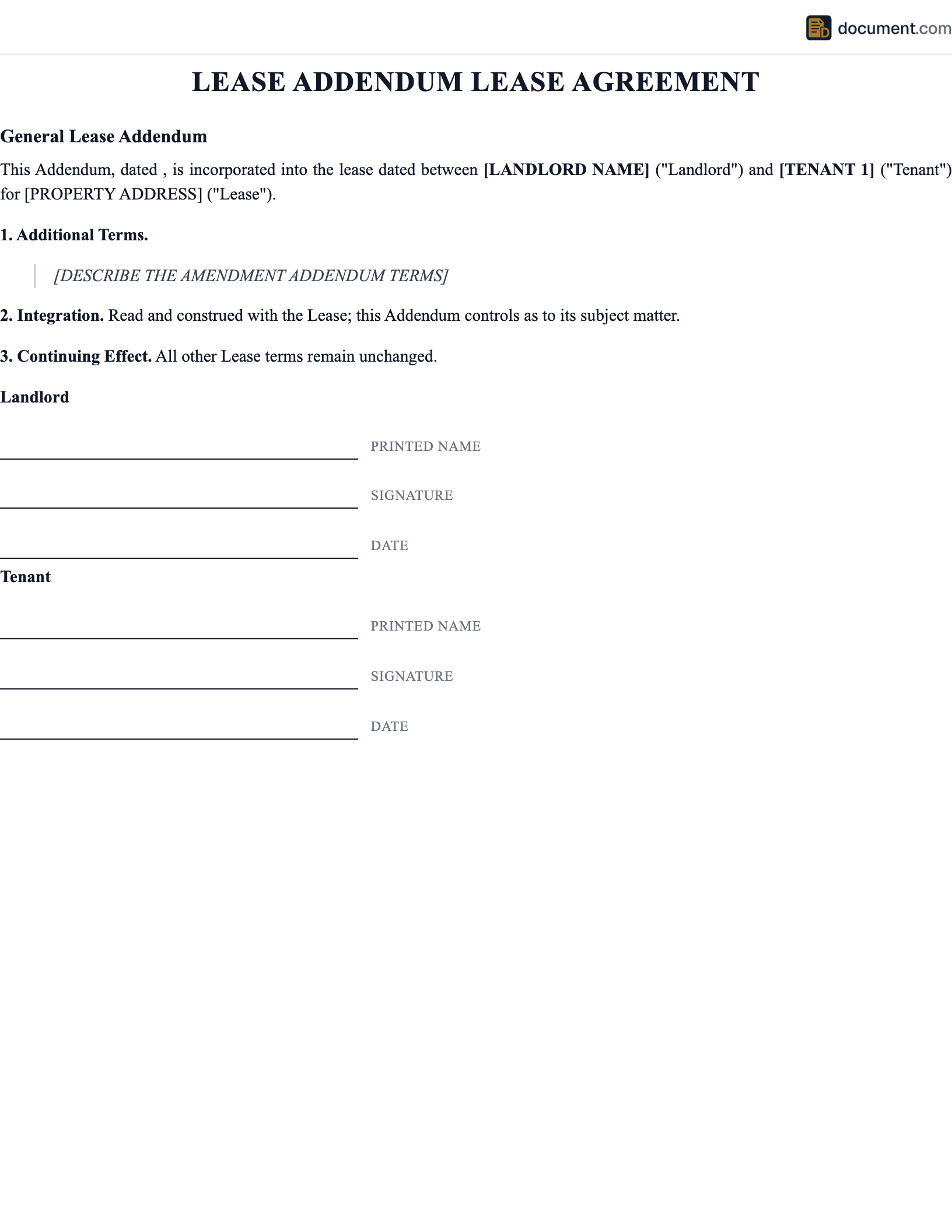



What Is a Lease Addendum?
A lease addendum is a written supplement attached to an existing lease that adds new terms, disclosures, or rules without rewriting the original instrument. Examples include the federal Lead-Based Paint Disclosure under 42 U.S.C. § 4852d for pre-1978 target housing, bed bug disclosures under Cal. Civ. Code § 1954.603 and NYC Admin. Code § 27-2018.1, mold disclosures under Tex. Prop. Code § 92.201, pet and assistance-animal addendums governed by HUD's 2020 FHEO Notice on the Fair Housing Amendments Act, and crime-free housing addendums required for federally assisted housing under 24 CFR § 5.857 and 42 U.S.C. § 1437d(l)(6).
Once signed by landlord and tenant and incorporated by reference into the main lease, the addendum becomes part of the integrated agreement under the parol evidence rule (Restatement (Second) of Contracts § 213). Courts apply the same rules of construction to the addendum as to the main lease: specific terms control over general terms, and the parties' last expressed intent controls conflicting provisions absent a contrary priority clause. Properly drafted addendums survive lease renewals and holdover tenancies under URLTA § 1.401, importing every fee, restriction, and disclosure into the renewed term unless the renewal instrument explicitly drops them.
Most residential leases include at least two mandatory addendums. The federal lead-based paint disclosure applies to all target housing built before 1978 and carries civil penalties up to $19,507 per violation under 24 CFR § 30.65. State disclosure addendums vary: California requires bed bug disclosure under Civ. Code § 1954.603 and mold disclosure under Health & Safety Code § 26147; New York City requires annual bed bug disclosure under NYC Admin. Code § 27-2018.1; Florida requires radon disclosure under Stat. § 404.056(5); Illinois requires radon disclosure under 420 ILCS 46.
Addendum versus amendment versus rider
An addendum supplements: it adds new terms the original lease did not address. An amendment modifies: it changes existing lease provisions and replaces the affected clauses. A rider is functionally an addendum, used in some commercial practice to describe landlord-drafted supplements attached at signing. The labels matter for evidentiary clarity, not enforceability; courts apply the substance of the document. The drafter should identify the right instrument: a rent-change document is an amendment because it modifies an existing obligation, while a new pet policy is an addendum because it addresses a subject the lease did not cover.
Integration clauses and conflict resolution among multiple addendums
Standard residential leases include an integration (merger) clause stating the lease and attached exhibits constitute the entire agreement and that no oral or written representations outside the document modify it. When the lease has multiple addendums, conflicts among them are resolved by the contract-construction rules in Restatement (Second) of Contracts § 203: specific controls over general; later-dated controls over earlier; handwritten controls over typed; typed controls over preprinted form language. Best practice is to label every addendum (Exhibit A through Z) sequentially, reference each one in the main lease's integration clause, include an explicit priority clause in each addendum, and execute each addendum with separate signatures and dates to defeat any later claim that the addendum was not part of the original bargain.
Types of Lease Addendums
Choose the addendum that matches what you are adding. Each variant is drafted for a specific purpose and cites the governing statutes where applicable.
Bed Bug Addendum
Disclosure, reporting windows, and treatment cost allocation.
Crime and Drug-Free Addendum
One-strike clauses and HUD-compliant drug-free housing language.
Improvements and Modifications
Tenant alterations, consent, removal, and escrow.
Lease Extension Addendum
Extend term without rewriting the original lease.
Rent Increase Addendum
Document a mid-term rent change with proper notice.
Pet Addendum
Pet rules, deposits, and breed/weight restrictions.
Smoking Addendum
Non-smoking property rules and penalties.
Mold Addendum
Mold disclosure, prevention, and reporting duties.
Swimming Pool Addendum
Liability and safety rules for pool access.
Military Clause Addendum
SCRA-compliant early termination for service members.
Lead-Based Paint Disclosure
Federally required disclosure for pre-1978 housing.
Addendum vs. Amendment
The two are often confused but serve different purposes. Pick the right tool for the job.
| Feature | Addendum | Amendment |
|---|---|---|
| Purpose | Adds new terms or disclosures | Changes existing lease terms |
| Typical use | Pet, smoking, bed bug, lead paint | Rent change, party addition, term extension |
| Effect on main lease | Supplements; lease intact | Modifies; original clause replaced |
| Common trigger | New disclosure law or new rule | Life event (roommate move-in, rent change) |
How to Attach an Addendum
A clean addendum has four parts: identification, incorporation, the new terms, and signatures.
Reference the main lease
Identify the underlying lease by date, property address, and parties so there is no ambiguity about what the addendum modifies.
State the purpose
One sentence explaining why the addendum exists, e.g., 'This Addendum adds a bed bug disclosure required by [State] Civil Code §…'
Add the new terms
Spell out the new disclosures, rules, or obligations. Keep each term in its own numbered paragraph for easy reference.
Include a priority clause
In the event of a conflict between the addendum and the lease, specify which controls. Most addendums say the addendum controls.
Sign and date
Both landlord and tenant sign and date the addendum. Each party keeps a signed copy. Notarization is not required but strengthens enforceability.
State-Law Considerations
State law drives what addendums are required and how they must be delivered. A few examples:
- California: Bed bug disclosure required under Civil Code §1954.603; mold disclosure under Health & Safety Code §26147; just-cause lease terms under AB 1482 must be re-acknowledged.
- New York: Annual bed bug disclosure (DHCR form NYC-RA-79) required under NYC Administrative Code §27-2018.1.
- Texas: Mold disclosure under Property Code §92.201; lead paint for pre-1978 housing under federal rule; optional flood disclosure under §92.019.
- Florida: Radon disclosure required under §404.056(5); mold and bed bug addendums recommended but not statutory.
- Oregon: SB 608 (ORS 90.323) rent-increase notices must reference the addendum, and just-cause termination addendums (ORS 90.427) are common.
Federally Required Disclosures
Two federal rules generate mandatory addendums for residential leases:
Lead-Based Paint (1978)
42 U.S.C. §4852d requires disclosure for all target housing built before 1978. EPA/HUD pamphlet must be provided.
HUD Crime-Free (2015 Guidance)
24 CFR §5.857 applies to public housing and many Section 8 leases. Must not conflict with FHA protections.
Frequently Asked Questions
Common questions about attaching, enforcing, and terminating lease addendums.
Official Resources
HUD PHA Compliance Portal
Crime-free and one-strike addendum requirements for federally assisted housing
EPA Lead Paint Disclosure Rule
42 U.S.C. §4852d compliance for pre-1978 housing
Uniform Law Commission (URLTA)
Uniform Residential Landlord and Tenant Act reference
HUD Renters' Rights by State
State-by-state disclosure and tenant-rights summaries
Add an addendum to your lease in under 8 minutes.
Pick the addendum, answer a few questions, and download a signed-ready supplemental document keyed to your state's statutes.