



What Is a Rent Increase Addendum?
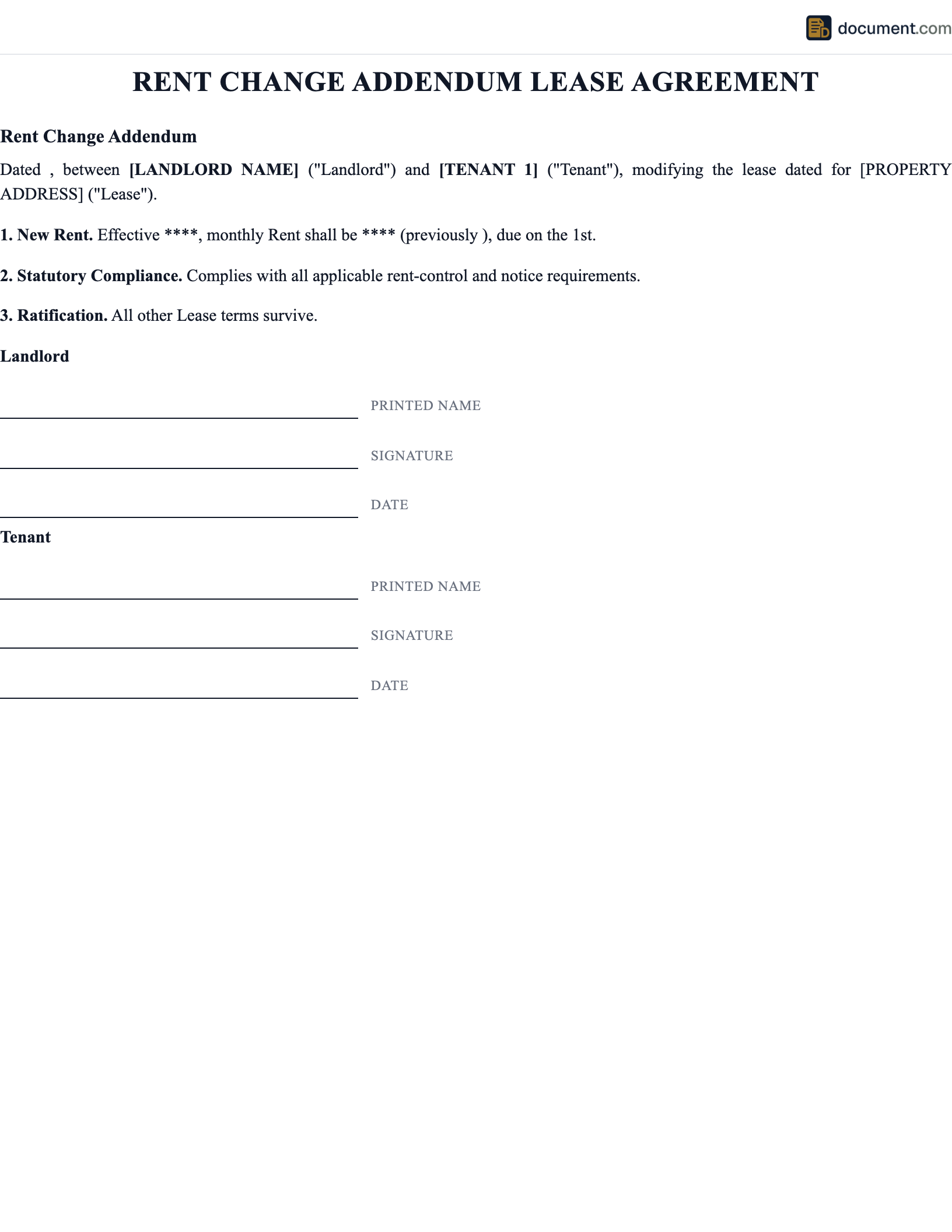
A rent increase addendum is a supplemental contract that raises the monthly rent in an existing lease without rewriting the entire document. It names the parties, references the original lease by date and address, recites the current rent, fixes the new rent, sets an effective date, and confirms that every other lease term carries forward. For a fixed-term lease (typically 12 months), the addendum operates as a bilateral contract modification under standard contract law. The pre-existing duty rule from Stilk v. Myrick and its American descendants requires new consideration, so the landlord typically pairs the increase with a term extension, a maintenance commitment, or another concession of value to the tenant. Without that consideration, the tenant can refuse to sign and continue paying the original rent through the end of the term.
For a month-to-month tenancy, the document operates as a statutory notice rather than a bilateral contract. The landlord serves the notice under the relevant state statute (Cal. Civ. Code §827 in California, NY RPL §226-c in New York, ORS 90.323 in Oregon, Tex. Prop. Code §91.001 in Texas), and the new rate takes effect after the notice period expires whether or not the tenant signs. The tenant's only counter-remedy is to terminate the tenancy by serving counter-notice within the same period.
The amount of the increase is capped by an expanding network of state and local statutes. California's Tenant Protection Act of 2019 (AB 1482, Civ. Code §1947.12) caps statewide increases at 5% plus regional CPI with a 10% ceiling. Oregon's SB 608 (ORS 90.324) caps annual increases at 7% plus West-region CPI (10.3% for 2026). New York's HSTPA and the Rent Guidelines Board set tighter caps for the city's roughly one million rent-stabilized units. San Francisco, Berkeley, Oakland, Los Angeles, Santa Monica, West Hollywood, and Washington D.C. all run their own ordinances. Our template calculates the maximum allowable increase from the current published CPI and refuses to draft any addendum that exceeds the cap.
Fixed-term versus month-to-month mechanics
Fixed-term tenancies require both signatures because a fixed-term lease is a binding promise to pay a fixed rent for a fixed period. The Restatement (Second) of Contracts §73 and the Uniform Commercial Code §2-209 both require new consideration for any modification, and most state common law applies the same rule to leases. A landlord who delivers a unilateral notice mid-term and then files an unlawful-detainer action when the tenant refuses to pay the higher amount typically loses the eviction and may face fee-shifting under prevailing-tenant statutes (Cal. Civ. Code §1717, NY RPAPL §234). Month-to-month tenancies, by contrast, can be terminated by either party on statutory notice, so the rent change is treated as a constructive offer of a new tenancy at the new rate. The tenant who pays the new rent accepts; the tenant who serves counter-notice and vacates rejects. There is no enforceable middle ground.
When a rent increase ripens into retaliation
Most jurisdictions create a rebuttable presumption that any rent increase served within a defined window after a tenant complaint to code enforcement is retaliatory. California Civ. Code §1942.5 sets the window at 180 days. Oregon ORS 90.385 sets it at six months. Washington RCW 59.18.240 sets it at 90 days. New York RPL §223-b sets it at one year. New Jersey N.J.S.A. 2A:42-10.10 covers the period for the duration of the tenancy with no time limit. The landlord can rebut the presumption by documenting a non-retaliatory business reason (CPI catch-up, comparable-market documentation, repair amortization) but the burden falls on the landlord. Increases that follow within days of a habitability complaint or a fair-housing inquiry are nearly impossible to defend.
State Rent-Control Caps
Statewide caps apply in five jurisdictions and are tightening every legislative session. The California, Oregon, and Washington statutes use a CPI-plus formula with a hard ceiling. New York and D.C. operate under board-set numbers tied to operating-cost surveys. Most other states preempt local rent control or leave the rent rate to private contract.
| State | Cap Formula | Statute |
|---|---|---|
| California | 5% + CPI (max 10%) | Civ. Code §1947.12 (AB 1482) |
| Oregon | 7% + CPI per year (10.3% for 2026) | ORS 90.324 (SB 608) |
| Washington | 7% + CPI (max 10%) for covered units | RCW 59.18.650 (HB 1217, 2025) |
| New York | Stabilized: RGB orders; free-market: none | RPL §226-c, NYC Admin. Code §26-501 |
| Washington D.C. | CPI + 2% (capped at 10%) | D.C. Code §42-3502.08 |
| New Jersey | Local ordinance (Newark, Jersey City, etc.) | N.J.S.A. 2A:42-84.4 |
| All other states | No statewide cap; local ordinances may apply | State preemption common in TX, FL, GA |
Coverage exemptions to confirm before raising
The statewide caps include statutory carveouts. AB 1482 exempts single-family homes and condos owned by natural persons (not entities, not LLCs with corporate members) where the landlord serves the §1947.12(d)(5) exemption notice; units constructed within the rolling 15-year window; deed-restricted affordable units; and dorms. SB 608 exempts units less than 15 years old, subsidized housing, and tenancies under one year. Washington's HB 1217 (effective May 2025) exempts single-family rentals owned by individuals, units less than 12 years old, and certain affordable housing. D.C. exempts buildings with four or fewer units owned by natural persons and units constructed after 1975. Confirm exemption status before drafting; mistakenly invoking an exemption that does not apply exposes the landlord to refund liability under the prevailing-tenant statutes.
Notice Periods by State
Notice runs from the date of delivery, not the date typed on the notice. Service must comply with the state's notice statute (typically personal delivery, substituted service, or post-and-mail), and the increase does not take effect until the period has fully elapsed.
- California: 30 days for increases under 10% over a 12-month period, 60 days for increases of 10% or more (Civ. Code §827(b)). Service per CCP §1162.
- New York: 30 days (tenancy under one year), 60 days (one to two years), 90 days (two-plus years) under RPL §226-c. Service per RPAPL §735.
- Oregon: 90 days for any tenancy over one year (ORS 90.323). First year of tenancy: no rent increase permitted at all under ORS 90.323(3).
- Washington: 60 days for state-cap-covered units (RCW 59.18.140); Seattle requires 180 days for any increase of 10% or more under SMC 7.24.030.
- Texas: 30 days for month-to-month (Prop. Code §91.001). Hand delivery or mail acceptable.
- Florida: 60 days for annual leases (Fla. Stat. §83.57(1)); 15 days for month-to-month (§83.57(3)).
- Washington D.C.: 30 days plus DCRA filing of the rent-control hardship petition where applicable (D.C. Code §42-3509.04).
- Massachusetts: One full rental period (typically 30 days) under G.L. c. 186 §12; longer required in rent-stabilized municipalities.
Rent-Controlled Cities
Local ordinances in these cities tighten state-default rules. Landlords subject to both must apply the more restrictive number. Most ordinances also impose annual registration, just-cause eviction, and tenant-relocation payment requirements that the rent-cap formula alone does not capture.
How to Use This Addendum
Determine tenancy type
Fixed-term lease requires tenant signature and new consideration. Month-to-month tenancy requires only statutory notice. Mixing the two procedures is the most common drafting error.
Calculate the allowable increase
Pull the current published CPI for your region (BLS CPI-U for AB 1482, West-region September CPI for SB 608, NYC RGB order for stabilized units). Apply the state and local cap, take the lower number.
Set the effective date
Earliest lawful date is the day after the notice period expires. Build in a five-day cushion for service disputes.
Draft the addendum
Recite current rent, new rent, effective date, and incorporate the original lease by reference. Add a survival clause for all other terms.
Deliver per statute
Personal delivery plus certified mail with return receipt. Photograph the posting. Keep the green card. The notice clock starts on delivery, not on the date typed on the notice.
Frequently Asked Questions
Rent-cap, notice, consent, and service questions.
Official Resources
CA AB 1482, Rent Cap and Just Cause
California Department of Real Estate official tenant protections
OR SB 608, Annual Cap
Oregon Office of Economic Analysis cap calculations
NYS DHCR Rent Regulation
New York rent-stabilized increase orders
D.C. DHCD Rent Control
Washington D.C. rent-control compliance guide
Raise rent compliantly in under 6 minutes.
Pick your state, answer a few questions, and download a rent-increase addendum that enforces your cap and delivers the correct statutory notice.