
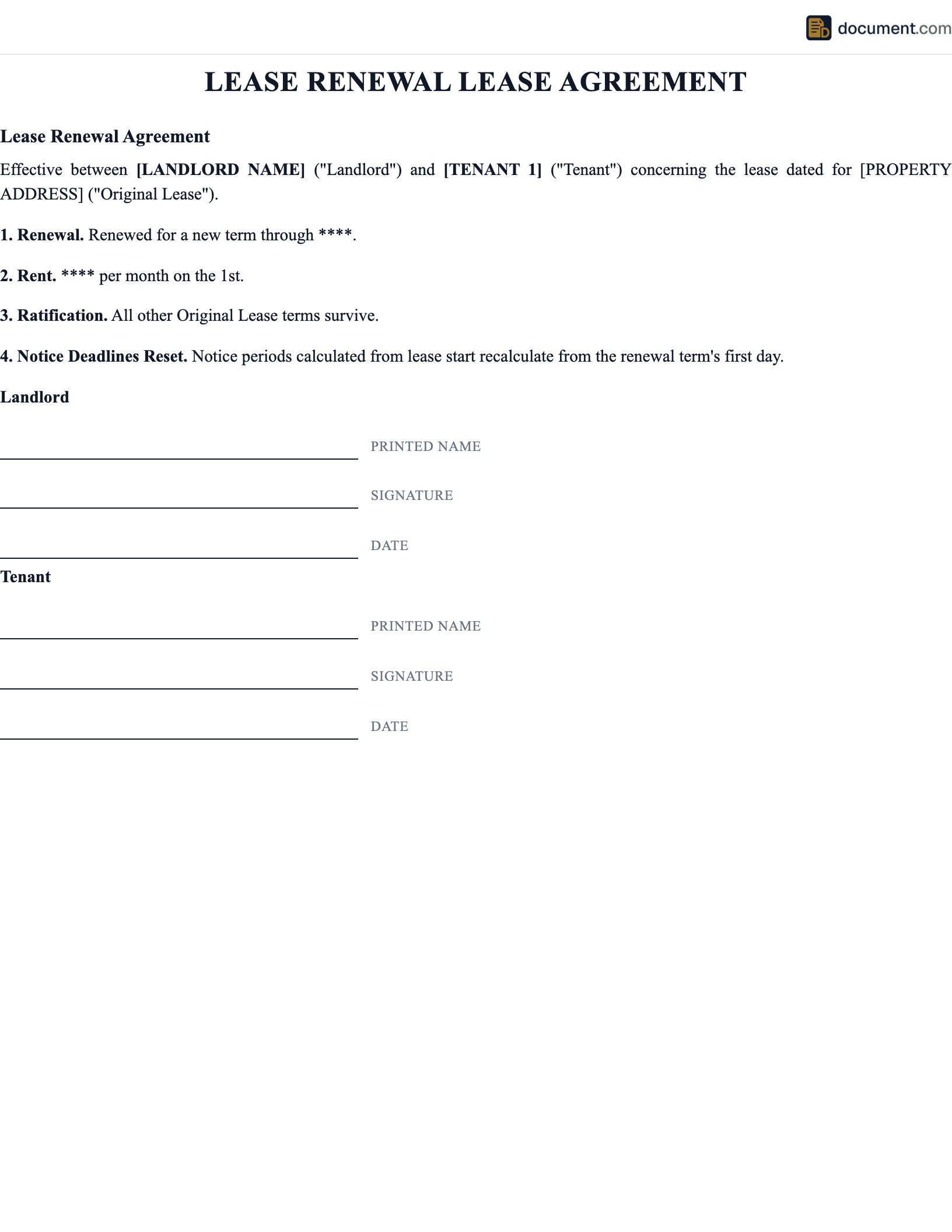



What Is a Lease Renewal?
A lease renewal is a written agreement that continues a residential or commercial tenancy for a new term after the original lease expires. The renewal creates fresh rights and obligations: a new start date, a new or updated rent, potentially new addendums, and a new end date. Unlike an extension, which keeps the original lease in force and only moves the end date, a renewal is typically drafted as a new integrated contract that incorporates or supersedes the prior lease. The renewal also resets the integration clause under Restatement (Second) of Contracts § 213, displacing any prior oral or written modifications and binding the parties to the four corners of the new instrument.
Three default rules govern when neither party acts at expiration. The lease may contain an express auto- renewal clause that converts the tenancy to a new fixed term or month-to-month at expiration unless notice is given (Connecticut Gen. Stat. § 47a-15a and Wisconsin Stat. § 704.15 require conspicuous formatting for residential auto-renewal). Where the lease is silent, holdover-to-month-to-month is the default in most states under URLTA § 4.301, Cal. Civ. Code § 1945, and N.Y. RPL § 232-c when the tenant remains in possession and the landlord accepts rent. Where the landlord refuses rent and serves a notice to quit, the tenancy ends and the tenant becomes a trespasser subject to summary eviction.
State law heavily regulates renewals in tenant-protective jurisdictions. California's AB 1482 (Civ. Code §§ 1946.2 and 1947.12) imposes statewide just-cause non-renewal on tenancies of 12 months or longer and caps annual rent increases at 5 percent plus CPI (maximum 10 percent). Oregon's SB 608 (ORS 90.323 and 90.427) caps increases at 7 percent plus CPI and requires just cause for termination after one year. New York's HSTPA 2019 amendments to GBL § 226-c require 30, 60, or 90 days' notice depending on tenancy length, and rent-stabilized apartments carry a statutory right to renewal under DHCR Form RTP-8.
Holdover at expiration: month-to-month or trespass
Holdover doctrine determines what happens when a tenant remains in possession after the lease ends. URLTA § 4.301 and most state landlord-tenant statutes recognize three possibilities. Holdover-to-month-to- month: the tenant remains, the landlord accepts rent, and the tenancy converts to month-to-month on the prior terms; either party may terminate on the standard state notice (30 days in most states, 60 days in California for tenancies over one year, 90 days in Oregon after the first year). Tenancy at sufferance: the landlord refuses to accept rent and serves a three-day or other statutory notice; the tenant becomes a trespasser subject to summary eviction. Holdover damages: many states permit double rent or per-diem damages during the holdover (California Civ. Code § 1949 imposes double rent for willful holdover).
Notice deadlines and rent-cap statutes by state
Notice deadlines and rent caps vary by jurisdiction. California AB 1482 caps annual increases at 5 percent plus regional CPI to a maximum of 10 percent and requires 30 days' notice (under one year) or 60 days (one year or more) for non-renewal. Oregon SB 608 caps increases at 7 percent plus CPI and requires 90 days' notice with just cause after one year. New York HSTPA 2019 imposes 30/60/90-day notice depending on tenancy length. Texas Property Code § 91.001 requires 30 days' default notice for any periodic tenancy. Florida Stat. § 83.57 requires 60 days for annual tenancies. Local rent-control ordinances in San Francisco, Los Angeles, Santa Monica, Berkeley, and Washington D.C. impose stricter caps and just-cause rules.
Types of Renewal
The right renewal depends on whether you are continuing for a new fixed term, rolling to month-to-month, or ending the tenancy.
Fixed-Term Renewal
Renew for a new fixed term (usually 12 months).
Month-to-Month Conversion
Convert an expiring lease into a month-to-month tenancy.
Lease Extension Addendum
Short extension without rewriting the lease.
Rent Increase at Renewal
Renewal with a rent increase subject to state caps.
Non-Renewal Notice
End the tenancy at the natural expiration date.
Automatic Renewal and Holdover
If neither party acts before expiration, one of three default rules applies:
- Auto-renewal clause: The lease expressly renews for a new fixed term or month-to-month unless notice is given. Some states (Connecticut, Wisconsin) require express highlighting of this clause.
- Holdover to month-to-month: Default in most states. Tenant remains and pays rent; landlord accepts. Tenancy converts to month-to-month on the same terms (URLTA §4.301, CA Civil Code §1945).
- Tenancy at sufferance: Landlord refuses to accept rent and treats the holdover as a trespass. Eviction action must follow; no new tenancy is created.
State Notice Periods
These are the most common statutory notice periods for non-renewal or renewal offer. Always verify against current local law.
| State | Statute | Notice Period |
|---|---|---|
| California | Civ. Code §1946.1 | 30 days < 1 year; 60 days ≥ 1 year |
| New York | GBL §226-c | 30 / 60 / 90 days by length |
| Oregon | ORS 90.427 | 90 days after first year |
| Texas | Prop. Code §91.001 | 30 days (default) |
| Florida | §83.57 | 60 days (annual tenancy) |
Just-Cause Jurisdictions
In just-cause jurisdictions, a landlord cannot refuse to renew an eligible tenancy except for one of the enumerated causes. This applies to:
- California statewide (AB 1482): Most residential tenancies after 12 months under Civil Code §1946.2.
- New York (HSTPA 2019): Rent-stabilized apartments; renewal is mandatory on substantially the same terms.
- Oregon statewide (SB 608): Tenancies over one year require just cause for termination under ORS 90.427.
- Washington D.C.: Rent-controlled and rent-stabilized under D.C. Code §42-3505.01.
- New Jersey: Anti-Eviction Act N.J.S.A. 2A:18-61.1, a broadly applicable good-cause statute.
How to Renew a Lease
Check the notice deadline
Calculate the correct state-law notice deadline for non-renewal; landlords miss this often.
Confirm just-cause status
Is the property covered by AB 1482, SB 608, or a local rent-control ordinance? Exemption notices must be served if applicable.
Calculate the allowed rent
In rent-controlled jurisdictions, verify the current allowable increase (CPI-linked). In California, cap is 5% + CPI (max 10%).
Draft the renewal document
Use the template to incorporate the prior lease, state the new term and rent, and update any addendums.
Deliver per statute
Personal delivery with witness, followed by certified mail, is the safest combination in every state.
Get signatures
Both parties sign. Tenant signature is not required for non-renewal, but is required if the renewal changes any material term.
Frequently Asked Questions
Questions about renewal, non-renewal notice, holdover, and rent increases.
Official Resources
CA DRE AB 1482 Tenant Protections
California Tenant Protection Act covering just cause and rent cap
NYS DHCR Rent Regulation
New York rent-stabilized renewal rules and RTP-8 form
Oregon SB 608 Renter Protections
Oregon 7% + CPI cap and 90-day just-cause rules
HUD Renters' Rights by State
State-by-state renewal and tenant-rights summaries
Renew your lease in under 8 minutes.
Pick the renewal type, answer a few questions, and download a renewal keyed to your state's rent caps and just-cause rules.