
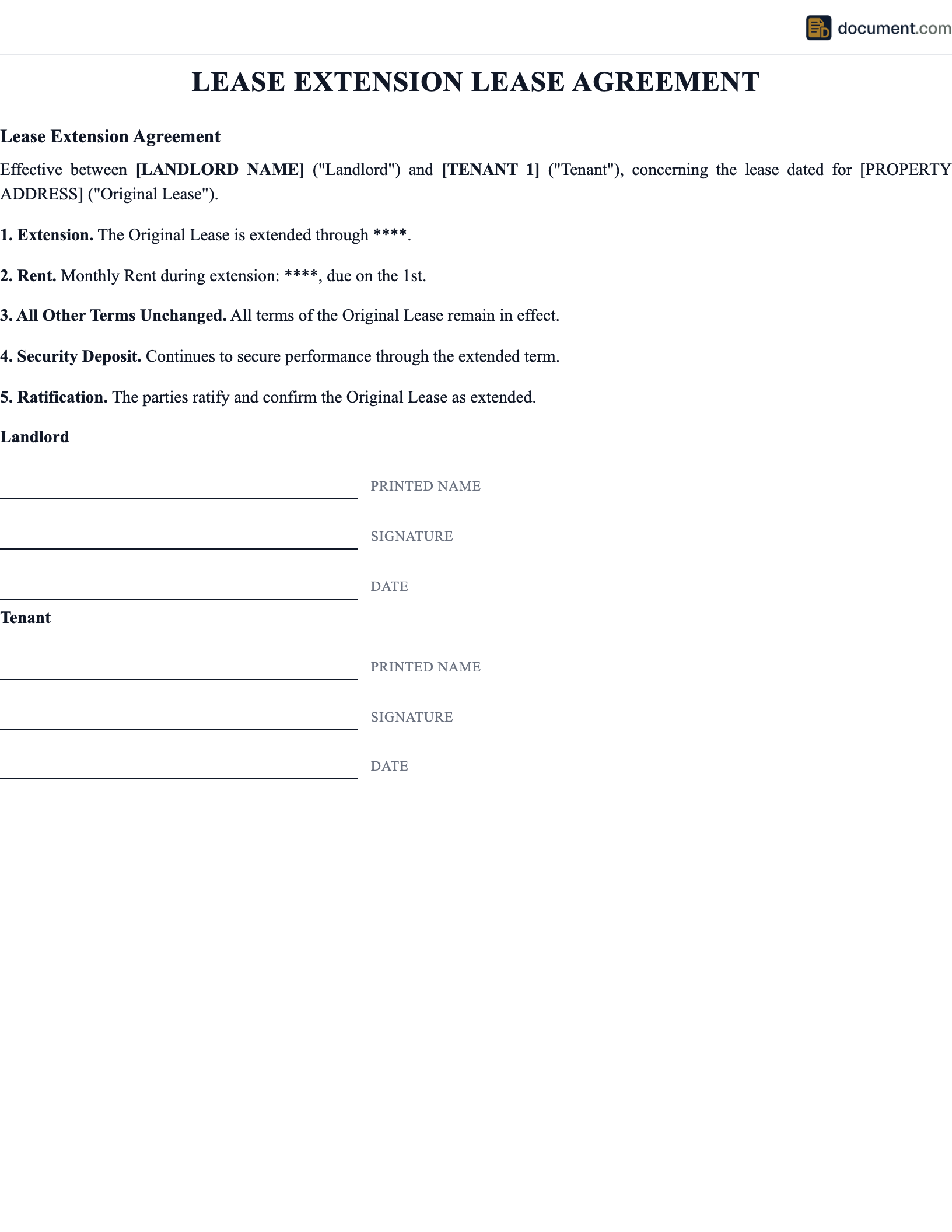



What Is a Lease Extension Addendum?
A lease extension addendum is a supplemental document that moves the end date of an existing lease forward without creating a new lease. The document identifies the parties, references the original lease by date, address, and execution version, states the new end date, confirms any rent change for the extension period (subject to applicable rent-cap law), and adds the standard survival clause: 'All other terms of the Lease remain in full force and effect.' Both landlord and all tenants sign. Extensions are the cleanest mechanism for short continuations of 1 to 3 months because they preserve the full integration clause of the original agreement, including every addendum, the security deposit, the disclosure acknowledgments, and the renewal-option language. The Statute of Frauds (Cal. Civ. Code §1624, NY GOL §5-703, Tex. Bus. & Com. Code §26.01, Mass. G.L. c. 259 §1) requires the extension to be in writing for any tenancy longer than one year.
Extensions are functionally and legally distinct from renewals. A renewal creates a new lease term with its own rent schedule, its own addendums, and its own effective date; the original lease becomes a referenced predecessor. An extension keeps the original lease in force and just changes the end date. For a bridge of 1 to 3 months (waiting for a new apartment to become available, closing on a home purchase, completing a remodel, finishing a school year), the extension is almost always the right tool. For an annual continuation with material changes to rent or terms, the renewal is the right tool. The wrong choice creates ambiguity about which addendums apply, what rent is owed, and when notice obligations reset.
The extension also defeats the holdover tenancy default rule in URLTA §4.301 and most state landlord-tenant statutes. Without an extension, a tenant who remains in possession past the lease end date and pays rent the landlord accepts creates an implied month-to-month tenancy on the same terms as the expired lease. The implied month-to-month is less secure for both parties: the landlord can terminate on 30 to 90 days of notice depending on state, and the tenant can terminate on 30 days. A signed extension converts what would otherwise be a holdover into a defined fixed-term continuation, preserving the security and predictability of the original lease.
Extension versus renewal in detail
The functional difference comes down to scope. A renewal restates the parties' bargain in a new document, often with updated rent, updated addendums, and updated disclosure forms. The renewal is the better vehicle when (1) the rent is changing materially, (2) the parties want to update or remove addendums, (3) the extension is for 12 months or longer, (4) state law requires fresh disclosures (California's AB 1482 exemption notice requires renewal under §1947.12(d)(5)(B); New York DHCR requires a renewal offer for stabilized units under 9 NYCRR §2523.5; lead-paint disclosure under 42 U.S.C. §4852d does not retrigger on extension but does on renewal of certain federally funded units), or (5) the parties want to reset just-cause clocks. The extension is the better vehicle for short bridges where the parties want continuity rather than renegotiation, and where the original lease's framework is doing what both parties need.
Holdover prevention as the core legal function
The single most valuable function of the extension addendum is preventing holdover tenancy from arising by default. URLTA §4.301 provides that a tenant who continues in possession after lease expiration with the landlord's consent (typically inferred from rent acceptance) becomes a tenant at sufferance, then a periodic tenant on the same terms as the expired lease. Cal. Civ. Code §1945 codifies the same rule. NY RPL §232-c codifies the New York version. The result is a month-to-month tenancy with weakened landlord remedies (no ability to enforce the expired fixed term's restrictions, no ability to enforce any escalation provisions, no ability to enforce the renewal-option mechanics) and weakened tenant remedies (no security in the unit beyond 30 days). Extension converts this default outcome into a defined fixed term with the original lease's full force.
Extension vs. Renewal
| Feature | Extension | Renewal |
|---|---|---|
| Scope | Moves end date forward | Creates a new term |
| Typical length | 1 to 3 months | 12 months |
| Original terms | All survive | May be updated |
| Best for | Bridges and short gaps | Annual continuation |
| Disclosures | Carry forward | May retrigger |
| Just-cause clock | Continues | May reset |
Avoiding Holdover Tenancy
If the tenant stays past the lease end date without a signed extension, URLTA §4.301 and most state statutes (Cal. Civ. Code §1945, NY RPL §232-c, Tex. Prop. Code §91.001(b), Wash. RCW 59.18.220, Fla. Stat. §83.59) convert the tenancy into a month-to-month holdover on the same terms as the expired lease. Holdover is less secure for both parties. The landlord can end it with 30 days' notice in most states and 60 days in California for tenancies over a year (Cal. Civ. Code §1946.1(b)). Oregon requires 90 days under ORS 90.427(4). The tenant can end it with 30 days' notice. Renewal options, escalation provisions, and renewal mechanics in the original lease may not survive into the holdover. A signed extension before expiration prevents this ambiguity entirely. Signed after expiration, an extension can retroactively convert the holdover into a fixed term if both parties consent and consideration is documented.
Rent-Increase Constraints at Extension
Extensions must respect the same rent-cap rules as renewals. The cap formula applies regardless of whether the rent change is in a renewal, an extension, or a mid-term addendum. Tenant consent does not waive the cap because most rent-control statutes are unwaivable as a matter of public policy.
- California AB 1482 (Civ. Code §1947.12): 5% plus regional CPI per 12-month period, maximum 10%.
- Oregon SB 608 (ORS 90.324): 7% plus West-region CPI for the calendar year (10.3% for 2026).
- Washington HB 1217 (RCW 59.18.650): 7% plus CPI, capped at 10%, effective May 2025 for covered units.
- NYC, San Francisco, Berkeley, Santa Monica, D.C.: Annual rent-board formula (RGB orders, 60% of CPI, AGA, Charter Amendment XVIII, CPI plus 2%).
- Notice statutes: Cal. Civ. Code §827 requires 30 days for increases under 10%, 60 days for 10% or more. NY RPL §226-c, ORS 90.323, Tex. Prop. Code §91.001 apply by tenancy length.
Notice Periods
Extension offers should be made at least 30 days before the current end date in most states, and further in advance in rent-stabilized or just-cause jurisdictions. Missing the notice window can force a holdover or trigger a statutory renewal obligation that limits the landlord's ability to refuse continuation.
- California: 30 days for tenancies under one year, 60 days for tenancies over one year (Cal. Civ. Code §1946.1).
- New York rent-stabilized: Renewal offer required 90 to 150 days before expiration (9 NYCRR §2523.5); extensions must fit within window.
- Oregon: 90-day just-cause notice for non-renewal after first year (ORS 90.427).
- Washington: 60 days for non-renewal under RCW 59.18.650 (just-cause covered units).
- Massachusetts: One full rental period (typically 30 days) under G.L. c. 186 §12.
- Texas, Florida, Georgia, Tennessee: No statutory renewal offer required; contract terms control.
Mutual Consent Requirement
An extension binds only those who sign. All tenants, co-tenants, and guarantors whose obligations carry forward must sign to preserve the joint-and-several allocation in the original lease. If one co-tenant refuses to sign, the extension is unenforceable as to that co-tenant, and the joint-and-several allocation typically breaks. The remaining co-tenants become individually liable for the full extended-term rent without the protection of joint-and-several recovery from the non-signing party. Oral extensions are unenforceable in every state under the Statute of Frauds for any tenancy longer than one year (Cal. Civ. Code §1624, NY GOL §5-703, Tex. Bus. & Com. Code §26.01). Even for tenancies under one year, written extensions are strongly preferred for evidentiary clarity. Always put extensions in writing and have everyone sign before the original term ends.
How to Use This Addendum
Identify the lease
Reference by date, property address, all parties, and the lease execution version. State that the addendum is incorporated into the original lease.
State the new end date
Single sentence: 'The end date of the Lease is extended from [date] to [date].' Include both the calendar date and the day of the week to defeat ambiguity.
Confirm rent
Either keep the current rent (preferred for short bridges) or schedule an increase consistent with the applicable rent-cap law (Cal. Civ. Code §1947.12, ORS 90.324, RCW 59.18.650, local ordinance).
Preserve all other terms
Add the standard 'All other terms of the Lease remain in full force and effect' clause. Confirm all addendums (pet, bed bug, lead paint, smoking) carry forward.
Address guarantor consent
If guarantors are on the original lease, include express guarantor reaffirmation language to preserve the guaranty under common-law surety principles.
Sign and date
Every tenant, co-tenant, guarantor, and the landlord signs. Missing signatures break the extension as to that party. File with the property manager and retain a copy.
Frequently Asked Questions
Questions about extensions, holdovers, rent caps, and signature requirements.
Official Resources
Extend your lease in under 7 minutes.
Pick your state, answer a few questions, and download an extension that preserves your existing terms and respects state rent caps.