



What Is a Month-to-Month Lease Agreement?
A month-to-month lease agreement (also called a periodic tenancy or rental agreement) is a residential lease that automatically renews at the end of each month until either the landlord or tenant provides written notice to terminate. Unlike a fixed-term lease that locks both parties into a set period (typically 6 or 12 months), a month-to-month arrangement offers maximum flexibility.
Month-to-month leases are governed by your state's landlord-tenant statutes, which dictate the required notice period for termination, rules about rent increases, security deposit limits, and tenant protections. While the flexibility benefits both parties, it also means either side can end the arrangement with relatively short notice — making it essential to understand your state's specific requirements.
A month-to-month tenancy can be created intentionally from the start, or it can arise automatically when a fixed-term lease expires and the tenant continues to pay rent with the landlord's acceptance. In either case, all terms of the agreement remain enforceable, and both parties retain their rights under state law.
Automatic Renewal
Renews each month without additional paperwork or signatures
Flexible Termination
Either party can end the lease with proper written notice
State-Compliant
Templates include your state's required notice periods and protections
Month-to-Month Lease Agreement by State
Each state has different notice requirements, rent increase rules, and tenant protections for month-to-month leases. Select your state below for a template that complies with your state's landlord-tenant laws.
How Month-to-Month Leases Work
A month-to-month lease follows a predictable cycle: the lease begins, rent is paid monthly, and the agreement automatically renews until one party provides proper notice. Here's what you need to know about the process.
Sign the Agreement
Both landlord and tenant sign the month-to-month lease agreement, which establishes the rent amount, payment due date, security deposit, house rules, maintenance responsibilities, and notice requirements. Unlike a fixed-term lease, there is no set end date — the lease simply states it renews monthly.
Automatic Monthly Renewal
Each month, the lease automatically renews under the same terms. No new signatures or paperwork are needed. The tenant pays rent on the agreed date, and the landlord maintains the property. This continues indefinitely until either party decides to make a change or terminate.
Modifications with Notice
Either party can propose changes to the lease terms (such as a rent increase or new pet policy) by providing written notice before the next renewal period. The required notice period varies by state, typically 30 days. If both parties agree to changes, they take effect at the start of the next month.
Termination with Notice
When either party wants to end the tenancy, they must provide written notice within the timeframe required by state law (usually 30 days before the next rent due date). The tenant moves out by the specified date, the landlord conducts a move-out inspection, and the security deposit is returned minus any lawful deductions within the state-mandated timeframe.
Key Components of a Month-to-Month Lease
A well-drafted month-to-month lease should include all the standard lease provisions plus specific clauses addressing the periodic nature of the tenancy.
| Component | Description |
|---|---|
| Parties & Property | Full names of landlord and tenant, property address, and unit number |
| Lease Term | Statement that the lease is month-to-month with automatic renewal |
| Rent Amount & Due Date | Monthly rent, due date, acceptable payment methods, and grace period |
| Security Deposit | Deposit amount, holding requirements, and return timeline per state law |
| Notice to Terminate | Required notice period for either party to end the tenancy |
| Rent Increase Notice | How much notice the landlord must give before raising rent |
| Late Fees | Late payment penalties and grace period (subject to state limits) |
| Maintenance & Repairs | Responsibilities of landlord and tenant for property upkeep |
| House Rules | Pet policy, noise restrictions, parking, guest policy, and smoking rules |
Notice to Terminate Requirements
The most critical aspect of a month-to-month lease is the notice requirement for termination. State law dictates the minimum notice period, and your lease can require more notice but never less.
Important: Notice Must Be in Writing
In virtually every state, notice to terminate a month-to-month lease must be in writing and delivered to the other party. Verbal notice is generally not sufficient and may not be enforceable. Many states require the notice to be delivered a certain number of days before the start of the next rental period, not just any 30-day window.
- 30 Days: The most common requirement — applies in the majority of states including Texas, Florida, Illinois, and Pennsylvania
- 60 Days: Required in some states for longer tenancies — California requires 60 days for tenancies over one year (landlord notice), Oregon requires 60 days for landlords
- 15 Days: A few states like Montana allow shorter notice periods for month-to-month tenancies
- One Rental Period: Some states tie the notice to the rental period — if you pay monthly, one month's notice is required
Rent Increase Rules for Month-to-Month Leases
One significant consideration with month-to-month leases is that landlords can adjust rent more frequently than with fixed-term leases. However, state law imposes notice requirements and, in some jurisdictions, caps on increases.
Notice Required
Most states require 30 days' written notice before any rent increase takes effect
Rent Control Areas
Some cities cap annual increases (e.g., 3-10%) regardless of lease type
No Retaliation
Rent increases cannot be used to retaliate against tenants who exercise legal rights
Written Notice
All rent increases must be communicated in writing and properly delivered
Converting from a Fixed-Term Lease
Many month-to-month tenancies begin as fixed-term leases that have expired. Understanding how this conversion works is important for both landlords and tenants.
Lease Expires
The fixed-term lease reaches its end date without a renewal agreement
Tenant Stays & Pays Rent
The tenant continues occupying the property and the landlord accepts rent payment
Holdover Tenancy Created
In most states, this automatically creates a month-to-month tenancy under the original lease terms
State Law Applies
The month-to-month tenancy is now governed by state notice requirements for termination and rent changes
Benefits of Month-to-Month Flexibility
Month-to-month leases offer unique advantages for both landlords and tenants:
No Long-Term Commitment
Either party can end the tenancy with proper notice, typically 30 days
Ideal for Transitional Housing
Perfect for job relocations, temporary assignments, or housing searches
Easy Rent Adjustments
Landlords can adjust rent to market rates with proper written notice
Automatic Renewal
Lease renews each month without paperwork until either party gives notice
Quick Vacancy Recovery
Landlords can reclaim property faster than with fixed-term leases
Trial Period for Tenants
Test a neighborhood or property before committing to a longer lease
Seasonal Flexibility
Useful for snowbirds, students, or seasonal workers who need short-term housing
Simplified Paperwork
Less complex than a 12-month lease with fewer long-term obligations
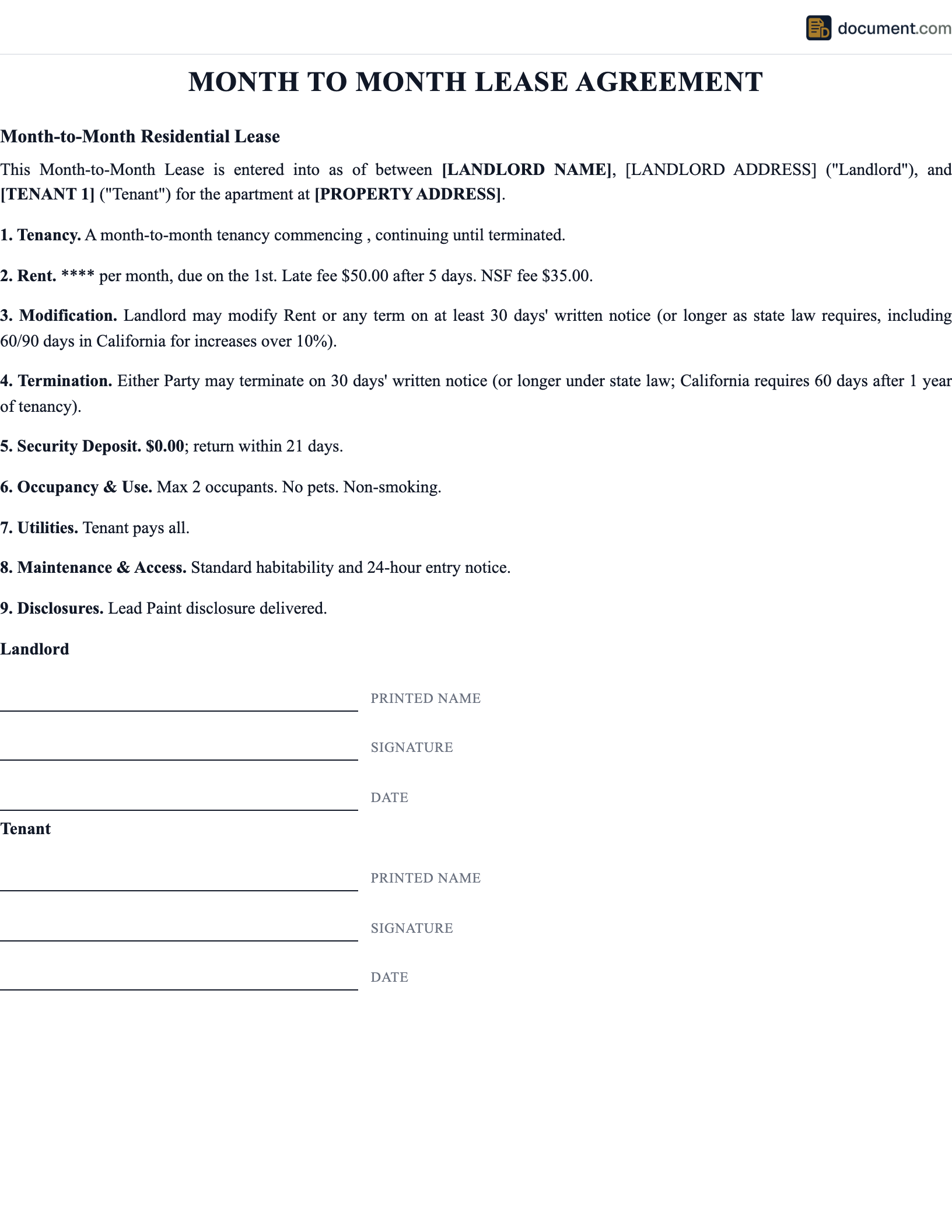
Sample Month-to-Month Lease Agreement
Below is a preview of our month-to-month lease agreement template. Your customized document will include all clauses required by your state's landlord-tenant laws.
MONTH-TO-MONTH LEASE AGREEMENT
Residential Rental Agreement — Periodic Tenancy
This Month-to-Month Lease Agreement is entered into on[Date]between:
LANDLORD:
Name: [Landlord Name]
Address: [Landlord Address]
TENANT:
Name: [Tenant Name]
Address: [Rental Property Address]
1. LEASE TERM
This lease begins on [Start Date] and continues on a month-to-month basis, automatically renewing each month, until terminated by either party with [30]days' written notice.
2. MONTHLY RENT
$[Amount] per month, due on the [1st] of each month.
3. SECURITY DEPOSIT
$[Amount], to be returned within [Days] days after move-out.
Frequently Asked Questions
Find answers to common questions about month-to-month lease agreements, notice requirements, and tenant rights.
Create your Month To Month Lease Agreement in under 10 minutes.
Answer a few questions and download a compliant, attorney-drafted document ready for your state.