



What Is a Rental Application?
A rental application is the document a prospective tenant signs to authorize the landlord to verify identity, income, employment, and rental history, and to pull consumer reports for tenant-screening purposes. It is the foundational record on which the leasing decision rests and the document that, if mishandled, exposes the landlord to liability under three federal statutes: the Fair Housing Act (42 U.S.C. § 3601 et seq.), the Fair Credit Reporting Act (15 U.S.C. § 1681 et seq.), and the Equal Credit Opportunity Act where rent payments are reported as credit (15 U.S.C. § 1691).
The application is not a lease and creates no tenancy. It serves three legal functions. First, it is the FCRA written authorization required by 15 U.S.C. § 1681b(a)(2) before the landlord may obtain a credit or background report. Second, it is a sworn statement of facts the landlord may rely on in the underwriting decision; material misrepresentations are grounds for denial and, in most states, grounds for lease termination if discovered after move-in. Third, it documents the consistent, written screening criteria the landlord must apply uniformly across applicants to avoid disparate-treatment fair-housing claims.
Application fees are governed by state law and range from outright prohibition to capped amounts to no statutory limit. Massachusetts (M.G.L. c. 186 § 15B) prohibits any application fee. New York caps the fee at $20 (Real Property Law § 238-a). California caps it at the actual cost of the consumer report plus reasonable processing time, with a 2024 ceiling of $59.67 (Civil Code § 1950.6). Oregon caps at $10 or actual cost. Texas, Florida, Georgia, and most southern and midwestern states impose no cap. Where state law requires a refund if the landlord does not run the report or rents the unit before deciding, the obligation is self-executing and not waivable.
Application vs lease vs holding deposit
Three distinct documents appear in sequence. The rental application authorizes screening and records the applicant's representations; the application fee pays for the consumer reports and may not function as a holding deposit. A holding deposit (also called a reservation deposit) takes the unit off the market while the lease is finalized; California Civil Code § 1950.6(b) requires it to be refundable if the landlord does not lease, and many states treat retention as a forfeiture subject to actual-damages limits. The lease is the operative contract that creates the leasehold estate, addressed on our lease-agreement hub. Combining these into one payment or document is a frequent source of small-claims litigation.
Three federal statutes that constrain the application
Every rental application is governed by the Fair Housing Act, the Fair Credit Reporting Act, and HUD's interpretive guidance on criminal-history screening. The Fair Housing Act prohibits questions or screening criteria that elicit or proxy for race, color, national origin, religion, sex (now including sexual orientation and gender identity per HUD's February 2021 Bostock-implementation memorandum), familial status, or disability. The FCRA requires written authorization before pulling a consumer report (15 U.S.C. § 1681b(a)(2)), use of the report only for the stated permissible purpose (§ 1681b(f)), an adverse action notice on denial (§ 1681m), and proper disposal of the report after use (16 C.F.R. § 682). HUD's 2016 Office of General Counsel guidance on criminal records (reaffirmed April 2024) bars blanket bans and requires individualized assessment.
Tenant Screening
Evaluate creditworthiness, rental history, and reliability
Legal Compliance
Fair Housing Act and FCRA compliant screening process
Complete Documentation
All sections needed for thorough applicant evaluation
Tenant Screening Criteria
The five screening categories below are standard. Each must be applied uniformly across applicants to defeat a fair-housing disparate-treatment claim, and each is constrained by FCRA procedures that apply to any consumer-report data the landlord obtains. Document the criteria in writing before reviewing applications and apply them in the same order to every applicant.
Credit report
The credit report from TransUnion, Experian, or Equifax shows FICO or VantageScore, payment history, outstanding balances, derogatory marks, and bankruptcies. Industry minimums cluster at 620 for market-rate units and 580 for working-class properties; luxury properties may require 700+. The FCRA requires the landlord to obtain written authorization before pulling the report (15 U.S.C. § 1681b(a)(2)), use the report only for the tenant-screening permissible purpose (§ 1681b(f)), and provide an adverse action notice on denial (§ 1681m). Bankruptcies stay on the report for 10 years (Chapter 7) or 7 years (Chapter 13); collections and most negative items drop off after 7 years under § 1681c.
Background and criminal history
Criminal-history screening must comply with HUD's 2016 OGC guidance on disparate impact (reaffirmed April 2024). Blanket bans are unlawful; individualized assessment of the nature and severity of the offense, time elapsed since conviction, and rehabilitation evidence is required. Arrests without conviction may not be considered. Look-back periods are capped by ordinance in growing list of jurisdictions: Cook County (3 years for misdemeanors, 7 for felonies after sentence completion under the Just Housing Amendment), Seattle Fair Chance Housing (no consideration of conviction history at all for most properties), Oakland (5 years), and California's 2024 SB 1018 amendments to Government Code § 12955. Sex-offender registry exclusions remain enforceable in most jurisdictions because they correspond to a specific safety interest.
Income verification
Industry standard requires gross monthly income of 2.5 to 3 times the monthly rent (a $2,000 unit requires $5,000 to $6,000 gross monthly income). Verification documents include the two most recent pay stubs, the prior year W-2 or full federal return for self-employed applicants (Schedule C, Form 1099-NEC), and 60 to 90 days of bank statements. Source-of-income protections in 22 states and over 100 localities prohibit refusing to consider Section 8 Housing Choice Vouchers, Social Security, SSDI, child support, alimony, or other lawful income sources. The voucher payment must be counted as income, and the rent the tenant contributes after the voucher is what the income test should apply to. New York State Human Rights Law § 296(5), California Government Code § 12955(a)(d) (effective January 2020), Massachusetts G.L. c. 151B § 4(10), and Washington RCW 59.18.255 are leading examples.
Rental history and eviction records
Prior-landlord verification confirms on-time payment, lease compliance, property condition at move-out, and whether eviction was filed (regardless of outcome). Eviction records appear on tenant-screening reports through services like RentBureau, CoreLogic, and SafeRent Solutions. Several states limit consideration of evictions: California Code of Civil Procedure § 1161.2 makes most eviction filings confidential unless the landlord prevails within 60 days (effectively shielding dismissed and tenant-prevailing cases); Oregon ORS 105.163 caps consideration at 5 years; Washington RCW 59.18.367 imposes the same cap; Connecticut bars consideration of cases dismissed in favor of the tenant. The CFPB and FTC have brought enforcement actions against tenant-screening services that report stale or inaccurate eviction data (TransUnion Rental Screening Solutions, 2023).
Personal and professional references
References supplement objective screening data and are most useful for applicants with limited credit or rental history (recent graduates, immigrants establishing US credit, those relocating from countries without standardized credit reporting). Two professional references (current employer plus one other professional contact) and one prior-landlord reference are typical. Reference checks must be conducted uniformly. Asking only minority applicants for additional references is disparate treatment; rejecting an applicant because the reference sounded foreign-accented or expressed a religious affiliation is direct evidence of FHA violation. Document each reference call with date, time, person spoken to, and substance of the conversation in the screening file.
How to Fill Out a Rental Application
Eight working sections, completed in this order. Each adult occupant who will be on the lease signs a separate application. Co-signers and guarantors complete a separate guaranty application with their own credit authorization. Misrepresentation in any section is grounds for denial and, in most states, grounds for eviction if discovered after move-in.
Adverse action notice requirements
When the landlord denies the application, charges higher rent or deposit, or imposes any other adverse term in whole or in part because of information in a consumer report, FCRA Section 615 (15 U.S.C. § 1681m) requires a written adverse action notice containing four elements: the name, address, and toll-free phone number of the consumer reporting agency that supplied the report; a statement that the CRA did not make the decision and cannot explain it; notice of the right to a free copy of the report from the CRA within 60 days; and notice of the right to dispute inaccurate or incomplete information. The notice is required even if the report was only one factor and even if the landlord verbally explained the decision. Failure triggers statutory damages of $100 to $1,000 per violation plus attorney fees.
Provide identifying information
Full legal name as it appears on government-issued ID, date of birth, SSN or ITIN, current phone, email, and current residential address. Use of an ITIN in place of an SSN is permitted under HUD guidance and most state laws; refusal to consider applicants without an SSN can constitute national-origin discrimination. Each adult who will occupy the unit completes a separate application; spouses are not exempted by marital status. The SSN supports the credit pull through the consumer reporting agency's identity-verification protocol and must be transmitted and stored securely (encryption in transit and at rest, access controls, FCRA Disposal Rule compliance under 16 C.F.R. § 682).
List rental history
Three years of prior addresses (five for executive or HUD-assisted housing), with prior landlord name and direct phone, monthly rent, exact tenancy dates, and reason for leaving. Eviction filings appear on the tenant-screening report regardless of outcome and should be disclosed proactively with context (the case was dismissed, judgment was vacated, the filing was retaliatory and the tenant prevailed). Several states cap consideration of evictions: California Code of Civil Procedure § 1161.2 (most filings sealed unless landlord wins within 60 days), Oregon and Washington (5-year cap), Connecticut (no consideration of tenant-prevailing cases). Disclosing a sealed or expunged eviction is not a misrepresentation to omit.
Enter employment and income details
Current employer, position, length of employment, supervisor name and direct phone, and gross monthly income. List all lawful income sources: salary, hourly wages, self-employment income (Schedule C net plus add-back of depreciation per common underwriting practice), Section 8 Housing Choice Voucher payments, Social Security retirement and SSDI, child support and alimony, GI Bill housing allowance, unemployment compensation, regular trust distributions, and recurring investment income. Source-of-income protections in 22 states and many cities require the landlord to count voucher payments and other lawful income sources in the income test; refusal to do so is direct evidence of discrimination in those jurisdictions.
Add emergency contacts and references
One emergency contact (name, relationship, phone, address) and two to three references with direct phone and email. Mix of professional (current or former supervisor, business partner) and prior-landlord references gives the underwriter a balanced view. Notify references in advance so they expect the call. The application typically grants the landlord express written authorization to contact references; without it, contacting third parties may breach the applicant's reasonable expectation of privacy under state law.
Disclose pets, vehicles, and occupants
All pets (species, breed, weight, age) so the landlord can apply the pet policy and charge pet deposits or pet rent where state law allows. Service animals and emotional support animals are not pets under the Fair Housing Act and ADA; landlords cannot charge a pet deposit, pet rent, breed restriction, or weight limit for an assistance animal (HUD FHEO Notice 2020-01). The landlord may request reliable supporting documentation if the disability is not obvious. List all adult occupants and any planned minor occupants; failure to disclose occupants is a frequent ground for lease termination. Vehicles parked at the property (make, model, year, license plate) should be listed where parking is assigned or limited.
Sign the FCRA authorization
The FCRA written authorization required by 15 U.S.C. § 1681b(a)(2) must be conspicuous and separately signed (or a clearly delineated section of the application). It should identify the consumer reports the landlord will obtain (credit, criminal background, eviction history, sex-offender registry where lawful), identify the consumer reporting agency, state the permissible purpose (tenant-screening decision), state the period for which authorization is valid, and inform the applicant of the right to receive a copy of the report on request. Several states layer on additional requirements: California Civil Code § 1786.16 requires a separate disclosure for investigative consumer reports; Massachusetts G.L. c. 93 § 50 et seq. restricts use of certain criminal-history data.
Pay the application fee
Fees are capped or prohibited by state. Massachusetts (M.G.L. c. 186 § 15B) prohibits any application fee. New York caps at $20 (Real Property Law § 238-a). California caps at the actual cost of the consumer report plus reasonable processing time, ceiling $59.67 for 2024 (Civil Code § 1950.6, indexed annually). Oregon caps at $10 or actual cost. Washington requires the landlord to provide a copy of the screening report on request and refund the fee if no report is obtained (RCW 59.18.257). Texas, Florida, Georgia, Nevada, and most other states impose no statutory cap; the fee must be reasonable and tied to actual cost. Landlord may not retain the fee while never running the screening.
Submit supporting documents
Government-issued photo ID (driver's license, state ID, passport, or military ID; the Real ID Act of 2005 is fully effective May 7, 2025 for federal identification but does not change tenant-screening practice). Two most recent pay stubs and the prior year W-2 or full federal return for self-employed applicants. Bank statements for 60 to 90 days where requested. Voucher paperwork (HUD-50058 family report or RFTA from the housing authority) where Section 8 applies. Reference contact information consolidated on a single sheet reduces back-and-forth. Documents transmitted electronically should be sent through a secure portal, not unencrypted email.
Key Components of a Rental Application
Six required sections plus supporting documentation. Each adult occupant submits a separate application; co-signers complete a separate guaranty application that includes their own credit authorization. Missing the FCRA authorization is the single most common defect and renders any consumer-report pull unlawful under 15 U.S.C. § 1681n.
| Component | Description |
|---|---|
| Personal Information | Full name, date of birth, SSN, phone, email, current address, government ID |
| Employment Details | Employer name, position, length of employment, supervisor contact, gross income |
| Income Verification | Monthly gross income from all sources, pay stubs, tax returns, bank statements |
| Rental History | Previous addresses, landlord contacts, rent amounts, dates, reason for leaving |
| References | Personal and professional references with contact information |
| Authorization & Consent | Credit check consent, background check authorization, FCRA disclosure, signature |
Legal Requirements for Rental Applications
Three federal statutes set the floor and roughly two dozen states layer additional protections on top. The application that ignores any layer exposes the landlord to administrative enforcement (HUD, FTC, state attorney general), private actions for statutory damages and attorney fees, and in some jurisdictions criminal liability for repeated violations.
Fair Housing Act (42 U.S.C. § 3601 et seq.)
Section 3604 prohibits refusing to rent, imposing different terms, or making any statement indicating preference based on race, color, religion, sex (including sexual orientation and gender identity per HUD's February 2021 Bostock-implementation memorandum), national origin, familial status (presence of children under 18, pregnancy), or disability. Disparate treatment requires only proof of differential treatment; disparate impact requires proof that a facially neutral policy has discriminatory effect under the three-step test in 24 C.F.R. § 100.500. Penalties under § 3612 include actual damages, punitive damages, attorney fees, and civil penalties up to $25,597 for a first violation (2024 inflation-adjusted under 24 C.F.R. § 180.671).
FCRA tenant-screening compliance
The Fair Credit Reporting Act (15 U.S.C. § 1681 et seq.) governs every consumer report used for tenant-screening. Five obligations apply to the landlord acting as a user of consumer reports:
- Permissible purpose certification: The landlord must certify to the consumer reporting agency the permissible purpose for the report (15 U.S.C. § 1681b(f)). Tenant-screening qualifies under § 1681b(a)(3)(F) as a legitimate business need in connection with a business transaction initiated by the consumer.
- Written authorization: Required by § 1681b(a)(2) before pulling the report. Must be conspicuous, separately signed, and identify the report types and purpose. California Civil Code § 1786.16 requires a separate document for investigative consumer reports.
- Adverse action notice (15 U.S.C. § 1681m): On any denial or adverse term based in whole or in part on the report, written notice with CRA name/address/toll-free phone, statement that CRA did not make the decision, right to free copy within 60 days, right to dispute. Required even if report was one factor of many.
- Risk-based pricing notice (12 C.F.R. § 1022.70 et seq.): If the landlord charges higher rent or larger deposit because of the credit score, a risk-based pricing notice with the score and key factors must be provided, separate from the adverse action notice.
- Disposal Rule (16 C.F.R. § 682): Consumer reports must be disposed of by shredding, burning, pulverizing, or secure electronic deletion. Storage during the active tenancy and the limitations period (typically 5 years) is permitted; indefinite retention is not.
Statutory damages under § 1681n run from $100 to $1,000 per violation for willful noncompliance, plus actual damages and attorney fees. Negligent noncompliance under § 1681o supports actual damages and fees. The FTC, CFPB, and state attorneys general have all brought enforcement actions; recent cases have produced settlements in the $11-19 million range.
Application fee caps by state
- Outright prohibition: Massachusetts (M.G.L. c. 186 § 15B permits only first month, last month, security deposit, and lock fee; application fee is unlawful). Vermont (9 V.S.A. § 4456a, prohibits application fees over $10).
- Hard caps: California $59.67 for 2024 (Civil Code § 1950.6, indexed annually). New York $20 (RPL § 238-a). Oregon $10 or actual cost (ORS 90.295). Wisconsin $25 (Wis. Stat. § 704.085). Maine actual cost only with refund obligation (14 M.R.S. § 6038).
- Refund requirements: Washington (RCW 59.18.257, must provide screening report on request; must refund if no report obtained). Colorado (must refund unused portion). Connecticut (refund if landlord does not run report).
- No statutory cap: Texas, Florida, Georgia, Tennessee, Nevada, Arizona, North Carolina, South Carolina, most southern and midwestern states. Fee must be reasonable and tied to actual screening cost; punitive or discriminatory pricing is actionable.
Source-of-income discrimination and Section 8 voucher rules
- State protections: 22 states protect source of income, including Housing Choice Vouchers. New York (Human Rights Law § 296(5)), California (Government Code § 12955(a)(d), effective January 2020), Massachusetts (G.L. c. 151B § 4(10)), Washington (RCW 59.18.255), Oregon, Maryland, Minnesota, New Jersey, Connecticut, Vermont, Maine, Delaware, Illinois, Wisconsin (limited), Colorado, Nevada (Las Vegas only), Hawaii, North Dakota, Utah, District of Columbia.
- Local protections: Over 100 cities and counties including New York City, Chicago, Cook County, Philadelphia, Pittsburgh, Miami-Dade, San Francisco, Seattle, Portland, Austin (limited), Dallas (limited), Atlanta (HUD-funded properties).
- Voucher mechanics: Where source-of-income protection applies, the landlord must apply the income test to the tenant's portion only (typically 30 percent of adjusted income), not the gross rent. The voucher payment from the public housing authority counts as guaranteed income. Refusing to participate in HAP contract execution or to pass HQS inspection is the practical equivalent of refusal to rent and is actionable.
Criminal-history screening restrictions
- HUD framework: Blanket bans prohibited under 2016 OGC guidance, reaffirmed April 2024. Three-step disparate-impact analysis (discriminatory effect, substantial legitimate nondiscriminatory interest, less discriminatory alternative). Individualized assessment required.
- Strict ban-the-box jurisdictions: Cook County Just Housing Amendment (no inquiry until conditional offer; 3-year cap misdemeanors, 7-year cap felonies). Seattle Fair Chance Housing (no consideration of conviction history at all for most rentals). Oakland (no inquiry until conditional offer; 5-year look-back). Newark, Detroit, San Francisco, Berkeley, and growing list.
- State laws: California SB 1018 (2024 amendments to Government Code § 12955); New Jersey Fair Chance in Housing Act (2022); Washington Fair Chance Housing rules in Seattle and statewide pending; Illinois Human Rights Act amendments.
Rental Application by State
Each state has its own laws governing rental applications, tenant screening, application fees, and fair housing protections. Select your state below for a rental application template customized to your state's specific requirements.
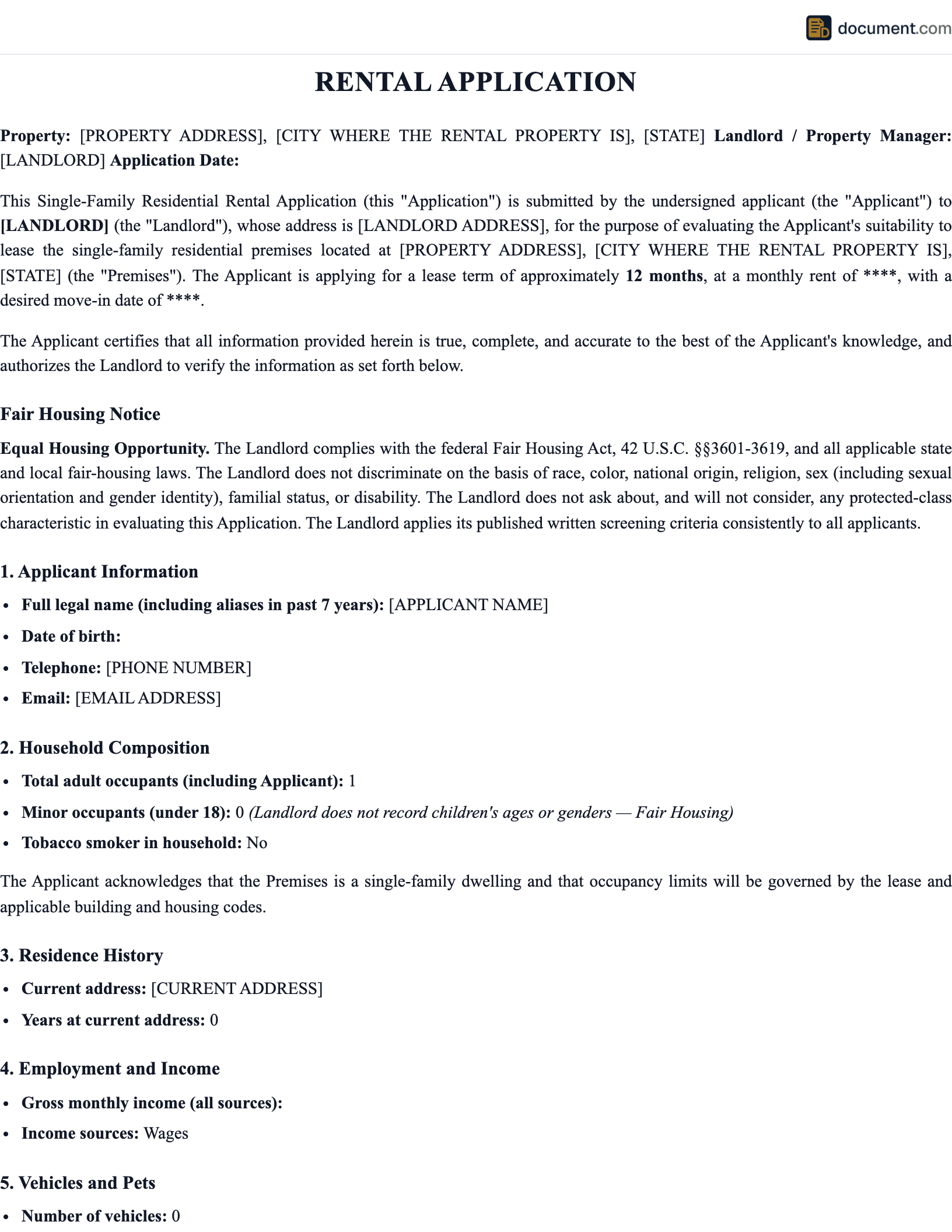
Sample Rental Application
Below is a preview of our rental application template. Your customized document will be tailored to your state's specific laws regarding application fees, screening restrictions, and fair housing protections.
RENTAL APPLICATION
Tenant Screening Form
Property Address: ______________________________
SECTION 1: APPLICANT INFORMATION
Full Name: [Legal Name]
Date of Birth: [DOB] SSN: [XXX-XX-XXXX]
Phone: [Phone] Email: [Email]
SECTION 2: RENTAL HISTORY
Current Address: [Address]
Landlord Name: [Name] Phone: [Phone]
Monthly Rent: $[Amount] Dates: [From - To]
SECTION 3: EMPLOYMENT & INCOME
Employer: [Company Name]
Position: [Title] Monthly Income: $[Amount]
AUTHORIZATION
I authorize the landlord to obtain my credit report, conduct a background check, and verify the information provided in this application...
Frequently Asked Questions
Find answers to common questions about rental applications, tenant screening, application fees, and your rights as an applicant or landlord.
Official Resources
Use these official federal resources to learn more about your rights and responsibilities regarding rental applications and tenant screening.
HUD Fair Housing & Equal Opportunity
Federal fair housing laws, complaints, and guidance
FTC — Fair Credit Reporting Act
FCRA full text, consumer rights, and landlord obligations
Consumer Financial Protection Bureau
Credit report disputes, consumer complaints, and financial guides
HUD Rental Assistance
Housing vouchers, rental assistance programs, and tenant resources
Create your Rental Application in under 10 minutes.
Answer a few questions and download a compliant, attorney-drafted document ready for your state.