
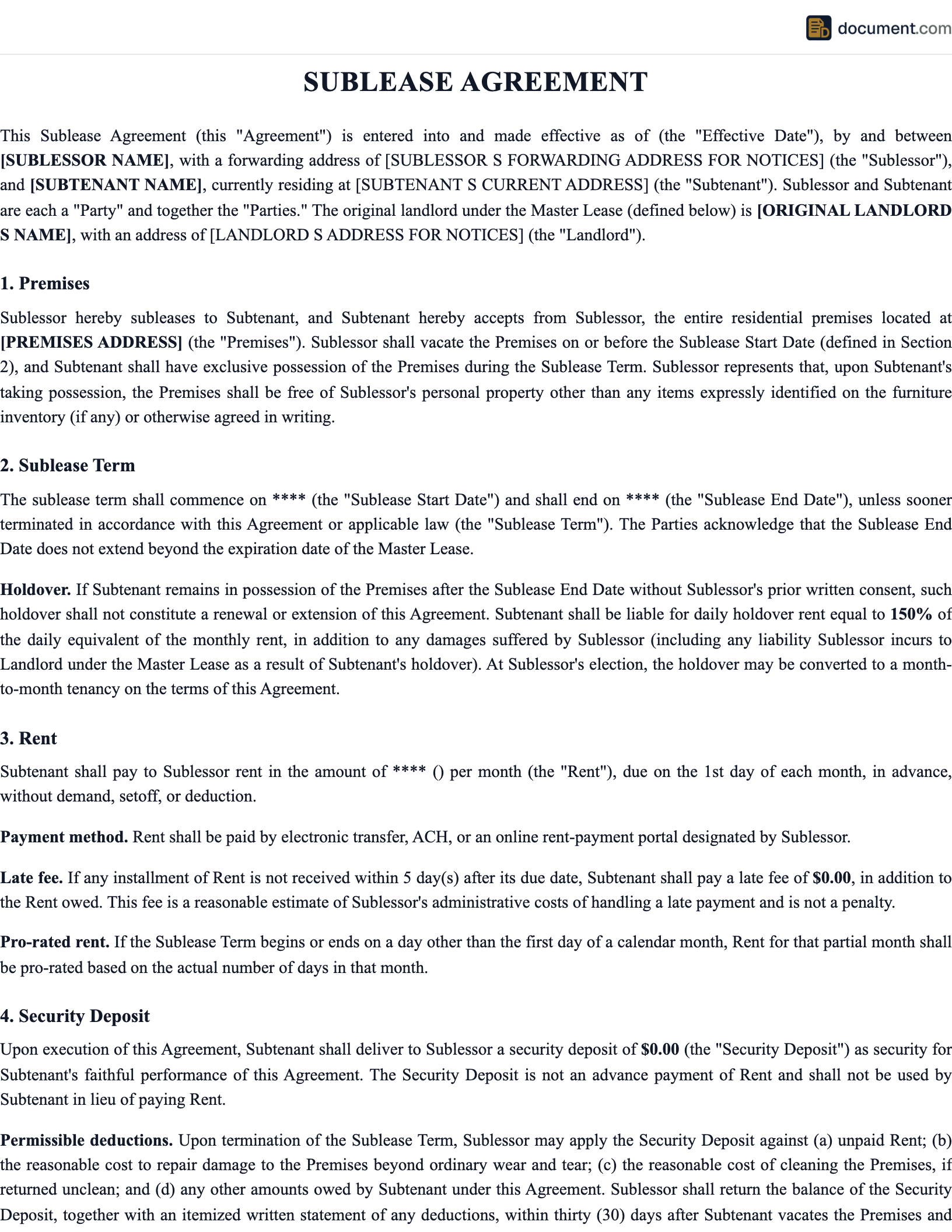



What Is a Sublease Agreement?
A sublease agreement is a legal contract that allows an existing tenant, called the sublessor or original tenant, to rent all or part of their leased property to a new occupant, called the sublessee or subtenant, for a portion of the remaining lease term. The sublease creates a secondary landlord-tenant relationship between the sublessor and sublessee, while the sublessor's original lease with the landlord remains in full force. This three-party structure, landlord, sublessor, sublessee, is what distinguishes a sublease from a standard lease or a lease assignment.
The critical point that every sublessor must understand is this: subletting does not release you from your original lease. You remain fully responsible to your landlord for rent, property damage, lease violations, and every other obligation under the original lease, regardless of what happens with your sublessee. If your sublessee fails to pay rent, you owe the landlord. If your sublessee damages the property, you are liable. If your sublessee violates a noise ordinance or lease term, the landlord comes after you. The sublease agreement gives you contractual recourse against the sublessee, but your primary obligation to the landlord does not change.
Subletting is common in a wide range of situations. Tenants sublet when they need to relocate temporarily for work or an internship, study abroad for a semester, undergo extended medical treatment, fulfill a military deployment, or simply need to reduce costs by bringing in someone to share rent. In some cases, a tenant sublets the entire unit because they want to preserve their lease (and its rental rate) while living elsewhere temporarily. In other cases, a tenant sublets a single room while continuing to occupy the rest of the unit.
A properly drafted sublease agreement protects all three parties in the triangle. It protects the sublessor by documenting the sublessee's obligations and providing legal recourse if those obligations are not met. It protects the sublessee by clearly defining the rental terms, duration, and conditions of the arrangement. And it protects the landlord by ensuring that someone is occupying and maintaining the property under documented terms while the original tenant is away.
Subletting Rights
Understand your legal right to sublet under your lease and state law before proceeding
Liability Protection
Clearly define who is responsible for rent, damages, utilities, and lease violations
Financial Terms
Document rent, security deposit, condition reports, and utility responsibilities
Sublease Agreement by State
Sublease rules and landlord-consent requirements vary by state, and some states give tenants a statutory right to sublet unless the lease clearly prohibits it. Select your state for a compliant sublease template.
Sublease Agreement Form Preview
Below is a visual preview of the sections and fields included in a standard sublease agreement form. This mockup illustrates the structure and level of detail our templates provide. Your completed document will be fully formatted, professionally styled, and customized for your specific sublease arrangement and state requirements.
Sublease Agreement
Residential Sublease Contract
Section 1: Parties to the Sublease
Sublessor (Original Tenant)
Sublessee (New Occupant)
Landlord / Property Owner
Section 2: Property & Sublease Term
Section 3: Financial Terms
Section 4: Signatures
Sublessor Signature
Sublessee Signature
When Subletting Is Allowed vs. Prohibited
Whether you can sublet your rental depends on three factors: your lease terms, your state's laws, and your landlord's consent. These three factors interact in ways that can be confusing, so understanding each one is essential before you begin the subletting process.
The lease: Most residential leases include a subletting clause. Some explicitly permit subletting with landlord approval. Some prohibit subletting entirely. And some are silent on the topic. If your lease prohibits subletting, you generally cannot sublet , but certain state laws may override this prohibition in specific circumstances. If your lease is silent, the default rule in most states allows subletting with landlord consent, though the landlord may reasonably withhold that consent.
State law: State laws on subletting vary considerably. Some states, like New York, give tenants a statutory right to sublet and prevent landlords from unreasonably refusing (for buildings with four or more units). California allows subletting unless the lease expressly prohibits it, and courts in California have sometimes found that blanket subletting prohibitions are unenforceable restraints on alienation. Other states take a more landlord-friendly approach and allow lease provisions to control completely.
Landlord consent:Even when subletting is permitted, most leases and state laws require the landlord's written consent before the sublease begins. The landlord may want to screen the proposed sublessee (credit check, references, background check), review the sublease terms, or impose conditions. In states where consent cannot be unreasonably withheld, the landlord must have a legitimate reason for refusal, such as poor credit, criminal history, or insufficient income, and cannot refuse simply because they do not want a subtenant.
Subletting Without Consent Can Have Serious Consequences
If your lease requires landlord consent and you sublease without obtaining it, you risk lease termination and eviction, both for you and your sublessee. The landlord may also hold you liable for any damages caused by the unauthorized subtenant. Even if your state restricts a landlord's ability to refuse consent, you must still go through the proper request process. Subletting first and asking for permission later is never the right approach.
Landlord Consent Requirements
Obtaining landlord consent is the most critical step in the subletting process. Even tenants who have a legal right to sublet must typically follow a formal consent process. The specific requirements depend on your lease and state law, but the general process is consistent across jurisdictions.
Review Your Lease
Read your lease's subletting clause carefully. Note whether subletting is permitted, prohibited, or requires consent. Look for any conditions, such as landlord screening rights, sublease term limits, or fees. If the lease is silent, check your state's default rules.
Submit a Written Request
Send your landlord a formal written request to sublet. Include the proposed sublessee's name, contact information, employment details, references, and the proposed sublease dates. In some states (such as New York), the landlord must respond within a specified timeframe (30 days) or consent is deemed granted.
Cooperate with Screening
The landlord may want to screen the proposed sublessee using the same criteria they apply to regular tenants: credit check, income verification, rental history, and background check. Facilitate this process by having the sublessee complete any applications the landlord requires.
Get Written Approval
Always obtain the landlord's consent in writing, a verbal "okay" is not sufficient. The written consent should specify the approved sublessee, the sublease dates, and any conditions. Attach the written consent to your sublease agreement as an exhibit.
Tip:Some landlords charge a subletting fee or require the sublessee to pay an additional security deposit. These fees must comply with state law, some states limit or prohibit subletting fees, while others allow reasonable administrative charges. Check your state's laws before agreeing to any fees.
Sublease vs. Lease Assignment
Tenants who need to leave a rental before the lease expires have two options: subletting or assigning the lease. These are fundamentally different legal mechanisms with different consequences for all parties. Understanding the distinction is critical for choosing the right approach for your situation.
| Feature | Sublease | Lease Assignment |
|---|---|---|
| Original Tenant's Liability | Remains fully responsible to landlord | Generally released from liability |
| Right to Return | Yes, sublessor can return after sublease ends | No, all rights transferred permanently |
| Duration | Temporary (portion of remaining lease) | Permanent (entire remaining lease) |
| New Occupant's Relationship | With sublessor (not landlord) | Directly with landlord |
| Rent Payment | Sublessee pays sublessor; sublessor pays landlord | Assignee pays landlord directly |
| Best For | Temporary absences with intent to return | Permanent departure with no intent to return |
When to choose a sublease: Use a sublease when you plan to return to the property after a temporary absence, such as studying abroad, completing an internship, or going on extended travel, and want to preserve your lease and your rental rate.
When to choose assignment: Use a lease assignment when you are leaving permanently and want to transfer all of your rights and obligations to a new tenant. An assignment releases you from liability (in most cases), but you give up all rights to the property.
Key Provisions of a Sublease Agreement
A comprehensive sublease agreement addresses every aspect of the subletting arrangement and protects all three parties, the sublessor, the sublessee, and the landlord. Below are the essential provisions every sublease agreement should include.
| Provision | Description |
|---|---|
| Parties Identified | Full names and contact information of sublessor, sublessee, and landlord |
| Original Lease Reference | Date, parties, and key terms of the original lease; copy attached as exhibit |
| Property Description | Full address and description of the space being subleased (entire unit or specific rooms) |
| Sublease Term | Start and end dates (cannot extend beyond original lease term) |
| Rent Amount & Payment | Monthly rent, due date, payment method, late fees, and grace period |
| Security Deposit | Amount, holding requirements, deduction conditions, and return timeline |
| Landlord Consent | Written landlord approval attached as an exhibit to the sublease |
| Original Lease Incorporation | Statement that all terms of the original lease flow through to the sublessee |
| Condition Report | Move-in checklist with photos documenting the property's condition |
| Utilities | Which utilities the sublessee pays directly and which are included in rent |
| Furnishings & Property | Inventory of furniture and personal property included in the sublease |
| Restrictions | No further subletting, pet restrictions, smoking policy, noise rules, and parking |
| Liability Statement | Acknowledgment that sublessor remains liable to landlord under original lease |
Partial vs. Full Sublease
Subleases come in two forms: a full sublease, where the sublessor vacates the entire unit and the sublessee takes over all of the space, and a partial sublease, where the sublessor remains in the unit and subleases a portion of it (typically a bedroom) to the sublessee. Each type creates different dynamics and requires different provisions in the agreement.
Full Sublease
- Sublessor vacates the entire unit for the sublease period
- Sublessee has exclusive use of all rooms and amenities
- Must include a detailed furniture and personal property inventory
- Comprehensive condition report with photographs is essential
- Common for study abroad, internships, and temporary relocations
Partial Sublease
- Sublessor continues living in the unit alongside the sublessee
- Sublessee rents a specific bedroom; shared areas are used jointly
- Requires roommate-style provisions for shared living
- Must clearly define private vs. shared spaces
- Common for cost-sharing and filling a departing roommate's room
How to Create a Sublease Agreement
Creating a proper sublease agreement involves more steps than a standard lease because you must account for the three-party relationship and ensure compliance with the original lease. Follow these three steps to create a comprehensive sublease that protects everyone involved.
Secure Landlord Consent and Screen the Sublessee
Before doing anything else, review your lease for subletting provisions and submit a formal written request to your landlord. Include the proposed sublessee's full name, employment and income information, rental history, and references. Allow the landlord to conduct their standard screening process (credit check, background check, income verification). Do not sign a sublease or accept any money from the sublessee until you have the landlord's written consent in hand. Simultaneously, conduct your own screening, remember, you remain liable for this person's behavior and payments, so vet them as carefully as a landlord would vet a tenant.
Warning: Never collect a deposit or sign a sublease before receiving written landlord consent. If the landlord refuses, you will need to return any funds and unwind any commitments you have made to the sublessee.
Draft the Sublease Agreement and Document the Property
Use our attorney-reviewed template to create a sublease agreement that identifies all three parties, references the original lease, specifies the sublease term and rent, defines the security deposit terms, lists utility responsibilities, and incorporates all relevant terms from the original lease. The sublessee should receive a copy of the original lease (or its key provisions) and acknowledge in writing that they agree to comply with its terms.
Before the sublessee moves in, document the property's condition with a detailed written checklist and dated photographs. Cover every room, appliance, fixture, wall, floor, and piece of furniture being included. Both the sublessor and sublessee should sign the condition report. This documentation protects both parties when the sublease ends and the security deposit is reconciled.
Execute, Distribute, and Manage the Sublease
Both the sublessor and sublessee must sign and date the agreement. Provide copies to all parties, including the landlord. Attach the landlord's written consent, a copy of the original lease (or its key terms), the move-in condition report with photographs, and any inventory of furnishings included in the sublease. Collect the security deposit and first month's rent from the sublessee before handing over the keys.
During the sublease, stay in contact with both the sublessee and the landlord. Even though you are not living in the unit, you remain responsible for ensuring rent reaches the landlord on time and the property is maintained. Set up a system to verify that the sublessee is paying on time and complying with lease terms. Address issues promptly , a small problem ignored can become an eviction-level situation.
Risks & Protections for All Three Parties
Every party in the sublease triangle, the sublessor, the sublessee, and the landlord, faces unique risks. A well-drafted sublease agreement mitigates these risks by establishing clear expectations, documentation, and remedies.
Sublessor (Original Tenant) Risks & Protections
Risks
- - Sublessee fails to pay rent (you still owe the landlord)
- - Sublessee damages the property (you are liable)
- - Sublessee violates lease terms (you face eviction)
- - Sublessee refuses to leave when sublease ends
- - Landlord raises issues with unauthorized changes
Protections
- - Thorough sublessee screening (credit, references, income)
- - Collect a security deposit equal to one month's rent
- - Detailed condition report with photos at move-in
- - Written sublease with clear end date and eviction clause
- - Require renter's insurance from the sublessee
Sublessee (Subtenant) Risks & Protections
Risks
- - Sublessor did not have landlord's consent (invalid sublease)
- - Sublessor defaults on original lease (you lose the unit)
- - Security deposit not returned properly
- - No direct relationship with landlord for repairs
- - Sublessor misrepresents the property condition
Protections
- - Verify landlord consent before signing or paying anything
- - Review the original lease for rules and restrictions
- - Document condition at move-in with signed checklist
- - Get landlord's contact info for emergency maintenance
- - Written sublease with deposit return provisions
Landlord Risks & Protections
Risks
- - Unknown occupant in the property without screening
- - Potential property damage from unvetted sublessee
- - Unauthorized subletting without consent
- - Sublessee claims tenant rights and resists removal
- - Liability issues with uninsured subtenant
Protections
- - Screen the sublessee using standard tenant criteria
- - Retain right to approve or deny the sublease
- - Original tenant remains liable for all lease obligations
- - Require a copy of the sublease agreement
- - Conduct periodic property inspections (with notice)
Common Sublease Situations
Subletting serves a wide range of life situations. Each scenario has unique considerations that should be reflected in the sublease agreement. Below are the most common reasons tenants sublet and the specific provisions to address in each case.
Study Abroad
Subletting during a semester or year abroad allows you to preserve your lease and rental rate. Key considerations: matching the sublease to the academic calendar, including furniture and belongings in the sublease inventory, coordinating key handoff across time zones, and establishing a clear end date aligned with your return. Have a local contact (friend, family member) who can handle emergencies.
Internship / Job Relocation
Temporary work assignments often require relocation for 3 to 12 months. A sublease lets you maintain your primary residence while working elsewhere. Provisions should address: flexible end dates (in case the assignment is extended or shortened), furnished vs. unfurnished arrangements, mail forwarding, and communication protocols between you and the sublessee during the assignment.
Military Deployment
Service members have special protections under the Servicemembers Civil Relief Act (SCRA), which allows lease termination for deployments and permanent change of station orders. However, if you prefer to keep your lease, subletting is a viable alternative. Address: uncertain return dates with flexible sublease end provisions, power of attorney for a trusted person to manage the sublease, and SCRA-specific language in the agreement.
Medical Leave / Recovery
Extended medical treatment, rehabilitation, or recovery may require temporary relocation. A sublease allows you to maintain your lease while residing at a treatment facility or with family. Special considerations include: uncertainty about the return date (build in extension options), privacy about medical information, designating a trusted person to manage the sublease on your behalf, and ensuring the sublessee understands the arrangement may be extended.
Extended Travel / Digital Nomad
Long-term travelers and remote workers who want to maintain a home base often sublet their apartment while traveling for several months. This is one of the most common subletting scenarios in expensive housing markets where losing a lease means losing a below-market rental rate. The sublease should address: furnished arrangement terms, care of personal belongings left in the unit, plant and pet care if applicable, mail and package handling, and a clear process for the sublessor to reclaim the property at the end of the travel period.
Legal Requirements Overview
Subletting laws vary significantly from state to state. While a comprehensive state-by-state analysis is beyond the scope of this page, understanding the major areas of variation helps you navigate the process in your jurisdiction and use the right template for your state.
Consent Requirements
Most states require landlord consent for subletting, but the standard varies. Some states require that consent not be "unreasonably withheld" (New York, California in certain situations, Illinois, Alaska, and others). Other states allow landlords to refuse subletting for any reason or no reason at all if the lease prohibits it. A few states permit subletting unless the lease expressly forbids it. Our templates include the appropriate consent provisions and landlord notification language for your state.
Security Deposit Rules
When you collect a security deposit from your sublessee, you are subject to your state's security deposit laws, the same rules that apply to landlords. This includes maximum deposit amounts (typically one to two months' rent), requirements for holding deposits in separate accounts, written receipts, itemized deduction statements, and return timelines (ranging from 14 to 60 days after the sublease ends, depending on the state). Failure to comply with these rules can result in penalties, including double or triple damages in some states.
Rent Control and Stabilization
If your unit is subject to rent control or rent stabilization, special subletting rules apply. Many jurisdictions limit the sublease rent to the legal regulated rent, require the tenant to maintain the unit as their primary residence, and impose specific notification requirements. Violating rent control subletting rules can result in loss of your rent-regulated status, substantial fines, or lease termination. Consult your local rent regulation agency before subletting a controlled or stabilized unit.
Eviction of Sublessees
If a sublessee violates the sublease or refuses to vacate, the sublessor must follow the state's formal eviction process. Self-help evictions (changing locks, removing belongings, shutting off utilities) are illegal everywhere and can result in significant liability. The eviction process, timeline, and costs vary by state. In some states, the sublessor can evict the sublessee directly; in others, the landlord may need to be involved. Our templates include the appropriate termination and eviction provisions for your jurisdiction.
Sample Sublease Agreement
Below is a condensed preview of our sublease agreement template. This sample shows the structure, language, and sections included in our attorney-reviewed documents. Your completed sublease will be fully customized for your specific arrangement, property, and state requirements.
SUBLEASE AGREEMENT
Residential Sublease Contract
This Sublease Agreement ("Sublease") is entered into on[Date]by and between:
SUBLESSOR (Original Tenant):
Name: [Full Legal Name]
Address: [Forwarding Address]
Phone: [Phone]Email: [Email]
SUBLESSEE (Subtenant):
Name: [Full Legal Name]
Phone: [Phone]Email: [Email]
1. PREMISES
Sublessor hereby subleases to Sublessee the[entire unit / specific rooms] located at[Property Address]("Premises"), which is currently leased by Sublessor under a lease agreement dated [Original Lease Date]with [Landlord Name]("Landlord")...
2. TERM
The Sublease shall commence on[Start Date] and terminate on [End Date], which does not extend beyond the expiration of the Original Lease on[Original Lease End Date]. Sublessee shall vacate the Premises by the termination date...
3. RENT & DEPOSIT
Sublessee shall pay monthly rent of $[Amount], due on the [Day] of each month. A security deposit of $[Amount] shall be paid upon execution of this Sublease and held by Sublessor in accordance with[State] law...
4. ORIGINAL LEASE INCORPORATION
Sublessee acknowledges receipt of a copy of the Original Lease and agrees to comply with all terms, conditions, and rules contained therein. Any violation of the Original Lease by Sublessee shall constitute a violation of this Sublease. In the event of a conflict between this Sublease and the Original Lease, the more restrictive provision shall control...
5. SUBLESSOR'S CONTINUED LIABILITY
Sublessor acknowledges and agrees that Sublessor remains fully responsible for all obligations under the Original Lease, including but not limited to the payment of rent to Landlord, property maintenance, and compliance with all lease terms, regardless of whether Sublessee performs their obligations under this Sublease...
6. LANDLORD CONSENT
Landlord's written consent to this Sublease is attached hereto as Exhibit A and incorporated by reference. This Sublease is contingent upon and shall not be effective without valid Landlord consent...
Frequently Asked Questions
Find answers to common questions about sublease agreements, subletting rights, landlord consent, liability, security deposits, and how subleases work in practice.
Official Resources
For additional information on subletting rights, tenant protections, security deposit laws, and landlord-tenant relationships, consult these official and reputable resources.
HUD, Rental Assistance
U.S. Department of Housing and Urban Development resources for tenants
Nolo, Subletting Guide
Comprehensive legal encyclopedia on sublease rights and procedures
CFPB, Housing Resources
Consumer Financial Protection Bureau guidance on rental housing
ABA, Housing Law
American Bar Association resources on tenant rights and housing law
USA.gov, Tenant Disputes
Official government guide to resolving landlord-tenant disputes
Military OneSource, SCRA
Servicemembers Civil Relief Act resources for military tenants
Create your Sublease Lease Agreement in under 10 minutes.
Answer a few questions and download a compliant, attorney-drafted document ready for your state.