



What Is a Landlord's Consent to Sublease?
A landlord's consent to sublease is a written instrument by which the landlord authorizes an existing tenant to sublet all or part of the leased premises to a third party for some portion of the remaining lease term. The document identifies the original lease, the proposed subtenant, the term of the sublease, the rent and security deposit terms, any conditions imposed by the landlord, and the parties' agreement that the original tenant's primary liability under the master lease remains intact. Most residential leases require landlord consent before any sublease, and several state statutes regulate the consent process directly: New York RPL §226-b for buildings of four or more units, California Civil Code §1995.260 for commercial leases, and equivalents in other states.
The consent serves three functions. First, it satisfies the lease's consent clause and avoids the breach that would otherwise support unlawful detainer or holdover under California CCP §1161(3), Texas Property Code §24.005, Florida §83.56(2), and equivalents. Second, it documents the conditions on which consent was granted (term limits, security deposit increase, screening criteria, prohibition on further subletting), which become binding on all three parties when signed. Third, it preserves the landlord's rights against the original tenant: without an express novation, the original tenant remains primarily liable on the master lease, and the consent should affirm that liability so the original tenant cannot later argue waiver.
Without proper written consent the sublease is voidable at the landlord's option, and the unauthorized subletting itself constitutes a lease breach. The original tenant may face eviction, the subtenant may face removal as a holdover occupant with no enforceable right to possession, and any rent the original tenant collected from the subtenant may be subject to disgorgement to the landlord in jurisdictions recognizing the constructive trust theory.
Landlord Refusal Grounds Under State Law
New York RPL §226-b applies to residential buildings of four or more units and prohibits unreasonable refusal. The tenant's written request must include the proposed subtenant's name and address, term of the sublease, reason for subletting, the tenant's new address, and a copy of the proposed sublease. The landlord has 10 days to request additional information and 30 days from the complete request to respond. Silence past 30 days is deemed consent under §226-b(3). California Civil Code §1995.260 governs commercial leases and requires reasonable consent based on enumerated factors. Texas Property Code §91.005 retains the common-law sole-discretion rule. Massachusetts G.L. c. 186 §15 requires written consent and treats silence as refusal. The Fair Housing Act (42 USC §3604) overrides any state rule when refusal is based on race, color, religion, sex, national origin, disability, or familial status.
Statutory Waiting Period and Deemed-Consent Rules
The deemed-consent rule under New York RPL §226-b(3) is the strongest tenant protection in the country: failure to respond within 30 days of a complete request grants the tenant the right to sublet on the terms requested, and the landlord cannot later object. California has no comparable residential statute but commercial leases under Civil Code §1995.260 default to a reasonable response time, generally 15 to 30 days. Massachusetts treats silence as refusal. For buildings outside New York's §226-b scope (three units or fewer, or one-to-three-family owner-occupied), the lease language controls. The consent document should be issued on or before the statutory deadline to avoid both the deemed-consent trap (where applicable) and any claim that silence reflected unreasonable withholding.
Written Consent
Satisfies state statute and lease consent clause
Original Tenant Liability
Master lease obligations survive without novation
Subtenant Terms
Screening, deposit, and conduct rules bind all parties
Form Preview
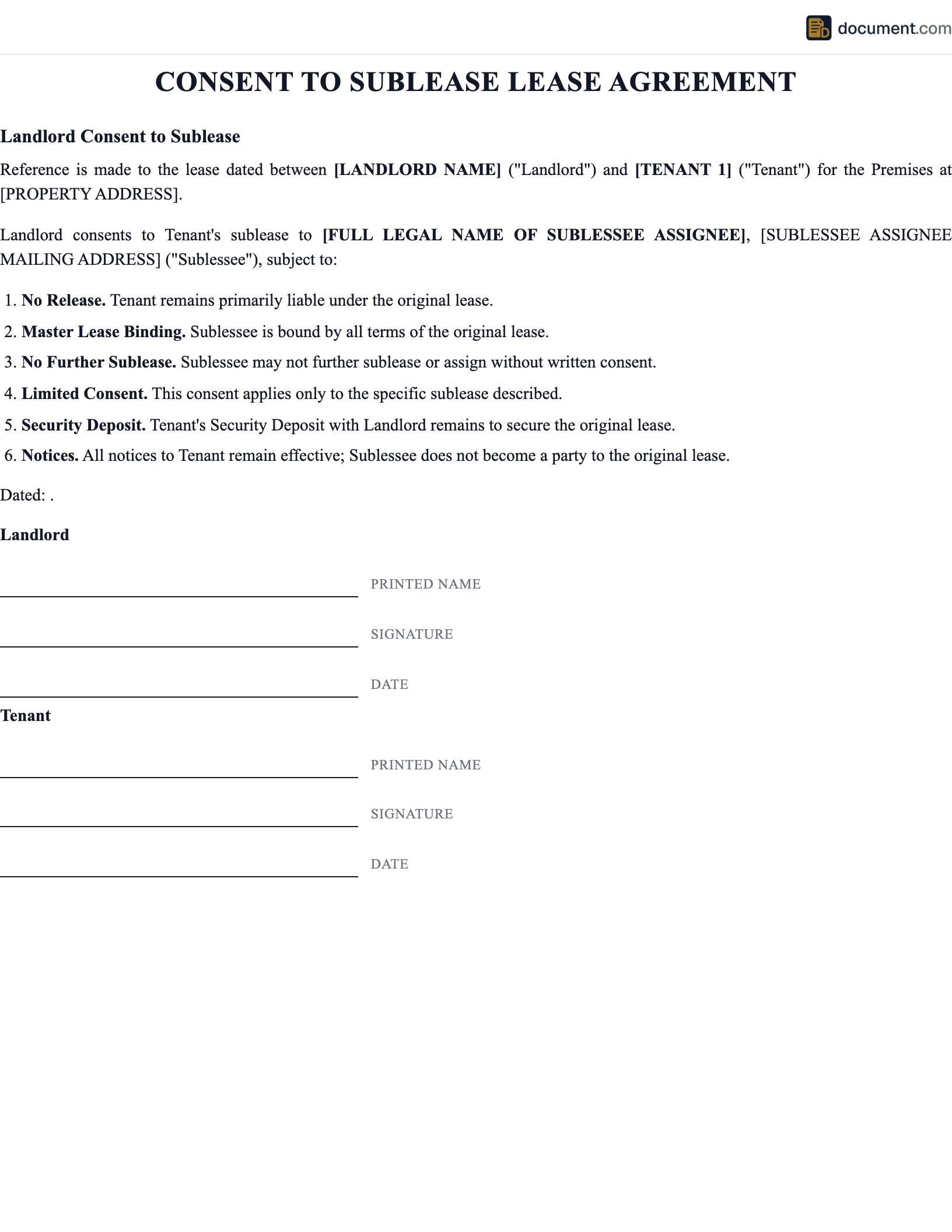
Below is a preview of the Landlord's Consent to Sublease template. Your customized document will include all provisions for your specific situation.
LANDLORD'S CONSENT TO SUBLEASE
Authorization to Sublet Rental Property
This document is entered into on [Date] between the parties identified below:
LANDLORD:
Name: [Landlord Name]
ORIGINAL TENANT:
Name: [Tenant Name]
How to Use This Document
Process the request promptly. New York's 30-day deemed-consent rule and most state reasonableness standards punish landlord delay, and any refusal must be tied to documented, non-pretextual screening criteria.
FHA-Compliant Subtenant Screening
Apply the same screening criteria used for any prospective tenant: credit (commonly FICO 650+), income (commonly 2.5x to 3x monthly rent for residential, 40x to 45x in NYC), rental history, and criminal background. HUD's 2016 Office of General Counsel guidance restricts blanket criminal-history exclusions; refusal based on a criminal record must be tied to a specific conviction with a demonstrated nexus to landlord, neighbor, or property safety, with consideration of the offense's nature, time elapsed, and rehabilitation evidence. Disparate-impact analysis under 24 CFR §100.500 applies to all screening criteria. Document the criteria applied and the basis for any refusal in writing; the documentation is the landlord's defense if the refusal is challenged as unreasonable or discriminatory.
Review the Original Lease
Identify the subletting clause and any conditions on consent. Determine whether state law overrides absolute prohibitions (NY RPL §226-b for buildings of four or more units treats absolute bars as unenforceable).
Verify the Subtenant
Require an application, credit report, income verification, rental references, and background check. Apply the same criteria used for any tenant and document the analysis. HUD guidance restricts blanket criminal-history exclusions.
Set Consent Conditions
Specify term limits (no longer than master lease), rent (within rent-control caps where applicable), security deposit (within state cap), insurance ($100,000 to $500,000 liability), prohibition on further subletting, and reservation of revocation rights on subtenant default.
Execute the Consent Form
All three parties sign: landlord, original tenant, subtenant. Attach the proposed sublease and the master lease as exhibits. Issue within the statutory response window (30 days under NY RPL §226-b) to avoid the deemed-consent trap.
Key Components
Each component below carries specific evidentiary or statutory weight. Skipping any one creates either a consent defect or an enforcement gap.
Three-Party Signature Block
The consent must be signed by three distinct parties: the landlord (granting consent), the original tenant (acknowledging continuing liability), and the subtenant (agreeing to be bound by master-lease terms incorporated into the sublease). Two-party consents (landlord and tenant only) leave the subtenant's rights and obligations underspecified, which becomes a problem at the back end when the subtenant fails to vacate or damages the unit. The three-party signature block also defeats later subtenant claims of lack of notice of the master-lease terms.
| Component | Description |
|---|---|
| Landlord Identification | Full name and contact information of the property owner or manager |
| Original Lease Reference | Date, parties, and property address of the original lease |
| Tenant Liability Statement | Confirmation that original tenant remains fully responsible |
| Subtenant Requirements | Screening, insurance, and deposit requirements for the subtenant |
| Sublease Term Limits | Maximum duration and any restrictions on the sublease period |
| Revocation Conditions | Circumstances under which consent may be withdrawn |
Frequently Asked Questions
Find answers to common questions about the Landlord's Consent to Sublease.
Resources
Create your Consent To Sublease Lease Agreement in under 10 minutes.
Answer a few questions and download a compliant, attorney-drafted document ready for your state.