



What Is a Lease Assignment?
A lease assignment is a legal agreement in which the current tenant (the "assignor") transfers their entire remaining interest in a lease to a new tenant (the "assignee"). Unlike a sublease, where the original tenant retains some interest in the lease and acts as an intermediary between the landlord and subtenant, an assignment transfers all rights and obligations directly from the assignor to the assignee. Once the assignment is complete and the landlord consents, the assignee steps into the shoes of the original tenant and deals directly with the landlord for rent payments, maintenance requests, and all other lease-related matters.
Lease assignments are governed by both the terms of the original lease agreement and state landlord-tenant law. Most residential and commercial leases contain a clause addressing whether assignments are permitted, prohibited, or allowed only with the landlord's prior written consent. Even in leases that are silent on the issue, many states impose a default rule requiring landlord consent for any transfer of the tenant's interest. When consent is required, many jurisdictions provide that the landlord may not unreasonably withhold, condition, or delay that consent.
One of the most important considerations in a lease assignment is the question of liability. Without an express release from the landlord, the original tenant typically remains secondarily liable for all lease obligations even after the assignment. This means that if the assignee fails to pay rent or violates the lease terms, the landlord can pursue the assignor for damages. A well-drafted lease assignment agreement addresses this issue by including a release of liability clause, which must be signed by the landlord to be effective.
Lease assignments are commonly used when tenants need to relocate due to job transfers, financial hardship, military deployment, health reasons, or changes in family circumstances. They are also frequently used in commercial real estate when a business is sold and the buyer needs to assume the existing lease for the premises. In all cases, a properly executed assignment protects all three parties — the assignor, the assignee, and the landlord — by clearly documenting the transfer of rights and obligations.
Full Transfer
Transfers entire lease interest from assignor to assignee for the remaining term
Landlord Consent
Requires written landlord approval to be valid and protect all parties involved
Release of Liability
Can include a release freeing the original tenant from future lease obligations
Lease Assignment by State
Whether a landlord can reasonably withhold consent to assignment, whether assignment fees are capped, and what releases of liability are enforceable all depend on state law. Choose your state for the right template.
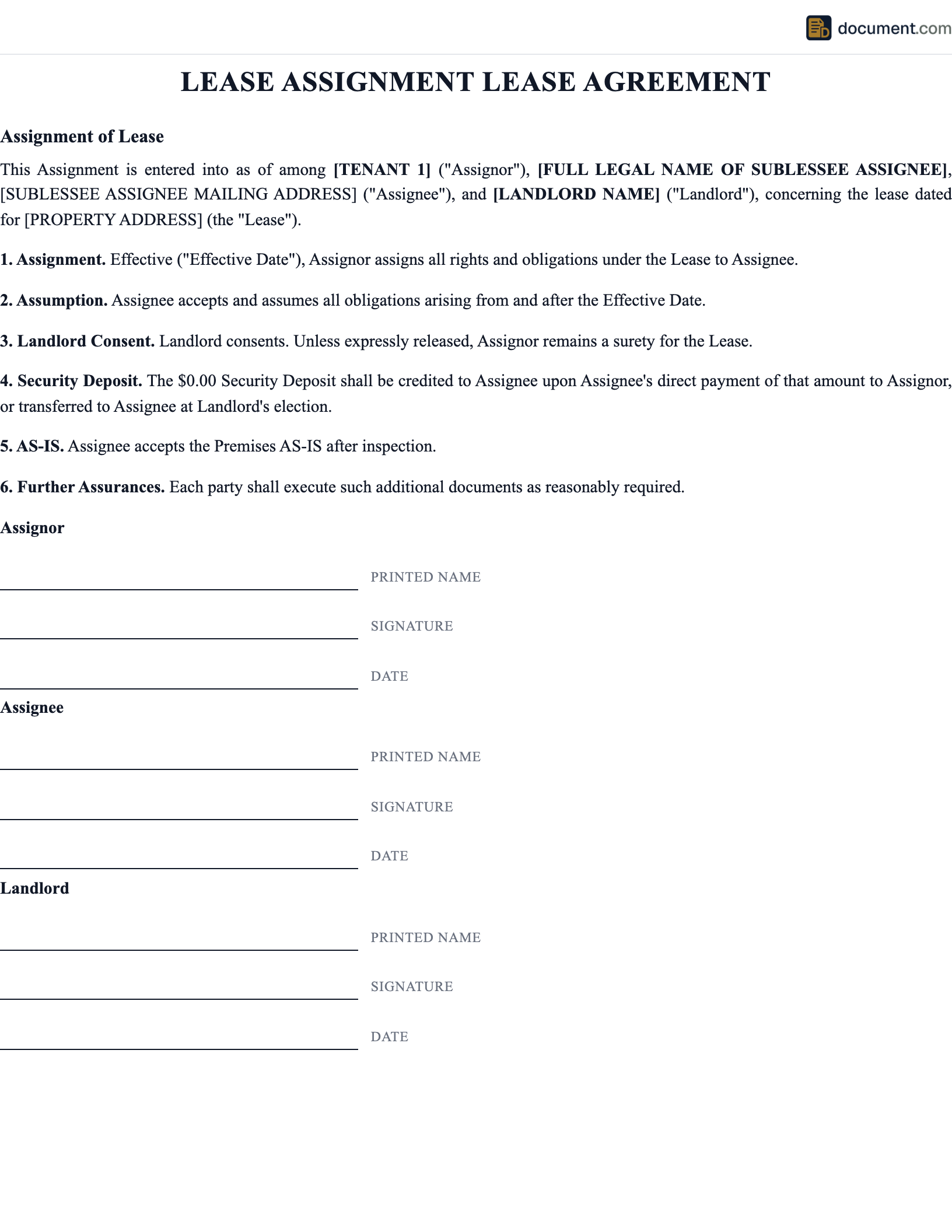
Lease Assignment Form Preview
Our lease assignment agreement includes all the fields required for a valid lease transfer. Below is a preview of the key sections. Your customized document will be tailored to your state's specific requirements and the terms of your original lease.
LEASE ASSIGNMENT AGREEMENT
Transfer of Lease Interest
ORIGINAL LEASE INFORMATION
Lease Date: [Original Lease Date]
Property Address: [Full Address]
Landlord: [Landlord Name]
Lease Expiration: [Expiration Date]
ASSIGNOR (Current Tenant)
Name: [Full Legal Name]
Current Address: [Street, City, State, ZIP]
ASSIGNEE (New Tenant)
Name: [Full Legal Name]
Current Address: [Street, City, State, ZIP]
ASSIGNMENT TERMS
Effective Date: [Date]
Monthly Rent: $[Amount]
Security Deposit Transfer: $[Amount]
LANDLORD CONSENT & RELEASE
The Landlord hereby consents to the assignment of the above-referenced lease...
Release of Assignor: [Yes / No]
Landlord Signature: [Signature]
How to Write a Lease Assignment
Creating a valid lease assignment requires careful attention to detail and coordination between the assignor, assignee, and landlord. Follow these steps to ensure your lease transfer is legally sound and protects all parties involved.
Review the Original Lease
Before initiating a lease assignment, carefully review the original lease agreement for any clauses related to assignment, subletting, or transfer of the tenant's interest. Look for whether assignment is prohibited, allowed with landlord consent, or allowed freely. Note any conditions or fees associated with assignment. If the lease prohibits assignment entirely, you may need to negotiate with the landlord or explore other options such as early termination.
Find a Qualified Assignee
Identify a new tenant who is willing and able to assume the lease obligations. The proposed assignee should have sufficient income to meet rent requirements (typically 2.5 to 3 times monthly rent), acceptable credit history, and positive rental references. Presenting a well-qualified assignee to the landlord significantly increases the likelihood of obtaining consent. Gather the assignee's employment verification, credit report, and rental history before approaching the landlord.
Notify the Landlord in Writing
Send a formal written request to the landlord asking for consent to assign the lease. Include the proposed assignee's name, contact information, employment details, and financial qualifications. Attach a completed rental application for the proposed assignee. Many leases specify a particular method for providing notice, so follow those requirements exactly. Keep a copy of the request and proof of delivery for your records.
Obtain Written Landlord Consent
The landlord's consent must be in writing to be enforceable. Do not rely on verbal approval. The consent should specifically identify the lease being assigned, the assignor and assignee, the effective date, and any conditions. If the landlord agrees to release the assignor from future liability, that release must also be in writing. Pay any required assignment processing fees at this stage.
Draft the Assignment Agreement
Prepare the lease assignment agreement with all required information: the original lease details, assignor and assignee identification, effective date of the assignment, monthly rent and security deposit amounts, assumption of obligations by the assignee, any release of liability for the assignor, and representations and warranties from both parties. Attach a copy of the original lease as an exhibit so the assignee can review all terms they are assuming.
Handle the Security Deposit
Determine how the security deposit will be handled. In most cases, the assignee reimburses the assignor for the existing security deposit, and the landlord transfers the deposit record to the assignee's name. Some landlords prefer to return the original deposit to the assignor and collect a new deposit from the assignee. Document the agreed-upon arrangement in the assignment agreement to avoid disputes later.
Execute the Agreement
Have all three parties — the assignor, assignee, and landlord — sign the assignment agreement. Each party should receive an original signed copy. The effective date of the assignment should be clearly stated, and all parties should understand that the assignee assumes the lease obligations starting on that date. Conduct a property walkthrough with the assignee on or before the effective date to document the condition of the premises.
Complete the Transition
Transfer keys, access cards, parking permits, and any other property-related items to the assignee. Transfer or cancel utilities in the assignor's name and ensure the assignee sets up new accounts. Notify the post office of the address change. Update any community or HOA records if applicable. Keep copies of the signed assignment agreement, landlord consent, and all related correspondence for at least the duration of the original lease term.
Key Components of a Lease Assignment
A valid lease assignment agreement must include specific elements to be legally enforceable and to adequately protect the interests of the assignor, assignee, and landlord.
| Component | Description |
|---|---|
| Original Lease Reference | Date, parties, and property address of the original lease being assigned |
| Assignor Information | Full legal name and contact information of the current tenant transferring the lease |
| Assignee Information | Full legal name and contact information of the new tenant receiving the lease |
| Landlord Information | Name and address of the landlord or property management company |
| Effective Date | Date on which the assignment becomes effective and obligations transfer |
| Property Description | Full address and description of the leased premises being transferred |
| Assumption of Obligations | Assignee's agreement to assume all rights and obligations under the original lease |
| Release of Liability | Whether the assignor is released from future lease obligations upon assignment |
| Security Deposit | Amount and handling of the security deposit transfer between parties |
| Landlord Consent | Written consent from the landlord approving the assignment |
| Remaining Lease Term | Duration remaining on the original lease from the assignment effective date |
| Rent and Payment Terms | Monthly rent amount, payment method, due date, and late fee provisions |
Legal Requirements for Lease Assignments
Lease assignments must comply with both the terms of the original lease and applicable state landlord-tenant law. Understanding these requirements is essential to ensure the assignment is valid and enforceable.
Important: Landlord Consent Is Usually Required
Most leases require the landlord's written consent before a lease can be assigned. Proceeding without consent when it is required constitutes a breach of the lease and can result in eviction of both the assignor and assignee. Always review the original lease and obtain written consent before completing the assignment.
Consent Requirements
- Written Consent: Landlord consent must be in writing. Verbal consent is generally unenforceable and cannot be relied upon to protect the assignor from future liability
- Reasonable Withholding: In many states, landlords cannot unreasonably withhold consent to an assignment. What is "reasonable" depends on factors like the proposed assignee's creditworthiness and rental history
- Assignment Fees: Some states allow landlords to charge a reasonable processing fee, while others prohibit fees beyond actual costs incurred
- Fair Housing Compliance: Landlords cannot refuse assignment based on the proposed assignee's race, color, religion, national origin, sex, disability, or familial status
Assignor Liability
Under the legal doctrine of privity of contract, the original tenant (assignor) remains liable under the lease unless explicitly released by the landlord. This secondary liability continues for the entire remaining lease term. To be relieved of this liability, the assignor must obtain a written release (also called a novation) from the landlord. Without this release, the landlord can pursue the assignor if the assignee defaults on rent or breaches the lease.
State-Specific Considerations
State laws regarding lease assignments vary significantly. Some states, such as California, have detailed statutory provisions governing the assignment process, including limits on fees and requirements for reasonable consent. Other states rely more heavily on common law principles and the specific terms of the lease. Commercial lease assignments may be subject to different rules than residential assignments in many jurisdictions.
Sample Lease Assignment Agreement
Below is a preview of a standard lease assignment agreement. Your customized document will include state-specific language and provisions tailored to your particular situation.
LEASE ASSIGNMENT AGREEMENT
Date: _______________
This Lease Assignment Agreement ("Agreement") is entered into by and between:
Assignor: [Full Legal Name]
Assignee: [Full Legal Name]
Landlord: [Full Legal Name]
RECITALS
WHEREAS, Assignor is the tenant under a lease agreement dated _______ for the property located at _______ ("Premises"); and WHEREAS, Assignor desires to assign all right, title, and interest in the Lease to Assignee...
1. ASSIGNMENT.Assignor hereby assigns, transfers, and conveys to Assignee all of Assignor's rights, title, and interest in and to the Lease, effective as of _______ ("Effective Date").
2. ASSUMPTION. Assignee hereby accepts the assignment and assumes all obligations of the Tenant under the Lease from and after the Effective Date.
Assignor Signature
Date: ___________
Assignee Signature
Date: ___________
Landlord Signature
Date: ___________
Frequently Asked Questions
Find answers to common questions about lease assignments, landlord consent, liability, and the differences between assignment and subletting.
Official Resources
Use these trusted resources for additional information about lease assignments, tenant rights, and landlord-tenant law in your state.
HUD Tenant Rights
Federal housing resources and tenant protections
Nolo — Lease Assignment Guide
Legal encyclopedia on assigning and subletting leases
CFPB Housing Resources
Consumer financial protection for renters and tenants
USA.gov — Landlord-Tenant Law
State-by-state landlord-tenant statutes and resources
Related Lease Documents
Depending on your situation, you may need additional documents to complement your lease assignment or to explore alternative options for transferring your lease.
Create your Lease Assignment Lease Agreement in under 10 minutes.
Answer a few questions and download a compliant, attorney-drafted document ready for your state.