
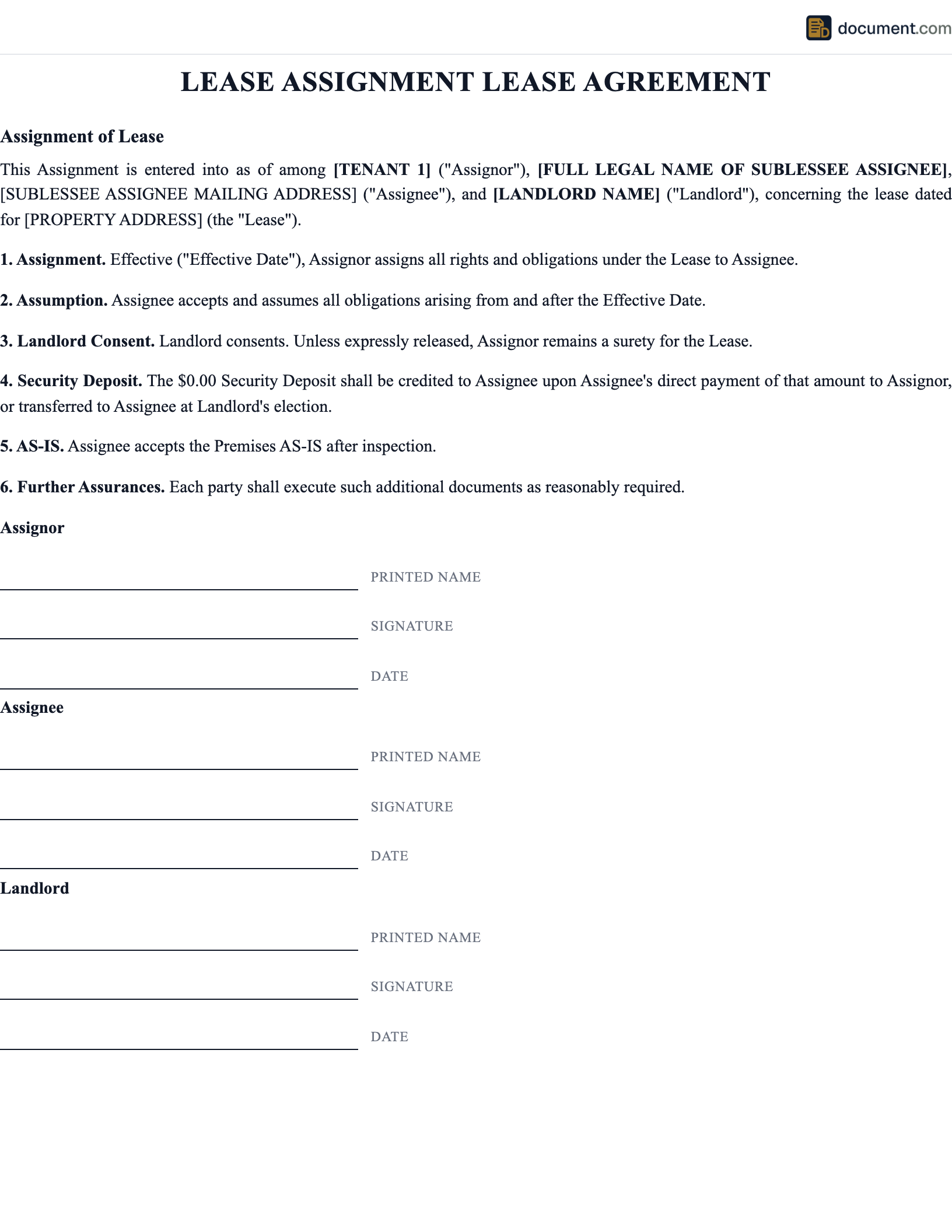



What Is Landlord Consent to Lease Assignment?
Landlord consent to lease assignment is a written document in which the landlord formally approves the transfer of a tenant's lease from the original tenant (the assignor) to a new tenant (the assignee). Most residential and commercial leases prohibit assignment without the landlord's prior written consent, which means the assignment cannot legally take effect until the landlord signs this form. Without proper consent, the assignment may be void, the original tenant may be in default, and the landlord may have grounds for eviction.
The consent form does far more than simply say "approved." It is the document where the landlord sets the conditions of the assignment, documents whether the original tenant is released from future liability, addresses how the security deposit will be handled, records any changes to the lease terms (rent adjustments, new insurance requirements, updated guarantees), and confirms that the assignee has been approved after a satisfactory review of their qualifications. It sits at the intersection of the original lease, the assignment agreement between the assignor and assignee, and state landlord-tenant law, and it needs to be consistent with all three.
From the landlord's perspective, the consent form is a control mechanism. The landlord gets to vet the new tenant, impose conditions that protect the property and the rent stream, and decide whether to release the original tenant from continuing liability. A landlord who signs a poorly drafted consent form may inadvertently release a creditworthy original tenant and replace them with a weaker assignee, lose the right to adjust rent or require additional security, or waive future consent rights for subsequent assignments. Getting the consent form right is not optional.
From the tenant's perspective, the consent form is the document that makes the assignment official and determines the tenant's continuing exposure. An original tenant who signs an assignment agreement and hands over the keys without obtaining proper landlord consent is still on the hook for the full remaining lease term. If the assignee defaults, the original tenant is liable for back rent, damages, and any other lease obligation. The tenant should push for a full release in the consent form and, at a minimum, negotiate a conditional release that terminates liability after the assignee performs for a specified period.
Our attorney-reviewed landlord consent form covers the complete approval process: identification of the parties and the lease, the landlord's consent and any conditions, the assignee's assumption of lease obligations, the original tenant's release or continuing liability, security deposit disposition, assignment fees, insurance requirements, and confirmation that all other lease terms remain in full force and effect. It works for residential and commercial assignments in every state and complies with the consent requirements in the most common lease forms.
Vet the New Tenant
Document the assignee's qualifications and set approval conditions
Control Liability
Decide whether the original tenant is released, conditionally released, or remains liable
Clean Transfer
Handle security deposits, assignment fees, and updated lease terms in one document
Landlord Consent Form Preview
Below is a visual preview of the sections and fields included in a standard landlord consent to lease assignment form. Your completed document will be customized for your lease, your property, and your state's requirements.
Landlord Consent to Assignment
Lease Transfer Approval
Section 1: Lease & Parties
Section 2: Consent & Conditions
Landlord consents to assignment effective March 1, 2026
Assignee assumes all lease obligations from effective date
Original tenant released from liability after 12 months of assignee performance
Section 3: Security Deposit
Section 4: Signatures
Landlord
Original Tenant
Assignee
How to Create a Landlord Consent Form
A proper landlord consent to lease assignment is built in seven steps. Each one addresses a different aspect of the approval, and together they create a clean, enforceable transfer that protects all three parties.
Identify the lease and the parties
Reference the original lease by date, property address, unit number, and the names of the landlord and original tenant. Identify the proposed assignee by full legal name and contact information. This section connects the consent to the specific lease being assigned.
Review the proposed assignee
Conduct the same tenant screening you would for a new tenant: credit check, income verification, rental history, references, and background check. Document the results and confirm that the assignee meets the landlord's qualification standards.
State the consent and effective date
Clearly state that the landlord consents to the assignment of the lease from the original tenant to the assignee, effective as of a specific date. If the consent is conditional, list the conditions that must be satisfied before the assignment takes effect.
Address the original tenant's liability
Specify whether the original tenant is fully released from future liability, conditionally released (released after the assignee performs for a specified period), or not released at all (remains liable as a guarantor). This is the most important provision for the original tenant.
Document the assignee's assumption
Require the assignee to expressly assume all of the original tenant's obligations under the lease, including rent, maintenance, insurance, and compliance with all lease terms, from the effective date forward.
Handle the security deposit and fees
Specify whether the original tenant's deposit transfers to the assignee's account, whether the landlord returns the original deposit and collects a new one from the assignee, or whether the assignee posts an additional deposit. Address any assignment fee the landlord is charging.
Get all three signatures
The landlord, the original tenant, and the assignee should all sign the consent form. All three signatures ensure that everyone is bound by the terms and that the assignment is documented from every angle.
Key Components
Every landlord consent to lease assignment form should include these core elements to create a clean, enforceable transfer.
Lease identification
Original lease date, property address, unit, and remaining term
Party identification
Landlord, original tenant, and proposed assignee full legal names
Consent statement
Clear, unambiguous statement of landlord's consent and effective date
Assignee assumption
Written assumption of all lease obligations by the new tenant
Original tenant release
Full release, conditional release, or continuing liability as guarantor
Security deposit handling
Transfer, return and recollect, or additional deposit from assignee
Assignment fee
Amount, who pays, and when it is due
Insurance requirements
Updated insurance certificates naming the landlord as additional insured
Remaining lease terms
Confirmation that all other lease terms remain unchanged and in full force
Three-party signature block
Landlord, original tenant, and assignee signatures with dates
Types of Landlord Consent
Landlord consent to lease assignment can take several forms depending on the landlord's level of control and the original tenant's desired outcome.
Unconditional Consent with Full Release
The landlord approves the assignment and fully releases the original tenant from all future liability under the lease. This is the cleanest outcome for the original tenant but the riskiest for the landlord, who gives up their right to pursue the original tenant if the assignee defaults. Landlords typically grant full releases only when the assignee is clearly more creditworthy than the original tenant.
Conditional Consent with Deferred Release
The landlord approves the assignment and agrees to release the original tenant after the assignee performs all lease obligations for a specified period (commonly 12 months). This gives the landlord a safety net during the transition while giving the original tenant a defined path to full release. If the assignee defaults within the probation period, the original tenant remains liable.
Consent Without Release
The landlord approves the assignment but the original tenant remains fully liable as a guarantor for the entire remaining lease term. This is the most common arrangement and the most protective for the landlord. The original tenant is essentially a backup if the assignee fails to perform. Many tenants accept this structure because the alternative is being stuck in a lease they can no longer fulfill.
Consent with Recapture
Instead of consenting to the proposed assignment, the landlord exercises a recapture clause in the lease, terminates the existing tenancy, and re-leases the space directly to the proposed assignee (or someone else) at current market rent. This is most common in commercial leases where the existing rent is below market and the landlord wants to capture the spread.
Legal Requirements
Landlord consent to lease assignment is governed by the original lease terms, state landlord-tenant law, and general contract principles. The requirements below apply in most jurisdictions.
- Written consent required when the lease prohibits assignment without landlord approval (virtually all leases do)
- Reasonableness standard applies in most states when the lease conditions assignment on landlord consent
- California Civil Code 1995.260 prohibits unreasonable withholding of consent for commercial leases
- New York law requires landlords to respond to assignment requests within a reasonable time
- Fair Housing Act prohibits withholding consent for discriminatory reasons in residential leases
- Assignment without proper consent may constitute a default under the lease, giving the landlord grounds for eviction
- Privity of contract keeps the original tenant liable unless the landlord signs a written release
- Security deposit laws in most states require proper documentation when deposits are transferred between tenants
Sample Landlord Consent Form
Below is a condensed preview of our standard landlord consent to lease assignment form. Your final document will be customized for your lease, property, and state requirements.
LANDLORD CONSENT TO LEASE ASSIGNMENT
Lease Transfer Approval
This Landlord Consent to Lease Assignment ("Consent") is executed as of[Date]by [Landlord]("Landlord"), [Original Tenant]("Assignor"), and [Assignee]("Assignee").
1. LEASE REFERENCE
This Consent relates to the lease dated[Date]for the premises located at[Address]("Lease").
2. CONSENT
Landlord hereby consents to the assignment of the Lease from Assignor to Assignee, effective [Date]("Effective Date"), subject to the conditions set forth herein.
3. ASSUMPTION
Assignee hereby assumes all of Assignor's obligations under the Lease from and after the Effective Date and agrees to be bound by all terms and conditions of the Lease as if Assignee were the original tenant.
4. RELEASE OF ASSIGNOR
[Select one: Assignor is fully released from all obligations under the Lease from and after the Effective Date. / Assignor shall be released from all obligations under the Lease after Assignee has performed all Lease obligations for[months] consecutive months. / Assignor is not released and remains liable as guarantor for the remaining Lease term.]
5. SECURITY DEPOSIT
The security deposit of $[Amount]currently held by Landlord shall be [transferred to Assignee's account / returned to Assignor, and Assignee shall deposit $[Amount] with Landlord].
6. REMAINING TERMS
Except as modified by this Consent, all terms and conditions of the Lease remain in full force and effect. This Consent does not constitute a waiver of Landlord's right to consent to any future assignment or sublease.
Frequently Asked Questions
Answers to common questions about landlord consent to lease assignments, tenant liability, security deposits, assignment fees, and the reasonableness standard.
Official Resources
For additional information on lease assignments, tenant rights, and landlord-tenant law, consult these official resources.
HUD Rental Assistance
U.S. Department of Housing and Urban Development resources for renters and landlords
Nolo - Landlord-Tenant Law
Comprehensive legal guides on lease assignments, subletting, and tenant rights
UCC Article 2A - Leases
Uniform Commercial Code provisions governing lease contracts
DOJ Fair Housing Act
Federal fair housing protections applicable to lease assignment consent
California Courts - Landlord-Tenant
California judicial resources for landlord-tenant disputes and lease issues
New York Real Property Law
New York state statutes governing landlord-tenant relationships and lease transfers
Create your Lease Assignment Landlord Consent Lease Agreement in under 10 minutes.
Answer a few questions and download a compliant, attorney-drafted document ready for your state.