



Louisiana Lease Assignment Overview
Louisiana is the only state that follows a civil law system derived from French and Spanish legal traditions rather than English common law. The Louisiana Civil Code has specific provisions governing the assignment (cession) of leases. Under La. C.C. Art. 2713, a tenant may assign the lease unless the lease prohibits it — this is the opposite default of most states, where assignment is restricted unless permitted. However, even with a valid assignment, the original tenant (cedent) remains liable unless expressly released. Louisiana uses unique terminology: the assignor is the 'cedent,' the assignee is the 'cessionary,' and the transfer is a 'cession.' New Orleans' unique rental market, with historic properties, tourism-driven demand, and hurricane-related insurance complexities, creates particular considerations for lease assignments.
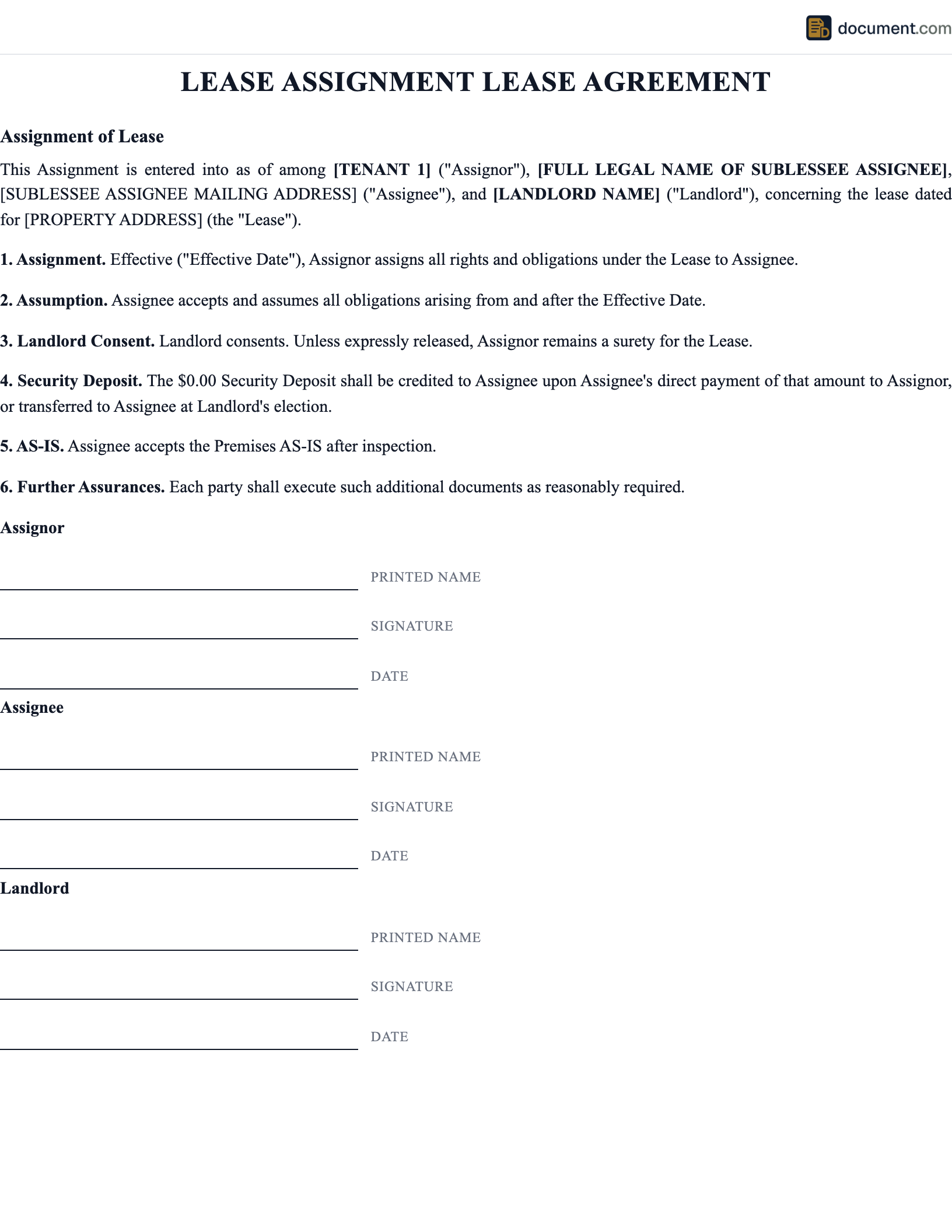
A lease assignment in Louisiana transfers a tenant's entire remaining interest in a lease to a new tenant (the assignee). Unlike a sublease, where the original tenant retains some rights and acts as an intermediary between the landlord and subtenant, an assignment places the assignee in direct legal relationship with the landlord. The assignee assumes all rights and obligations under the lease for the remaining term. Louisiana's legal framework for assignments is governed by La. Civ. Code Art. 2668-2729 (Lease).
No
Reasonable Refusal Standard
Not Required*
Landlord Consent
Yes
Continuing Liability
Yes
Written Required
Louisiana Legal Requirements for Lease Assignments
Landlord Consent
Louisiana Civil Code permits assignment unless the lease prohibits it (Art. 2713) — landlord consent not required by default. In Louisiana, most residential leases contain an anti-assignment clause that requires the landlord's prior written consent before any transfer of the tenant's interest. If the lease is silent on assignments, Louisiana Civil Code generally permits assignment unless the lease prohibits it (La. C.C. Art. 2713). When the lease requires consent, the tenant must submit a written request identifying the proposed assignee and providing sufficient information for the landlord to evaluate the request.
Reasonable Refusal Standard
Not applicable by default — assignment is permitted unless the lease restricts it. Regardless of the specific standard applied in Louisiana, a landlord cannot refuse an assignment based on the proposed assignee's race, color, religion, sex, national origin, familial status, or disability under the federal Fair Housing Act. Louisiana may have additional protected classes under state fair housing law.
Writing Requirement
Yes (for enforceability). A lease assignment in Louisiana should always be documented in writing to ensure enforceability. Louisiana's Statute of Frauds typically requires contracts involving interests in real property to be in writing. Even where the Statute of Frauds does not technically apply, the parol evidence rule may prevent oral agreements from contradicting written lease terms. A written assignment protects all parties — the assignor, assignee, and landlord — by clearly documenting the transfer terms and each party's obligations.
Security Deposit Considerations
Louisiana does not impose a statutory limit on security deposits. The landlord must return the deposit within 30 days after the tenant vacates. When processing a lease assignment, the security deposit handling must be explicitly addressed in the assignment agreement. Options include transferring the existing deposit to the assignee's account, having the landlord return the deposit to the assignor while collecting a new deposit from the assignee, or having the assignor and assignee settle the deposit amount between themselves.
How to Assign a Lease in Louisiana
Follow these steps to complete a valid lease assignment in Louisiana. Each step should be documented in writing to protect all parties involved.
Review the original lease for assignment restrictions — most Louisiana leases require landlord consent before any assignment
Identify a qualified assignee and compile their application including credit check authorization, employment verification, income proof, and references
Submit a written assignment request to the landlord providing the proposed assignee's qualifications and your reason for seeking the assignment
Allow the landlord reasonable time (typically 14-30 days) to screen the proposed assignee and respond to the request
Draft a written lease assignment agreement that references the original lease, identifies all parties, specifies the transfer date, addresses the security deposit, and includes liability provisions
Execute the agreement with signatures from the assignor, assignee, and landlord, and provide copies to all parties along with the original lease
Assignor Liability in Louisiana
Original tenant (cedent) remains liable unless released (Art. 2713). In Louisiana, the original tenant (assignor) typically remains liable for all lease obligations even after a valid assignment unless the landlord specifically releases them in writing. This continuing liability exists because the original lease contract (privity of contract) remains intact between the assignor and landlord even though the assignee now has a direct property relationship (privity of estate) with the landlord.
To eliminate continuing liability, the assignor must obtain a novation — a written agreement signed by the landlord that substitutes the assignee for the original tenant and releases the assignor from all future obligations. Without a novation, if the assignee fails to pay rent, damages the property, or otherwise violates the lease, the landlord in Louisiana can pursue the original tenant for those obligations. Under Louisiana Civil Code Art. 2713, the original tenant (cedent) remains bound to the landlord unless the landlord expressly discharges them. Louisiana's civil law tradition uses specific terminology — the assignor is the cedent and the assignee is the cessionary.
Louisiana Liability Warning
Always negotiate a written release of liability (novation) as part of your Louisiana lease assignment. Without an explicit release signed by the landlord, you remain financially responsible for the lease even after the assignee takes possession. This includes rent, property damage, and any other lease obligations through the end of the original lease term.
Common Lease Assignment Scenarios in Louisiana
Job Relocation
Job relocations are one of the most common reasons for lease assignments in Louisiana, particularly in New Orleans, Baton Rouge, Shreveport. When an employer requires a move before the lease expires, assigning the lease allows the tenant to transfer their obligation to a new tenant rather than paying early termination fees or breaking the lease. Louisiana's economy, driven by the energy industry (oil and gas), tourism and hospitality, port and maritime commerce, and petrochemical manufacturing, creates steady demand for relocation-related lease assignments.
Military Orders
Service members stationed in or near Louisiana who receive permanent change of station (PCS) orders or deployment orders have protections under the federal Servicemembers Civil Relief Act (SCRA). While the SCRA provides the right to terminate a lease early, many military tenants prefer to assign their lease, particularly if they may return to the area or if they want to avoid the administrative process of early termination. Barksdale Air Force Base (Shreveport), Fort Polk (Leesville), and Naval Air Station Joint Reserve Base New Orleans create military assignment demand across the state.
Roommate Departure
When one roommate needs to leave a shared Louisiana rental, assigning their interest in the lease to a replacement tenant is often the cleanest solution. This involves assigning only the departing roommate's interest while the remaining roommates stay on the lease. The landlord's consent is typically required, and the incoming roommate should be screened and approved before the assignment takes effect. The assignment should clearly define how the security deposit is handled between the departing and incoming roommates.
Financial Hardship
When a Louisiana tenant can no longer afford rent due to job loss, medical expenses, or other financial setbacks, a lease assignment can avoid the negative consequences of eviction or lease default. Finding a qualified assignee to take over the lease allows the tenant to exit responsibly while maintaining their rental history. In Louisiana, landlords may be more receptive to a proposed assignment than dealing with a potential eviction, which involves court costs and potential vacancy periods.
Official Louisiana Resources
Consult these official Louisiana resources for landlord-tenant law and lease assignment guidance.
Louisiana Landlord-Tenant Statutes
Louisiana landlord-tenant law overview
Louisiana Attorney General — Consumer Protection
Consumer protection resources for Louisiana residents
Louisiana Legal Aid
Free legal assistance for qualifying Louisiana residents
Louisiana Housing Authority
HUD resources for Louisiana
Louisiana Lease Assignment FAQ
Common questions about assigning a lease in Louisiana under state landlord-tenant law.
Create Your Louisiana Lease Assignment
Answer a few questions and download your Louisiana-compliant lease assignment in minutes.
Get Started FreeNo account required. Free to create and preview.