



What Is a Roommate Agreement?
A roommate agreement is a private, legally binding contract between people who share a rental property. It is not a lease and does not replace or modify the lease agreement with your landlord. Instead, it establishes the rules, responsibilities, and expectations between co-tenants for shared living — covering everything from how rent is divided and who pays which bills to quiet hours, guest policies, cleaning schedules, and what happens when someone decides to move out. Think of it as the "house rules" document that every roommate signs and agrees to follow from day one.
No state requires roommates to sign a roommate agreement, but not having one is one of the most common mistakes people make when moving in with others. Without a written agreement, disputes over money, chores, noise, and personal boundaries are resolved through he-said-she-said arguments with no documentation to reference. A signed roommate agreement gives every co-tenant a clear, written record of what was agreed upon — and if necessary, it provides evidence in small claims court. It protects everyone by making expectations explicit before problems arise, not after tempers have flared and relationships have soured.
Roommate agreements are especially important when sharing space with people you do not know well — such as roommates found through listings, university housing assignments, or mutual friends — but even close friends and family members benefit from putting expectations in writing. Money and living habits are the two most common sources of conflict between roommates, and these conflicts can escalate quickly when there is no written baseline to reference. A well-drafted roommate agreement prevents misunderstandings that can damage both your living situation and your personal relationships.
Unlike a lease, which is governed by landlord-tenant law, a roommate agreement is governed by general contract law. This means it is enforceable as long as it meets the basic requirements of any valid contract: mutual agreement between the parties, consideration (each party gives up something, such as agreeing to pay their share of expenses), and a lawful purpose. The agreement does not need to be notarized, witnessed, or filed with any government agency to be legally binding — though having witnesses sign can strengthen enforcement if a dispute reaches court.
Expense Clarity
Documented rules for rent splitting, utility payments, groceries, and shared costs that prevent financial disputes
Living Standards
Agreed-upon guest policies, quiet hours, cleaning schedules, and shared space rules that reduce daily friction
Legal Protection
Written, signed record enforceable in small claims court that protects every co-tenant's rights and interests
Roommate Agreement by State
Roommate agreements sit alongside your lease, but state law still governs how disputes over shared expenses, security deposits, and move-outs are resolved. Select your state for a template shaped by local practice.
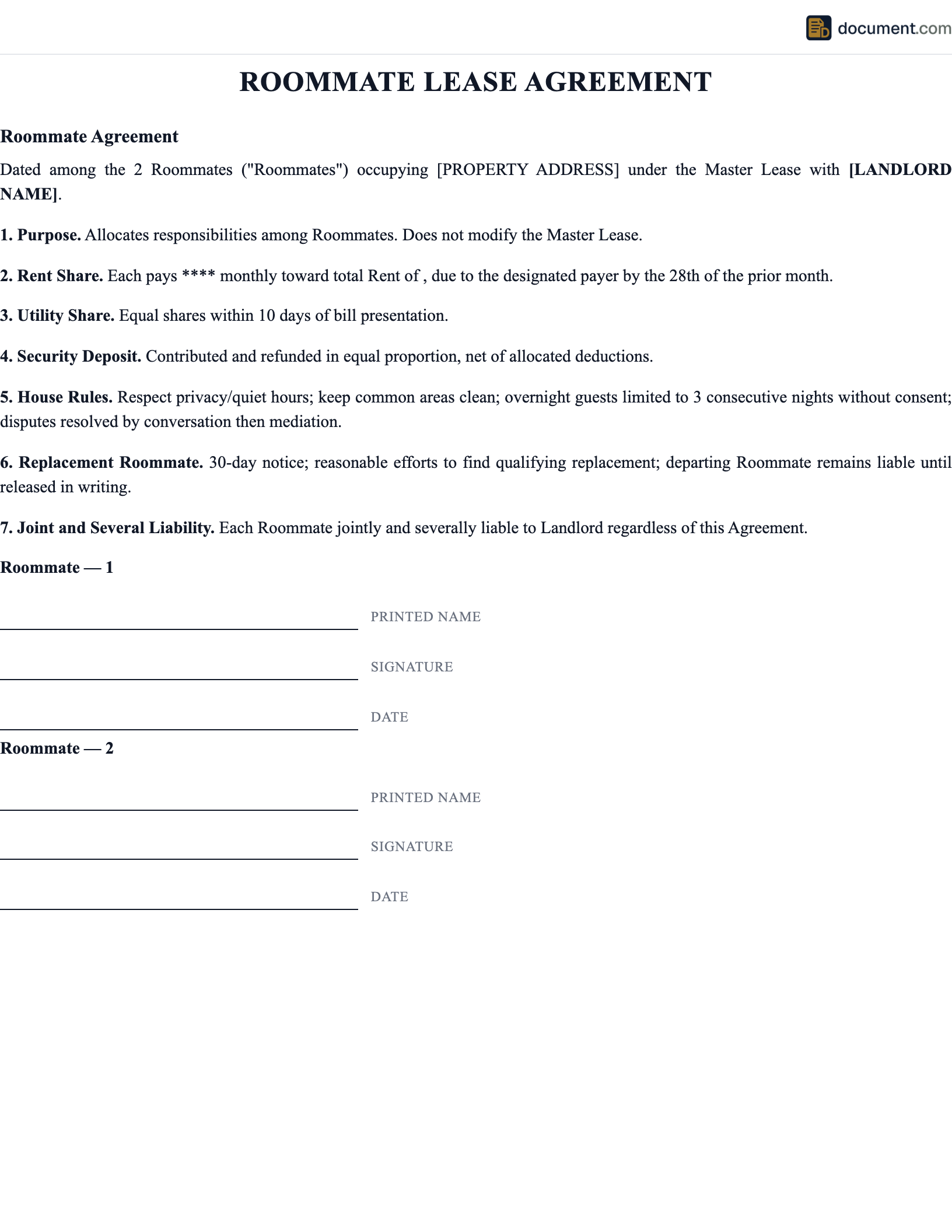
Roommate Agreement Form Preview
Below is a visual preview of the sections and fields included in a standard roommate agreement form. This mockup illustrates the structure and level of detail our templates provide. Your completed document will be fully formatted, professionally styled, and customized for your specific living arrangement and state.
Roommate Agreement
Private Agreement Between Co-Tenants
Section 1: Property & Roommates
Section 2: Rent & Expenses
Section 3: House Rules
Section 4: Move-Out & Dispute Resolution
Section 5: Signatures
Roommate 1 Signature
Roommate 2 Signature
Roommate Agreement vs. Lease Agreement
One of the most common misconceptions is that a roommate agreement and a lease agreement are interchangeable. They are not. These are fundamentally different documents that serve different purposes, involve different parties, and are governed by different areas of law. Understanding the distinction is critical because it affects your legal rights, your obligations to your landlord, and your recourse if something goes wrong with your living arrangement.
A lease is a contract between the landlord (property owner) and the tenant(s) that governs the rental of the property itself — including the rent amount, lease term, security deposit, maintenance responsibilities, and rules set by the landlord. A roommate agreement, by contrast, is a contract between co-tenants that governs how they share the space among themselves. The landlord is not a party to the roommate agreement and is not bound by its terms. You need both documents: the lease to establish your right to occupy the property, and the roommate agreement to establish how you and your co-tenants will live together.
Important: A Roommate Agreement Does NOT Replace a Lease
Your roommate agreement is a private contract between co-tenants. Your landlord is not a party to it and is not bound by its terms. You still need a lease agreement with your landlord that governs the rental of the property. The roommate agreement handles the internal arrangement between you and your roommates — it cannot override, modify, or contradict any terms in the lease.
| Feature | Lease Agreement | Roommate Agreement |
|---|---|---|
| Parties | Landlord and tenant(s) | Roommate and roommate |
| Purpose | Governs rental of property | Governs shared living arrangement |
| Landlord Involvement | Yes — the landlord signs it | No — private between roommates |
| Covers | Rent, term, rules, deposits, maintenance | Expense split, chores, guests, food, parking |
| Governed By | Landlord-tenant law (state-specific) | General contract law |
| Enforcement | Housing court / landlord-tenant court | Small claims court / mediation |
| Required? | Yes — required to rent property | No — optional but strongly recommended |
Key Provisions of a Roommate Agreement
A thorough roommate agreement anticipates the most common sources of conflict in shared living and addresses them with clear, specific terms before problems arise. The more detailed the agreement, the fewer arguments you will have later. Below are the essential provisions every roommate agreement should cover, along with practical guidance for each.
Rent Splitting
The agreement should specify each roommate's exact share of rent, the basis for the split (equal, by room size, by income, or by amenities), the payment due date, accepted payment methods, and consequences for late payment. If the rent split is unequal — for example, because one roommate has the master bedroom — document the reasoning so it is clear and agreed upon. Specify who collects rent from roommates and pays the landlord if a single person is responsible for that task.
Utility Division
List every utility and recurring bill — electricity, gas, water, sewer, trash, internet, cable, streaming services — and specify how each is divided. Name whose name is on each account, who is responsible for paying each bill, the reimbursement deadline for other roommates, and what happens if a utility bill is unusually high due to one roommate's usage. Consider whether any utilities will be divided by usage rather than equally — for example, if one roommate works from home and uses significantly more electricity.
Shared Expenses
Beyond rent and utilities, roommates share many other costs: cleaning supplies, paper products, kitchen essentials, trash bags, light bulbs, and household repairs not covered by the landlord. The agreement should specify how these expenses are divided, whether there is a shared household fund (each person contributes a set amount monthly), spending limits for individual purchases that can be reimbursed without group approval, and the process for handling larger shared purchases like furniture or appliances.
Cleaning Schedule
Different cleanliness standards are one of the top reasons roommate relationships deteriorate. The agreement should specify minimum standards for shared spaces (kitchen, bathroom, living room, hallways), a cleaning schedule or rotation, specific expectations (dishes washed within 24 hours, counters wiped after cooking, bathroom cleaned weekly), and consequences for not meeting cleaning obligations. Options include a rotating chore chart, permanently assigned tasks, or pooling money to hire a cleaning service.
Guest Policies
Guest policies should define: the maximum number of nights per week a guest can stay (typically 3–4 nights before they are considered an unofficial occupant), whether advance notice is required for overnight guests, rules about guests using shared amenities (shower, kitchen, laundry, parking), responsibility for guest behavior and damage, and the point at which a frequent guest must contribute to expenses or be added to the agreement. Address whether different rules apply to romantic partners versus other guests, and what happens during holidays or special events when multiple guests may visit.
Quiet Hours
Noise is a constant source of roommate tension. Set specific quiet hours for weeknights and weekends (a common standard is 10 PM to 8 AM on weeknights and 11 PM to 9 AM on weekends). Address television and music volume in shared spaces, headphone use after quiet hours, party and gathering policies (advance notice required, frequency limits), and noise expectations during exam periods if roommates are students. Include provisions for early-morning noise as well — a 6 AM alarm that wakes the entire apartment is just as disruptive as a late-night party.
Food & Groceries
Decide whether food and groceries are shared, separate, or a hybrid (staples like milk, eggs, and bread are shared while specialty items are personal). If food is separate, specify how to label personal items and establish refrigerator and pantry space allocation. If food is shared, determine how grocery costs are split and who is responsible for shopping. Address cooking cleanup expectations: dishes washed and counters cleaned immediately after cooking, or within a specified timeframe. Include rules about eating each other's labeled food without permission.
Parking & Storage
If the property has limited parking, assign spaces to specific roommates. Address guest parking rules, any costs associated with parking (permits, garage fees), and what happens if a roommate does not have a vehicle (they may still want to preserve their right to a space). For storage areas — garage, basement, attic, shared closets — define how space is divided and what can be stored. Specify what happens to a departing roommate's belongings if they are not removed by the agreed-upon date.
Pets
First, verify that the lease allows pets. If pets are permitted, the roommate agreement should specify which roommates may have pets, what types and sizes are allowed, who is responsible for pet-related damage and cleaning (always the pet owner), noise and behavior expectations, restrictions on pets in shared areas, and whether the pet owner pays an additional share of the security deposit. Require unanimous written consent from all roommates before anyone acquires a new pet. Address allergies, phobias, and situations where a new roommate moves in and has issues with existing pets.
Conflict Resolution
Every roommate agreement should include a structured process for resolving disputes. A common approach is: (1) direct conversation between the affected roommates, (2) a house meeting where all roommates discuss the issue, (3) mediation through a neutral third party (many universities and community organizations offer free mediation), and (4) small claims court as a last resort. Specify a cooling-off period before escalating disputes, and establish a rule against passive-aggressive behavior — all concerns should be raised directly and in good faith.
Move-Out Terms
Specify the minimum notice period required for a roommate to move out (30 to 60 days is standard), the departing roommate's obligation to help find and screen a replacement, how the security deposit share is handled upon departure, the condition in which the room and shared spaces must be left, responsibility for rent until a replacement begins paying, and the process for removing a roommate's name from utility accounts. Address what happens if a roommate is asked to leave due to repeated agreement violations.
How to Create a Roommate Agreement
Creating a roommate agreement should be a collaborative process. All roommates should participate so everyone has input, understands the terms, and feels ownership over the final document. Agreements imposed by one roommate on the others rarely work well. Follow these three steps to create a comprehensive agreement that protects everyone.
Sit Down Together and Discuss Expectations
Before drafting anything, all roommates should have an open, honest conversation about their living habits, schedules, preferences, and dealbreakers. Discuss sleep schedules and quiet hour preferences, cleanliness standards (what does "clean" mean to each person?), guest and significant-other expectations, food sharing preferences, study and work-from-home needs, pet policies, and financial comfort levels. This conversation is often the most valuable part of the process because it surfaces potential conflicts before anyone has moved in.
Tip: Have this conversation in person, not over text or email. Tone and nuance get lost in written communication, and roommate discussions benefit from face-to-face dialogue where everyone can read body language and respond in real time.
Draft the Agreement Using a Template
Use our attorney-reviewed template as a starting point — it covers all the essential provisions and prompts you for the specific details of your arrangement. Customize each section based on the discussion from Step 1. Be specific: instead of writing "roommates will keep the apartment clean," write "dishes will be washed within 24 hours of use; the bathroom will be cleaned every Saturday on a rotating schedule; the kitchen floor will be swept daily by the roommate who cooked dinner." Vague terms are unenforceable and lead to arguments about what the agreement actually requires.
Include all financial details: each person's rent share, their security deposit contribution, utility responsibilities, reimbursement deadlines, and late payment consequences. Name the specific accounts, amounts, and dates — not just "everyone pays their share."
Review, Sign, and Distribute Copies
Once the agreement is drafted, every roommate should read it carefully, ask questions, and propose changes. Do not rush this step — it is better to spend an extra day refining the agreement than to sign something a roommate is uncomfortable with. After everyone agrees to the final terms, all roommates should sign and date the document. Give each roommate a signed copy (digital or physical) and store the original in a safe place. Consider having a witness sign as well, though this is not required for enforceability.
Tip:Schedule a "check-in" review of the agreement after the first 30 days of living together. Real-world experience often reveals issues that were not anticipated during the initial drafting. Amending the agreement early, with everyone's consent, is much easier than dealing with built-up resentment months later.
College & University Roommate Considerations
College roommate situations have unique dynamics that require special attention in a roommate agreement. Many college students are living away from home for the first time, sharing a bedroom (not just an apartment), and navigating relationships with people they did not choose to live with. The stakes are high — a bad roommate experience can affect academic performance, mental health, and the overall college experience.
Most universities require incoming students living in dormitories to complete a roommate agreement as part of their housing onboarding. However, university-provided agreements are typically very basic and do not cover the level of detail that prevents real conflicts. If you are living off-campus in a shared apartment or house, you should create a comprehensive roommate agreement that goes well beyond what the university requires.
College-specific provisions to address include: study hours and academic quiet time (especially during midterms and finals), rules about having significant others sleep over during shared-bedroom situations, alcohol and substance policies (particularly when some roommates are under 21), use of shared electronics and appliances, decoration of shared spaces, thermostat and temperature preferences, laundry schedules for shared machines, semester break responsibilities (who stays, who leaves, security while the unit is empty), and what happens when roommates are randomly assigned and want to switch mid-semester. Many campuses offer free mediation services through the residential life office — reference this resource in the dispute resolution section of your agreement.
For parents: Encourage your student to create a written roommate agreement before or during the first week of the semester. It is much easier to have this conversation when everyone is excited and getting along than after a conflict has already erupted. Many resident advisors (RAs) are trained to facilitate roommate agreement conversations and can serve as a neutral party during the discussion.
What Happens When a Roommate Wants to Leave
One of the most disruptive events in a shared living arrangement is when a roommate decides to move out before the lease ends. Without clear terms in the roommate agreement, a mid-lease departure can create financial chaos for the remaining roommates, who may suddenly be responsible for a larger share of rent they cannot afford. A well-drafted agreement anticipates this situation and sets clear expectations for all parties.
Written Notice
The departing roommate must provide written notice to all other roommates at least 30 to 60 days before their intended move-out date. This gives the remaining roommates time to find a replacement and prevents surprise departures that leave others scrambling to cover rent.
Finding a Replacement
The departing roommate should be responsible for helping find a suitable replacement — including posting listings, showing the room, and providing candidate information to the remaining roommates. The remaining roommates should have approval rights over any replacement, and the new roommate must sign the roommate agreement and (if required) be added to the lease by the landlord.
Continued Rent Obligation
The departing roommate remains responsible for their share of rent until a replacement is found, the notice period expires (whichever is later), or the lease ends. This provision protects remaining roommates from bearing the full burden of rent during the transition period.
Security Deposit Handling
The departing roommate's share of the security deposit is typically not refunded until the lease ends and the landlord returns the full deposit, unless the replacement roommate pays the departing roommate directly for their share. The agreement should specify which approach applies and address deductions for damage caused by the departing roommate.
Lease Implications
A roommate moving out does not automatically remove them from the lease. The landlord must agree to release the departing roommate and may require lease modification, a new lease, or a sublease arrangement. Until the landlord formally removes them, the departing roommate may remain legally liable for rent and damages under joint and several liability.
Security Deposit & Subletting Considerations
Security deposits and subletting rights are two areas where the roommate agreement and the lease intersect, and confusion between the two can lead to significant financial disputes. The roommate agreement should clearly address how these topics are handled between co-tenants.
Security Deposit
- Document each roommate's contribution to the security deposit
- Photograph the property at move-in to document existing conditions
- Specify that damage deductions come from the responsible roommate's share
- Address how common-area damage is allocated when fault is unclear
- State the timeline for refunding a departing roommate's share
Subletting
- Check the lease — subletting must be allowed by the landlord
- Require unanimous roommate approval before any subletting occurs
- The sublessor remains responsible for their obligations under the roommate agreement
- Require the sublessee to sign the roommate agreement before moving in
- Address duration limits and any restrictions on subletting frequency
Important:The landlord holds the security deposit and returns it based on the condition of the entire unit at the end of the lease. The roommate agreement governs how roommates divide the deposit among themselves, but the landlord is only obligated to return the deposit to the tenants named on the lease — not to individual roommates based on your internal agreement. If one roommate causes damage, the remaining roommates may need to pursue that person in small claims court for reimbursement of the deducted amount.
Legal Enforceability of Roommate Agreements
A common question is whether a roommate agreement is "just a piece of paper" or whether it has real legal teeth. The answer is clear: a properly written roommate agreement is a legally enforceable contract. Courts across the country have consistently upheld roommate agreements as valid contracts when they meet the basic requirements of contract law — mutual assent (all parties agreed to the terms), consideration (each party gives up something, such as agreeing to pay their share), and lawful purpose (the agreement does not require anyone to do anything illegal).
If a roommate violates the agreement — for example, by refusing to pay their share of utilities, failing to clean as agreed, or moving out without proper notice — the other roommates can enforce the agreement through small claims court. Small claims court is designed for exactly these kinds of disputes: the filing fees are low (typically $30 to $100), lawyers are usually not required, and cases are resolved relatively quickly (often within 30 to 90 days of filing).
To maximize enforceability, the agreement should be in writing (oral agreements are technically enforceable but nearly impossible to prove), signed and dated by all roommates, specific and detailed (vague terms like "roommates will be considerate" are unenforceable — specific terms like "dishes will be washed within 24 hours" are enforceable), and reasonable (courts will not enforce terms that are unconscionable or one-sided). Notarization is not required but can add credibility. Having a witness sign provides additional evidence that the agreement was voluntarily entered into by all parties.
Enforceable
"Roommate A pays $650/month by the 1st; $25 late fee per day after the 3rd"
Not Enforceable
"Everyone pays their fair share of rent on time"
Enforceable
"Overnight guests limited to 3 nights/week with 24-hour notice"
Not Enforceable
"Be respectful about having guests over"
Sample Roommate Agreement
Below is a condensed preview of our roommate agreement template. This sample shows the structure, language, and sections included in our attorney-reviewed documents. Your completed agreement will be fully customized for your specific living arrangement, number of roommates, and state.
ROOMMATE AGREEMENT
Private Agreement Between Co-Tenants
This Roommate Agreement ("Agreement") is entered into on[Date]by and between the following individuals ("Roommates"), who share the rental property located at[Full Property Address].
ROOMMATES:
1. [Full Legal Name] — Bedroom: [Room Assignment]
2. [Full Legal Name] — Bedroom: [Room Assignment]
3. [Full Legal Name] — Bedroom: [Room Assignment]
1. RENT & PAYMENT
Total monthly rent is $[Amount]. Each Roommate's share is as follows: Roommate 1: $[Amount]; Roommate 2: $[Amount]; Roommate 3: $[Amount]. Rent is due on the [Day] of each month. A late fee of $[Amount] per day applies after a [Number]-day grace period...
2. UTILITIES & SHARED EXPENSES
Utilities shall be divided as follows:[Equal split / By usage / Other].[Roommate Name] shall be responsible for paying the following accounts and collecting reimbursement from other Roommates within [Number] days of providing receipts: electricity, gas, water, internet, trash...
3. HOUSE RULES
Quiet Hours: [Time] to[Time] on weeknights;[Time] to[Time] on weekends. Overnight guests are limited to [Number] nights per week with [Number]hours' advance notice to all Roommates...
4. CLEANING & MAINTENANCE
Roommates agree to maintain shared spaces according to the following schedule:[Rotating chore chart / Assigned tasks / Other]. Dishes must be washed within [Hours] hours. Each Roommate is responsible for cleaning their own bedroom. Common areas shall be cleaned [Frequency]...
5. MOVE-OUT PROCEDURES
Any Roommate wishing to move out before the lease ends must provide at least[Number]days' written notice to all other Roommates. The departing Roommate shall assist in finding an approved replacement and remains responsible for their share of rent until a replacement begins paying or the notice period expires, whichever is later...
6. DISPUTE RESOLUTION
Disputes shall be resolved in the following order: (1) direct discussion between affected Roommates; (2) house meeting with all Roommates present; (3) mediation through [Mediator/Service]; (4) small claims court as a last resort...
Frequently Asked Questions
Find answers to common questions about roommate agreements, shared living arrangements, expense splitting, guest policies, and legal enforceability.
Official Resources
For additional information on tenant rights, shared living arrangements, and small claims court procedures, consult these official and reputable resources.
HUD — Rental Assistance
U.S. Department of Housing and Urban Development resources for renters
Nolo — Renters' Rights
Free legal encyclopedia covering tenant rights and shared living issues
CFPB — Housing Resources
Consumer Financial Protection Bureau guidance for renters and tenants
ABA — Housing Resources
American Bar Association resources on tenant rights and housing law
USA.gov — Tenant Disputes
Official government guide to resolving landlord-tenant and roommate disputes
FTC — Money & Credit
Federal Trade Commission advice on managing shared financial obligations
Create your Roommate Lease Agreement in under 10 minutes.
Answer a few questions and download a compliant, attorney-drafted document ready for your state.