
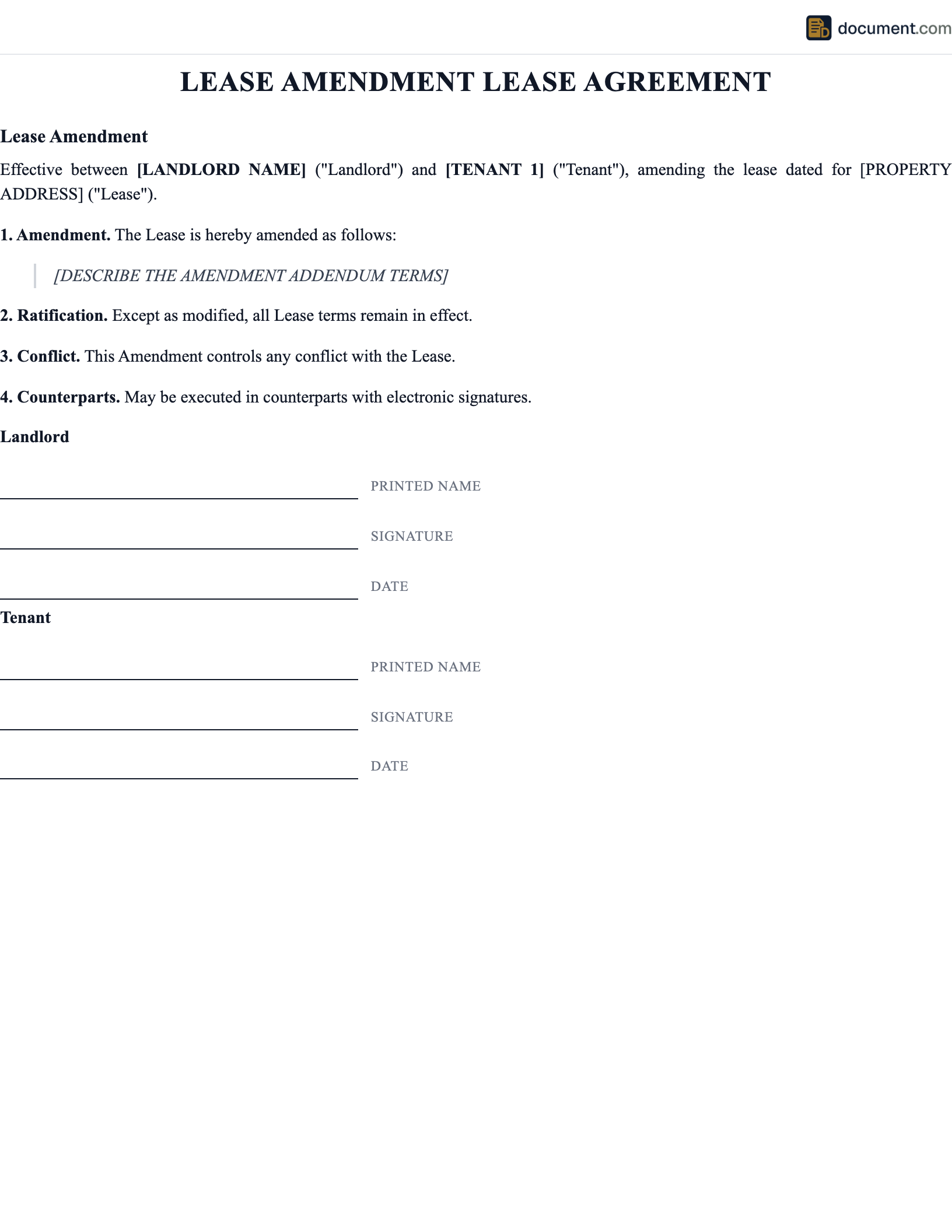



What Is a Lease Amendment?
A lease amendment is a signed contract that modifies an existing lease by changing one or more existing terms while leaving the rest of the lease in full force and effect. Common uses include adding or removing a tenant, adjusting the rent amount, extending or shortening the term, forgiving back rent, reallocating the security deposit among co-tenants, releasing a guarantor, and changing the renewal-option mechanics. Amendments are the standard mechanism for responding to life events that arise during tenancy: a roommate moves out, a tenant loses a job and needs forgiveness, the lease term needs to bridge to a home purchase, the parties want to convert a fixed-term tenancy to month-to-month. The amendment is the cleaner alternative to terminating and re-leasing because it preserves continuity, deposits, addendums, and the integration clause of the original lease.
Unlike an addendum, which adds a new term to the lease without changing what is already there, an amendment overrides the existing clause. Under the parol-evidence rule and the last-in-time canon of contract construction codified in Restatement (Second) of Contracts §216 and applied by every state, the amendment controls over the original lease wherever the two conflict. This is why amendments must be drafted carefully. A sloppy amendment that is silent on whether it replaces or supplements the original clause leaves both parties exposed at enforcement and invites litigation about which version of the rent, the term, or the addendum controls. Best practice is to quote the original clause verbatim, then state the new clause, then add a 'this Section X of the Lease is amended in its entirety to read as follows' or 'this Section X is supplemented by adding the following' modifier.
Our amendment templates are drafted by landlord-tenant attorneys and handle the jurisdiction-specific wrinkles. The pre-existing duty rule from Stilk v. Myrick requires new consideration for any modification, addressed by mutual concessions or express recital of consideration. Joint-and-several reallocation under URLTA §4.302 and state common-law equivalents requires every signature when the tenant roster changes. Rent-control caps under California Civ. Code §1947.12 (AB 1482), Oregon ORS 90.324 (SB 608), Washington RCW 59.18.650 (HB 1217), New York Rent Stabilization Code, San Francisco Admin. Code Ch. 37, and D.C. Code §42-3502.08 are unwaivable. The 1099-C tax treatment under IRC §61(a)(12) and §108 applies to forgiven rent over $600. Pick the amendment below that fits your situation.
Types of Amendments
Select the amendment that matches the change you are making to the lease.
Add or Remove a Tenant
Add a new co-tenant or formally remove a departing one.
Rent Forgiveness Amendment
Forgive back rent with proper 1099-C and bank-covenant handling.
Rent Increase Amendment
Document a mid-term rent change with required notice periods.
Lease Extension Amendment
Extend the term without rewriting the full lease.
Lease Assignment
Transfer the entire lease from the tenant to a new party.
Release of Guarantor
Formally release a co-signer from the lease guaranty.
Amendment vs. Addendum
The two terms are commonly confused. The functional distinction every landlord and tenant should know is whether the document changes an existing term (amendment) or adds a new one (addendum). The legal consequence flows from this distinction: amendments override the original clause under the last-in-time rule, while addendums supplement without overriding unless an express conflict-resolution clause specifies otherwise.
| Feature | Amendment | Addendum |
|---|---|---|
| Changes existing terms? | Yes | No, adds new terms |
| Typical examples | Rent change, tenant swap, extension, forgiveness | Pet rules, bed bug disclosure, smoking policy |
| Consideration needed? | Yes, pre-existing duty rule (Restatement §73) | Usually continued tenancy suffices |
| Conflict with main lease | Amendment controls (last-in-time) | Depends on priority clause |
| All parties must sign? | Yes, including guarantors | Yes, but guarantor consent often optional |
How to Amend a Lease
A clean amendment follows six steps. Skip any of them and enforcement becomes uncertain.
Identify the original lease
Reference the lease by date, address, all parties (including guarantors), and execution version. Defeats any ambiguity about what is being amended.
State the purpose
One sentence: 'This First Amendment changes the monthly rent from $X to $Y effective [date].' Number sequential amendments (First Amendment, Second Amendment) so the document chain is clear.
Quote the original clause
Restate the section being changed verbatim so both parties agree on the starting point. Avoids disputes about which version of the original clause was being amended.
Add the new language
Replace, delete, or modify the clause. Use clear amend/delete/insert markers for complex changes. State expressly whether the amendment 'replaces in its entirety' or 'supplements' the original clause.
Confirm everything else survives
Include a standard 'All other terms of the Lease remain in full force and effect' clause. State that all addendums (pet, bed bug, lead paint, smoking) carry forward unchanged.
Sign and date, all parties
Every tenant, co-tenant, guarantor, and the landlord must sign. Missing signatures break the amendment as to the non-signing party and may break joint-and-several allocation as to the signing parties.
Consideration and Mutual Consent
Contract law requires new consideration to modify an existing agreement. Under the pre-existing duty rule from Stilk v. Myrick (Engl. 1809) and codified in Restatement (Second) of Contracts §73, a one-sided amendment that benefits only one party without that party giving something new in return is often unenforceable. The doctrine has been softened in some jurisdictions: California Civ. Code §1698 allows modifications without consideration if executed in writing, and UCC §2-209 eliminates the requirement entirely for sale-of-goods contracts. But for residential leases in most states, the safer drafting practice is to recite consideration on both sides.
Rent Increase Amendment
Consideration: extended term, maintenance commitment, or new amenity. Without it, the tenant can refuse and continue paying the original rent through the end of the term.
Rent Forgiveness Amendment
Consideration: tenant's promise to cure defaults, extend tenancy, or accept the writeoff in lieu of pursuing landlord counterclaims. Forgiveness over $600 generates a 1099-C under IRC §61(a)(12).
Form requirements and Statute of Frauds
Lease amendments must be in writing under the Statute of Frauds in every state for any tenancy longer than one year. California Civ. Code §1624 codifies the rule. New York General Obligations Law §5-703 codifies it. Texas Business and Commerce Code §26.01 codifies it. Massachusetts G.L. c. 259 §1 codifies it. The writing must identify the parties, the property, the original lease, and the modified term. Oral amendments to leases over one year are unenforceable, even if both parties agree. Written amendments to leases under one year are strongly preferred for evidentiary clarity even where the Statute of Frauds does not require it. Notarization is not required by any state for a residential amendment but is recommended for amendments touching security deposits over $5,000, long-term extensions over 12 months, rent forgiveness over $10,000, or any commercial lease over five years.
Frequently Asked Questions
Questions about amending leases, consideration, signature requirements, and the amendment-versus-addendum distinction.
Official Resources
Amend your lease in under 8 minutes.
Pick the amendment type, answer a few questions, and download a signed-ready modification with the right consideration language for your state.