
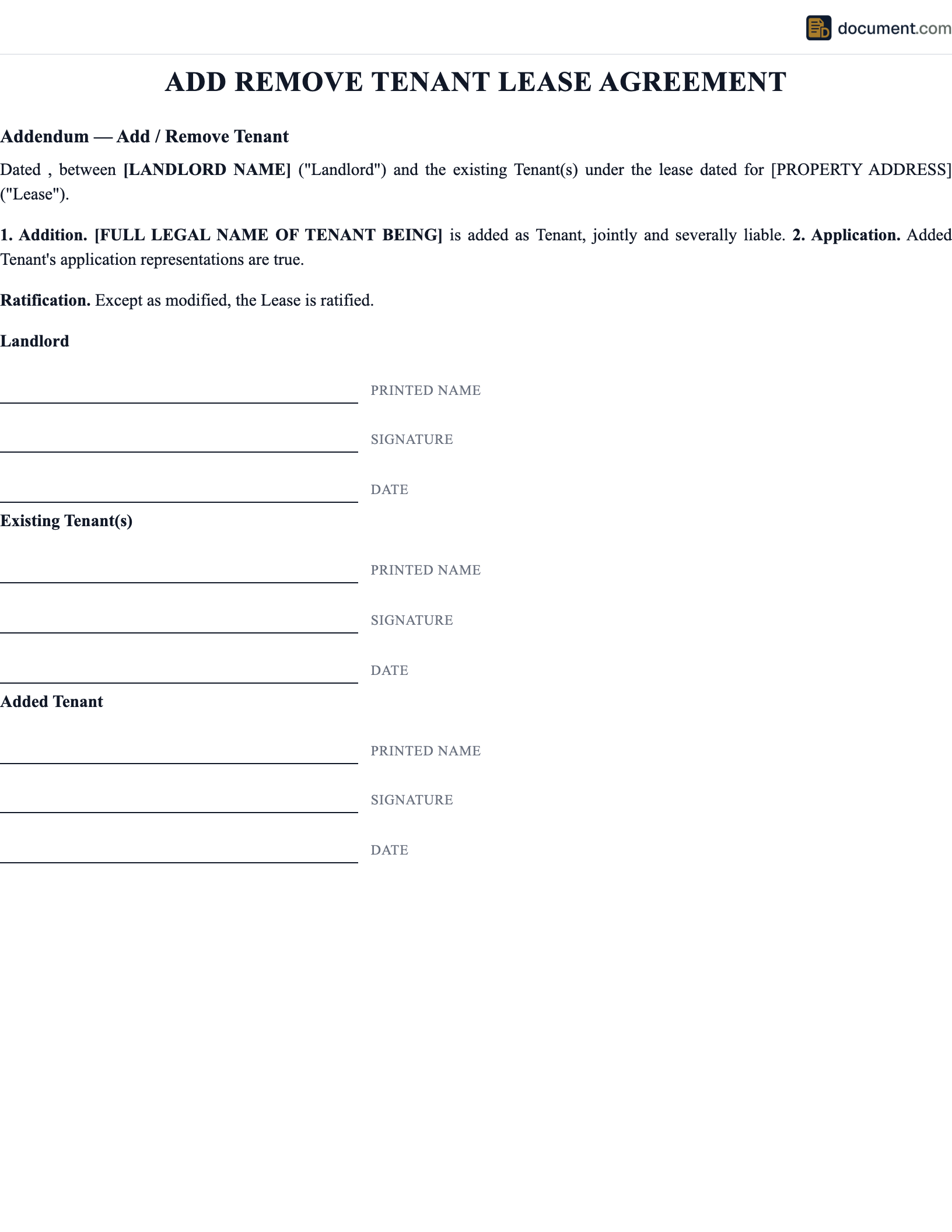



What Is an Add/Remove Tenant Amendment?
An add/remove tenant amendment is a contract modification that changes the roster of tenants on an existing lease without rewriting the entire agreement. It is a multi-party document: the landlord, every current tenant, every incoming tenant, and any guarantors whose obligations carry forward all sign. Without this amendment, an incoming person has no lease rights. They are an unauthorized occupant who can be evicted under the lease's occupancy clause and most state landlord-tenant statutes. A departing person remains liable for rent through the end of the original term under the joint-and-several allocation, leaving them exposed to collection action even after they have physically vacated the unit. Common use cases: a spouse moves in after marriage, a roommate moves out for a job relocation, an adult child needs to be added or removed for income-qualification purposes, an estranged spouse needs to be removed from the lease following separation.
The amendment handles four legal questions that otherwise fall through the cracks. Joint-and-several liability reallocation under URLTA §4.302 and state common-law equivalents. Security deposit share adjustment under state deposit-accounting statutes (Cal. Civ. Code §1950.5, NY GOL §7-108, Mass. G.L. c. 186 §15B), including refund of the departing tenant's share or top-up by the incoming tenant. Guarantor reaffirmation under common-law surety principles, where material changes to the principal obligation can release the guarantor unless they expressly reaffirm. Landlord background-screening consent for the new tenant under the Fair Credit Reporting Act (15 U.S.C. §1681), the Fair Housing Act (42 U.S.C. §3604), and applicable state and local fair-chance-housing ordinances.
Our template covers all four questions and includes the FCRA-compliant screening authorization, the fair-housing protected-class disclosure, the guarantor reaffirmation language required to preserve the original guaranty, and the deposit-reallocation math that complies with the state cap (California two months unfurnished post-July 2024, New York one month, Massachusetts one month, New Jersey 1.5 months, with no statutory cap in Texas, Florida, Georgia, and Illinois). The amendment is signature-ready for every required party including any guarantor whose obligations would otherwise be released.
Lease term remains unchanged
The add/remove tenant amendment changes who is on the lease, not how long the lease runs. The end date of the original lease remains in effect, and the new tenant assumes liability for the remainder of the term, not for a fresh 12-month period. This is the central difference from a renewal: the renewal restarts the term clock, while the add/remove amendment preserves it. Co-tenants who want a fresh term should pair the amendment with a lease extension or renewal, signed simultaneously. Without the explicit term-preservation clause, an incoming tenant could later argue that the amendment created a new tenancy with an implicit new term. State the original end date in the amendment and confirm that all term provisions of the original lease remain in effect.
Application screening for the new tenant under FCRA
The Fair Credit Reporting Act (15 U.S.C. §1681 et seq.) governs any consumer report used in the screening of the incoming tenant. Required steps under §1681b(b)(2): written authorization from the applicant before pulling the report. Required steps under §1681b(b)(3) if the report leads to denial or modified offer: pre-adverse-action notice with a copy of the report and the FTC summary of rights. Required steps under §1681m(a) after the decision: adverse-action notice with the denial reason, identity of the credit reporting agency, and summary of rights. State law adds caps on screening fees: California Civ. Code §1950.6 caps at actual cost plus around $66 administrative; Washington RCW 59.18.257 caps at actual cost; New York RPL §238-a effectively prohibits fees over $20. Fair-chance-housing ordinances in San Francisco, Seattle, Oakland, Berkeley, Cook County (IL), Detroit, Newark, and New Jersey statewide limit consideration of criminal history.
Joint-and-Several Liability
Nearly every residential lease with multiple tenants uses joint-and-several liability. Each tenant is individually liable for the full rent, not just a pro-rata share. The doctrine is codified by URLTA §4.302 and adopted as common law or by statute in nearly every state. California Civ. Code §1442 codifies the joint-and-several presumption for co-obligors. New York GOL §15-103 codifies it as a default. Texas applies it as common law per Hegar v. Texas BLC, Inc. The amendment must reallocate liability correctly to preserve enforceability:
- Adding a tenant: New tenant assumes joint-and-several liability for the remainder of the term, effective on the amendment date. Liability does not extend backward to obligations that accrued before the amendment.
- Removing a tenant: Departing tenant is released prospectively but remains liable for unpaid obligations through the removal date. Without express prospective release, the departing tenant remains liable through the end of the original term.
- Remaining tenants: Continue joint-and-several liability at the full rent, unless the amendment also reduces the rent. The remaining tenants absorb the departed tenant's share.
Security Deposit Reallocation
The security deposit is held by the landlord under state-law deposit-accounting rules (California Civ. Code §1950.5, New York GOL §7-103, Massachusetts G.L. c. 186 §15B, New Jersey N.J.S.A. 46:8-19, Maryland Real Prop. §8-203). When tenants change, the deposit must be reallocated and the new total must not exceed the state cap.
Adding a tenant
New tenant deposits their proportional share. Total cannot exceed state cap (CA: 2 months unfurnished post-July 2024, NY: 1 month, MA: 1 month, NJ: 1.5 months).
Removing a tenant
Departing tenant's share is refunded, typically from the incoming tenant's new deposit, or by the remaining tenants buying out the share through a side agreement.
Guarantor Continuity
A material change to the principal obligation can release a guarantor under common-law surety principles articulated in Pingrey v. Watkins, 32 Vt. 30 (1859) and Restatement (Third) of Suretyship and Guaranty §41. Adding a tenant whose liability spreads the guaranty, materially increasing the rent, or extending the term beyond the original guaranty period are all material changes that can discharge the guarantor unless the guaranty document specifically waives this protection. To preserve the guaranty, the amendment should include an express reaffirmation:
- Guarantor acknowledges the amendment and the new roster of tenants.
- Guarantor expressly reaffirms their obligations as to the continuing tenant or tenants.
- If the original guaranty was for a specific tenant who is now leaving, that guaranty can be released unless the guarantor signs a new one for the new roster.
- Reaffirmation is not waiver of the guarantor's defenses under the original guaranty document; it preserves the guaranty as to the new principal obligation.
Landlord Consent and Screening
The landlord can condition consent on successful credit and background screening of the incoming tenant under the same standards applied to original applicants. Screening must follow the Fair Credit Reporting Act (15 U.S.C. §1681 et seq.) for any consumer report used: written authorization before pulling the report, pre-adverse-action notice if denial follows, adverse-action notice with reason and credit-bureau identity. Screening must follow the Fair Housing Act (42 U.S.C. §3604) protected-class rules: no discrimination based on race, color, religion, sex, national origin, familial status, or disability. State and local civil rights laws add source of income (California Gov. Code §12955, NYC Admin. Code §8-107), marital status, sexual orientation, gender identity, age, and military status to the protected list. State-law screening-fee caps apply: California Civ. Code §1950.6, Washington RCW 59.18.257, New York RPL §238-a.
How to Use This Amendment
Identify all parties
Original lease (date and address), current tenants, incoming tenant, departing tenant, all guarantors. State the original lease end date, which remains unchanged.
Landlord screens and consents
FCRA-compliant screening of the new tenant: written authorization, pre-adverse-action notice if needed, adverse-action notice. Apply the same screening criteria as for original applicants. Confirm consent in writing.
Reallocate the deposit
Document refund to departing tenant (or buyout by remaining tenants) and new deposit from incoming tenant. Confirm total does not exceed state cap.
Update liability
Joint-and-several reallocated among the new roster for the remaining term. Departing tenant prospectively released; remaining and incoming tenants jointly and severally liable through end of term.
Reaffirm guarantors
Existing guarantors sign express reaffirmation as to the new roster. New guarantors sign fresh guaranty if the financial profile of the new tenant requires it.
Sign and retain
Landlord, all current tenants, incoming tenant, departing tenant, and all guarantors sign. Each party retains a copy. File with property manager.
Frequently Asked Questions
Questions about joint-and-several liability, deposit reallocation, FCRA screening, and guarantor continuity.
Official Resources
HUD Fair Housing Act Overview
Protected-class rules for tenant screening
CA Civil Code §1950.6, Screening Fees
California cap on tenant screening fees
URLTA §4.302, Joint and Several
Uniform Residential Landlord and Tenant Act liability rule
CFPB Co-Signer Guidance
Consumer protection rules for guarantors and co-signers
Add or remove a tenant in under 8 minutes.
Pick your state, answer a few questions, and download a signature-ready amendment with deposit math, guarantor reaffirmation, and liability updates.