



What Is a Release of Personal Guarantee?
A release of personal guarantee is a written instrument by which a landlord discharges a co-signer (guarantor) from financial obligations under a previously executed personal guarantee that secured a tenant's lease. The release identifies the original guarantee by date and parties, the lease it supports, the effective date of the release, the scope of the discharge (prospective only or also discharging accrued obligations), any conditions precedent (replacement guarantor approval, security deposit increase, settlement payment), and the parties' signatures. Once executed, the released guarantor has no further liability for obligations arising on or after the release date, though pre-release obligations survive unless expressly discharged.
Releases arise in three common contexts. First, the tenant initially required a guarantor (typically because of insufficient credit history, low income relative to rent, or first-time renter status) and has since established independent qualification through 12 to 24 months of on-time payment, improved credit (FICO 650 to 700+), or income increase to 2.5x or 3x monthly rent (40x to 45x in NYC). Second, a replacement guarantor with equal or superior financial qualifications steps in, allowing the original to exit. Third, the lease is restructured with stronger landlord protections (increased security deposit within the state cap, shorter term, higher rent) that compensate for the lost guarantee. The landlord's consent is required in every case because the release modifies the landlord's contractual security.
The legal framework comes from the law of suretyship, codified in the Restatement (Third) of Suretyship and Guaranty (1996) and incorporated by reference in most state common law. A guarantor is a surety, and the surety's obligations terminate only when the principal obligation is performed, the surety is expressly released by the creditor, or the principal obligation is materially modified without surety consent (Restatement §§39 to 44). Express landlord release is the cleanest route. Material modification analysis is more uncertain and usually requires litigation to resolve.
Discharge of Co-Signer Obligations
The release must specify what is discharged and what survives. Standard practice releases prospective obligations (rent, late fees, damages, attorney fees, and other charges arising on or after the effective date) while preserving liability for amounts already accrued. The release should identify any accrued amounts by line item so there is no later dispute about scope. Where the landlord is willing to extend the discharge to accrued obligations as well (commonly in exchange for a settlement payment of 25 to 75 percent of accrued arrears), the release should expressly enumerate the discharged charges. Generic language like "all obligations" without dates or amounts invites litigation over scope.
Lender Notification When Guarantee Supports Credit
In commercial leases where the guarantor provided the personal guarantee as collateral support for tenant operating credit (revolving lines of credit, SBA-backed loans under SBA SOP 50 10 6, equipment financing), any release affecting the credit profile typically requires lender notification under the loan documents. The lender may treat the release as a covenant breach triggering acceleration. The release should require tenant cooperation in notifying any affected lender within a defined window (typically 10 to 30 days post-release) and should disclaim any landlord obligation regarding the guarantor's separate credit relationships. For SBA-backed lending the borrower's failure to notify can result in guaranty repurchase under SBA standards, with potentially substantial financial consequences for the lender who failed to receive notice.
Express Release
Required under suretyship law to discharge the guarantor
Scope Definition
Prospective only by default; pre-release liability survives
Lender Notification
Required where guarantee supports tenant credit lines
Form Preview
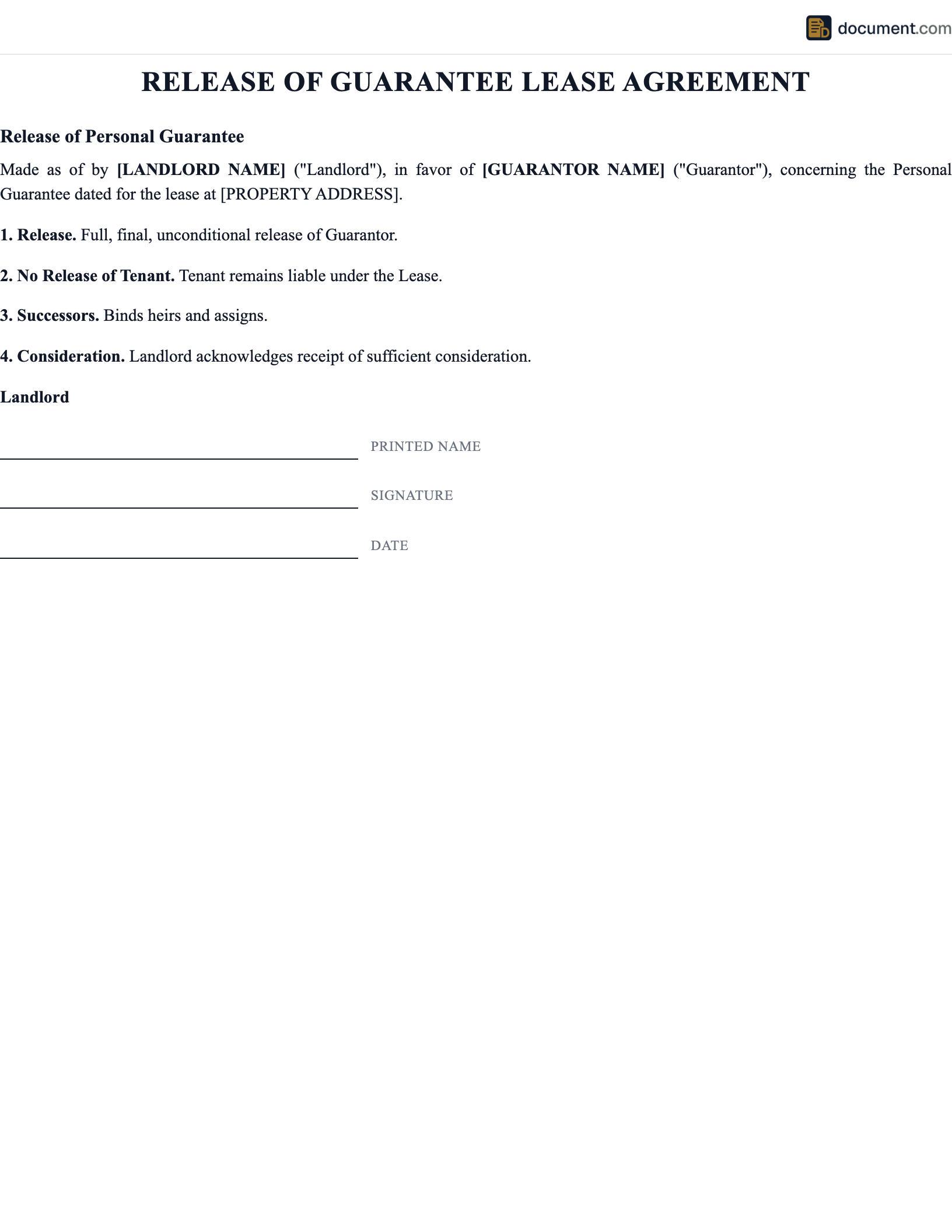
Below is a preview of the Release of Personal Guarantee template. Your customized document will include all provisions for your specific situation.
RELEASE OF PERSONAL GUARANTEE
Guarantor Release Agreement
This document is entered into on [Date] between the parties identified below:
LANDLORD:
Name: [Landlord Name]
GUARANTOR (Being Released):
Name: [Guarantor Name]
How to Use This Document
Build the documentary case before requesting release. Landlords evaluate guarantor releases based on the same underwriting analysis used for any tenant qualification, with added scrutiny because the release removes existing security.
State-Specific Waiver Compliance
Where the original guarantee included broad waivers of suretyship defenses, the release should expressly preserve or override those waivers as appropriate. California Civil Code §2856 requires waivers to be conspicuous (capitalized) and signed with specific reference to rights waived; the release should indicate whether the underlying waivers continue to bind the released party for any pre-release obligations that survive. New York General Obligations Law §15-303 governs releases generally and requires either consideration or recital of consideration on the face of the document; a release reciting one dollar consideration is enforceable, but expressly stating actual consideration (replacement guarantor approval, increased deposit, settlement payment) is preferable.
Assess Eligibility for Release
Document tenant's current qualification: credit reports (FICO 650 to 700+ for most markets), 24 most recent pay stubs or W-2s for income verification (2.5x to 3x rent), 12-month payment history showing no late payments, and bank statements showing reserves of 2 to 6 months rent.
Request Landlord Approval
Submit a written request with the documentation package. The landlord has no statutory obligation to consent unless the original guarantee includes a release-on-condition clause. Be prepared to negotiate consideration (settlement payment, increased deposit, lease re-execution at higher rent).
Arrange a Replacement (If Needed)
A replacement guarantor must complete the landlord's standard application and meet the same financial criteria as the original (typically income of 80x to 100x monthly rent for NYC institutional landlords, lower elsewhere). The replacement signs a new personal guarantee on the landlord's standard form.
Execute the Release Document
Landlord and released guarantor sign with effective date stated. Confirm prospective scope or include express discharge of pre-release liability. Notarize where guarantee exceeds $25,000 to invoke the evidentiary presumption under California Civil Code §1633.11, NY CPLR §4538, or Texas Government Code §406.013.
Key Components
Each component below carries specific evidentiary or contract-formation weight. Skipping any one creates either a discharge defect or a future enforcement gap.
Consideration and Recital Requirements
Under New York Gen. Oblig. Law §15-303 and analogous statutes elsewhere, a release of an existing obligation is enforceable only if supported by consideration or if the release expressly recites consideration. Common forms of consideration include the replacement guarantor's execution of a substitute guarantee, the tenant's tender of an increased security deposit (within state caps), the released guarantor's payment of a settlement amount, and the landlord's general release of any claim against the released guarantor for amounts already accrued. The release should expressly recite the consideration; reciting one dollar consideration is enforceable but expressly stating the actual consideration is preferable for litigation defense.
| Component | Description |
|---|---|
| Original Guarantee Reference | Date and terms of the original personal guarantee |
| Released Party | Full identification of the guarantor being released |
| Release Conditions | Terms that must be met before the release takes effect |
| Effective Date | Specific date from which the guarantor is no longer liable |
| Replacement Guarantor | Details of any substitute guarantor, if applicable |
| Landlord Consent | Signed acknowledgment from the landlord approving the release |
Frequently Asked Questions
Find answers to common questions about the Release of Personal Guarantee.
Resources
Create your Release of Guarantee Lease Agreement in under 10 minutes.
Answer a few questions and download a compliant, attorney-drafted document ready for your state.