



What Is a Personal Guarantee?
A personal guarantee is a legally binding agreement in which an individual personally assumes responsibility for the lease obligations of a tenant, typically a business entity such as an LLC or corporation. By signing a personal guarantee, the guarantor promises to pay the rent and fulfill all other lease terms if the primary tenant fails to do so. This creates a direct obligation between the guarantor and the landlord, allowing the landlord to pursue the guarantor's personal assets if the business tenant defaults on the lease.
Personal guarantees are most commonly required in commercial leases where the tenant is a business entity with limited assets or credit history. Because LLCs and corporations provide their owners with limited liability protection, a landlord has no recourse against the owners' personal assets if the business fails to pay rent — unless a personal guarantee is in place. The guarantee effectively "pierces" the corporate veil for purposes of the lease, giving the landlord an additional layer of security beyond the business entity's assets.
There are two primary types of personal guarantees: unlimited and limited. An unlimited guarantee makes the guarantor liable for the full amount of all lease obligations, including rent, property damage, legal fees, and any other costs. A limited guarantee caps the guarantor's liability at a specific dollar amount or time period. The type of guarantee, along with specific terms such as duration, joint and several liability provisions, and burn-off conditions, are all negotiable elements that should be carefully considered before signing.
Landlords may also require personal guarantees in residential settings when the primary tenant has poor credit, insufficient income, limited rental history, or is a foreign national without a U.S. credit profile. In these cases, a parent, relative, employer, or other financially qualified individual may be asked to guarantee the lease to provide the landlord with additional assurance that the rent will be paid.
Unlimited Guarantee
Full liability for all lease obligations with no cap on total guarantor exposure
Limited Guarantee
Capped liability up to a specific dollar amount or time period for protection
Joint & Several
Multiple guarantors where each is liable for the entire obligation amount
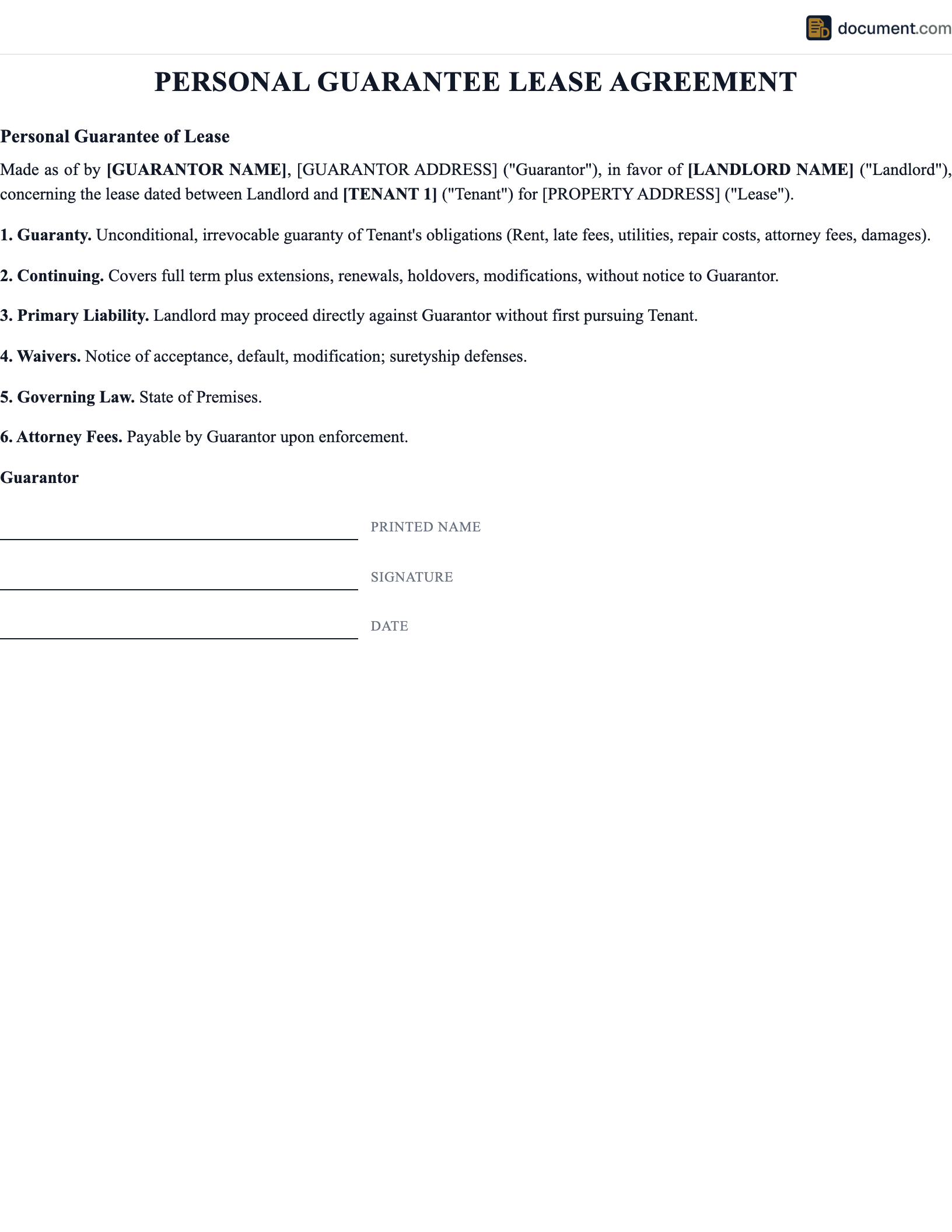
Personal Guarantee Form Preview
Our personal guarantee form includes all fields required for a legally enforceable guarantee. Below is a preview of the key sections. Your customized document will be tailored to your specific lease terms and state requirements.
PERSONAL GUARANTEE OF LEASE
Individual Guarantee of Lease Obligations
LEASE INFORMATION
Tenant Entity: [Business Name]
Landlord: [Landlord Name]
Property Address: [Full Address]
Lease Date: [Date]
GUARANTOR INFORMATION
Name: [Full Legal Name]
Address: [Home Address]
Relationship to Tenant: [Owner / Officer / Other]
GUARANTEE TYPE & TERMS
Type: [Unlimited / Limited]
Maximum Liability: $[Amount or N/A]
Duration: [Full Term / Specified Period]
GUARANTEE OBLIGATIONS
The Guarantor unconditionally guarantees to Landlord the full and timely performance of all obligations of Tenant under the Lease, including payment of rent and all other sums due...
How to Write a Personal Guarantee
Creating a properly structured personal guarantee requires careful consideration of both the landlord's need for security and the guarantor's desire to limit exposure. Follow these steps to draft a comprehensive guarantee.
Identify the Underlying Lease
Reference the specific lease agreement being guaranteed, including the date, parties, property address, lease term, and monthly rent amount. The guarantee must clearly identify which lease obligations it covers. Attach a copy of the lease as an exhibit to the guarantee document so there is no ambiguity about the scope of the guarantor's obligations.
Specify the Guarantor's Identity and Qualifications
Include the guarantor's full legal name, residential address, relationship to the tenant entity (owner, officer, director, family member), and relevant financial qualifications. The landlord will typically verify the guarantor's financial capacity through credit checks, personal financial statements, and income documentation before accepting the guarantee.
Define the Guarantee Type
Clearly state whether the guarantee is unlimited (covering all obligations with no cap) or limited (capped at a specific dollar amount or time period). If limited, specify the exact maximum liability amount and any conditions. Include whether the guarantee covers rent only or extends to damages, legal fees, and other costs. This is often the most heavily negotiated provision.
Address Joint and Several Liability
If there are multiple guarantors, state whether their liability is joint and several (each guarantor is liable for the full amount) or several only (each guarantor is liable only for their proportionate share). Joint and several liability gives the landlord maximum flexibility to pursue any guarantor for the full amount, while several liability limits each guarantor's exposure to their agreed share.
Include Duration and Burn-Off Provisions
Specify how long the guarantee remains in effect. Options include the full lease term, a fixed period (such as the first 24 months), or a declining balance approach where the guaranteed amount decreases over time as the tenant demonstrates reliable performance. Burn-off provisions can incentivize timely payments and reward a strong track record, reducing guarantor risk over time.
Add Waivers and Default Provisions
Include standard guarantee provisions such as waiver of notice of default, waiver of demand for payment, consent to lease modifications, and the landlord's right to pursue the guarantor without first exhausting remedies against the tenant. Define what constitutes a default triggering the guarantee and the process for demanding payment from the guarantor.
Execute and Deliver the Guarantee
The guarantor must sign the guarantee in front of a notary public if required by state law or the landlord. The guarantee should be executed simultaneously with or prior to the lease signing. Each party should retain an original signed copy. The guarantor should keep copies of the lease, guarantee, and all related financial documents for their records.
Key Components of a Personal Guarantee
A well-drafted personal guarantee must include specific elements to be legally enforceable and to clearly define the scope of the guarantor's liability.
| Component | Description |
|---|---|
| Guarantor Name | Full legal name of the individual providing the personal guarantee |
| Tenant Entity | Name of the business entity or individual whose lease is being guaranteed |
| Landlord Name | Name of the landlord or property management company |
| Lease Reference | Date, property address, and term of the underlying lease being guaranteed |
| Guarantee Type | Unlimited (full obligations) or limited (capped amount or time period) |
| Maximum Liability | Dollar cap on guarantor liability (for limited guarantees only) |
| Duration | Time period during which the guarantee remains in effect |
| Joint & Several Liability | Whether each guarantor is liable for the full amount or proportionate share |
| Burn-Off Provisions | Conditions under which guarantee liability decreases or terminates over time |
| Waivers | Guarantor waivers of notice, demand, and other procedural protections |
| Default Triggers | Events that trigger the landlord's right to invoke the guarantee |
| Guarantor Signature | Original signature of the guarantor with date and notarization if required |
Legal Requirements for Personal Guarantees
Personal guarantees must meet specific legal requirements to be enforceable. Because a guarantee is a contract, it must satisfy all elements of a valid contract, plus any additional requirements imposed by state law.
Important: Understand Your Exposure
Signing a personal guarantee creates significant financial risk. The guarantor's personal assets — including bank accounts, real estate, and other property — can be seized to satisfy a judgment if the tenant defaults. Always consult an attorney before signing a personal guarantee and understand the full extent of your potential liability.
Enforceability Requirements
- Written Agreement: Under the Statute of Frauds, a guarantee of another party's obligation must be in writing to be enforceable in virtually every state
- Consideration: The guarantee must be supported by consideration, which is typically the landlord's agreement to enter into or continue the lease with the tenant
- Clear Terms: The scope of the guarantee must be clearly defined, including what obligations are covered and any limitations on liability
- Voluntary Execution: The guarantor must sign voluntarily and with full understanding of the obligations being assumed
Guarantor Protections
Some states provide statutory protections for guarantors, such as requiring the landlord to give notice of tenant default before pursuing the guarantor, or requiring the landlord to first exhaust remedies against the tenant. However, many of these protections can be waived in the guarantee document, so it is critical for guarantors to carefully review all waiver provisions before signing.
Statute of Limitations
The statute of limitations for enforcing a personal guarantee varies by state, typically ranging from 3 to 10 years from the date of the default. The applicable statute of limitations may depend on whether the guarantee is treated as a written contract, a promissory obligation, or some other type of agreement under state law.
Sample Personal Guarantee
Below is a preview of a standard personal guarantee of lease. Your customized document will include state-specific language and terms tailored to your particular situation.
PERSONAL GUARANTEE OF LEASE
Date: _______________
In consideration of the Landlord entering into or continuing the Lease described below, the undersigned Guarantor hereby personally, absolutely, and unconditionally guarantees to Landlord the full and timely performance of all obligations of Tenant under the Lease.
GUARANTEED LEASE
Tenant: _______ | Property: _______ | Lease Date: _______ | Monthly Rent: $_______
GUARANTEE. The Guarantor guarantees to Landlord the prompt payment of all rent and other sums due under the Lease and the faithful performance of all terms, covenants, and conditions of the Lease to be performed by the Tenant.
Guarantor Signature
Printed Name: _______________
Landlord Signature
Printed Name: _______________
Frequently Asked Questions
Find answers to common questions about personal guarantees, liability exposure, negotiation strategies, and when guarantees are typically required.
Official Resources
Use these trusted resources for additional information about personal guarantees, small business leasing, and commercial tenant rights.
SBA — Leasing Commercial Space
Small Business Administration guide to commercial leases
SBA — Manage Your Finances
Financial management resources for small businesses
CFPB Housing Resources
Consumer financial protection for renters and tenants
USA.gov — Landlord-Tenant Law
State-by-state landlord-tenant statutes and resources
Related Lease Documents
Depending on your situation, you may need additional documents alongside your personal guarantee.
Create your Personal Guarantee Lease Agreement in under 10 minutes.
Answer a few questions and download a compliant, attorney-drafted document ready for your state.