



What Is an Affiliate Agreement?
An affiliate agreement is a written contract between a merchant (sometimes called the advertiser, brand, or program owner) and an affiliate (sometimes called the publisher, partner, or promoter) that establishes the terms under which the affiliate will promote the merchant's products or services in exchange for a commission on resulting sales, leads, or other tracked actions. It is the legal foundation of every affiliate program, performance marketing partnership, and influencer commission arrangement, and it converts what would otherwise be an informal handshake into a binding, enforceable relationship with clear rules, payment terms, and remedies if either side fails to perform.
At its core, an affiliate agreement answers four practical questions: what the affiliate is allowed to promote and how, how conversions are tracked and attributed, how much the affiliate gets paid and on what schedule, and when and why either side can walk away. Around those four pillars, a complete agreement layers in trademark license terms, brand guidelines, prohibited promotional methods, FTC disclosure obligations, chargeback and refund handling, audit rights, confidentiality, indemnification, and the standard boilerplate (governing law, dispute resolution, assignment, notices) that every commercial contract needs.
Affiliate agreements differ from traditional sales-rep contracts in several important ways. First, the affiliate is almost always an independent contractor with no authority to bind the merchant or speak on its behalf — they are publishing recommendations to their own audience using their own platforms. Second, the relationship is typically high-volume and low-touch: large affiliate programs may have thousands of participants and the merchant cannot realistically negotiate individual terms with each one, so the agreement is usually presented as a click-through program agreement that the affiliate accepts when they join. Third, affiliate compensation is almost always purely performance-based, with no minimums, draws, or guarantees, which shifts most of the marketing risk onto the affiliate.
Because affiliate marketing exists at the intersection of advertising, e-commerce, tax, and consumer protection law, an affiliate agreement also has to play defense against a surprisingly wide range of legal exposures. The Federal Trade Commission's Endorsement Guides require affiliates to disclose their material connection to the merchant, and enforcement actions in the past several years have made it clear that the merchant is also liable when affiliates fail to disclose. State sales-tax nexus rules can be triggered by in-state affiliates, the CAN-SPAM Act governs any email promotion the affiliate sends, the Lanham Act and trademark law govern keyword bidding and brand use, and the IRS requires Form 1099 reporting for U.S. affiliates earning more than $600 in a year.
Whether you are launching a new affiliate program, formalizing an existing influencer partnership, signing up to a SaaS partner program, or papering a one-off promotional arrangement, our attorney-reviewed templates give you a defensible starting point with the standard provisions every affiliate relationship needs and the flexibility to customize commission structures, attribution windows, prohibited methods, and termination rules for your specific program.
Commission Clarity
Lock in rates, attribution windows, and chargeback rules so neither side is surprised at payout time
FTC Compliance
Build in disclosure obligations and brand guidelines that keep both parties on the right side of the FTC Endorsement Guides
Risk Allocation
Define prohibited promotional methods, indemnities, and termination rights so brand risk stays where it belongs
Affiliate Agreement Form Preview
Below is a visual preview of the sections and fields included in a standard affiliate agreement. Your completed document will be fully formatted and customized for your program type, commission structure, and attribution rules.
Affiliate Program Agreement
Performance Marketing Partnership
Section 1: Parties
Section 2: Commission Structure
Section 3: Tracking & Attribution
Section 4: Prohibited Methods
• Brand-keyword bidding in paid search
• Unsolicited commercial email (spam)
• Bots, click farms, and incentivized traffic
• Cookie stuffing or iframe injection
• Misleading or exaggerated product claims
Section 5: Payment Terms
Section 6: Execution
Merchant Signature
Affiliate Signature
Types of Affiliate Agreements
Affiliate agreements come in several flavors depending on the commission model, the channel, and the relationship structure. Picking the right template up front avoids the painful exercise of retrofitting a contract that doesn't match how you actually pay your partners.
Standard Affiliate Agreement
General affiliate program terms covering commission, tracking, and promotional rights
Pay-Per-Sale (CPS) Agreement
Commission paid only when a referred customer completes a qualifying purchase
Pay-Per-Lead (CPL) Agreement
Commission paid for qualified leads such as form submissions or sign-ups
Pay-Per-Click (CPC) Agreement
Commission paid based on traffic clicks delivered through tracked links
Influencer Affiliate Agreement
Tailored for social media creators promoting products to their audience
Two-Tier Affiliate Agreement
Includes commissions on referred sub-affiliates in addition to direct sales
SaaS Affiliate Agreement
Recurring commissions for subscription software referrals with retention triggers
White-Label Affiliate Agreement
Branded reseller arrangement allowing co-branding or rebranding of offers
International Affiliate Agreement
Cross-border affiliate arrangements addressing tax, currency, and compliance
Affiliate Agreement vs Other Contracts
Affiliate agreements are often confused with adjacent contract types. Understanding the differences keeps you from using the wrong template for the relationship you actually have.
| Document | Pays For | Relationship | Best For |
|---|---|---|---|
| Affiliate Agreement | Tracked conversions (sales, leads, clicks) | Independent publisher; no exclusivity | Performance marketing programs |
| Commission Agreement | Sales closed by a named representative | Direct sales rep, often with quota | Outside sales, manufacturer reps |
| Influencer Agreement | Specific deliverables (posts, videos) | Sponsored content with usage rights | Flat-fee creator campaigns |
| Reseller Agreement | Margin on resold inventory | Reseller takes title to product | Distribution and channel sales |
| Marketing Agreement | Defined services and deliverables | Agency or contractor relationship | Retainer marketing engagements |
| Licensing Agreement | Royalty on licensed IP use | IP owner grants use rights | Brand, content, or patent licensing |
How to Create an Affiliate Agreement
A useful affiliate agreement is built in seven concrete steps. Working through them in order ensures you don't leave commercial holes that you'll have to renegotiate later.
Define your commission model
Decide whether you are paying for sales, leads, clicks, or a hybrid. Lock in the base rate, any volume tiers, new-customer bonuses, recurring commissions for subscriptions, and whether commissions are paid on net or gross order value (after refunds, taxes, shipping, and discounts).
Set the attribution and cookie window
Choose first-click, last-click, or multi-touch attribution and pick a cookie window between 7 and 90 days. Specify how coupon codes interact with cookies, what happens on cross-device journeys, and which tracking platform is the system of record for disputes.
Document prohibited promotional methods
List the channels and tactics that are off-limits: brand-keyword bidding, unsolicited email, incentivized traffic, cookie stuffing, adware, false claims, and any sites containing illegal or adult content. Be specific — vague prohibitions are hard to enforce.
Lock in payment terms
Specify the payment schedule (net-30 or net-60 from month-end), minimum payout threshold, currency, payment method, who bears transfer fees, the lock period for chargebacks, and the affiliate's right to a detailed earnings report.
Add FTC disclosure obligations
Require the affiliate to clearly and conspicuously disclose their material connection to the merchant on every promotion, in compliance with the FTC's Endorsement Guides. Provide approved sample disclosure language so there is no ambiguity.
Include termination and IP terms
Define termination rights for both convenience and cause, the post-termination obligations (stop using brand assets, disable tracking links), the IP license granted to the affiliate, brand guidelines, and what happens to outstanding commissions on termination.
Sign and onboard the affiliate
Execute the agreement (e-signature is fine), provide the affiliate with their unique tracking link, brand assets, approved disclosure language, and any program-specific guidelines. Confirm the affiliate has submitted a W-9 (or W-8BEN for non-U.S.) for tax reporting.
Key Components of an Affiliate Agreement
Every affiliate agreement should contain the following building blocks. Skipping any of them creates the kind of ambiguity that turns a profitable partnership into a dispute.
Parties and recitals
Full legal names, entity types, addresses, and a brief recital of the program purpose
Commission schedule
Rates, tiers, qualifying actions, exclusions, and how commissions are calculated
Tracking and attribution
Cookie window, attribution rules, system of record, and dispute process
Prohibited methods
Detailed list of disallowed promotional tactics and traffic sources
FTC disclosure obligations
Requirement to disclose material connection on every promotion
Trademark license
Limited, revocable license to use brand assets within guidelines
Payment terms
Schedule, threshold, method, currency, and chargeback handling
Term and termination
Initial term, renewal, termination for convenience and cause
Indemnification
Mutual indemnities for IP, FTC, and content-related claims
Governing law and disputes
Choice of law, venue, and dispute resolution mechanism
FTC Disclosure Rules for Affiliates
The FTC's Endorsement Guides (16 CFR Part 255) require affiliates to clearly and conspicuously disclose any material connection with the merchant. The 2023 update significantly tightened the rules and expanded merchant liability for affiliate noncompliance. Your affiliate agreement should require the affiliate to comply with the Guides and provide approved disclosure language.
What "clear and conspicuous" means in practice
- Disclosure must be unavoidable — not buried in a footer or behind a "more" link
- Disclosure must precede the affiliate link or recommendation, not follow it
- Plain language: "I earn a commission" or "paid partnership", not vague terms
- On video, the disclosure must appear visually and audibly
- On social media, hashtags must be visible without expanding the post
- Acceptable: #ad, #sponsored, #paidpartnership. Not acceptable: #sp, #collab, #thanks
Legal Requirements
Affiliate agreements are governed primarily by general contract law, but several federal statutes and regulatory regimes overlay specific obligations on the parties.
- FTC Act Section 5 and the Endorsement Guides (16 CFR Part 255) — material-connection disclosure
- CAN-SPAM Act — governs all commercial email sent by affiliates, even if sent to their own list
- Lanham Act — trademark use, brand-keyword bidding, and confusingly similar domains
- IRS reporting — Form 1099-NEC for U.S. affiliates earning over $600 per calendar year
- State sales-tax nexus rules — in-state affiliates can create sales-tax collection obligations
- GDPR / UK GDPR — applies whenever EU or UK personal data is collected through tracking
- California CCPA / CPRA — applies to California consumer data and tracking pixels
- DSA (EU Digital Services Act) — additional disclosure rules for advertising in the EU
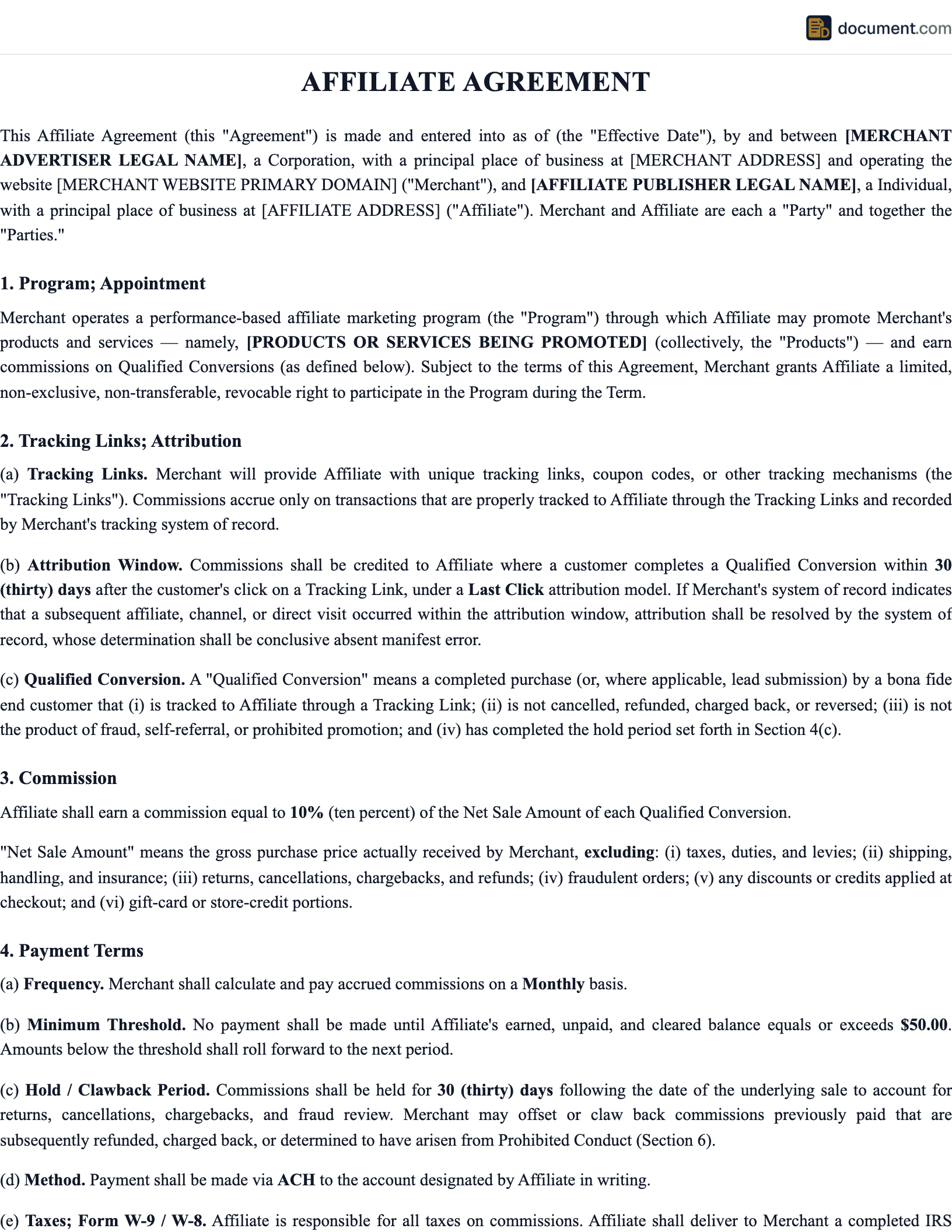
Sample Affiliate Agreement
Below is a condensed preview of our standard affiliate agreement template, showing the structure and key provisions of an attorney-reviewed document.
AFFILIATE PROGRAM AGREEMENT
Performance Marketing Partnership
This Affiliate Program Agreement ("Agreement") is entered into as of[Date]between [Merchant Name]("Merchant") and [Affiliate Name]("Affiliate").
1. PROGRAM ENROLLMENT
Merchant grants Affiliate a non-exclusive, revocable, worldwide right to participate in Merchant's affiliate program and to promote Merchant's products and services using the tracking links, banners, and creative assets provided by Merchant, subject to the terms and restrictions set forth in this Agreement and the Program Policies.
2. COMMISSIONS
Merchant shall pay Affiliate a commission of[%]of Net Order Value for each Qualifying Sale generated through Affiliate's tracking link within the Cookie Window of[days]days. "Net Order Value" means the customer's purchase price excluding taxes, shipping, discounts, and refunded amounts.
3. ATTRIBUTION
Commissions are awarded on a last-click basis. Merchant's tracking platform shall be the sole and final system of record for all commission calculations. Affiliate must raise any tracking dispute in writing within 30 days of the close of the relevant payout period or the dispute is waived.
4. PROHIBITED PROMOTIONAL METHODS
Affiliate shall not: (a) bid on Merchant's trademarks or common misspellings in paid search; (b) send unsolicited commercial email; (c) use bots, click farms, or incentivized traffic; (d) engage in cookie stuffing or iframe injection; (e) make false or misleading claims about Merchant's products; or (f) promote Merchant on websites containing illegal, hateful, or sexually explicit content.
5. FTC DISCLOSURE
Affiliate shall clearly and conspicuously disclose its material connection with Merchant on every promotion in compliance with the FTC Endorsement Guides (16 CFR Part 255). Merchant shall provide approved disclosure language. Affiliate is solely responsible for ensuring its disclosures meet applicable regulations.
6. PAYMENT
Merchant shall pay accrued commissions on a Net-30 basis from the close of each calendar month, subject to a minimum payout threshold of $[Amount]. Merchant may withhold or reverse commissions corresponding to refunded, charged-back, or fraudulent transactions for up to 90 days after the original sale.
7. TERM AND TERMINATION
This Agreement begins on the Effective Date and continues until terminated. Either party may terminate for convenience on 14 days' written notice. Merchant may terminate immediately for cause if Affiliate breaches any prohibited methods clause or violates the FTC disclosure requirements.
8. INDEPENDENT CONTRACTORS
The parties are independent contractors. Nothing in this Agreement creates an employer-employee relationship, partnership, joint venture, or agency. Affiliate has no authority to bind Merchant or make representations on its behalf.
Frequently Asked Questions
Find answers to common questions about commission structures, attribution, FTC disclosure, exclusivity, termination, payment terms, and tracking discrepancies.
Official Resources
For additional information on affiliate marketing law, FTC compliance, tax reporting, and industry standards, consult these official and reputable resources.
FTC Endorsement Guides FAQ
Federal Trade Commission guidance on disclosure requirements for endorsers and affiliates
16 CFR Part 255 - Endorsement Guides
Full text of the FTC Endorsement Guides
FTC CAN-SPAM Compliance Guide
Federal rules governing all commercial email, including affiliate promotional email
IRS Form 1099-NEC
Reporting requirements for nonemployee compensation paid to U.S. affiliates
Performance Marketing Association
Industry trade association with affiliate marketing standards and best practices
USPTO Trademark Resources
Trademark search and registration tools for protecting brand assets used in affiliate programs
Create your Affiliate Agreement in under 10 minutes.
Answer a few questions and download a compliant, attorney-drafted document ready for your state.