
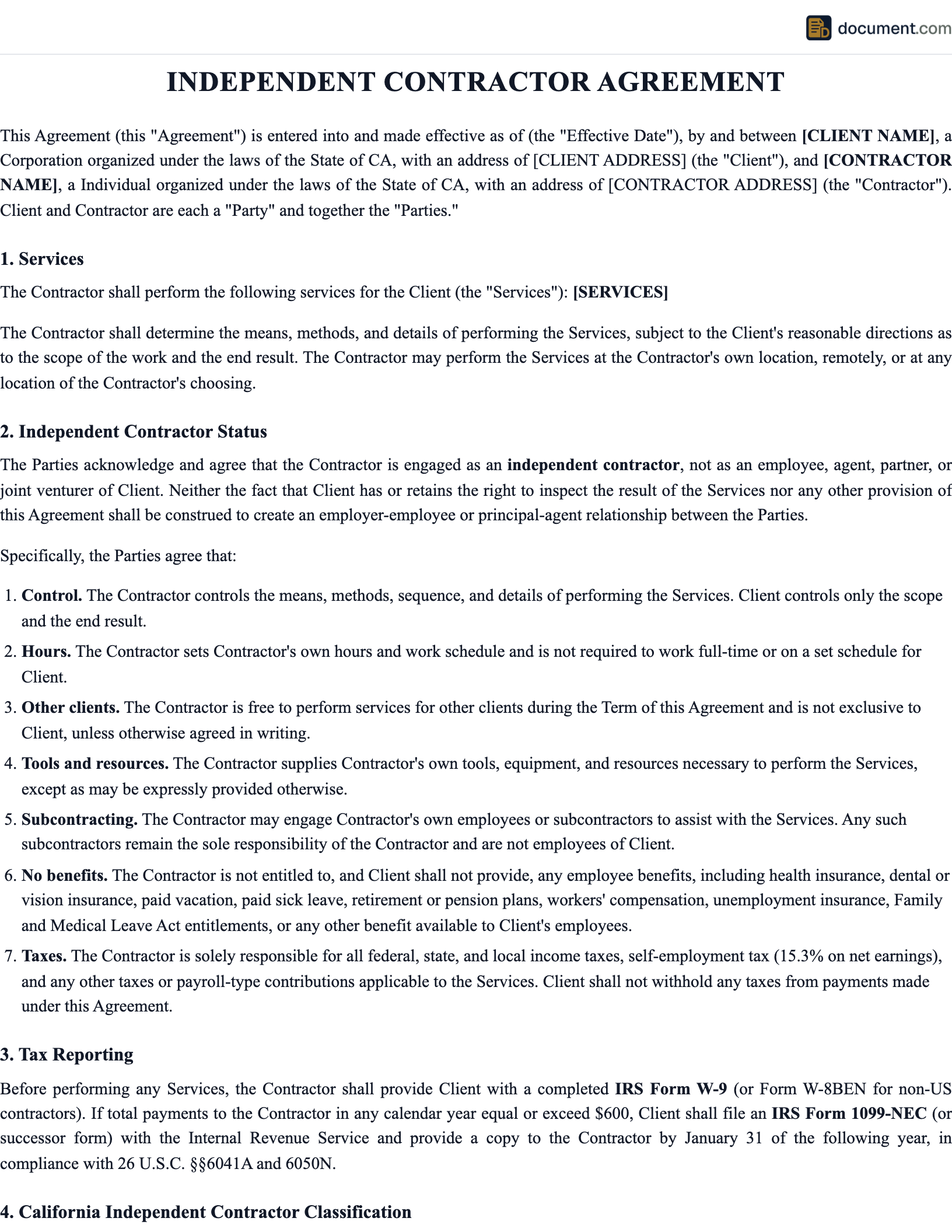



What Is an Independent Contractor Agreement?
An independent contractor agreement is a legally binding contract between a business (the client or hiring party) and a self-employed individual or entity (the independent contractor) that defines the terms under which the contractor will provide services. Unlike an employment agreement, an IC agreement establishes that the worker is not an employee — the client does not withhold taxes, provide benefits, or exercise day-to-day control over how the work is performed. The contractor controls the manner and means of completing the work, uses their own tools and equipment, sets their own schedule, and is free to work for other clients.
The distinction between an independent contractor and an employee is one of the most consequential classifications in U.S. labor and tax law. The IRS, the Department of Labor, state tax agencies, and state labor departments all have their own tests for determining worker status, and the standards vary across jurisdictions. Federal law uses a multi-factor "economic reality" test under the Fair Labor Standards Act (FLSA), while the IRS applies its own behavioral-control, financial-control, and relationship-type analysis. An increasing number of states — including California, New Jersey, Massachusetts, and Illinois — use the stricter ABC test, which presumes worker status is employment unless the hiring party proves otherwise.
A written independent contractor agreement is the foundation of a proper IC relationship. While the written agreement alone does not determine worker classification — the IRS and courts look at the actual working relationship, not just the contract language — the agreement establishes the parties' intent and creates a framework that supports independent contractor status. It also addresses critical business issues such as intellectual property ownership, confidentiality, liability, insurance, dispute resolution, and the terms under which either party can end the engagement.
Our attorney-reviewed independent contractor agreement templates are customized for each state's classification standards, tax requirements, and industry-specific provisions. Whether you are hiring a consultant, freelance developer, construction contractor, marketing agency, or personal service provider, our templates include the specific language that supports proper classification and protects both parties' interests.
Classification Protection
Establish the independent contractor relationship to protect against misclassification claims
IP Ownership
Secure intellectual property rights to work product created by the contractor
Clear Terms
Define scope, deliverables, payment, and termination to prevent disputes
Independent Contractor Agreement Form Preview
Below is a visual preview of the sections and fields included in a standard independent contractor agreement. This mockup illustrates the structure and detail our templates provide. Your completed document will be fully formatted and customized for your specific engagement and state requirements.
Independent Contractor Agreement
Service Engagement Contract
Section 1: Client (Hiring Party)
Section 2: Independent Contractor
Section 3: Scope of Services
Section 4: Compensation
Section 5: Signatures
Client Signature
Contractor Signature
Types of Independent Contractor Agreements
Independent contractor relationships span virtually every industry and profession. Select the agreement type that best fits your engagement to get a template with industry-specific provisions, scope-of-work language, and payment structures.
Consulting Agreement
For professional advisors providing strategic, technical, or management consulting services
Service Agreement
General agreement for contractors providing defined services such as cleaning, landscaping, or maintenance
Retainer Agreement
Ongoing engagement where the contractor reserves availability for a set number of hours per month
Construction Contract
Agreement for general contractors, builders, and construction trades with progress payment terms
Photography Contract
For photographers covering events, portraits, commercial shoots, and licensing usage rights
Nanny Contract
Agreement for nannies, au pairs, and childcare providers with schedule, duties, and household rules
Caregiver Contract
For in-home caregivers providing personal care, companionship, and daily living assistance
Babysitting Contract
Simplified agreement for regular babysitters covering rates, responsibilities, and emergency contacts
Hairstylist Contract
For salon booth renters and freelance stylists covering booth rent, supplies, and client ownership
Personal Training Contract
For fitness trainers covering session rates, cancellation policy, liability waiver, and client goals
DJ Contract
For event DJs covering equipment, setup time, music requests, overtime rates, and cancellation terms
Landscaping Contract
For lawn care, landscaping, and groundskeeping services with seasonal scheduling and scope
Handyman Contract
General handyman services covering labor, materials, project scope, and completion timelines
Electrical Contract
For licensed electricians covering permits, inspections, materials, and code compliance
Plumbing Contract
For licensed plumbers covering labor, parts, permits, warranties, and emergency service terms
Painting Contract
For interior and exterior painting contractors covering prep work, materials, and color selection
Roofing Contract
For roofing contractors covering materials, warranties, permits, and weather delay provisions
Flooring Contract
For flooring installers covering materials, subfloor prep, waste disposal, and warranty
Interior Design Contract
For designers covering design fees, procurement markup, revisions, and intellectual property
Remodeling Contract
For home remodeling projects covering change orders, permits, timelines, and payment schedules
Moving Contract
For moving companies covering inventory, insurance, delivery windows, and damage liability
Catering Contract
For caterers covering menu, headcount, setup/breakdown, tastings, and event-day logistics
Cleaning Contract
For cleaning services covering frequency, scope, supplies, access, and quality standards
Tutoring Contract
For private tutors covering subject areas, session length, cancellation policy, and progress tracking
Pet Sitting Contract
For pet sitters and dog walkers covering pet care instructions, emergency contacts, and liability
Delivery Service Agreement
For independent delivery drivers covering routes, vehicle requirements, and insurance obligations
One-Page IC Agreement
Simplified one-page agreement for straightforward contractor engagements with minimal complexity
Engagement Letter
Professional services engagement letter for attorneys, CPAs, and other licensed professionals
Employee vs Independent Contractor
Understanding the distinction between employees and independent contractors is essential for compliance. Misclassification can trigger severe tax penalties, back-wage liability, and enforcement actions from the IRS, DOL, and state agencies.
Employee
- - Employer controls how the work is done
- - Employer provides tools, equipment, workspace
- - Set schedule and hours determined by employer
- - Paid wages with tax withholding (W-2)
- - Entitled to benefits (insurance, PTO, retirement)
- - Protected by employment laws (FLSA, FMLA, ADA)
- - Work product owned by employer automatically
- - Can be terminated at will (in most states)
Independent Contractor
- - Contractor controls how the work is done
- - Provides own tools, equipment, workspace
- - Sets own schedule and hours
- - Paid per project/invoice, no withholding (1099)
- - No benefits — responsible for own insurance
- - Not covered by most employment laws
- - Owns work product unless assigned in contract
- - Terminated per contract terms only
Key takeaway:The label the parties use does not determine classification — the IRS and courts examine the actual working relationship. Calling someone a "contractor" in an agreement while treating them like an employee in practice is the definition of misclassification.
How to Create an Independent Contractor Agreement: A 7-Step Guide
Creating a proper IC agreement requires careful attention to classification factors, scope definition, IP assignment, and state-specific requirements. Follow these seven steps to create an agreement that protects both parties and supports proper worker classification.
Confirm Independent Contractor Status
Before drafting the agreement, honestly assess whether the worker qualifies as an independent contractor under the applicable federal and state tests. Key indicators of IC status include: the worker controls the manner and means of performing the work, uses their own tools and equipment, works for multiple clients, has an opportunity for profit or loss, and performs work outside the client's core business operations. If the working relationship looks more like employment, use an employment contract instead — no amount of contract language can transform an employee into an independent contractor.
Warning:In states using the ABC test (California, New Jersey, Massachusetts, Illinois), Prong B requires that the worker perform work outside the client's usual course of business. A marketing agency cannot classify its marketing staff as contractors; a software company cannot classify its engineers as contractors.
Define the Scope of Work
Clearly describe the services the contractor will provide, the deliverables expected, the project timeline, and any milestones. Be specific enough to define the engagement but avoid language that dictates how, when, or where the work must be performed — that kind of control suggests an employment relationship. Describe the end result, not the process. Include any acceptance criteria the deliverables must meet and the process for requesting revisions.
Establish Compensation and Payment Terms
Specify whether the contractor will be paid a fixed project fee, an hourly rate, or a retainer. Define the payment schedule (upon completion, in milestones, net-30 invoicing), invoicing procedures, and any expense reimbursement policies. Avoid paying contractors like employees — no salary, no bi-weekly paychecks, no benefits. Payment by project or milestone is the strongest indicator of an IC relationship. Include provisions for late payment penalties if appropriate.
Tip:Collect a completed W-9 form from the contractor before making the first payment. You will need the contractor's taxpayer identification number to file Form 1099-NEC at year end.
Address Intellectual Property Ownership
This is one of the most critical provisions. By default under U.S. copyright law, the independent contractor owns the copyright to work they create — even if you paid for it. Include both a work-made-for-hire clause (effective for certain categories under copyright law) and a broad IP assignment clause that transfers all rights, title, and interest in the work product to the client. Specify that the contractor will execute any further documents needed to perfect the client's ownership. If the contractor will use any pre-existing materials, define their license to the client.
Include Confidentiality and Non-Disclosure Terms
Define what constitutes confidential information, the contractor's obligations to protect it, the permitted uses, and the duration of confidentiality obligations (which typically survive termination). Trade secrets should be protected indefinitely. Include provisions requiring the contractor to return or destroy all confidential materials upon termination. If the engagement involves access to particularly sensitive information, consider a standalone NDA in addition to the contract provisions.
Reinforce Independent Contractor Status
Include explicit provisions that reinforce the IC relationship: the contractor controls the manner and means of work, provides their own tools, is responsible for their own taxes and insurance, is free to work for other clients, is not entitled to employee benefits, and is not the client's agent. Include a statement that the contractor has their own established business and is engaged in a bona fide occupation. These provisions are not dispositive — the actual working relationship matters more — but they establish the parties' intent and framework.
Define Termination and Wind-Down
Specify how either party can end the engagement: termination for convenience (with notice period, typically 14-30 days), termination for cause (material breach, failure to perform, violation of confidentiality), and natural expiration upon project completion. Address what happens upon termination: return of materials and confidential information, delivery of completed and in-progress work product, final invoicing, and survival of provisions like confidentiality, IP assignment, and indemnification.
Key Components of an Independent Contractor Agreement
A comprehensive IC agreement must address every aspect of the engagement, from scope and compensation to intellectual property and dispute resolution. The table below outlines the essential elements.
| Component | Description |
|---|---|
| Party Identification | Full legal names, business names, addresses, and tax identification numbers of both parties |
| Scope of Services | Detailed description of services, deliverables, milestones, and acceptance criteria |
| Compensation | Payment amount (fixed, hourly, retainer), schedule, invoicing, and expense reimbursement |
| Term and Termination | Start date, end date or project completion, termination for convenience and cause, notice periods |
| IC Status Provisions | Explicit statement of independent contractor status, control provisions, tax responsibility, no benefits |
| Intellectual Property | Work-made-for-hire clause, IP assignment, pre-existing materials license, moral rights waiver |
| Confidentiality | Definition of confidential information, non-disclosure obligations, return of materials, survival period |
| Non-Solicitation | Restrictions on soliciting the client's employees or customers for a defined period |
| Insurance | Contractor's obligation to maintain liability insurance, workers' comp (if required), auto insurance |
| Indemnification | Each party's obligation to hold the other harmless from claims arising from their actions |
| Limitation of Liability | Cap on total liability, exclusion of consequential damages, and any carve-outs |
| Dispute Resolution | Choice of mediation, arbitration, or litigation; governing law; venue selection |
| Governing Law | Which state's laws govern interpretation and enforcement of the agreement |
IRS Classification Factors
The IRS evaluates worker classification based on three categories of evidence. No single factor is determinative — the IRS considers the totality of the relationship.
Behavioral Control
Does the company control how the worker does the job?
- - Type and degree of instructions given
- - Evaluation systems measuring methods vs results
- - Training provided by the company
- - Whether work sequence is dictated
Financial Control
Does the worker have business-like financial arrangements?
- - Significant investment in own equipment
- - Unreimbursed business expenses
- - Opportunity for profit or loss
- - Services available to open market
- - Method of payment (per-project vs salary)
Type of Relationship
What is the nature and permanence of the relationship?
- - Written contracts and their terms
- - Employee-type benefits provided
- - Permanency of the relationship
- - Services as key activity of business
Misclassification Risks and Penalties
Worker misclassification is one of the most aggressively enforced areas of labor and tax law. Federal and state agencies devote significant resources to identifying businesses that improperly classify employees as independent contractors to avoid tax obligations, benefits costs, and employment law protections.
Federal Tax Penalties
Liable for back income tax withholding, employer's share of FICA, penalties (up to 100% of tax owed), plus interest
Back Wages and Overtime
Liable for unpaid minimum wage, overtime, and break-period violations under FLSA and state wage laws
Benefits Liability
Retroactive eligibility for health insurance, retirement contributions, stock options, PTO, and other employee benefits
State Penalties
Unpaid state unemployment insurance, workers' comp premiums, and state-specific penalties (CA, NJ, MA impose up to $25K per violation)
Class Action Exposure
Misclassification claims often become class actions covering all similarly situated workers, multiplying damages
Criminal Penalties
Willful misclassification can result in criminal prosecution under federal and state tax fraud statutes
Legal Requirements by State
Independent contractor classification is heavily influenced by state law, and the standards vary dramatically. Some states follow the IRS multi-factor test, while others use the stricter ABC test that presumes employment status unless all three prongs are satisfied.
The ABC Test
Under the ABC test, a worker is presumed to be an employee unless the hiring entity proves all three of: (A) the worker is free from control and direction in performing the work; (B)the work is outside the usual course of the hiring entity's business; and (C)the worker is customarily engaged in an independently established trade or business. Prong B is the most restrictive — it effectively prevents companies from classifying workers who perform the company's core business function as contractors. States using the ABC test include California (AB5), New Jersey, Massachusetts, Illinois, Connecticut, and Vermont.
Key State-Specific Considerations
- California (AB5): Uses the ABC test with limited exemptions for specific professions (doctors, lawyers, accountants, certain freelancers). The strictest IC classification standard in the country. Penalties for willful misclassification range from $5,000 to $25,000 per violation.
- New York:Uses a multi-factor "economic reality" test that examines the degree of control, opportunity for profit/loss, investment in facilities, permanency, and skill required. New York also has industry-specific presumptions for construction workers.
- Texas:Uses a multi-factor right-to-control test that is generally more favorable to IC classification than ABC-test states. Texas examines the degree of control, investment in tools, profit/loss opportunity, and the parties' relationship.
- Florida:Uses a multi-factor analysis but has no state income tax, reducing the state-level tax exposure of misclassification. Workers' compensation and unemployment insurance classification remain important.
- New Jersey: Uses the ABC test and imposes some of the heaviest penalties for misclassification — up to $250 per misclassified worker for first offense, plus back taxes, interest, and potential criminal prosecution for willful violations.
Multi-State Engagements
If a contractor works in multiple states or if the client and contractor are in different states, the classification analysis may need to satisfy the standards of each relevant jurisdiction. The most restrictive state's test generally controls for workers performing services in that state. A contractor who is properly classified in Texas may be deemed an employee in California for work performed there. Include a governing law clause in the agreement, but be aware that the state where the work is performed may apply its own classification standards regardless of the contract's choice of law.
Sample Independent Contractor Agreement
Below is a condensed preview of our independent contractor agreement template. Your completed document will be fully customized for your specific engagement, state, and industry requirements.
INDEPENDENT CONTRACTOR AGREEMENT
Service Engagement Contract
This Independent Contractor Agreement ("Agreement") is entered into as of[Date], by and between:
CLIENT:
Name: [Company / Individual Name]
Address: [Business Address]
EIN: [Tax ID]
CONTRACTOR:
Name: [Contractor Name / Business]
Address: [Contractor Address]
EIN/SSN: [Tax ID]
1. SERVICES
Contractor shall provide the following services: [Description of Services]. Contractor shall complete the services by [Completion Date]. Contractor shall have sole control over the manner and means of performing the services, including the time, place, and method of performance...
2. COMPENSATION
Client shall pay Contractor [Amount][per project / per hour / per month]. Contractor shall submit invoices [frequency]and Client shall pay within [30] days...
3. INDEPENDENT CONTRACTOR STATUS
Contractor is an independent contractor, not an employee of Client. Contractor is solely responsible for all federal, state, and local taxes, including self-employment tax. Contractor is not entitled to employee benefits including health insurance, retirement contributions, workers' compensation, or unemployment insurance...
4. INTELLECTUAL PROPERTY
All work product created by Contractor in connection with the services shall be considered a "work made for hire" as defined by the Copyright Act. To the extent any work product does not qualify as a work made for hire, Contractor hereby irrevocably assigns to Client all right, title, and interest in and to such work product, including all copyrights, patents, and trade secrets...
5. CONFIDENTIALITY
Contractor shall not disclose any Confidential Information of Client to any third party, or use such information for any purpose other than performing the services under this Agreement. This obligation survives termination of this Agreement...
Frequently Asked Questions
Find answers to common questions about independent contractor agreements, worker classification, tax obligations, and IP ownership.
Official Resources
For additional information on independent contractor classification, tax obligations, and state-specific requirements, consult these official resources.
IRS - Worker Classification
IRS guidance on determining whether a worker is an employee or independent contractor
DOL - Misclassification
Department of Labor guidance on employee misclassification under the FLSA
IRS Form SS-8
Request for determination of worker status — file when classification is uncertain
SBA - Hiring Guide
Small Business Administration guide to hiring employees and contractors
Nolo - IC FAQ
Free legal information on independent contractor law and classification
IRS - Form 1099-NEC
Information on reporting non-employee compensation to independent contractors
Ready to Create Your Independent Contractor Agreement?
Select your state, define your engagement terms, and download your attorney-reviewed independent contractor agreement in minutes. Customized for your state's classification standards and fully compliant with IRS requirements.
Create DocumentNo account required. Free to create and preview.