



What Is a Non-Compete Agreement?
A non-compete agreement (NCA) is a contractual provision in which one party — typically an employee, independent contractor, or business seller — agrees to refrain from entering into competition with the other party for a specified period of time after the business relationship ends. The agreement restricts the individual from working for competitors, starting a competing business, or soliciting the company's clients or employees within a defined geographic area and time frame. Non-compete agreements are one of the most heavily litigated areas of employment law because they directly impact a person's ability to earn a livelihood.
Also known as a covenant not to compete, restrictive covenant, or competition restriction clause, non-compete agreements serve to protect an employer's legitimate business interests. These interests typically include trade secrets, proprietary information, customer relationships, and specialized training investments. The core principle is that an employer should be able to protect the value it has built without unreasonably restricting a former employee's right to work. Finding this balance is what makes non-compete law so complex and state-specific.
Non-compete agreements are used across a wide range of business contexts. In the employment context, they are most common for executives, salespeople, engineers, physicians, and other professionals who have access to confidential information or key customer relationships. In business transactions, they are standard when selling a company — the seller agrees not to compete with the buyer for a period of time to protect the goodwill that was part of the purchase price. They also appear in partnership dissolution agreements, franchise agreements, and independent contractor relationships.
For a non-compete agreement to be enforceable in states that permit them, it must generally be reasonable in three dimensions: scope (the activities restricted), duration (how long the restriction lasts), and geography (where the restriction applies). Courts apply a fact-specific analysis weighing the employer's legitimate business needs against the burden imposed on the employee. An agreement that prevents a software engineer from working anywhere in the technology industry worldwide for five years would almost certainly be struck down. One that prevents them from working for a direct competitor within 50 miles for one year is much more likely to survive judicial scrutiny.
Critically, non-compete enforceability varies more by state than almost any other type of legal agreement. California, Oklahoma, North Dakota, and Minnesota ban non-compete agreements for employees almost entirely. Colorado, Oregon, Washington, and Illinois restrict them to higher-earning employees. Massachusetts requires employers to pay "garden leave" compensation during the restricted period. Florida is highly employer-friendly and presumes irreparable harm from a violation. The Federal Trade Commission (FTC) attempted to ban most non-competes nationally in 2024, but the rule was enjoined by federal courts. Understanding your state's specific rules is essential before signing or drafting a non-compete agreement.
Employment Protection
Protect trade secrets, client relationships, and proprietary knowledge from competitors
Business Sale
Ensure sellers do not undermine the value of the business they sold by competing immediately
Reasonable Restrictions
Must be balanced — limited in scope, duration, and geography to be enforceable
Non-Compete Agreement by State
Non-compete enforceability varies dramatically by state — California, Oklahoma, North Dakota, and Minnesota ban most non-competes entirely, while other states apply their own duration, scope, and consideration rules. Select your state for a compliant template.
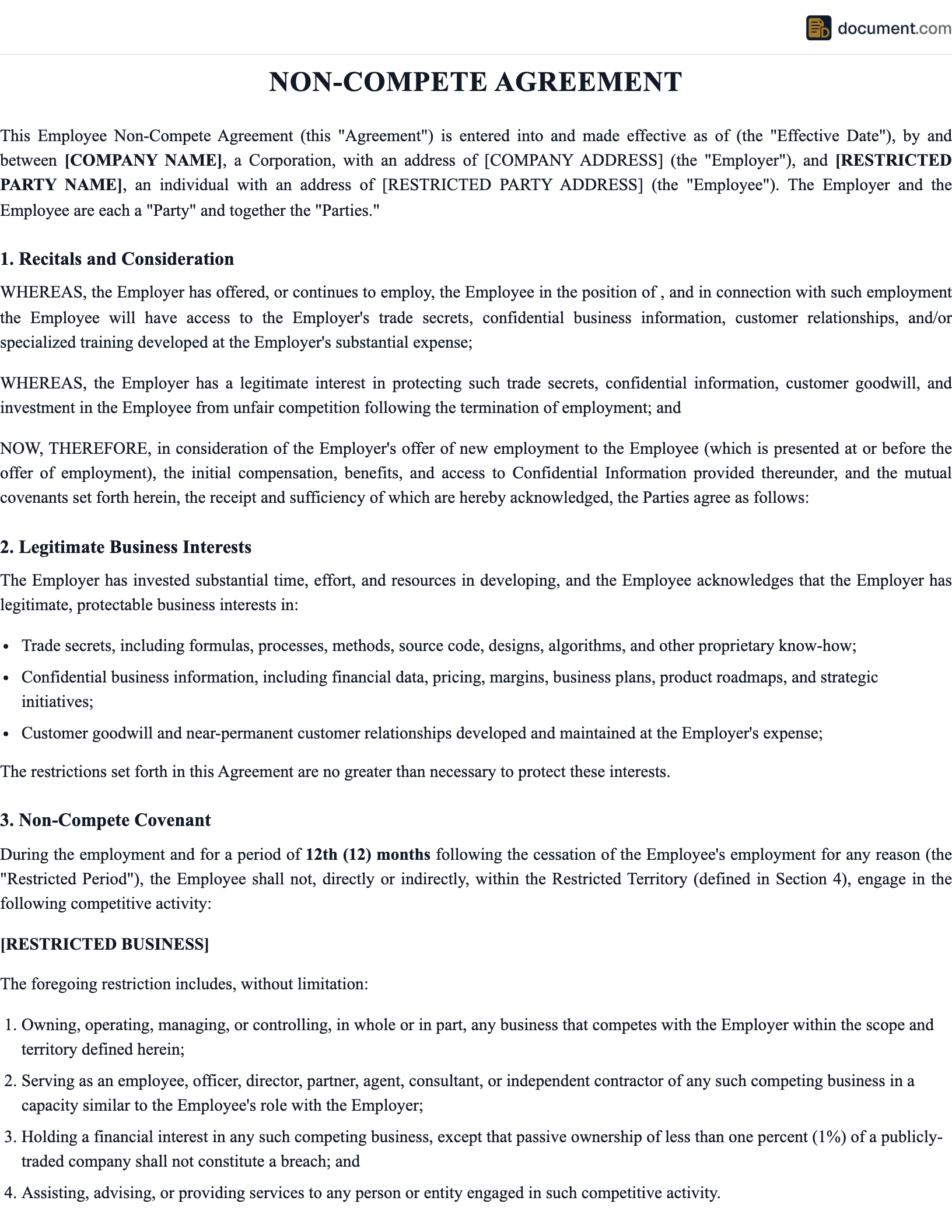
Non-Compete Agreement Form Preview
Our non-compete agreement form includes all the provisions required for enforceability in your state. Below is a preview of the key sections. Your customized document will be tailored to your state's specific enforceability requirements and restrictions.
NON-COMPETE AGREEMENT
Covenant Not to Compete
EMPLOYER / COMPANY INFORMATION
Company Name: [Legal Entity Name]
Address: [Street, City, State, ZIP]
Principal Business: [Industry / Description]
EMPLOYEE / CONTRACTOR INFORMATION
Name: [Full Legal Name]
Title / Position: [Job Title]
Start Date: [Employment Start Date]
RESTRICTED ACTIVITIES
The Employee agrees not to directly or indirectly:
[Specific competing activities prohibited]
Industry Restriction: [Specific industry or field]
GEOGRAPHIC SCOPE
Restricted Area: [Miles radius / Counties / States / Nationwide]
Territory Definition: [Specific geographic boundaries]
DURATION / TIME PERIOD
Restricted Period: [Months / Years] following termination
Start Trigger: [Last day of employment / Date of termination notice]
CONSIDERATION
In exchange for the non-compete restriction, the Employee receives:
[Employment offer / Bonus / Raise / Stock options / Garden pay / Other]
EXCEPTIONS AND CARVE-OUTS
The following activities are excluded from this restriction:
[Passive investments, different industries, etc.]
REMEDIES FOR BREACH
Injunctive Relief: [Available / Per state law]
Liquidated Damages: $[Amount, if applicable]
Attorney's Fees: [Prevailing party / Each party bears own]
GOVERNING LAW & SIGNATURES
Governing Law: State of [State]
Employer Signature: [Authorized Representative]
Employee Signature: [Employee / Contractor]
Date: [Execution Date]
Types of Non-Compete Agreements
Non-compete agreements serve different purposes depending on the relationship between the parties. Select the type that matches your situation to get a form with the right consideration language, enforceability provisions, and state-specific requirements.
Employee Non-Compete Agreement
Standard non-compete for W-2 employees restricting competition after termination. Covers consideration, scope, duration, and state-specific enforceability requirements.
Independent Contractor Non-Compete Agreement
Non-compete tailored for 1099 independent contractors. Addresses stricter judicial scrutiny, misclassification risks, and contractor-specific consideration requirements.
Release of Non-Compete Agreement
Formal release that terminates or modifies an existing non-compete obligation. Used in severance negotiations, layoffs, or mutual agreements to end restrictions early.
Sale of Business Non-Compete Agreement
Non-compete tied to the sale of a business, partnership interest, or professional practice. Enforceable in all 50 states including California, with broader scope and longer duration.
When Are Non-Compete Agreements Used?
Non-compete agreements serve different purposes depending on the business context. Understanding when they are appropriate helps ensure the agreement will survive legal challenge. Here are the most common scenarios where non-competes are employed.
New Employee Onboarding
The most common use of non-compete agreements is as part of the employment offer package for new hires. The employee signs the NCA before starting work, and the offer of employment itself serves as consideration. This is the cleanest scenario because the employee has the opportunity to negotiate or decline before accepting the position. Non-competes are particularly common for sales roles, executive positions, engineers, and anyone with access to trade secrets or proprietary systems.
Executive and C-Suite Agreements
Senior executives, C-suite officers, and board members almost always have non-compete provisions in their employment agreements. Because these individuals have the deepest access to strategic plans, financial information, and key relationships, courts are most willing to enforce non-competes at this level. Executive non-competes typically have broader geographic scope and longer durations than those for rank-and-file employees, and they often include garden leave compensation.
Sale of a Business
When a business is sold, the purchase price includes the value of goodwill — the company's reputation, customer relationships, and brand value. To protect this investment, buyers require sellers to sign a non-compete agreement preventing the seller from starting or joining a competing business. Courts are most willing to enforce non-competes in the sale-of-business context because the seller receives substantial consideration (the purchase price) and the buyer has a clear legitimate interest to protect. Even California, which bans employee non-competes, allows them in connection with the sale of business goodwill.
Partnership Dissolution
When business partners part ways, the remaining partners may require the departing partner to sign a non-compete to protect the partnership's client base, trade secrets, and ongoing operations. Partnership non-competes are treated similarly to sale-of-business non-competes because the departing partner typically receives a buyout payment that serves as consideration. The geographic scope is usually limited to the partnership's existing market area.
Independent Contractor Agreements
Companies hiring independent contractors may include non-compete provisions to prevent the contractor from using the client's proprietary methods, processes, or customer relationships to benefit a competitor. However, courts scrutinize these more heavily because contractors have less job security than employees and typically serve multiple clients. Some states treat contractor non-competes differently from employee non-competes, and misclassification issues can complicate enforcement.
Franchise Agreements
Franchise agreements frequently contain non-compete clauses preventing the franchisee from operating a competing business during and after the franchise term. These clauses protect the franchisor's brand, system, and other franchisees from competition by someone who had access to the franchisor's proprietary methods and training. Post-term non-competes in franchise agreements are generally enforceable if reasonable in scope and duration.
Mergers and Acquisitions
In M&A transactions, non-compete agreements are standard for key employees and founders who are retained after the acquisition. The acquiring company wants to ensure that critical talent does not leave and immediately compete. These non-competes are usually part of a retention package that includes equity, bonuses, or other incentives, providing clear consideration for the restriction. Courts generally enforce M&A non-competes more readily because they are negotiated between sophisticated parties with legal representation.
Trade Secret Protection
When employees have access to highly sensitive trade secrets — formulas, algorithms, customer databases, manufacturing processes, or strategic plans — a non-compete may be the only effective way to prevent misappropriation. While non-disclosure agreements protect against direct disclosure, an employee may inevitably use trade secret knowledge in a competing role even without intentionally sharing it. This "inevitable disclosure" doctrine has been recognized by some courts as grounds for enforcing non-competes, though it remains controversial.
Enforceability Requirements
Courts evaluate five key factors when determining whether a non-compete agreement is enforceable. Failing any one of these factors can render the entire agreement void in many jurisdictions. Understanding these requirements is essential for both employers drafting agreements and employees evaluating them.
Reasonable Time Period
The duration of the restriction must be reasonable given the nature of the business and the employee's role. For employment non-competes, courts typically find 6 months to 2 years reasonable. Massachusetts caps non-competes at 12 months. Oregon also caps at 12 months. Durations exceeding 2 years for employee agreements are frequently struck down. For sale-of-business non-competes, 3 to 5 years is generally acceptable because the buyer needs sufficient time to establish goodwill with acquired customers. The appropriate duration depends on the industry — fast-moving technology sectors may warrant shorter periods than professional services.
Reasonable Geographic Scope
The geographic restriction must be limited to the area where the employer actually does business or where the employee had influence. A company that operates only in three states cannot enforce a nationwide non-compete. Common approaches include a mile radius from the employer's offices, specific counties or states, or the territories the employee managed. For companies with national or global operations, broader geographic restrictions may be justified, but courts will scrutinize whether the full scope is necessary. Some modern agreements use customer-based restrictions instead of geographic ones, prohibiting contact with specific clients rather than work in specific areas.
Legitimate Business Interest
The employer must demonstrate a legitimate business interest that the non-compete protects. Recognized interests include trade secrets, confidential business information, customer relationships and goodwill, specialized training provided at the employer's expense, and unique or extraordinary services. An employer cannot use a non-compete simply to prevent competition or restrict an employee's career mobility. The business interest must be specific and articulable — a vague claim of "protecting our business" is insufficient.
Adequate Consideration
Like any contract, a non-compete requires consideration — something of value exchanged between the parties. For new employees, the offer of employment is generally sufficient consideration in most states. For existing employees, many states require independent consideration beyond continued employment, such as a raise, bonus, promotion, stock options, or access to confidential information. Illinois requires at least two years of continued employment after signing. Massachusetts requires "garden pay" of at least 50% of the employee's highest annualized base salary during the restricted period. Texas requires the non-compete to be ancillary to an otherwise enforceable agreement that provides consideration.
Not Unduly Burdensome on Employee
Even if the other factors are met, a court will not enforce a non-compete that imposes an undue hardship on the employee. This is a balancing test: the employer's interest in protecting its business is weighed against the employee's right to earn a living. A non-compete that effectively prevents a specialist from working in their field entirely is likely to fail this test. Courts consider the employee's education, skills, and ability to find work outside the restricted scope. The public interest is also considered — non-competes that restrict doctors in underserved areas or create a shortage of specialized professionals may be struck down on public policy grounds.
Non-Compete vs Other Restrictive Covenants
Non-compete agreements are just one type of restrictive covenant. Understanding the differences helps you choose the right level of protection. In states that ban non-competes, employers often use these alternative covenants to protect their business interests.
Non-Compete vs Non-Disclosure Agreement (NDA)
| Feature | Non-Compete Agreement | Non-Disclosure Agreement |
|---|---|---|
| What It Restricts | Working for competitors or starting competing business | Disclosing or using confidential information |
| Impact on Employment | Prevents working in specific roles or industries | Can work anywhere but cannot share secrets |
| Enforceability | Varies widely by state; banned in some states | Enforceable in all 50 states |
| Duration | Typically 6 months to 2 years | Often 2-5 years or indefinite for trade secrets |
| Best For | Preventing direct competition | Protecting specific confidential information |
Non-Compete vs Non-Solicitation Agreement
| Feature | Non-Compete Agreement | Non-Solicitation Agreement |
|---|---|---|
| What It Restricts | Working for or starting a competing business | Soliciting specific clients or recruiting employees |
| Scope | Broad — restricts entire categories of work | Narrow — restricts specific contacts only |
| Enforceability | Harder to enforce; banned in some states | More easily enforced; permitted in most states |
| Employee Impact | Significant restriction on career options | Can work for competitors, just cannot poach clients |
Non-Compete vs Confidentiality Agreement
A confidentiality agreement (sometimes used interchangeably with NDA) focuses specifically on protecting proprietary information, trade secrets, and business data. Unlike a non-compete, it does not restrict where or for whom the person can work. Confidentiality agreements are enforceable in all 50 states, including those that ban non-competes. They are often the preferred alternative for California employers who cannot use non-competes but need to protect sensitive information.
Non-Compete vs Garden Leave Clause
A garden leave clause requires the departing employee to serve a notice period during which they remain employed (and paid) but are not required to work and may be prohibited from starting new employment. This effectively functions as a paid non-compete period. Garden leave is common in the United Kingdom and is gaining traction in the United States. Massachusetts now requires a form of garden leave pay (50% of highest annualized base salary) for any non-compete to be enforceable. The advantage for employees is compensation during the restriction period; the advantage for employers is stronger enforceability because the employee is not unfairly burdened.
How to Write a Non-Compete Agreement
A well-drafted non-compete agreement balances protecting your business interests with reasonableness to ensure enforceability. Follow these eight steps to create an agreement that courts will uphold.
Identify the Parties
Clearly identify the employer (company legal name and address) and the employee or contractor (full legal name, position, and start date). If the agreement is in connection with a business sale, identify the buyer and seller entities. Specify whether the agreement binds the employee individually or extends to their agents, affiliates, or family members. Also identify who at the company is authorized to modify or waive the non-compete provisions.
Define Restricted Activities
Be specific about what activities are restricted. Instead of broadly prohibiting "any competing business," specify the particular products, services, or industry segments that are off-limits. For example, "developing, marketing, or selling enterprise customer relationship management software" is far more enforceable than "working in the software industry." Vague restrictions are the most common reason courts invalidate non-competes.
Set Geographic Scope
Limit the geographic restriction to areas where the company actually operates or where the employee had client contact or responsibilities. Options include a specific mile radius, named counties or states, territories the employee managed, or areas where the company has existing customers. For remote or national roles, consider client-based rather than geographic restrictions. The restriction should match the company's actual competitive footprint, not an aspirational one.
Set the Time Period
Choose a duration that is reasonable for the industry and the employee's level of access to sensitive information. For most employment non-competes, 6 to 12 months is the safest range. Up to 2 years may be justified for senior executives or employees with deep trade secret access. Check your state's maximum — Massachusetts and Oregon cap at 12 months, Washington at 18 months. Specify whether the clock starts on the last day of employment, the date of termination notice, or another trigger.
Specify Consideration
Explicitly state what the employee receives in exchange for the non-compete restriction. For new hires, state that the offer of employment is the consideration. For existing employees, provide and document additional consideration — a raise, bonus, stock options, promotion, or access to confidential information. In Massachusetts, you must provide garden pay equal to at least 50% of the employee's highest annualized base salary. In Oregon, the employer must give notice of the non-compete requirement at least two weeks before the start of employment.
Include Exceptions and Carve-Outs
Listing what is not restricted demonstrates reasonableness and helps the agreement survive judicial review. Common exceptions include passive ownership of publicly traded stocks (typically under 5%), work in non-competing divisions of a competitor, academic or teaching positions, volunteer or nonprofit work, and consulting in unrelated industries. Carve-outs show that the agreement targets specific competitive harm rather than broadly restricting the employee's livelihood.
Add a Severability Clause
A severability clause states that if any provision is found unenforceable, the remaining provisions remain in effect. In blue-pencil states, you should also include language authorizing the court to modify overbroad terms to the maximum enforceable extent. This is critical — without severability, one unreasonable provision could void the entire agreement. Even in states that allow blue-penciling, explicit authorization for the court to modify terms strengthens your position.
Get Proper Signatures
Both parties must sign the agreement. The employer's signature should be from an authorized representative (typically an officer, HR director, or other authorized signatory). The employee should sign and date the agreement, and it is best practice to have both parties initial each page. While notarization is not required for non-compete agreements in most states, it can help prove the agreement was signed voluntarily. In Illinois, the employee must be given 14 days to review the agreement before signing, and the employer must advise the employee to consult an attorney.
Key Components of a Non-Compete Agreement
A comprehensive non-compete agreement should include the following components. Each element plays a role in ensuring the agreement is clear, enforceable, and tailored to your state's requirements.
| Component | Description |
|---|---|
| Employer Name & Address | Full legal name and principal place of business of the company |
| Employee / Contractor Name | Full legal name, position, and employment start date |
| Effective Date | Date the agreement becomes effective (usually date of signing or start of employment) |
| Recitals / Background | Context for the agreement — employment relationship, access to confidential information, etc. |
| Defined Terms | Definitions of key terms: "Competing Business," "Restricted Area," "Confidential Information" |
| Restricted Activities | Specific activities the employee may not engage in after termination |
| Geographic Scope | The geographic area where the restrictions apply (miles, counties, states, or nationwide) |
| Duration / Time Period | How long the restriction lasts after the employment relationship ends |
| Consideration | What the employee receives in exchange: employment, bonus, raise, garden pay, stock options |
| Exceptions / Carve-Outs | Activities excluded from the restriction (passive investments, different industries, etc.) |
| Remedies for Breach | Injunctive relief, monetary damages, liquidated damages, attorney's fees |
| Severability Clause | If any provision is unenforceable, remaining provisions survive; court may modify terms |
| Governing Law | Which state's law governs interpretation and enforcement of the agreement |
| Dispute Resolution | Forum selection, mandatory arbitration, mediation requirements, venue |
| Assignment Clause | Whether the agreement transfers to a successor company (acquisition, merger) |
| Signatures | Signatures of both parties, printed names, titles, and date of execution |
FTC Non-Compete Ban
On April 23, 2024, the Federal Trade Commission (FTC) voted 3-2 to issue a final rule that would ban most non-compete agreements nationwide. The rule was one of the most significant proposed changes to employment law in decades, reflecting growing concern that non-competes suppress wages, reduce worker mobility, and stifle innovation.
The rule was scheduled to take effect on September 4, 2024. However, before it could take effect, a federal district court in Texas (Ryan LLC v. Federal Trade Commission) issued a nationwide injunction blocking the rule, finding that the FTC likely exceeded its statutory authority under the FTC Act and that the rule was arbitrary and capricious. The court determined that the FTC's enabling statute does not grant the agency substantive rulemaking authority over unfair methods of competition. This ruling is being appealed.
Current Status (2025)
The FTC non-compete ban is currently NOT in effect. The federal court injunction remains active, and the case is proceeding through the appeals process. Until the legal challenges are resolved, non-compete agreements remain governed by individual state law. Employers should continue to comply with their state's specific non-compete rules and monitor developments closely.
What the FTC Rule Would Do
- Ban new non-competes: Employers could not enter into non-compete agreements with any workers, including employees, independent contractors, and volunteers
- Void existing agreements: Existing non-competes for non-senior executives would become unenforceable
- Notice requirement: Employers would be required to notify affected workers that their non-competes are no longer enforceable
Exemptions
- Senior executives: Existing non-competes for workers earning more than $151,164 annually who are in "policy-making positions" would remain enforceable (but no new ones could be entered)
- Sale of business: Non-competes entered into as part of a bona fide sale of a business entity or substantially all of its operating assets would remain permissible
- Other restrictive covenants: Non-disclosure agreements, non-solicitation agreements, and confidentiality agreements would NOT be affected — only non-competes
Legal Requirements for Non-Compete Agreements
Non-compete law is primarily governed at the state level, and the variation between states is enormous. What is perfectly enforceable in Florida may be void and illegal in California. Before drafting or signing a non-compete, you must understand your specific state's requirements.
States That Ban Non-Competes
California (Bus. & Prof. Code § 16600), Oklahoma(Tit. 15 § 219A), North Dakota (N.D.C.C. § 9-08-06), and Minnesota(Minn. Stat. § 181.988, effective July 2023) prohibit non-compete agreements for employees entirely, with narrow exceptions for the sale of a business. Employers in these states should use NDAs and non-solicitation agreements instead.
State-by-State Enforceability Overview
States fall into several categories regarding non-compete enforcement. Some ban them outright. Others allow them only for higher-earning employees. Many enforce them subject to reasonableness requirements. And some are very employer-friendly with strong enforcement. Knowing where your state falls is the first step in determining your rights and obligations.
The Blue-Pencil Doctrine
The blue-pencil doctrine determines what happens when a court finds part of a non-compete agreement unreasonable. In "blue-pencil" states (such as Texas, Florida, Georgia, Michigan, North Carolina, South Carolina, and many others), courts have the power to modify or narrow the overbroad terms to make the agreement reasonable and then enforce the modified version. For example, if a 5-year restriction is too long, the court might reduce it to 2 years. In contrast, "red-pencil" or "all-or-nothing" states (such as Wisconsin, Nebraska, and historically Arkansas and Virginia) require courts to either enforce the agreement exactly as written or strike it down entirely. The blue-pencil doctrine significantly impacts drafting strategy — in blue-pencil states, employers have an incentive to draft broadly knowing courts will trim; in red-pencil states, employers must draft conservatively or risk losing the entire agreement.
Consideration Requirements for Existing Employees
One of the most common grounds for invalidating a non-compete is lack of adequate consideration. When an employer asks an existing employee to sign a non-compete (as opposed to a new hire), many states require something more than just continued employment. This "independent consideration" can take many forms: a raise, bonus, promotion, stock grant, access to trade secrets, or additional benefits. Illinois specifically requires at least two years of continued employment after signing for the non-compete to be supported by adequate consideration. Without proper consideration, the agreement is a unilateral promise that courts will not enforce.
Sample Non-Compete Agreement
Below is a preview of a standard non-compete agreement. Your customized document will include state-specific enforceability language, consideration requirements, and any mandatory provisions required by your jurisdiction.
CONFIDENTIAL
NON-COMPETE AGREEMENT
Covenant Not to Compete
This Non-Compete Agreement ("Agreement") is entered into as of [DATE], by and between [EMPLOYER NAME]("Employer"), and [EMPLOYEE NAME]("Employee").
WHEREAS, Employer is engaged in the business of [business description]; and Employee has been or will be employed in the position of [job title]; and Employee will have access to Employer's Confidential Information, trade secrets, and client relationships;
NOW, THEREFORE, in consideration of [employment / bonus / raise / other], the parties agree as follows:
1. NON-COMPETE COVENANT
For a period of [months/years] following termination, Employee shall not directly or indirectly engage in [restricted activities] within[geographic area].
2. EXCEPTIONS
[Passive stock ownership under 5%, work in non-competing divisions, etc.]
3. REMEDIES
[Injunctive relief, damages, attorney's fees provisions]
Employer Signature
Name: _______________
Title: _______________
Employee Signature
Name: _______________
Date: _______________
Frequently Asked Questions
Find answers to common questions about non-compete agreements, enforceability, state-specific rules, the FTC ban, and strategies for both employers and employees.
Official Resources
Use these trusted resources for additional information about non-compete agreements, federal rulemaking, state labor laws, and employment rights.
FTC Non-Compete Rulemaking
Federal Trade Commission non-compete rule, status, and public comments
DOJ Antitrust Division
Department of Justice antitrust enforcement and competition resources
U.S. Department of Labor
Federal employment law resources and worker protection information
ABA Section of Labor and Employment Law
American Bar Association resources on employment agreements and restrictive covenants
Related Employment Documents
Depending on your situation, you may need additional documents to complement your non-compete agreement or to use as alternatives in states where non-competes are restricted.
Non-Disclosure Agreement (NDA)
Protect confidential information and trade secrets
Non-Solicitation Agreement
Prevent poaching of clients and employees after departure
Employment Agreement
Comprehensive employment terms including compensation and benefits
Independent Contractor Agreement
Define scope of work, payment, and IP ownership for contractors
Severance Agreement
Separation terms including non-compete enforcement and garden pay
Employment Offer Letter
Formal job offer referencing non-compete as condition of employment
Create your Non Compete Agreement in under 10 minutes.
Answer a few questions and download a compliant, attorney-drafted document ready for your state.