
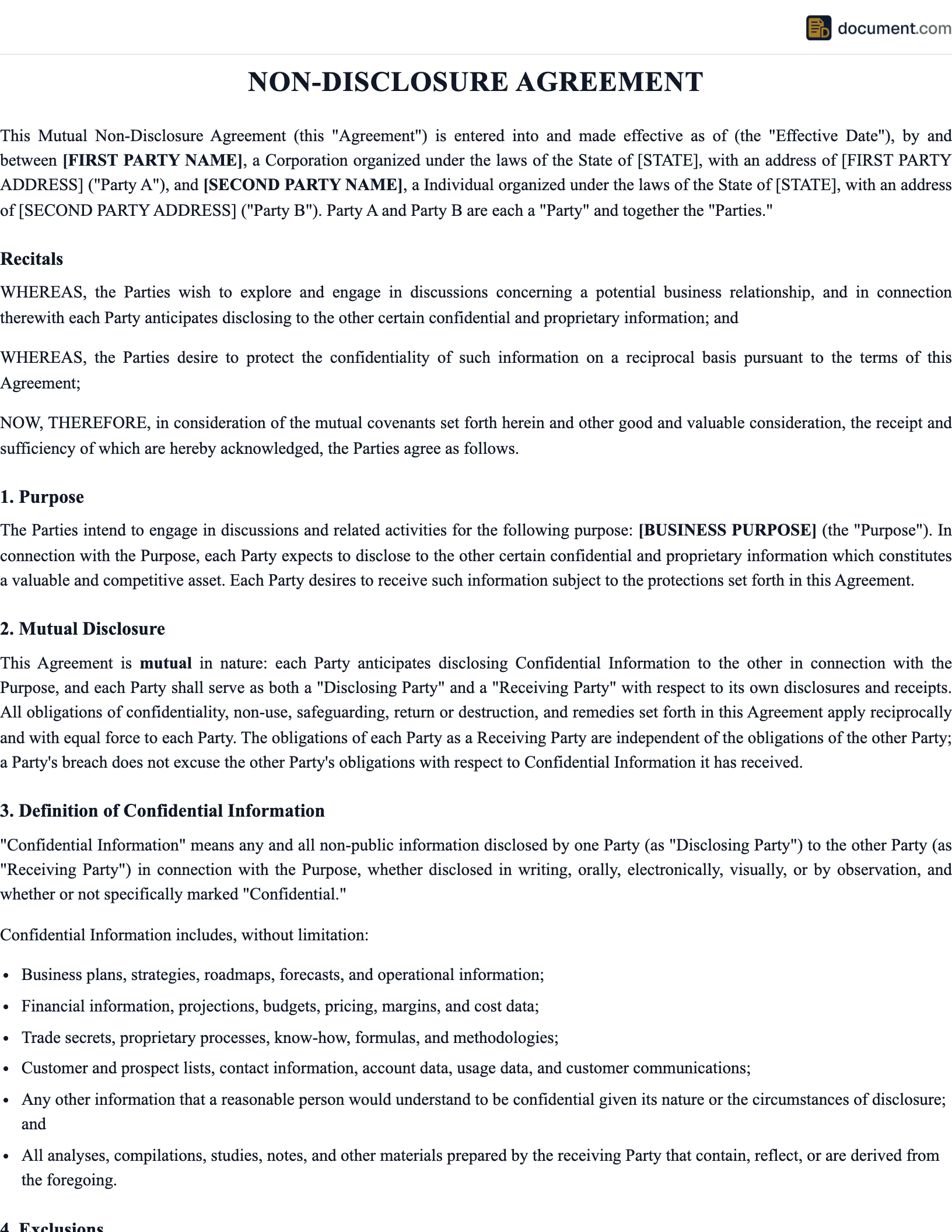



What Is a Non-Disclosure Agreement?
A non-disclosure agreement is a contract that converts informal access to information into a legally enforceable secrecy obligation. The receiving party agrees not to disclose the information to anyone outside the agreement, not to use it for any purpose other than the one stated, and to take reasonable measures to protect it. The disclosing party retains ownership of the information and the right to sue for damages and injunctive relief if the receiving party breaches. NDAs operate at the front end of nearly every commercial relationship: hiring, vendor onboarding, M&A due diligence, investor pitches, joint development, vendor evaluation, and licensing negotiations all begin with one. Confidentiality agreement, secrecy agreement, and proprietary information agreement are interchangeable terms; the legal effect is identical.
Two layers of law govern NDAs. Contract law (governed by the law of the state chosen in the agreement) controls formation, interpretation, and breach remedies. Trade-secret law (the federal Defend Trade Secrets Act, 18 U.S.C. § 1836, plus the Uniform Trade Secrets Act adopted by 48 states) operates in parallel and protects qualifying information regardless of whether the NDA is in force. The interaction matters: the NDA establishes the duty of confidentiality and the procedural framework for enforcement, while trade-secret law provides federal jurisdiction, ex parte seizure, exemplary damages up to twice actual damages, and attorney fees. A well-drafted NDA preserves both regimes by including the whistleblower immunity notice required by 18 U.S.C. § 1833(b).
Mutual vs unilateral vs multilateral
A unilateral NDA binds one party (the receiving party) to protect information disclosed by the other (the disclosing party). Use it when only one side will share, such as a startup pitching investors, an inventor showing a prototype to a manufacturer, or a company onboarding a vendor with access to customer data. A mutual NDA binds both parties because both will share. Use it for M&A talks, joint ventures, technology partnerships, and most strategic discussions. A multilateral NDA covers three or more parties under a single document, common in industry consortia, standards bodies, and collaborative research, where pairwise NDAs would create unnecessary administrative cost. The structural choice affects negotiation dynamics: mutual NDAs settle faster because both parties feel the same restrictions, unilateral NDAs require more careful drafting because the receiving party bears all the risk and will push for narrower scope and shorter duration.
Trade secrets vs confidential information
Confidential information is the broad category: any non-public information the disclosing party wants protected. Trade secrets are a defined statutory subset that meets two tests under DTSA § 1839(3) and the Uniform Trade Secrets Act: the information derives independent economic value from not being generally known, and the owner takes reasonable measures to keep it secret. Customer lists, pricing schedules, marketing plans, internal financials, and business strategies are confidential information; the Coca-Cola formula, the Google ranking algorithm, and a proprietary manufacturing process are trade secrets. The distinction drives drafting. Confidential information should be tied to a finite term (two to five years is the commercial standard) because indefinite restrictions on routine business information look like restraints on competition. Trade secrets should be identified as such and protected for as long as they qualify, which can be perpetual. The strongest NDAs use a hybrid definition that captures both, with separate duration provisions.
Speak Out Act and whistleblower limitations
Three federal regimes carve mandatory disclosures out of every NDA. The Speak Out Act, signed December 7, 2022 and codified at 9 U.S.C. § 401, voids any pre-dispute NDA or non-disparagement clause that would bar a sexual-assault or sexual-harassment claim. The DTSA whistleblower immunity at 18 U.S.C. § 1833(b) protects disclosure of trade secrets to government officials or attorneys made in confidence to report or investigate a suspected violation of law; an employer that omits the required notice forfeits exemplary damages and attorney fees against the employee. SEC Rule 21F-17 makes it unlawful to enforce any agreement that impedes a securities whistleblower from communicating with the SEC; the Commission has fined JPMorgan, BlueLinx, and others for restrictive separation language. Section 7 of the National Labor Relations Act protects employees' right to discuss wages and working conditions regardless of any NDA. Each of these overrides the contract by operation of law, so they should be expressly carved out in the agreement.
Protects Confidentiality
Legally enforceable obligation to keep sensitive information secret
Trade Secret Defense
Establishes the reasonable secrecy efforts required for trade secret status
Universally Enforced
Enforceable in all 50 states unlike non-compete restrictions
NDA Form Preview
Below is a structured preview of the key sections in a non-disclosure agreement. Your final document will be tailored to the type of NDA you select, the parties involved, and the specific information being protected.
NON-DISCLOSURE AGREEMENT
Mutual / Unilateral / Multilateral
DISCLOSING PARTY
Name: [Legal Entity Name]
Address: [Street, City, State, ZIP]
RECEIVING PARTY
Name: [Legal Entity Name]
Address: [Street, City, State, ZIP]
PURPOSE OF DISCLOSURE
Purpose: [Evaluation, partnership, employment, vendor relationship, etc.]
DEFINITION OF CONFIDENTIAL INFORMATION
Categories: [Customer lists, financials, business plans, source code, etc.]
Marking: [Marked confidential / All disclosures]
OBLIGATIONS
1. Keep information strictly confidential
2. Limit access to need-to-know employees
3. Use only for the stated purpose
4. Return or destroy at termination
EXCLUSIONS
(a) Publicly available; (b) Already known; (c) Independently developed; (d) Lawfully received from third party; (e) Required by law
DTSA WHISTLEBLOWER IMMUNITY
Notice under 18 U.S.C. §1833(b): immunity from liability for confidential disclosure to government officials.
DURATION
Term: [2-5 years standard / Perpetual for trade secrets]
GOVERNING LAW & SIGNATURES
Governing Law: [State]
Disclosing: [Signature]
Receiving: [Signature]
Date: [Date]
Types of NDAs
Choose the NDA type that matches your relationship and the direction of information flow.
Mutual NDA
Both parties exchange and protect each other's confidential information
Unilateral NDA
One party shares confidential information with another who agrees to keep it secret
Confidentiality Agreement
General confidentiality protections built into employment, consulting, or vendor contracts
HIPAA Business Associate Agreement
HIPAA-compliant agreement covering protected health information shared with vendors
Violation
Notice and demand letter sent when a party breaches NDA confidentiality terms
NDA vs Non-Compete vs Confidentiality Clause
These three tools all protect business interests but operate very differently.
| Feature | NDA | Non-Compete | Confidentiality Clause |
|---|---|---|---|
| Protects | Specific information | Future employment | Information within a contract |
| Standalone document? | Yes | Sometimes | No (embedded) |
| Enforceability | All 50 states | Banned in CA, OK, ND, MN | All 50 states |
| Typical duration | 2-5 years (perpetual for trade secrets) | 6 months to 2 years | Same as host contract |
| Federal protection | DTSA available | No | DTSA available |
How to Write an NDA
An enforceable NDA has ten working parts. Drop any one of them and the agreement becomes a litigation risk rather than a litigation tool. The order below tracks the structure most courts expect to see, and it matches the order in which a judge will read the document during a temporary restraining order hearing. Every clause should be specific enough that a stranger reading the agreement two years later can answer the question "what counts as confidential and what does the receiving party have to do about it?" without needing to interview either party.
Two drafting choices carry outsized weight. The definition of Confidential Information sets the scope of every other provision: too narrow and protected information falls outside; too broad and the entire agreement may be unenforceable as a restraint on competition. The duration provision sets the back-end risk: a flat 10-year term for routine business information will be reduced or struck in California (Cal. Bus. & Prof. Code § 16600) and viewed skeptically in most other states. Tier the duration by information type and the agreement holds up.
Three statutory carve-outs are non-negotiable: the DTSA whistleblower notice (18 U.S.C. § 1833(b)), the Speak Out Act limitation on pre-dispute restrictions covering sexual harassment and assault (9 U.S.C. § 401), and SEC Rule 21F-17 protections for securities whistleblowers. Drafting around them does not work; the law overrides the contract.
Defining Confidential Information
Use a hybrid definition with two parts. Part one is a broad catch-all: "any non-public information disclosed by Disclosing Party to Receiving Party in connection with the Purpose, in any form (oral, written, electronic, or visual), whether or not marked confidential." Part two enumerates categories so the boundary is concrete: customer lists, pricing schedules, business plans, financial statements, technical specifications, source code, formulas, processes, marketing strategies, and trade secrets. If oral disclosures are covered, require the disclosing party to confirm them in writing within 30 days; this is the industry-standard solution to the evidentiary problem that orals create. If the disclosing party intends to mark documents "Confidential," say so, and treat unmarked information as confidential by default to avoid an inadvertent waiver.
Setting duration that holds up
Two to five years is the enforceable range for ordinary commercial information in every state. Trade secrets should remain protected for as long as they qualify, which the agreement can express as "perpetual, or until the information ceases to qualify as a trade secret under applicable law, whichever occurs first." California treats anything longer than five years for non-trade-secret information as suspect under § 16600. Massachusetts Noncompetition Agreement Act (Mass. Gen. Laws ch. 149, § 24L) caps employee post-employment confidentiality scope at 12 months for ordinary information. Build in a survival clause: post-termination obligations to return or destroy materials, continuing confidentiality, and remedies survive the term and any earlier termination.
Choose the structure
Unilateral when only one party shares (investor pitch, employee onboarding). Mutual when both share (M&A, joint venture). Multilateral for three or more parties under one document.
Identify the parties
Use the registered legal entity name as it appears with the Secretary of State. For affiliates, define the term and decide whether disclosures to or from affiliates are covered. Verify signatory authority by board resolution for material agreements.
State the purpose
Narrow purpose narrows scope of permitted use. "Evaluating a potential acquisition of Disclosing Party" is enforceable; "general business discussions" is not.
Define confidential information
Hybrid definition: broad catch-all plus enumerated categories plus marking convention plus oral-disclosure procedure. Identify trade secrets separately so they get perpetual treatment.
Specify the obligations
Hold in confidence, use only for the Purpose, limit access to need-to-know personnel bound by similar obligations, protect with at least reasonable care (and not less than the care used for own confidential information), return or destroy at termination.
Include standard exclusions
Public information, prior knowledge, independent development, third-party disclosure without obligation, and disclosure compelled by law or court order. Carve out the DTSA whistleblower immunity, the Speak Out Act limitation, and SEC Rule 21F-17.
Add DTSA immunity language
Verbatim notice under 18 U.S.C. § 1833(b)(3): an individual is not liable for disclosure of a trade secret made in confidence to a federal, state, or local official, or to an attorney, solely to report or investigate a suspected violation of law. Without this, exemplary damages and attorney fees are unavailable.
Set the duration
Two to five years for ordinary information, perpetual for trade secrets. Add a survival clause covering return of materials, continuing confidentiality, and remedies.
Specify remedies
Acknowledge that breach causes irreparable harm and that money damages are inadequate, supporting injunctive relief without bond. Add fee-shifting (the prevailing party recovers attorney fees) to align with DTSA § 1836(b)(3)(D).
Choose governing law and venue
Pick a state with developed trade-secret case law (Delaware, New York, California for tech, Texas for energy) and a court with subject-matter jurisdiction. Federal jurisdiction is automatic under the DTSA for trade-secret claims affecting interstate commerce.
Key Components
Every enforceable NDA contains these core provisions.
Parties
Disclosing party, receiving party, and any related affiliates.
Definition of confidential information
Specific categories and marking requirements.
Permitted purpose
The specific reason for sharing confidential information.
Confidentiality obligations
Duty to protect, limit access, and prevent disclosure.
Standard exclusions
Information not subject to confidentiality obligations.
DTSA immunity
Federally required whistleblower notice.
Term and termination
Duration of obligations and return/destruction of information.
Remedies
Injunctive relief, monetary damages, attorneys' fees.
Trade Secrets and the DTSA
The Defend Trade Secrets Act of 2016, codified at 18 U.S.C. § 1836, created a federal cause of action for trade-secret misappropriation that runs in parallel to state law (the Uniform Trade Secrets Act, adopted by 48 states; New York and North Carolina rely on common law). Federal jurisdiction is available whenever the trade secret is used in or intended for use in interstate or foreign commerce, which captures essentially every commercial trade-secret claim. The plaintiff chooses federal or state court. Federal court is the typical preference because of broader discovery, ex parte seizure under § 1836(b)(2), and uniform precedent.
Remedies stack. Actual loss to the owner plus the defendant's unjust enrichment (without double-counting) are baseline. Exemplary damages up to twice the actual damages are available for willful and malicious misappropriation. Attorney fees are available where the misappropriation is willful, where a claim is brought in bad faith, or where a motion to terminate an injunction is made or opposed in bad faith (§ 1836(b)(3)(D)). The statute of limitations is three years from discovery, with a continuing-misappropriation rule that treats the wrongful conduct as a single claim. Criminal prosecution under the Economic Espionage Act, 18 U.S.C. § 1832, is available for intentional misappropriation, with penalties up to 10 years' imprisonment and fines of $5 million for organizations.
The two-element trade-secret test
Trade-secret status under DTSA § 1839(3) requires two elements proven independently. First, the information must derive independent economic value, actual or potential, from not being generally known to and not being readily ascertainable through proper means by another person who could obtain economic value from its disclosure or use. Second, the owner must take reasonable measures to keep the information secret. Reasonable measures include written confidentiality policies, signed NDAs, limited need-to-know access, password protection and encryption, document marking, exit interviews that recover materials, and physical access controls. The Seventh Circuit's analysis in Rockwell Graphic Systems v. DEV Industries, 925 F.2d 174 (7th Cir. 1991), remains the leading authority on what counts as reasonable: the measures must be cost-justified, not perfect.
Ex parte seizure under § 1836(b)(2)
In extraordinary circumstances, a DTSA plaintiff can obtain an ex parte order directing federal marshals to seize misappropriated trade secrets before the defendant has notice. The standard is high: the plaintiff must show that no other equitable relief would be adequate, that immediate and irreparable injury will occur otherwise, that the defendant would destroy or hide the materials if given notice, and that the harm to the plaintiff outweighs the harm to the defendant. Seized materials are held in court custody pending an adversarial hearing within seven days. Wrongful seizure exposes the plaintiff to damages and attorney fees under § 1836(b)(2)(G). The remedy is rare in practice (Westlaw shows roughly 50 reported orders since 2016) but it is the most powerful tool in the trade-secret enforcement arsenal.
DTSA whistleblower immunity notice
Section 1833(b)(3) requires every employer to provide notice of trade-secret immunity in any contract or agreement with an employee or contractor that governs the use of trade secrets or other confidential information. The notice tells the employee that they cannot be held criminally or civilly liable under any federal or state trade-secret law for the disclosure of a trade secret made in confidence to a federal, state, or local government official, either directly or indirectly, or to an attorney, solely for the purpose of reporting or investigating a suspected violation of law. The penalty for omission is forfeiture of exemplary damages and attorney fees against the employee in any DTSA action. The notice can be either reproduced in the agreement itself or referenced via a cross-reference to the employer's policy document. Reproducing it verbatim is the safer practice because policy documents change without the employee's signature.
Standard Exclusions from Confidentiality
Five contractual exclusions and three statutory exclusions limit what an NDA can cover. The contractual exclusions prevent the agreement from being weaponized to claim ownership of information that is not actually confidential. The statutory exclusions are imposed by federal law and override the contract regardless of any waiver. Drafted properly, the exclusions section runs about 200 words and resolves nearly every later dispute about what falls inside or outside the agreement.
The five contractual exclusions are: information that becomes public through no fault of the receiving party, information already known to the receiving party before disclosure (with contemporaneous documentation), information independently developed without reference to the confidential information, information lawfully received from a third party without confidentiality obligations, and information compelled by law, court order, or regulator. Each exclusion places the burden of proof on the receiving party. Drafting tip: require the receiving party to give the disclosing party prompt written notice of any compelled disclosure (subpoena, regulator request, court order) so the disclosing party can seek a protective order before production.
The three statutory exclusions are: DTSA whistleblower disclosures to government officials and attorneys for reporting violations of law (18 U.S.C. § 1833(b)); pre-dispute restrictions on sexual-harassment and sexual-assault claims under the Speak Out Act (9 U.S.C. § 401); and securities-whistleblower communications with the SEC under Dodd-Frank and Rule 21F-17. The NLRA Section 7 protection of concerted activity (including discussions of wages and working conditions) operates as a fourth statutory limit in the employment context. Drafting tip: include each exception as an express carve-out in the agreement so the receiving party knows what is permitted and the agreement does not appear to overreach.
Publicly available information
Information that is or becomes publicly available through no fault or wrongful act of the receiving party.
Prior knowledge
Information that was already known to the receiving party before disclosure, as documented by the receiving party's records.
Independent development
Information that is independently developed by the receiving party without reference to or use of the confidential information.
Third-party disclosure
Information lawfully received from a third party who is not under any confidentiality obligation to the disclosing party.
Required by law
Information required to be disclosed by law, court order, regulation, or government investigation.
Whistleblower disclosures
Information disclosed in confidence to government officials when reporting suspected violations of law (DTSA immunity).
Legal Requirements
An NDA must satisfy three layers of requirements: basic contract formation, confidentiality-specific drafting standards, and statute-specific carve-outs that operate by force of federal law. A failure at any layer can void the agreement or strip its most useful remedies. Contract formation requires offer, acceptance, consideration, mutual assent, and signatures by parties with authority to bind. Consideration is rarely a problem in commercial NDAs because the exchange of information itself supplies it; in employment NDAs, continued employment counts in most states, but a few jurisdictions require additional consideration for an NDA imposed mid-employment (Pennsylvania under Pulse Technologies v. Notaro, 67 A.3d 778 (Pa. 2013), Minnesota, and Texas).
Confidentiality-specific standards require a definition of Confidential Information specific enough to put the receiving party on notice, a stated permitted purpose, a duration tied to the type of information (two to five years for ordinary information, perpetual for trade secrets), the standard exclusions, and a remedy clause that supports injunctive relief. Indefinite NDAs covering ordinary business information face reasonableness challenges in California (Cal. Bus. & Prof. Code § 16600 read by AMN Healthcare v. Aya Healthcare, 28 Cal. App. 5th 923 (2018) to limit even non-solicitation provisions), and several other states reduce them to a reasonable period.
Statute-specific carve-outs are the third layer. The DTSA whistleblower notice (18 U.S.C. § 1833(b)) is required in any agreement with an employee or contractor governing trade secrets; omission forfeits exemplary damages and attorney fees. The Speak Out Act (9 U.S.C. § 401) voids pre-dispute restrictions on sexual-harassment and sexual-assault claims. SEC Rule 21F-17 voids restrictions on securities-whistleblower communications. NLRA Section 7 protects concerted activity. Each operates regardless of the parties' contrary intent.
Consideration in employment NDAs
When an NDA is signed at the outset of employment, the offer of employment is consideration in every state. When an NDA is imposed mid-employment, the rules diverge. In most states, continued at-will employment is sufficient consideration. Pennsylvania (Pulse Technologies, 2013), Minnesota (Davies & Davies Agency v. Davies, 298 N.W.2d 127 (Minn. 1980)), and a handful of others require new consideration: a raise, a promotion, a bonus, or a stock grant. Massachusetts under the 2018 Noncompetition Agreement Act (Mass. Gen. Laws ch. 149, § 24L) requires \"garden leave\" pay for non-competes but treats NDAs separately. In jurisdictions that require fresh consideration, a $100 signing bonus tied specifically to the new agreement, paid contemporaneously with execution, is the cheapest reliable cure.
Choice of law and venue
The chosen-law clause governs interpretation of the NDA and the available remedies, subject to public-policy limits. Delaware, New York, and California are the most common choices for commercial NDAs because each has developed trade-secret and confidentiality case law. California public policy will refuse to enforce an out-of-state choice-of-law clause that would impose a non-compete or overlong NDA on a California employee, under Cal. Lab. Code § 925 for employment agreements signed in California. Federal jurisdiction over a DTSA claim is automatic where the trade secret is used in or intended for use in interstate commerce, regardless of the contractual venue clause. A typical commercial NDA pairs a Delaware governing-law provision with consent to jurisdiction in either Delaware state court or the federal court of any state where the breach occurs.
Signatures, electronic execution, and counterparts
An NDA is enforceable when signed by parties with authority to bind. Notarization is not required in any state. Electronic signatures are valid under the federal E-SIGN Act (15 U.S.C. § 7001) and the Uniform Electronic Transactions Act adopted in 49 states (New York has its own statute, N.Y. Tech. Law § 304). DocuSign, Adobe Sign, and similar platforms produce execution audit trails that hold up in court. Authority to bind is the more common problem. For corporate parties, signature by an officer is presumed authorized; for an LLC, signature by a manager or member with authority under the operating agreement; for a partnership, by a general partner. For high-value NDAs (M&A, large licensing deals), request a board resolution or a representations clause confirming the signatory's authority.
In writing
Oral confidentiality agreements are difficult to enforce. Always use a written NDA.
Specific scope
Confidential information must be defined with specificity, not vaguely as 'all information.'
Reasonable duration
Term must be reasonable for the type of information protected.
Adequate consideration
Each party must give something of value: information exchange, payment, or contractual relationship.
Authority to sign
Signatory must have actual or apparent authority to bind the entity.
DTSA compliance
Whistleblower immunity language is required for trade secret protection.
State Law Considerations
This document can still be affected by state law even when we do not maintain a dedicated state-by-state route for it yet. Review local execution rules, filing standards, and agency guidance before relying on the final form.
Execution Rules
Witness, notary, delivery, and recordkeeping requirements can vary by jurisdiction and by the way the document will be used.
Agency Forms
State agencies, courts, and licensing boards sometimes publish their own approved forms or instructions that should be reviewed alongside this template.
Enforcement Standards
Consumer-protection, contract, probate, employment, or property rules may change the enforceability of key provisions depending on where the document is signed or performed.
Sample NDA
Below is the operative language of a representative mutual NDA. Your final document will include state-specific provisions, DTSA immunity language, and other required terms.
MUTUAL NON-DISCLOSURE AGREEMENT
This Mutual Non-Disclosure Agreement ("Agreement") is entered into as of [DATE], by and between [PARTY A] and [PARTY B](collectively, the "Parties").
1. PURPOSE. The Parties wish to explore [BUSINESS PURPOSE] and in connection therewith may disclose to each other certain confidential information.
2. CONFIDENTIAL INFORMATION."Confidential Information" means any non-public information disclosed by one Party ("Disclosing Party") to the other ("Receiving Party"), whether oral, written, or in electronic form, including but not limited to business plans, customer lists, financial information, pricing, technical data, source code, marketing strategies, and trade secrets.
3. OBLIGATIONS. The Receiving Party shall (a) hold all Confidential Information in strict confidence; (b) use it only for the Purpose; (c) limit access to employees, agents, and advisors with a need to know who are bound by similar confidentiality obligations; (d) protect it with the same degree of care it uses for its own confidential information, but not less than reasonable care; and (e) return or destroy it upon request.
4. EXCLUSIONS. The obligations herein do not apply to information that (a) is or becomes publicly available through no fault of the Receiving Party; (b) was already known to the Receiving Party prior to disclosure; (c) is independently developed by the Receiving Party without reference to the Confidential Information; (d) is lawfully received from a third party without confidentiality obligations; or (e) is required to be disclosed by law or court order.
5. DTSA NOTICE. Pursuant to 18 U.S.C. §1833(b), an individual shall not be held criminally or civilly liable under any federal or state trade secret law for the disclosure of a trade secret that is made in confidence to a federal, state, or local government official, either directly or indirectly, or to an attorney, solely for the purpose of reporting or investigating a suspected violation of law.
6. TERM. This Agreement shall remain in effect for [3 years] from the date of execution. Trade secret obligations shall continue for as long as the information qualifies as a trade secret under applicable law.
7. REMEDIES. The Parties acknowledge that breach of this Agreement may cause irreparable harm for which monetary damages are inadequate, and the non-breaching Party shall be entitled to injunctive relief in addition to all other available remedies.
8. GOVERNING LAW. This Agreement shall be governed by the laws of the State of [STATE].
Party A Signature
Name: _______________
Title: _______________
Party B Signature
Name: _______________
Title: _______________
Frequently Asked Questions
Common questions about NDAs, enforceability, trade secrets, the DTSA, and confidentiality obligations.
Official Resources
Trusted resources for additional information on NDAs, trade secret law, and confidentiality obligations.
USPTO Trade Secret Policy
Federal trade secret law and DTSA enforcement information
DOJ Economic Espionage Resources
Federal criminal trade secret prosecution under 18 U.S.C. §1832
HHS HIPAA Business Associate Guidance
HIPAA Business Associate Agreement requirements for protected health information
ABA Section of Intellectual Property Law
American Bar Association resources on trade secrets and confidentiality