
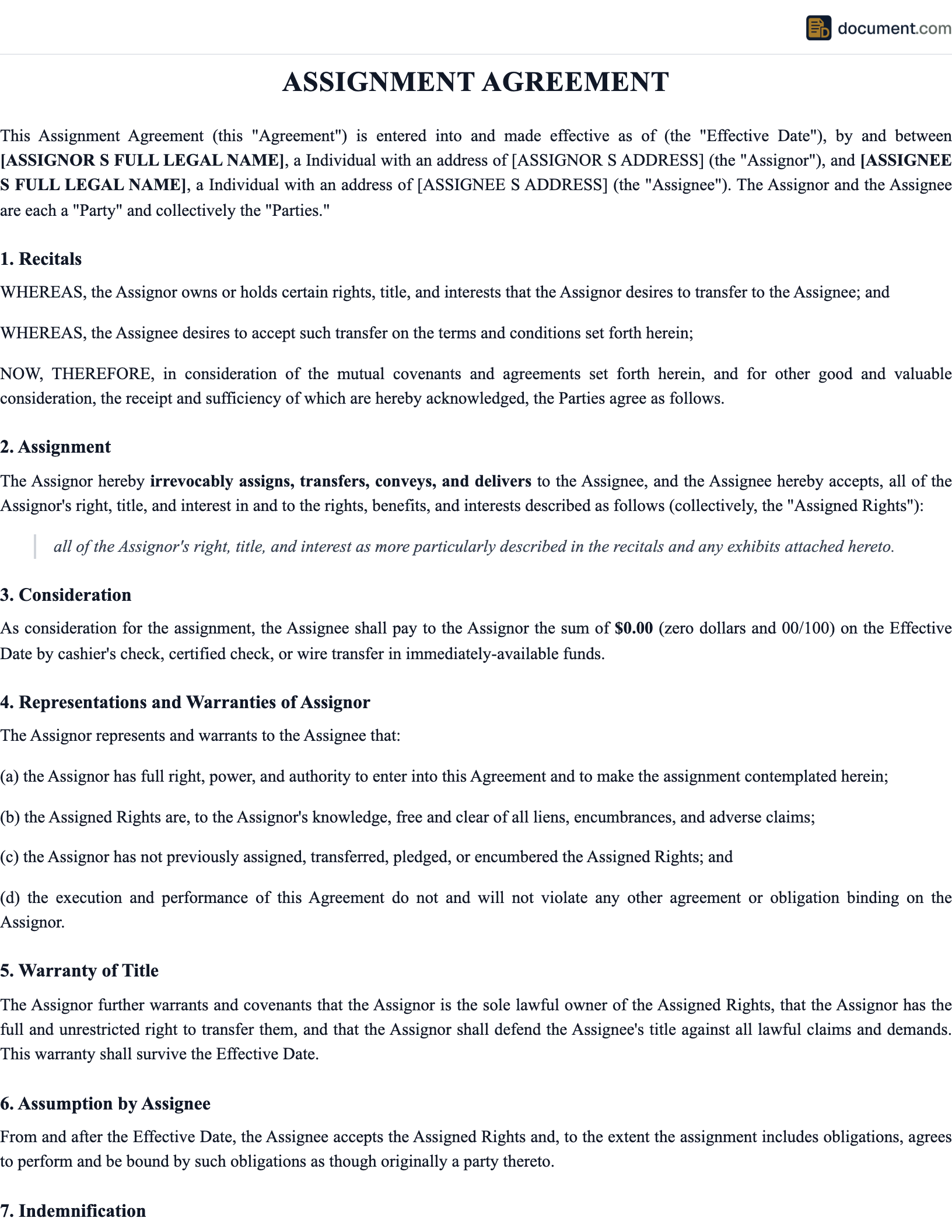



What Is an Assignment Agreement?
An assignment agreement is a written contract that transfers rights, property, or obligations from one party (the assignor) to another party (the assignee). It is one of the most fundamental tools in commercial law, allowing parties to reorganize ownership without requiring a brand-new contract every time something changes hands. Assignment agreements are used to transfer everything from a single account receivable to a multi-million-dollar trademark portfolio, from a startup founder's share of pre-incorporation work product to a debt purchaser's acquisition of a portfolio of charged-off loans. The right assignment, properly documented and recorded where required, creates clear title in the assignee and protects against later disputes.
Assignment agreements can transfer four broad categories of property. Contract rights — such as the right to receive payment under an existing services contract, the right to receive goods, or the right to enforce a noncompete. Intellectual property — trademarks, patents, copyrights, trade secrets, and domain names, each of which has its own statutory transfer requirements and recording systems. Tangible personal property and real-property interests — leases, mortgages, and equipment subject to UCC security interests. And equity and partnership interests — economic and management rights in LLCs, partnerships, and joint ventures, often subject to consent and right-of-first-refusal restrictions in the operating documents.
Three legal concepts that are often confused with assignment but are technically different are delegation, novation, and license. Delegation is the transfer of duties (as opposed to rights) — and the original obligor remains liable unless released. Novation is a three-party substitution that completely releases the original party and replaces them with a new one. Licensing grants permission to use property (especially intellectual property) without transferring ownership. A well-drafted assignment agreement makes clear which of these mechanics is being used, because the legal consequences for the original party are very different.
Assignment law sits at the intersection of common law contract doctrine, the Uniform Commercial Code (which governs accounts receivable, security interests, and the assignment of certain commercial paper), and federal intellectual property statutes (the Lanham Act for trademarks, the Patent Act for patents, the Copyright Act for copyrights). Each of those regimes imposes its own writing, signature, and recording requirements, and each has its own consequences for failing to comply. A trademark assignment without an explicit transfer of associated goodwill is void as an "assignment in gross." A copyright assignment that is not in writing and signed is unenforceable under 17 U.S.C. § 204. A patent assignment that is not recorded within three months can be defeated by a subsequent good-faith purchaser. These traps are the main reason templated assignment agreements need to be type-specific rather than one-size-fits-all.
Whether you are selling a contract to a successor entity, recording a patent assignment with the USPTO, transferring a partnership interest among family members, papering an employee invention assignment for an investor due-diligence file, or buying a portfolio of trademarks from a distressed seller, our attorney-reviewed templates give you a defensible starting point with the standard provisions courts and recording offices expect — and the flexibility to customize the consideration, scope, warranties, and indemnities for your specific transaction.
Clean Transfer
Move rights and property between parties with clear title and proper consideration
Recording Compliance
Meet the USPTO, Copyright Office, and UCC recording requirements that protect priority
Defensible Title
Establish ownership that holds up in litigation, due diligence, and chain-of-title reviews
Assignment Agreement Form Preview
Below is a visual preview of the sections and fields included in a standard assignment agreement. Your completed document will be customized for the type of property being transferred and any required recording instructions.
Assignment Agreement
Transfer of Rights and Property
Section 1: Parties
Section 2: Property Assigned
Section 3: Consideration
Section 4: Representations & Warranties
• Assignor owns the property free and clear
• No prior assignments, liens, or licenses
• No pending claims of infringement
• Authority to execute the assignment
Section 5: Recording
Section 6: Execution
Assignor Signature
Assignee Signature
Types of Assignment Agreements
Different categories of property require different assignment templates because the legal requirements, recording rules, and warranty language vary substantially.
Contract Assignment
Transfers a party's rights (and sometimes duties) under an existing contract to a third party
Trademark Assignment
Transfers ownership of a registered or common-law trademark and associated goodwill
Patent Assignment
Transfers ownership of a patent or patent application from inventor to assignee
Copyright Assignment
Transfers ownership of an original work of authorship to a new copyright owner
Partnership Interest Assignment
Transfers a partner's economic or full ownership interest in a partnership
CIIAA (Confidentiality & IP Assignment)
Confidential Information and Invention Assignment Agreement used in employment and consulting
Lease Assignment
Transfers a tenant's rights and obligations under an existing lease to a new tenant
Loan Assignment
Transfers the right to receive loan payments to a new lender or assignee
Intellectual Property Assignment
General IP transfer covering trademarks, patents, copyrights, and trade secrets
Assignment vs Delegation vs Novation
Understanding the differences between these three contract-transfer mechanisms is essential before signing any document that moves rights or duties from one party to another.
| Mechanism | What Transfers | Original Party Released? | Counterparty Consent |
|---|---|---|---|
| Assignment | Rights only | No (still liable for duties) | Usually no |
| Delegation | Duties only | No (remains as guarantor) | Sometimes |
| Novation | Entire contract position | Yes (fully released) | Yes — required |
| License | Use rights only | N/A (still owns) | N/A |
| Sublease/Subcontract | Use or performance to third party | No | Often required |
How to Create an Assignment Agreement
A defensible assignment is built in seven concrete steps. Skipping any of them can invalidate the transfer or leave the assignee with unexpected liabilities.
Identify the property to be assigned
Be specific. For contracts, attach a copy or include the date and parties. For trademarks, list the registration number and class. For patents, list the application or patent number. Vague descriptions like 'all assets' invite disputes.
Check the underlying contract for anti-assignment clauses
Read the contract being assigned. If it contains a no-assignment clause, you may need the counterparty's written consent — or to structure the deal as a novation.
Confirm the assignor actually owns the property
For IP, check the chain of title. For contracts, confirm that prior assignments have not already transferred the rights. Title searches at the USPTO and Copyright Office are inexpensive insurance.
Document consideration
Even nominal consideration ($1 and other valuable consideration) is usually enough for enforceability, but real consideration is better — and may be required for tax and bankruptcy purposes.
Add representations, warranties, and indemnities
Standard reps include free and clear title, no prior assignments, no infringement claims, and authority to execute. Indemnities allocate the risk of breach.
Sign and notarize where required
Most assignments require only signatures, but real estate, patent, and some state-recorded assignments need notarization. Recording offices have specific format requirements.
Record with the appropriate registry and notify the counterparty
Trademark assignments go to the USPTO, copyright assignments to the U.S. Copyright Office, real estate to the county recorder, UCC interests to the secretary of state, and contract assignments require written notice to the obligor.
Key Components
Every assignment agreement should contain the following building blocks regardless of the type of property being transferred.
Identification of parties
Full legal names and entity types of assignor and assignee
Description of property assigned
Specific identification of contracts, IP, or interests being transferred
Consideration
What the assignee is giving in exchange — cash, equity, or other value
Representations and warranties
Title, authority, no-prior-encumbrance, and infringement reps
Indemnification
Allocates risk for breach of reps or third-party claims
Further assurances
Assignor's obligation to sign additional documents needed to perfect title
Anti-assignment compliance
Confirmation that consent has been obtained where required
Recording instructions
Direction to record with USPTO, Copyright Office, county recorder, etc.
Governing law
Choice of state law that governs interpretation and enforcement
Effective date and execution
Clear effective date and signature blocks for all parties
Anti-Assignment Clauses
Anti-assignment clauses are standard in commercial contracts and they trip up more attempted assignments than any other single issue. Before you assign any contract, read the original document looking for language like "this Agreement may not be assigned without the prior written consent of the other party" — and pay attention to whether the clause prohibits assignment of rights, delegation of duties, or both.
Important interpretation rules
- A generic "no assignment" clause is often interpreted to bar only delegation of duties, not assignment of rights to receive money
- Change-of-control provisions are usually treated as separate from anti-assignment clauses and need their own analysis
- UCC § 9-406 invalidates anti-assignment clauses for accounts receivable to encourage commercial finance
- Federal copyright assignments override most contractual restrictions on the assignor's ability to transfer ownership
- Mergers and reorganizations may or may not trigger anti-assignment clauses depending on state law
Recording Assignments
Many assignment types should — or must — be recorded with a government registry to perfect the assignee's rights against later purchasers and creditors.
Trademark Assignments
Recorded with the USPTO Assignment Recordation Branch under 15 U.S.C. § 1060. $40 per mark. Must include explicit transfer of goodwill.
Patent Assignments
Recorded with the USPTO under 35 U.S.C. § 261. $40 per patent. Must record within 3 months to defeat subsequent purchasers.
Copyright Assignments
Recorded with the U.S. Copyright Office under 17 U.S.C. § 205. Voluntary but provides constructive notice and priority.
Real Estate Assignments
Recorded with the county recorder where the property is located. State-specific format and notarization requirements.
UCC Security Interests
Filed with the secretary of state under UCC Article 9 to perfect security interests in personal property.
Domain Name Transfers
Recorded with the domain registrar through the registrant's account; not a government registry but functions similarly.
Legal Requirements
Assignment agreements are governed by a combination of common-law contract doctrine, the UCC, and federal IP statutes. The following requirements apply across most jurisdictions.
- Written form for IP assignments under federal statutes (17 USC 204, 35 USC 261)
- Signature of the assignor on copyright and patent assignments
- Express transfer of goodwill in trademark assignments to avoid 'assignment in gross'
- Compliance with anti-assignment clauses in the underlying contract
- Consideration sufficient to support the transfer under contract law
- Notice to the obligor for contract assignments to bind future performance
- UCC Article 9 perfection rules for security-interest assignments
- State recording statutes for real estate and certain personal property
Sample Assignment Agreement
Below is a condensed preview of our trademark assignment template. Your final document will be customized for the specific property type and recording office.
TRADEMARK ASSIGNMENT AGREEMENT
Transfer of Trademark and Goodwill
This Trademark Assignment Agreement ("Agreement") is made as of[Date]between [Assignor]("Assignor") and [Assignee]("Assignee").
1. ASSIGNMENT
For good and valuable consideration, the receipt and sufficiency of which are hereby acknowledged, Assignor hereby sells, assigns, transfers, and conveys to Assignee, its successors and assigns, all right, title, and interest in and to the trademark identified below, together with the goodwill of the business symbolized by the mark.
2. MARK ASSIGNED
Trademark: [Mark]
Registration No.: [Number]
Class(es): [Class]
Goods/Services: [Description]
3. CONSIDERATION
Assignee shall pay Assignor the sum of $[Amount]on the Effective Date by wire transfer to the account designated by Assignor.
4. REPRESENTATIONS AND WARRANTIES
Assignor represents and warrants that: (a) Assignor is the sole and exclusive owner of the Mark; (b) the Mark is free and clear of all liens, encumbrances, licenses, and prior assignments; (c) no third party has asserted any claim of infringement against the Mark; and (d) Assignor has full power and authority to execute this Assignment.
5. RECORDING
Assignor authorizes the United States Patent and Trademark Office to record this Assignment with the Assignment Recordation Branch and to update its records to reflect Assignee as the owner of record.
6. FURTHER ASSURANCES
Assignor agrees to execute any additional documents and take any further actions reasonably requested by Assignee to perfect, record, or enforce Assignee's rights in the Mark.
7. INDEMNIFICATION
Assignor shall indemnify and hold harmless Assignee from and against any losses arising from any breach of the representations and warranties in Section 4.
8. GOVERNING LAW
This Agreement shall be governed by and construed in accordance with the laws of the State of [State], without regard to its conflict-of-laws principles.
Frequently Asked Questions
Find answers to common questions about assignment vs delegation, anti-assignment clauses, novation, consent requirements, and recording.
Official Resources
For additional information on assignments, recording requirements, and intellectual property transfers, consult these official resources.
USPTO Trademark Assignments
Official information on recording trademark assignments with the USPTO
USPTO Patent Assignments
Patent assignment recording, searching, and EPAS electronic filing
U.S. Copyright Office Recordation
Information on recording copyright assignments and other documents
Uniform Commercial Code
Uniform Law Commission resources on UCC Article 9 and assignment of accounts
17 U.S.C. § 204 - Copyright Transfers
Federal statute governing the form and execution of copyright transfers
35 U.S.C. § 261 - Patent Ownership
Federal statute on ownership and recording of patent assignments
Create your Assignment Agreement in under 10 minutes.
Answer a few questions and download a compliant, attorney-drafted document ready for your state.