
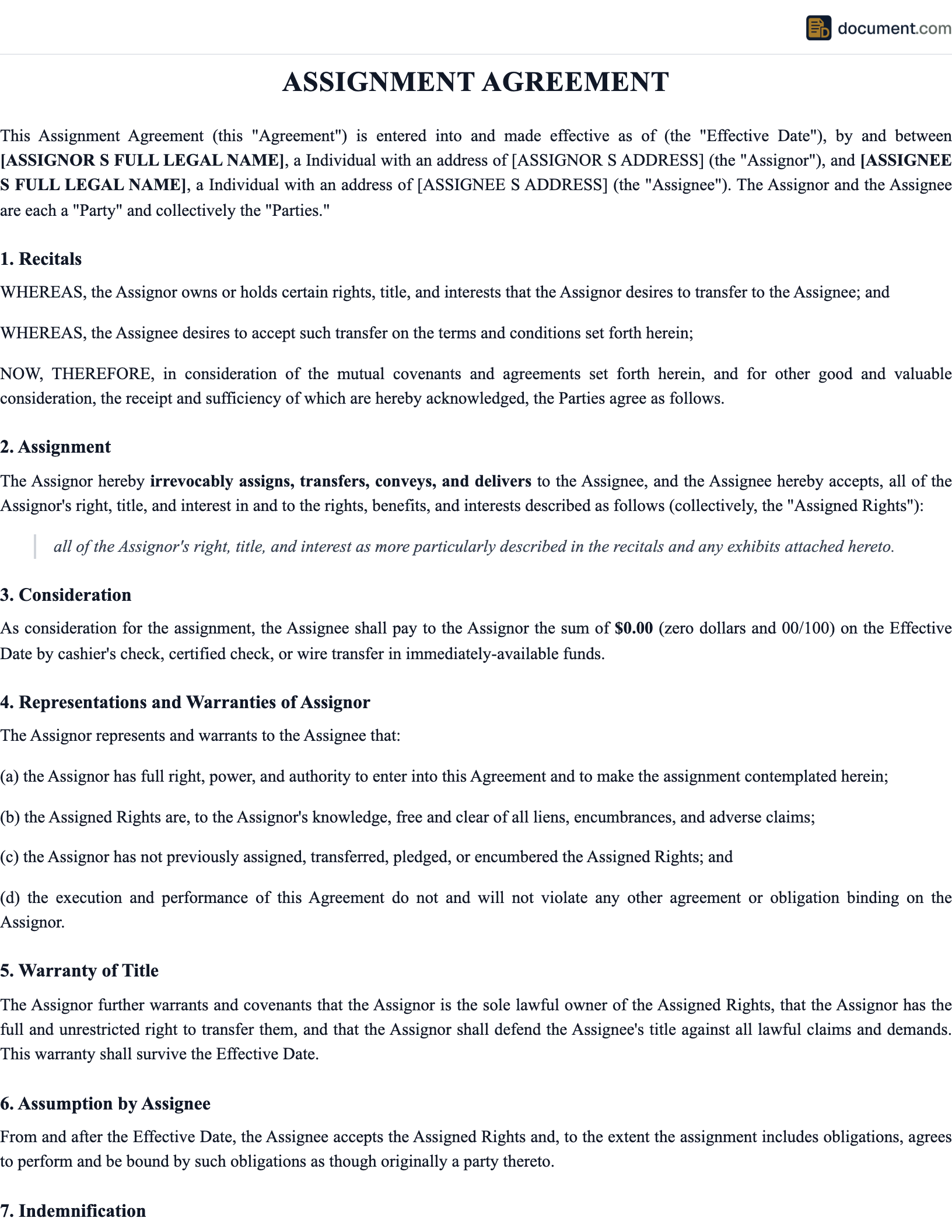



What Is a Confidential Information and Invention Assignment Agreement?
A Confidential Information and Invention Assignment Agreement— abbreviated as CIIAA and sometimes called a PIIAA (Proprietary Information and Invention Assignment Agreement), an invention assignment agreement, or simply an "at-hire IP agreement" — is a contract between a company and an individual (employee, founder, consultant, contractor, or advisor) that accomplishes two interlocking goals. First, it requires the individual to protect the company's confidential information and trade secrets from disclosure. Second, and equally important, it assigns to the company ownership of any inventions, works, ideas, software, designs, and other intellectual property the individual creates in connection with their work for the company.
The CIIAA exists because U.S. law does not automatically give employers ownership of everything their employees create. Absent a written agreement, copyright in works created by employees within the scope of employment generally vests in the employer under the "work for hire" doctrine — but that doctrine has significant limitations, does not cover independent contractors for most types of work, and does not reliably cover patents, trade secrets, or non-copyrightable inventions. The CIIAA fills these gaps by using a carefully drafted present assignment of all future inventions — language that the U.S. Supreme Court held in Stanford v. Roche is necessary to create an immediate, self-executing transfer of IP rights.
The CIIAA is also a foundational document for any company seeking outside investment. Venture capital funds, angel investors, and acquirers examine CIIAAs during due diligence as a first-order indicator of whether the company actually owns its technology. A gap in CIIAA coverage — a founder who never signed, an early engineer who was treated as a contractor without a proper agreement, or an advisor who contributed code without an IP assignment — can halt a financing, trigger escrows, require indemnification, or in extreme cases unwind a transaction. For this reason, every serious technology company requires a signed CIIAA from every person before they begin work.
A well-drafted CIIAA goes beyond the basics. It defines what counts as confidential information with precision, establishes the scope of assigned inventions, excludes pre-existing IP via a prior-inventions schedule, provides the statutory notices required by states like California, addresses return of materials on termination, includes cooperation obligations for patent and copyright filings, and — where enforceable — layers in non-competition, non-solicitation, and non-disparagement covenants. Our attorney-reviewed CIIAA template addresses all of these elements and includes variants for employees, contractors, and founders, with state-specific carve-outs.
Trade Secret Protection
Legally binds employees and contractors to protect confidential information indefinitely
IP Ownership
Present assignment of all future inventions, works, code, and designs to the company
VC Due Diligence Ready
Satisfies investor due diligence requirements for clean IP ownership chains
CIIAA Form Preview
Below is a preview of the sections included in our CIIAA template, customized for the worker classification (employee, contractor, or founder) and the governing state law.
Confidential Information and Invention Assignment Agreement
Employee / Consultant / Founder
Section 1: Parties
Section 2: Scope of Assignment
Exhibit A: Prior Inventions
Why Companies Require CIIAAs
CIIAAs are not a nicety — for IP-driven companies, they are foundational infrastructure. The reasons companies require them fall into several categories.
Securing IP Ownership
Without a CIIAA, the company's claim to ownership of inventions, code, and other IP created by workers is uncertain. This is especially true for independent contractors, whose IP the company generally does not automatically own.
Protecting Trade Secrets
Trade secret protection under the DTSA and state Uniform Trade Secrets Act requires the owner to take reasonable steps to maintain secrecy. A signed CIIAA is evidence of such reasonable steps.
Investor Due Diligence
Venture capital and acquisition due diligence includes a systematic review of every CIIAA for every person who has touched the technology. Gaps are expensive or fatal.
Defending Against Claims
A properly drafted CIIAA protects the company from later claims by former employees or contractors asserting ownership of IP or rights to licensing fees.
Supporting Patent Prosecution
Patent filings require assignment documents chaining title from inventor to company. The CIIAA's cooperation clause obligates employees to execute any additional documents the patent office requires.
What a CIIAA Covers
A comprehensive CIIAA addresses multiple categories of protection, each with its own legal basis and enforcement mechanisms.
Confidential Information
- - Customer lists, pricing, and business strategy
- - Technical data, algorithms, and architecture
- - Financial information and forecasts
- - Personnel data and compensation
- - Third-party confidential information held by company
Intellectual Property
- - Source code and software
- - Patent-eligible inventions
- - Product designs and specifications
- - Research data and experimental results
- - Written works and documentation
Return of Materials
- - All company property upon termination
- - Documents, files, and electronic data
- - Hardware and access credentials
- - Copies stored on personal devices
- - Certification of return and deletion
Restrictive Covenants
- - Non-solicitation of employees (where enforceable)
- - Non-solicitation of customers
- - Non-competition (state-law dependent)
- - Non-disparagement
- - Cooperation with future IP filings
CIIAA vs NDA vs Non-Compete
CIIAAs are often confused with related but distinct agreements. Understanding the differences helps ensure you use the right document for each situation.
| Feature | CIIAA | NDA | Non-Compete |
|---|---|---|---|
| Confidentiality | Yes | Yes (primary) | Sometimes |
| IP Assignment | Yes (primary) | No | No |
| Work Restrictions | Optional | No | Yes (primary) |
| Used For | Employees, contractors, founders | Third parties, partners | Key employees |
How to Create a CIIAA
Identify the Worker Classification
Decide whether the individual is an employee, independent contractor, consultant, founder, or advisor. Each classification requires slightly different language — for contractors, a work-for-hire fallback is essential; for founders, equity-related provisions may be included.
Define Confidential Information Precisely
Draft the definition of confidential information broadly enough to cover the company's actual sensitive information but with enough specificity to be enforceable. Include carve-outs for information that becomes publicly known, was already known to the employee, or is independently developed.
Use Present Assignment Language
Ensure the agreement uses 'hereby assigns' rather than 'agrees to assign' for the IP assignment. Under Stanford v. Roche, the former creates a self-executing present transfer, while the latter is merely a promise to assign in the future, which may be defeated by a later assignment to another party.
Include State-Specific Carve-Outs
For California, Washington, Minnesota, Illinois, Delaware, Kansas, North Carolina, Utah, and similar states, include the statutory carve-out for inventions developed on the employee's own time, without company resources, and unrelated to company business. California additionally requires written notice of Section 2870.
Attach a Prior Inventions Schedule
Provide an exhibit where the employee can list pre-existing inventions that are excluded from the assignment. Make clear that failure to list a prior invention may be interpreted as an admission that none exist.
Address Open Source and Third-Party IP
Include representations that the employee will not incorporate third-party IP (including open source code) into company work without proper authorization and will comply with company policies on open source usage.
Set Out Return of Materials Obligations
Require the employee to return all company property upon termination, certify return, and delete any copies stored on personal devices. Include the right to inspect personal devices in cases of suspected breach.
Calibrate Restrictive Covenants to State Law
Non-compete and non-solicitation provisions must be drafted with awareness of state law. For California and similar states, omit non-competes entirely. For states where they are enforceable, keep scope, duration, and geography reasonable.
Execute Before Work Begins
Have the employee sign on or before the first day of employment. Do not allow access to systems, code, or confidential information until the CIIAA is executed. Counter-sign on behalf of the company and store the signed agreement in personnel records.
Review Periodically
Review and update CIIAAs whenever the company expands into new states, adds new lines of business, raises institutional capital, or encounters new types of IP. Consider refreshing CIIAAs at promotion, stock grant, or material role change events.
Key Components of a CIIAA
| Component | Description |
|---|---|
| Definition of Confidential Information | Broad definition covering trade secrets, technical data, business information, and third-party confidential information |
| Confidentiality Obligations | Duty to hold in confidence, use only for company purposes, and not disclose to third parties |
| Present Assignment of Inventions | "Hereby assigns" language for all future inventions, works, and IP |
| Scope of Assigned Inventions | Inventions within scope of employment, using company resources, or related to company business |
| Prior Inventions Schedule | Exhibit listing pre-existing inventions excluded from the assignment |
| State-Law Carve-Outs | Statutory exclusions for personal inventions unrelated to the business (CA 2870 and similar) |
| Statutory Notice | California Labor Code 2870 written notice, where applicable |
| Cooperation Obligation | Duty to execute additional documents for patent and copyright filings |
| Power of Attorney | Irrevocable power of attorney for the company to execute IP documents if the employee is unavailable |
| Moral Rights Waiver | Waiver of moral rights in copyrightable works, where permitted |
| Third-Party IP Representation | Representation that the employee will not incorporate unlicensed third-party IP |
| Return of Materials | Duty to return all company property at termination and certify deletion |
| Non-Solicitation | Limited restriction on soliciting employees and customers post-termination |
| Non-Competition | Optional restriction, calibrated to state law |
| Survival Clause | Provisions that survive termination — confidentiality, assignment, return of materials |
| Governing Law and Venue | State whose law applies and forum for disputes |
The Prior Inventions Schedule
The prior inventions schedule — usually attached as Exhibit A — is one of the most consequential parts of a CIIAA for employees who have created IP before joining the company. It is the employee's opportunity to identify and exclude pre-existing inventions from the automatic assignment that otherwise sweeps in future IP.
Warning: If an employee signs a CIIAA without listing their prior inventions, they may later be unable to prove that a particular invention pre-dated their employment. Courts in several jurisdictions have treated a blank schedule as an admission that the employee had no prior inventions to exclude.
The schedule should describe each prior invention with enough specificity to identify it and distinguish it from future work, but without disclosing trade secrets or confidential details. A typical entry includes a short descriptive title, the date of creation, a brief non-confidential description, and the type of IP (patent, copyright, trade secret). For founders and senior engineers joining with substantial prior work, careful drafting of this schedule is often the most important part of the CIIAA process.
State-Law Limitations on CIIAAs
Several states have enacted statutes that limit the scope of permissible invention assignments or require specific notices to employees. These statutes are a key reason CIIAAs must be state-specific.
- California Labor Code 2870: Excludes employee inventions developed on own time, without company resources, and unrelated to company business. Labor Code 2872 requires written notice to employees.
- Washington RCW 49.44.140: Nearly identical to California, with the same scope limitation and written notice requirement.
- Minnesota Statutes 181.78: Similar scope limits; applies to invention assignment provisions in employment contracts.
- Illinois 765 ILCS 1060: Employee Patent Act; prevents employers from claiming inventions developed outside the scope of employment.
- Delaware, Kansas, North Carolina, Utah: Similar statutes with varying specific requirements.
Sample CIIAA Language
CONFIDENTIAL INFORMATION AND INVENTION ASSIGNMENT AGREEMENT
This Confidential Information and Invention Assignment Agreement (this "Agreement") is entered into as of [Effective Date] between [Company Name], a [State] corporation (the "Company"), and [Employee Name] ("Employee").
1. CONFIDENTIALITY
Employee acknowledges that during the course of employment Employee will have access to confidential and proprietary information of the Company, including trade secrets, technical data, customer lists, financial information, and business plans ("Confidential Information"). Employee agrees to hold all Confidential Information in strict confidence, to use it solely for the benefit of the Company, and not to disclose it to any third party without the prior written consent of the Company, both during and after employment.
2. ASSIGNMENT OF INVENTIONS
Employee hereby assigns, and agrees to assign, to the Company all right, title, and interest in and to any and all Inventions (as defined below) that Employee solely or jointly conceives, develops, or reduces to practice, or causes to be conceived, developed, or reduced to practice, during the period of Employee's employment with the Company. "Inventions" means all inventions, improvements, discoveries, works of authorship, designs, formulae, processes, algorithms, techniques, ideas, know-how, and other intellectual property, whether or not patentable or copyrightable.
3. PRIOR INVENTIONS
Employee has listed on Exhibit A all Inventions that Employee created prior to employment with the Company that Employee wishes to exclude from this Agreement. If no Prior Inventions are listed on Exhibit A, Employee represents that there are no such Prior Inventions.
4. NOTICE REQUIRED BY CALIFORNIA LABOR CODE 2870
This Agreement does not apply to an Invention that qualifies fully under the provisions of Section 2870 of the California Labor Code, which provides that the assignment does not apply to inventions that the Employee developed entirely on Employee's own time without using the Company's equipment, supplies, facilities, or trade secret information, except for inventions that either (1) relate to the Company's business or anticipated research, or (2) result from work performed for the Company.
5. COOPERATION
Employee agrees to execute, at the Company's request and expense, any documents necessary to perfect the Company's ownership of Inventions, including patent applications, copyright registrations, and assignment documents. Employee irrevocably appoints the Company as attorney-in-fact to execute such documents if Employee is unavailable.
6. RETURN OF MATERIALS
Upon termination of employment, Employee will promptly return all Company property, documents, and Confidential Information in Employee's possession and certify in writing that no copies have been retained.
Frequently Asked Questions
Official Resources
USPTO - Patents
U.S. Patent and Trademark Office patent filing and assignment guidance
U.S. Copyright Office
Copyright registration, work-for-hire doctrine, and assignment recording
California Labor Code 2870
Statutory limitation on employee invention assignments in California
FTC - Non-Compete Rules
Federal Trade Commission guidance on non-compete enforcement
Create your Ciiaa Assignment Agreement in under 10 minutes.
Answer a few questions and download a compliant, attorney-drafted document ready for your state.