



What Is a Work for Hire Agreement?
A work for hire agreement is a contract that ensures the hiring party, not the creator, is recognized as the legal author and copyright owner of a commissioned work from the moment it is created. Under normal copyright rules, the person who creates a work automatically owns the copyright. A work for hire arrangement inverts that default, giving full ownership to the party who commissioned and paid for the work. This is essential for businesses that hire freelancers, designers, writers, developers, and other creative professionals to produce content, code, designs, or other deliverables that the business needs to own outright.
The concept of "work made for hire" is defined in Section 101 of the U.S. Copyright Act (17 U.S.C. Section 101). For employees, any work created within the scope of employment is automatically a work for hire with no written agreement necessary. For independent contractors, the rules are much stricter: the work must fall into one of nine statutory categories, and the parties must sign a written agreement designating it as a work for hire before the work is created. If either condition is not met, the creator retains copyright ownership regardless of payment.
This is why most work for hire agreements include a fallback copyright assignment clause. If the work does not qualify as a statutory work for hire (because it falls outside the nine categories), the assignment clause transfers copyright from the creator to the hiring party as a separate transaction. The combination of both provisions creates a belt-and-suspenders approach that protects the hiring party's ownership under either legal theory.
Our attorney-reviewed template produces a work for hire agreement tailored to your specific project type, covering IP ownership, scope of work, deliverables, acceptance criteria, revision rounds, compensation, confidentiality, representations, and indemnification. It includes both the work for hire designation and the fallback assignment, plus provisions for moral rights waivers in jurisdictions that recognize them.
Full Ownership
Secure copyright ownership from the moment the work is created, with no residual claims
Belt and Suspenders
Work for hire designation plus fallback copyright assignment for complete protection
Clear Deliverables
Detailed scope of work, acceptance criteria, and revision processes built in
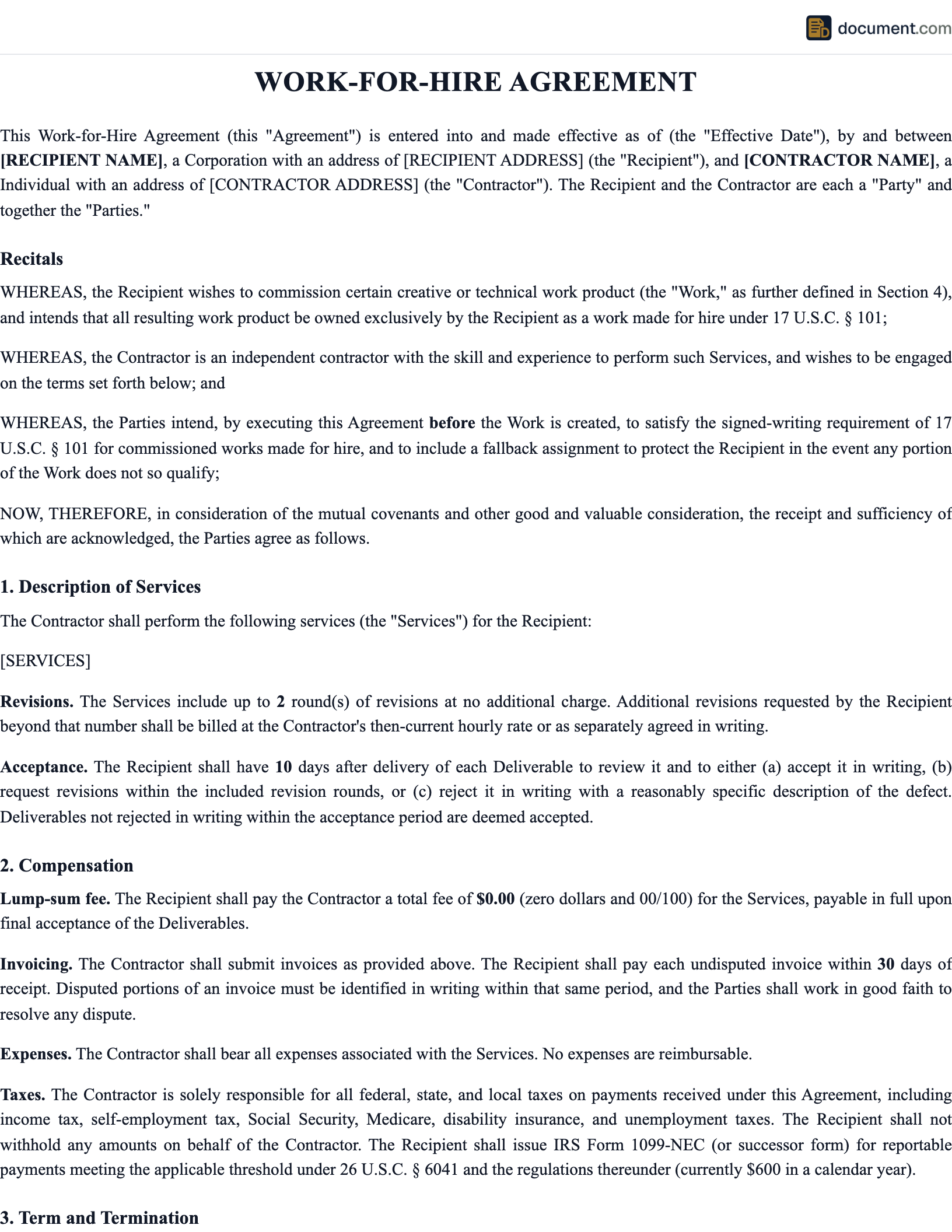
Work for Hire Agreement Form Preview
Below is a visual preview of the sections included in our standard work for hire agreement template. The completed document is customized to your project type, deliverables, and payment structure.
Work for Hire Agreement
Intellectual Property Assignment Contract
Section 1: Parties
Section 2: Scope of Work
Section 3: IP Ownership
The Nine Statutory Categories
For independent contractor work to qualify as a work made for hire, it must fall into one of nine specific categories defined in 17 U.S.C. Section 101. Understanding these categories is critical because work that falls outside them cannot be a work for hire no matter what the contract says.
Contribution to a Collective Work
A contribution to a collective work such as a magazine, anthology, or encyclopedia. The contributor's individual work (an article, a poem, a photograph) can be a work for hire if part of a larger collective project.
Part of a Motion Picture or Audiovisual Work
A work created as part of a motion picture or other audiovisual work. This covers screenplays, music composed for a film, special effects, and other elements produced specifically for an audiovisual production.
Translation
A translation of an existing work into another language. The translator's output can be designated as a work for hire if created under a written agreement.
Supplementary Work
A work prepared for publication as a supplement to another author's work, such as forewords, afterwords, illustrations, maps, charts, editorial notes, bibliographies, appendixes, and indexes.
Compilation
A compilation is a work formed by selecting, arranging, and organizing preexisting materials or data in a way that constitutes original authorship. Databases, curated collections, and anthologies can qualify.
Instructional Text
A literary, pictorial, or graphic work prepared for publication and intended for use in systematic instructional activities. Textbooks, training manuals, and educational course materials fall here.
Test
A test used to evaluate the abilities, aptitude, or knowledge of individuals. Standardized tests, certification exams, and assessment instruments qualify.
Answer Material for a Test
Material prepared to answer questions in a test. Answer keys, scoring rubrics, and grading guides created for a commissioned test.
Atlas
An atlas, which is a bound collection of maps. This is the narrowest category and is rarely invoked in modern practice.
What About Software, Logos, and Marketing Materials?
Custom software, standalone logos, independent marketing copy, and website designs do not neatly fit any of the nine categories. A logo is not a contribution to a collective work. A custom web application is not a compilation or an instructional text. For these common project types, the work for hire designation alone will not secure ownership. You must include a fallback copyright assignment clause. Our template includes this by default.
How to Create a Work for Hire Agreement: 8 Steps
A work for hire agreement must be signed before the work begins to be enforceable as a work for hire. Retroactive designations do not work. Follow these steps to build an agreement that secures your intellectual property from day one.
Define the Parties and Relationship
Identify the hiring party (company or individual commissioning the work) and the creator (freelancer, contractor, or agency performing the work). State explicitly that the creator is an independent contractor, not an employee. This is important for tax, benefits, and workers' compensation purposes. Include the creator's legal name, business entity if applicable, and contact information.
Describe the Scope of Work in Detail
Write a specific, detailed description of what the creator will produce. Vague descriptions like 'design work' or 'content creation' invite disputes. Instead, list every deliverable: 'Primary logo in vector format (AI, EPS, SVG), horizontal and vertical lock-ups, color palette specification document, typography guidelines, and brand usage manual.' Include quantities, formats, dimensions, and any technical requirements.
Set Milestones and Deadlines
Break the project into phases with specific deadlines: concept presentation, first draft, revision rounds, and final delivery. Define what 'acceptance' means at each stage and how many business days the hiring party has to review and respond. Specify that if the hiring party does not respond within the review period, the deliverable is deemed accepted. This prevents projects from stalling indefinitely.
Include the Work for Hire Designation
State that the work is a 'work made for hire' as defined by 17 U.S.C. Section 101, and that the hiring party is considered the author for all purposes. Identify which of the nine statutory categories applies. If the work might not fit any category, include the fallback language: 'To the extent that any Work Product is not deemed a work made for hire, Creator hereby irrevocably assigns to Company all right, title, and interest, including all copyrights, in and to such Work Product.'
Add the Fallback Copyright Assignment
Draft a comprehensive assignment clause covering all intellectual property rights: copyrights, patent rights (if applicable), trade secret rights, and all derivative works. The assignment should be worldwide, perpetual, and irrevocable. Require the creator to execute any additional documents reasonably necessary to perfect the assignment, such as copyright registration applications. Include a power of attorney allowing the hiring party to execute such documents on the creator's behalf if the creator is unavailable.
Structure Compensation and Payment
Specify the total fee or rate, payment schedule, invoice requirements, and payment method. Tie milestone payments to deliverable acceptance. Define what happens if the project is terminated early: is partial compensation owed? For unpaid work, how are pre-existing rights handled? Address expenses, and state whether the creator or the hiring party pays for stock assets, fonts, model releases, and similar costs.
Address Confidentiality and Non-Disclosure
Require the creator to keep all project details, business information, and unpublished work product confidential. Define the scope of confidential information, the obligations of the receiving party, the permitted disclosures (legal requirements, professional advisors), and the duration of the confidentiality obligation. Many work for hire agreements incorporate confidentiality provisions directly rather than requiring a separate NDA.
Include Representations, Warranties, and Indemnification
The creator should represent that the work is original, does not infringe any third-party intellectual property, and is free of any liens or encumbrances. Include a warranty against plagiarism and unauthorized use of third-party content. The indemnification clause should require the creator to hold the hiring party harmless against claims arising from breaches of these representations. Mutual indemnification (the hiring party indemnifies the creator against claims arising from the hiring party's use of the delivered work) makes the agreement more balanced.
Key Components of a Work for Hire Agreement
A comprehensive work for hire agreement covers each of the following areas. Missing any one of them can leave gaps in your IP protection or create disputes about scope, payment, or ownership.
| Component | Description |
|---|---|
| Parties and Relationship | Legal names, addresses, and independent contractor status |
| Scope of Work | Detailed description of deliverables, specifications, and requirements |
| Work for Hire Designation | Statement that work is made for hire under 17 U.S.C. Section 101 |
| Fallback Copyright Assignment | Assignment of all IP rights if work for hire status fails |
| Moral Rights Waiver | Waiver of attribution and integrity rights where permitted |
| Compensation | Fees, payment schedule, milestones, expenses, and late payment terms |
| Deliverables and Acceptance | Format, delivery method, review period, and acceptance criteria |
| Revision Process | Number of included revisions, scope of revisions, and additional revision fees |
| Timeline and Milestones | Project phases, deadlines, and consequences of delay |
| Confidentiality | Non-disclosure obligations for project details and business information |
| Representations and Warranties | Originality, non-infringement, and authority to enter the agreement |
| Indemnification | Protection against third-party IP infringement claims |
| Termination | Grounds for termination, notice period, and post-termination rights |
| Pre-Existing Materials | Treatment of creator's pre-existing IP incorporated into the work |
| Governing Law | Choice of law and dispute resolution mechanism |
Legal Requirements and Considerations
Work for hire law is highly specific and full of traps for the unwary. Understanding the statutory framework, the employee vs. contractor distinction, and the state-level complications helps you draft an agreement that will hold up when it matters.
Employee vs. Independent Contractor
The Supreme Court's decision in Community for Creative Non-Violence v. Reid (1989) established a multi-factor test to determine whether a creator is an employee or an independent contractor for copyright purposes. Factors include the hiring party's right to control the manner and means of production, the skill required, the source of tools and materials, the location of work, the duration of the relationship, tax treatment, and whether employee benefits are provided. If the creator is an employee, all work within the scope of employment is automatically work for hire. If the creator is an independent contractor, the nine-category and written-agreement requirements apply.
Written Agreement Requirement
For independent contractor work, 17 U.S.C. Section 101 requires a written instrument signed by both parties expressly designating the work as made for hire. Oral agreements are not sufficient. The agreement should be signed before or at the time work begins. While some courts have permitted agreements signed after work begins if they were agreed upon in principle beforehand, the safest practice is to execute the agreement before any creative work starts. Email threads and informal communications do not reliably substitute for a signed written agreement.
Section 203 Termination Rights
One of the most significant practical differences between work for hire and copyright assignment is the termination right under 17 U.S.C. Section 203. Authors (and their heirs) have an inalienable right to terminate a copyright transfer between 35 and 40 years after the grant. This right cannot be waived by contract. However, it does not apply to works made for hire, because the hiring party is deemed the author and there is no "transfer" to terminate. For intellectual property with long commercial lifespans (brand identities, franchise characters, evergreen content), work for hire status provides permanent, non-terminable ownership.
California Employment Considerations
In California, designating a commissioned work as "made for hire" may create a statutory employment relationship for purposes of workers' compensation insurance and unemployment insurance under California Labor Code Section 3351.5 and Unemployment Insurance Code Section 686. This means the hiring party could be liable for workers' compensation premiums and unemployment insurance contributions. Many California attorneys recommend relying primarily on the fallback copyright assignment rather than the work for hire designation to avoid this issue.
International Considerations
- Moral Rights: Many countries (France, Germany, UK) recognize moral rights of attribution and integrity that cannot be fully waived. Your agreement should include a moral rights waiver to the maximum extent permitted by applicable law.
- EU and UK: European copyright law does not recognize the U.S. work for hire doctrine. Ownership transfers require explicit assignment, and some moral rights are perpetual and inalienable.
- Canada: Canadian Copyright Act Section 13(3) provides that the employer is the first owner of copyright for works made in the course of employment, but commissioned works by contractors require assignment.
Frequently Asked Questions
Common questions about work for hire agreements, copyright ownership, the nine statutory categories, and contractor IP rights.
Official Resources
Authoritative sources on copyright law, work for hire doctrine, and intellectual property protection.
U.S. Copyright Office
Federal copyright registration, circulars, and guidance on works made for hire
Circular 9: Works Made for Hire
Official Copyright Office guidance on the work for hire doctrine
17 U.S.C. Section 101
Statutory definition of 'work made for hire' in the U.S. Copyright Act
17 U.S.C. Section 201
Ownership of copyright, including work for hire provisions
IRS Worker Classification
IRS guidance on determining whether a worker is an employee or independent contractor
WIPO Copyright
World Intellectual Property Organization resources on international copyright
Create your Work for Hire Agreement in under 10 minutes.
Answer a few questions and download a compliant, attorney-drafted document ready for your state.