



What Is a Service Agreement?
A service agreement is a contract between a client and an independent contractor who provides defined, typically hands-on services — construction, cleaning, landscaping, photography, catering, moving, painting, plumbing, electrical work, or any other operational service. Unlike a consulting agreement, which centers on professional advice and strategic recommendations, a service agreement governs the delivery of tangible work product or the performance of physical tasks at a specific location, on a defined schedule, and to measurable quality standards.
Service agreements occupy a critical space in contractor law because the services involved often carry significant liability exposure. A cleaning contractor who damages expensive flooring, a landscaper whose equipment injures a bystander, a construction contractor whose work fails an inspection, or a caterer whose food causes illness — each scenario creates potential legal and financial liability that the service agreement must address through insurance requirements, indemnification provisions, warranty terms, and limitation-of-liability clauses.
The scope of service agreements spans virtually every industry where physical work is performed by an independent contractor rather than an employee. A homeowner hires a painting contractor to repaint the interior of their house. A property management company engages a landscaping service for weekly maintenance of a commercial park. An event planner contracts with a photographer, DJ, and caterer for a corporate event. A restaurant chain signs a service level agreement with a commercial cleaning company for nightly sanitation. In each case, the service agreement establishes the scope, quality standards, payment terms, insurance requirements, and the legal framework for handling problems that arise during service delivery.
Our attorney-reviewed service agreement templates are tailored to each service category with industry-specific provisions. Construction contracts include progress payment schedules, change order procedures, mechanic's lien protections, and permit requirements. Photography and videography contracts include usage licensing, image ownership, and model release provisions. Cleaning contracts include scope checklists, supply responsibilities, and quality inspection procedures. Each template addresses the unique liability, insurance, and regulatory requirements of the specific service.
Defined Scope
Precise description of services, materials, schedule, and quality standards for the engagement
Liability Protection
Insurance requirements, indemnification, and damage liability provisions for physical service work
Payment Structure
Per-visit, milestone, or retainer payment models with materials and expense provisions
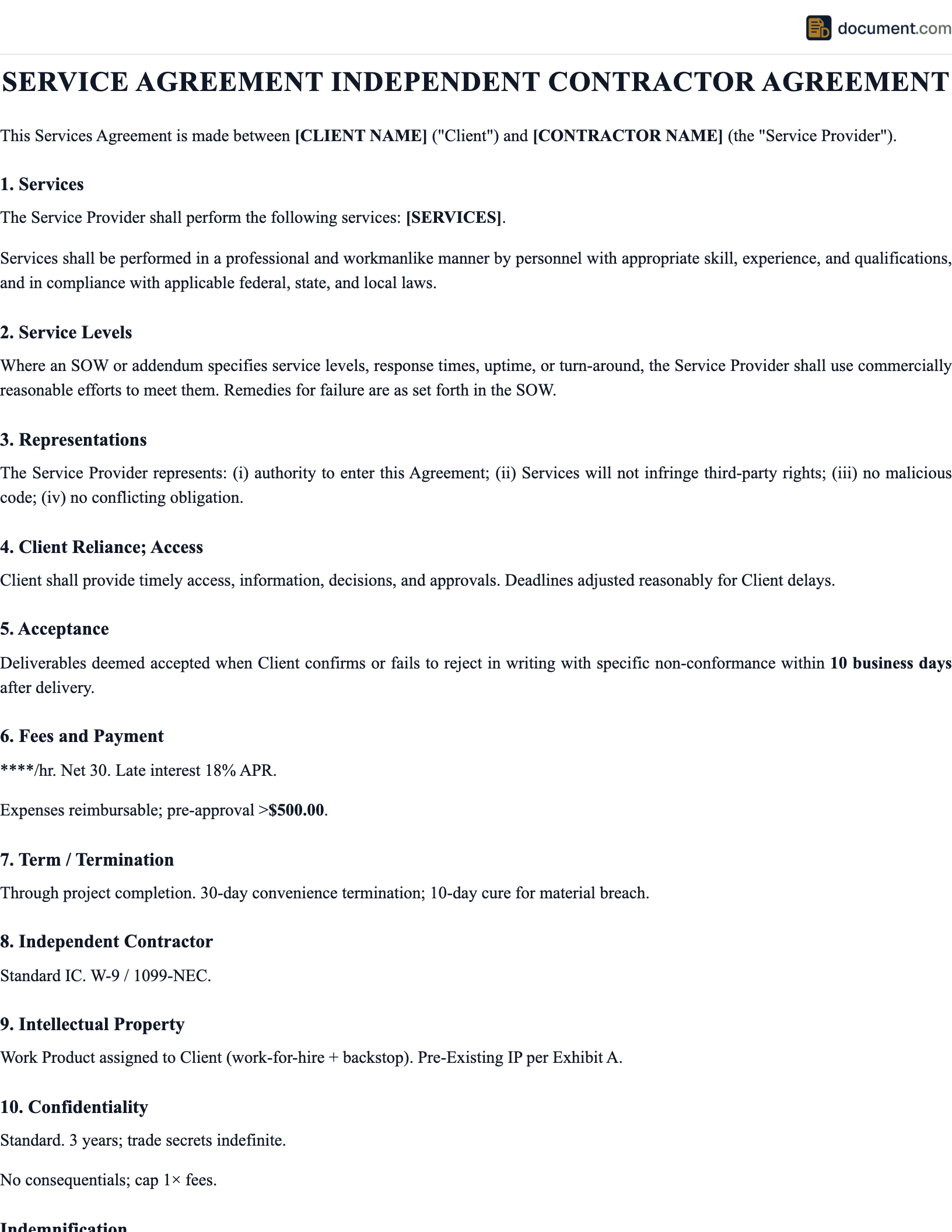
Service Agreement Form Preview
This visual preview shows the structure of our service agreement template. Your completed document will be customized for your specific service type, including industry-specific scope descriptions, materials provisions, and insurance requirements.
Service Agreement
Independent Contractor Service Contract
Section 1: Parties
Section 2: Scope of Services
Section 3: Compensation
Section 4: Signatures
Client Signature
Service Provider Signature
Types of Service Agreements
Service agreements cover a broad range of contractor-provided services, from construction and trades work to event services and creative production. Select the service type that matches your engagement to get a template with industry-specific provisions.
Catering Contract
For caterers covering menu, headcount, setup/breakdown, tastings, and event-day logistics
Cleaning Contract
For cleaning services covering frequency, scope, supplies, access, and quality standards
Construction Contract
For general contractors, builders, and construction trades with progress payments and lien waivers
Daycare Contract
For daycare providers covering enrollment, fees, schedules, policies, and licensing compliance
DJ Contract
For event DJs covering equipment, setup time, music requests, overtime rates, and cancellation terms
Electrical Contract
For licensed electricians covering permits, inspections, materials, and code compliance
Flooring Contract
For flooring installers covering materials, subfloor prep, waste disposal, and warranty
Handyman Contract
General handyman services covering labor, materials, project scope, and completion timelines
Interior Design Contract
For designers covering design fees, procurement markup, revisions, and intellectual property
Landscaping Contract
For lawn care, landscaping, and groundskeeping services with seasonal scheduling and scope
Model Contract
For models covering usage rights, booking terms, exclusivity, and image licensing
Moving Contract
For moving companies covering inventory, insurance, delivery windows, and damage liability
Nanny Contract
Agreement for nannies, au pairs, and childcare providers with schedule, duties, and household rules
Painting Contract
For interior and exterior painting contractors covering prep work, materials, and color selection
Performance Agreement
For performers and entertainers covering venue, compensation, technical requirements, and cancellation
Photography Contract
For photographers covering events, portraits, commercial shoots, and licensing usage rights
Plumbing Contract
For licensed plumbers covering labor, parts, permits, warranties, and emergency service terms
Remodeling Contract
For home remodeling projects covering change orders, permits, timelines, and payment schedules
Roofing Contract
For roofing contractors covering materials, warranties, permits, and weather delay provisions
Service Level Agreement (SLA)
Performance-based agreement defining uptime, response times, penalties, and service metrics
Snow Removal Contract
For snow removal services covering trigger depth, de-icing, liability, and seasonal pricing
Videography Contract
For videographers covering filming, editing, deliverables, usage rights, and revision limits
Service Agreement vs Consulting Agreement
Both service agreements and consulting agreements establish independent contractor relationships, but they serve fundamentally different types of engagements. Choosing the right agreement type ensures the provisions match the actual working relationship.
Service Agreement
- - Delivers tangible work or physical services
- - Performed at a specific location or property
- - Requires materials, equipment, and supplies
- - Significant property damage and injury liability
- - Often requires contractor licensing and permits
- - Quality measured by objective physical standards
- - Insurance: general liability, workers' comp critical
- - Payment: per visit, per project, or monthly
Consulting Agreement
- - Delivers knowledge and advice
- - Performed remotely or at consultant's discretion
- - Requires expertise, not physical materials
- - Professional malpractice and IP liability
- - Typically no licensing required (with exceptions)
- - Quality measured by professional standards
- - Insurance: professional liability (E&O) critical
- - Payment: hourly, retainer, or success-based
Key takeaway: Use a service agreement when the contractor is performing physical work, using equipment on your property, or delivering a tangible end product. Use a consulting agreement when the contractor is providing professional advice, strategic analysis, or expert recommendations.
How to Draft a Service Agreement: A 7-Step Guide
A well-drafted service agreement prevents disputes about scope, protects against property damage and liability, establishes clear payment terms, and supports independent contractor classification. Follow these steps to create an agreement that works for both the client and the service provider.
Define the Scope of Services in Detail
Be specific about exactly what services the contractor will provide. For a cleaning contract, list each area to be cleaned and the tasks (vacuuming, mopping, restroom sanitation, window cleaning). For landscaping, specify mowing, edging, leaf removal, fertilization, and irrigation. For construction, reference detailed plans and specifications. Include what is not included — out-of-scope work prevents misunderstandings about what the price covers. Specify the service schedule, frequency, access arrangements, and any seasonal variations.
Establish Payment Terms and Materials Provisions
Define the payment structure — per-visit fee, monthly retainer, milestone payments, or hourly rate plus materials. Specify who provides materials and supplies, any markup on materials, expense reimbursement policies, and invoicing procedures. For construction and remodeling, define progress payment schedules tied to completion of defined phases. Include late payment penalties (typically 1-1.5% per month) and the process for disputed invoices. Collect a W-9 before the first payment for 1099 reporting at year-end.
Specify Insurance and Licensing Requirements
Require the contractor to maintain appropriate insurance coverage — general liability, workers' compensation (if the contractor has employees), commercial auto, and any industry-specific coverage. Specify minimum coverage amounts and require certificates of insurance before work begins. Verify that the contractor holds all necessary licenses and permits for their trade and jurisdiction. For construction, electrical, plumbing, and HVAC work, verify the contractor's license number with the state licensing board.
Address Liability, Indemnification, and Warranties
Service work on a client's property creates substantial liability exposure. Include mutual indemnification provisions requiring each party to hold the other harmless from claims arising from their own negligence. Define the contractor's warranty on workmanship (typically 1-2 years for construction, 30-90 days for routine services) and any manufacturer warranties on materials. Specify the contractor's obligation to repair defective work at their own expense. Include a limitation-of-liability clause capping the contractor's total exposure.
Document Quality Standards and Inspection Procedures
Define how quality will be measured and what constitutes satisfactory performance. For cleaning services, create a checklist of tasks and standards. For construction, reference plans and specifications and include an inspection and acceptance process. For landscaping, specify appearance standards and seasonal expectations. Include a process for reporting and remediating quality deficiencies — typically a written notice with a defined cure period before the client can withhold payment or terminate.
Include Safety and Compliance Provisions
For service work performed on the client's property, safety is a shared responsibility. Require the contractor to comply with OSHA standards, use proper safety equipment, maintain equipment in safe working condition, and report accidents immediately. The client should disclose known hazards (asbestos, lead paint, unstable structures, aggressive animals). Address who is responsible for pulling permits, scheduling inspections, and ensuring code compliance for regulated work like electrical, plumbing, and structural modifications.
Define Termination and Transition
Specify how either party can end the agreement — termination for convenience with notice (15-30 days), termination for cause (material breach, safety violations, quality failures after cure period), and natural expiration for project-based work. Upon termination, address removal of contractor's equipment and materials from the site, return of keys and access credentials, completion or hand-off of in-progress work, final invoicing, and lien waiver requirements. For recurring service contracts, include auto-renewal terms and the process for preventing renewal.
Key Components of a Service Agreement
A comprehensive service agreement addresses every aspect of the contractor's engagement, from scope and materials to safety and dispute resolution. The table below outlines the essential provisions.
| Component | Description |
|---|---|
| Scope of Services | Detailed task list, service area, frequency, schedule, exclusions, and quality standards |
| Materials and Supplies | Who provides materials, cost allocation, quality specifications, markup rates, unused materials |
| Compensation | Fee structure, payment schedule, invoicing, deposits, late penalties, expense reimbursement |
| Insurance | General liability, workers' comp, auto, coverage minimums, certificate requirements |
| Licensing and Permits | Contractor license verification, permit responsibilities, code compliance obligations |
| Warranty | Workmanship warranty period, materials warranty, defect remediation procedures, exclusions |
| Indemnification | Mutual hold-harmless, property damage responsibility, injury liability, defense obligations |
| Safety Compliance | OSHA compliance, safety program, PPE, accident reporting, hazard disclosure |
| Property Access | Keys, access codes, security requirements, working hours, supervised vs unsupervised access |
| Lien Waivers | Conditional and unconditional waivers, subcontractor payment verification, lien protection |
| Termination | Convenience and cause provisions, notice periods, transition obligations, final payment |
| Dispute Resolution | Mediation, arbitration, or litigation; governing law; venue; attorney fee provisions |
Liability and Insurance Requirements by Service Type
Different service categories carry different liability profiles and insurance needs. Understanding the risk exposure for your specific service type helps you draft appropriate protections into the agreement.
Construction and Trades
Highest liability exposure — structural failures, code violations, worker injuries, and property damage.
- - General liability: $1-2M per occurrence
- - Workers' comp: required if contractor has employees
- - Builder's risk insurance for projects
- - Contractor's license bond where required
Cleaning and Maintenance
Moderate liability — property damage from chemicals, slip-and-fall, theft exposure.
- - General liability: $500K-$1M per occurrence
- - Fidelity bond for theft protection
- - Chemical handling and MSDS compliance
- - Background checks for employees
Creative Services
Lower physical liability but significant IP and deliverable-quality exposure.
- - General liability: $500K-$1M per occurrence
- - Equipment insurance for cameras/gear
- - E&O insurance for deliverable quality
- - Copyright and usage rights provisions
Event Services
High liability for food safety, guest injuries, equipment failures, and venue damage.
- - General liability: $1-2M per occurrence
- - Liquor liability if serving alcohol
- - Food safety and health department compliance
- - Event cancellation provisions
Frequently Asked Questions
Find answers to common questions about service agreements, contractor insurance, liability protection, and payment structures for service-based engagements.
Official Resources
For additional information on service contractor requirements, licensing, insurance, and safety compliance, consult these official resources.
OSHA - Small Business Resources
Workplace safety requirements for small businesses and contractors
IRS - Worker Classification
IRS guidance on independent contractor vs employee classification
SBA - Hiring Guide
Small Business Administration guide to hiring contractors and employees
DOL - Misclassification
Department of Labor guidance on employee misclassification under the FLSA
EPA - Lead Paint RRP Rule
EPA regulations on lead paint for renovation, repair, and painting contractors
IRS - Form 1099-NEC
Reporting non-employee compensation to independent service contractors
Ready to Create Your Service Agreement?
Select your service type, define the scope and payment terms, and download your attorney-reviewed service agreement in minutes. Industry-specific provisions for construction, cleaning, landscaping, photography, and 20+ other service categories.
Create DocumentNo account required. Free to create and preview.