
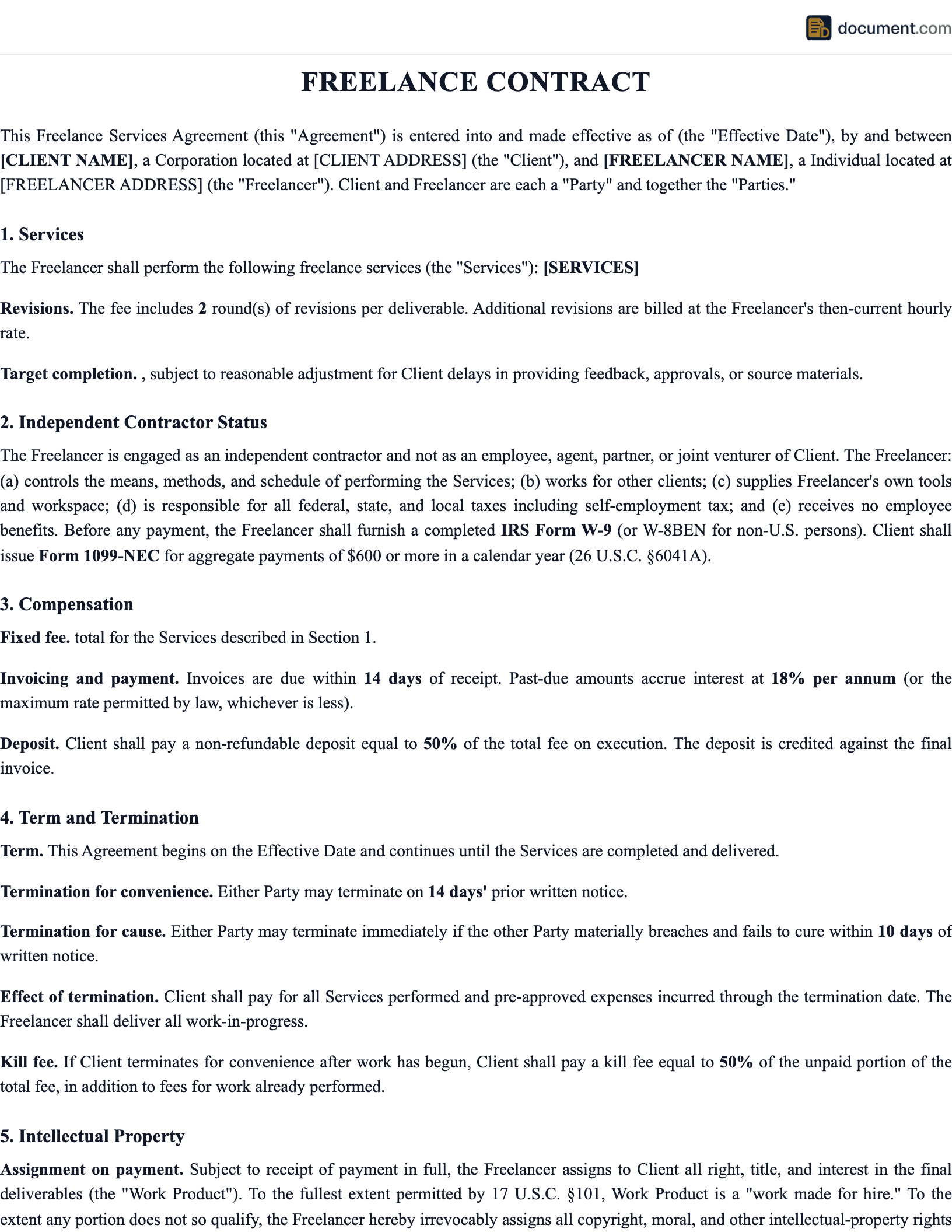



What Is a Freelance Contract?
A freelance contract is a written agreement between a freelancer (an independent professional in business for themselves) and a client that defines the scope of work, the deliverables, the payment terms, who owns the intellectual property created, what happens if the project is canceled, and how disputes will be resolved. It is the foundational document of every healthy freelance relationship — the difference between getting paid on time for work you actually agreed to do and a months-long collection effort over a project that kept growing while the deposit kept shrinking. Roughly 60 million Americans now do freelance work in some form, and the most successful freelancers treat written contracts as a non-negotiable starting point for every engagement, no matter how small or how friendly the client.
At its core, a freelance contract answers six practical questions that every project needs answered. What is being delivered, in what format, and to what level of quality? When is it due, and what milestones mark progress? How much does it cost, on what payment schedule, and what happens if the client pays late? Who ownsthe work product, the source files, the underlying IP, and the freelancer's portfolio rights? What happens if the client cancels mid-project, asks for revisions outside the scope, or simply ghosts? And how are disputes handled if the relationship breaks down?
Freelance contracts differ from employment contracts in three legally critical ways. First, the freelancer is an independent contractor, not an employee, which means no payroll withholding, no employer-provided benefits, no workers' compensation, and no entitlement to overtime under the Fair Labor Standards Act. Second, the freelancer controls how the work is done — the client controls what is delivered, but not the means or methods. Third, default intellectual property ownership belongs to the freelancer unless the contract clearly transfers it. These three differences are the reason worker classification is one of the most heavily enforced areas of employment law: misclassifying an employee as a freelancer can expose the client to back payroll taxes, unpaid overtime, penalties, interest, and class action liability.
Several jurisdictions have enacted statutes specifically protecting freelancers. The most prominent is the New York City Freelance Isn't Free Act (NYC Admin. Code §§ 20-927 et seq.), which took effect in 2017 and gives freelancers in NYC the right to a written contract for any project worth more than $800, timely payment by the contractually agreed date or within 30 days if no date is specified, and protection from retaliation. Violating freelancers can sue for double damages plus attorneys' fees and costs, and the city Department of Consumer and Worker Protection can impose civil penalties of up to $25,000 for repeat violators. Similar laws have followed in Los Angeles, Seattle, Minneapolis, the entire state of Illinois (the Freelance Worker Protection Act), Minnesota, and most recently the entire state of New York.
Whether you are a designer pricing your first branding project, a developer signing your tenth client, a writer trying to stop scope creep, or a consultant moving from W-2 to self-employment, our attorney-reviewed templates give you a defensible starting point with the standard provisions courts and freelance protection statutes expect — and the flexibility to customize the deliverables, payment structure, IP rights, and termination provisions for your specific project.
Get Paid On Time
Lock in deposits, milestones, and late fees that protect cash flow
Stop Scope Creep
Define deliverables and require change orders for any out-of-scope request
Protect Your IP
Hold ownership of work product until final payment is received
Freelance Contract Form Preview
Below is a visual preview of the sections and fields included in a standard freelance contract. Your completed document will be customized for your discipline, deliverables, and payment structure.
Freelance Services Agreement
Independent Contractor Project
Section 1: Parties
Section 2: Scope of Work
• Logo design (3 initial concepts, 2 rounds of revisions)
• Brand color palette and typography system
• Packaging design for 4 SKUs
• Brand guidelines PDF
Section 3: Fees & Payment
Section 4: Timeline
Start date: Nov 1, 2025
Final delivery: Dec 20, 2025
Section 5: IP & Kill Fee
Section 6: Execution
Freelancer Signature
Client Signature
Types of Freelance Contracts
Different freelance disciplines and engagement structures call for different contract templates. Picking the right one ensures the deliverables, IP rights, and payment structure match how the work actually flows.
Design Freelance Contract
Graphic, brand, web, and product design projects with deliverables and revisions
Development Freelance Contract
Software, web, and app development with milestone-based delivery
Writing Freelance Contract
Content writing, copywriting, ghostwriting, and editorial projects
Photography Freelance Contract
Commercial, editorial, and event photography with usage rights
Marketing Freelance Contract
Marketing strategy, campaign execution, and social media services
Consulting Freelance Contract
Strategic, technical, or operational consulting on a project basis
Hourly Freelance Contract
Time-and-materials engagements billed at an agreed hourly rate
Fixed-Fee Project Contract
Defined scope and deliverables for a single fixed price
Retainer Freelance Contract
Recurring monthly engagement with a defined scope of work
Freelance vs Employment vs Contractor
Freelance, independent contractor, and employee are three different legal classifications with very different consequences for taxes, IP, benefits, and liability.
| Feature | Freelancer | Independent Contractor | Employee |
|---|---|---|---|
| Tax form | 1099-NEC | 1099-NEC | W-2 |
| Withholding | None | None | By employer |
| Benefits | None from client | None from client | Often provided |
| Control | Freelancer controls methods | Contractor controls methods | Employer controls methods |
| IP default | Freelancer owns | Contractor owns | Employer owns (work-for-hire) |
| Overtime rights | No | No | Yes (FLSA non-exempt) |
| Engagement style | Project-based, multiple clients | Long-term project or service | Ongoing employment |
How to Create a Freelance Contract
A defensible freelance contract is built in seven concrete steps. Working through them in order ensures you have a real agreement before any work begins.
Define the scope of work
List the exact deliverables, formats, dimensions, page counts, file types, and quality standards. Specific scope is the single best defense against scope creep.
Set the timeline and milestones
Map out a project schedule with intermediate checkpoints. Each milestone is an opportunity for client feedback and a trigger for the next payment installment.
Lock in the fee and payment terms
Decide on hourly, fixed-fee, or retainer pricing. Require a deposit before work begins, set milestone payments, and specify late fees and the right to suspend work for nonpayment.
Specify IP ownership
Decide whether IP transfers on payment, on delivery, or never (license-only). Use a work-for-hire designation plus a backup assignment for full transfer.
Add a kill fee and revision policy
Specify what happens if the client cancels (kill fee structure based on project progress) and how many rounds of revisions are included before extra fees apply.
Include the standard protective clauses
Confidentiality, indemnification, limitation of liability, independent contractor classification, governing law, and dispute resolution. Don't skip these to keep the contract short.
Sign before any work begins
Get both signatures (electronic is fine), keep a copy in the project file, and never start work — or accept any briefing call — before the contract is fully executed.
Key Components
A complete freelance contract contains the following building blocks regardless of the discipline or project type.
Parties and project description
Full legal names of freelancer and client and a clear summary of the project
Detailed scope of work
Specific deliverables, formats, quantities, and quality standards
Timeline and milestones
Start date, milestone dates, and final delivery date
Fees and payment schedule
Total fee, deposit, milestone payments, late fees, and reimbursable expenses
Intellectual property
Ownership, work-for-hire, assignment, and freelancer portfolio rights
Kill fee and revisions
Cancellation fees and the number of included revision rounds
Confidentiality
Protection of client information and freelancer trade secrets
Independent contractor status
Confirmation of classification, tax responsibilities, and lack of benefits
Indemnification and liability
Mutual indemnities and a cap on liability for both parties
Termination and dispute resolution
Termination rights, governing law, venue, and prevailing party fees
NYC Freelance Isn't Free Act
The Freelance Isn't Free Act (NYC Administrative Code §§ 20-927 et seq.) was the first comprehensive freelance protection law in the United States. It took effect on May 15, 2017 and has since become the model for similar laws in Los Angeles, Seattle, Minneapolis, Illinois, Minnesota, and the entire state of New York.
Key requirements of the Freelance Isn't Free Act
- Written contract required for any work over $800 (single project or aggregate over 120 days)
- Contract must include parties' names, scope, value, and payment date
- Payment must be made by the contractually agreed date or within 30 days of completion
- No retaliation against freelancers who exercise their rights
- Freelancers can sue for double damages plus attorneys' fees and costs
- NYC DCWP can investigate and impose civil penalties up to $25,000 for repeat violators
Legal Requirements
Freelance contracts are governed by general contract law, intellectual property statutes, tax law, and an increasing number of freelance protection laws.
- Written contract required by NYC Freelance Isn't Free Act for projects over $800
- Written contract required by Illinois Freelance Worker Protection Act effective 2024
- Worker classification under IRS 20-factor test, DOL economic-realities test, and state ABC tests
- Form 1099-NEC for U.S. freelancers earning over $600 in a calendar year
- Self-employment tax of 15.3% on net earnings paid by the freelancer
- Quarterly estimated tax payments using Form 1040-ES
- Copyright Act work-for-hire requirements under 17 USC § 101
- State sales tax registration where freelancers sell taxable services
Sample Freelance Contract
Below is a condensed preview of our standard freelance contract template. Your final document will be customized for your discipline, deliverables, and jurisdiction.
FREELANCE SERVICES AGREEMENT
Independent Contractor Project
This Freelance Services Agreement ("Agreement") is entered into as of[Date]between [Freelancer]("Freelancer") and [Client]("Client").
1. SERVICES
Freelancer shall provide the services described in Exhibit A ("Services"), which is incorporated by reference. Any work outside the scope of Exhibit A requires a written change order signed by both parties before Freelancer is required to perform it.
2. FEES AND PAYMENT
The total fee for the Services is $[Amount], payable as follows: [%]% deposit on signing, [%]% on milestone delivery, and the balance on final delivery. Late payments accrue interest at 1.5% per month or the maximum permitted by law.
3. TIMELINE
Freelancer shall deliver the Services in accordance with the schedule in Exhibit A. Client delays in providing feedback, materials, or approvals shall extend Freelancer's deadlines by an equal number of business days.
4. INTELLECTUAL PROPERTY
Upon receipt of full payment, Freelancer assigns to Client all right, title, and interest in the final deliverables. Until full payment is received, Freelancer retains all ownership and Client has no right to use the deliverables. Freelancer retains the right to display the deliverables in Freelancer's portfolio.
5. REVISIONS AND KILL FEE
The fee includes [#]rounds of revisions. Additional revisions are billed at $[rate]per hour. If Client cancels the project after work has begun, Client shall pay a kill fee of [%]% of the total fee in addition to all amounts already invoiced.
6. INDEPENDENT CONTRACTOR
Freelancer is an independent contractor, not an employee. Freelancer is responsible for all federal, state, and local taxes on amounts received under this Agreement. Client shall issue Form 1099-NEC for amounts paid to Freelancer if required by law.
7. CONFIDENTIALITY
Each party shall protect the other's confidential information with the same degree of care it uses for its own confidential information, and shall not disclose it to any third party except as necessary to perform the Services.
8. TERMINATION
Either party may terminate this Agreement on 14 days' written notice. On termination, Client shall pay Freelancer for all work performed through the termination date plus any applicable kill fee. Freelancer may suspend work immediately if any invoice is more than 15 days overdue.
Frequently Asked Questions
Find answers to common questions about freelance vs employment classification, IP ownership, payment terms, scope creep, kill fees, the NYC Freelance Isn't Free Act, and taxes.
Official Resources
For additional information on freelancing law, taxes, and worker protections, consult these official resources.
NYC Freelance Isn't Free Act
Official New York City information on freelancer rights and complaint filing
IRS Self-Employed Tax Center
Federal tax information for freelancers and independent contractors
U.S. DOL - Worker Misclassification
Department of Labor guidance on independent contractor classification
U.S. Copyright Office - Works Made for Hire
Official guidance on the work-for-hire doctrine and freelance copyright
Freelancers Union
Nonprofit advocacy and resources for independent workers
NASE - National Association for the Self-Employed
Trade association serving the self-employed and microbusiness community
Create your Freelance Contract in under 10 minutes.
Answer a few questions and download a compliant, attorney-drafted document ready for your state.