



What Is a Photography Contract?
A photography contract is a legally binding agreement between a photographer and a client that establishes the terms for a photography session or event coverage. At its core, the contract answers the fundamental questions that govern the engagement: what will be photographed, when and where, how many edited images the client will receive, in what format and on what timeline, how much the client will pay and on what schedule, who owns the copyright to the images, what usage rights the client receives, and what happens if either party needs to cancel or reschedule.
Photography contracts are essential because photography sits at the intersection of creative services and intellectual property law. Under U.S. copyright law, the photographer — not the client who paid for the shoot — owns the copyright to the images by default. This surprises many clients, who assume that paying for a photography session means they own the resulting photographs outright. A well-drafted photography contract defines precisely what rights the client receives (a personal-use license, a commercial license, or a full copyright assignment), eliminating the ambiguity that leads to disputes and infringement claims. The contract also protects the photographer by documenting the agreed scope, limiting liability for missed moments or equipment failure, and securing the right to use selected images in the photographer's portfolio and marketing.
Our photography contract templates cover the full range of photography verticals — wedding and engagement, portrait and family, headshot and branding, event and corporate, real estate and architectural, product and food, fashion and editorial, and fine art. Each template is designed to comply with federal copyright law and state contract law and includes all the standard protective provisions: session details, deliverables, licensing, editing scope, payment terms, cancellation policy, model release, liability limitation, and dispute resolution.
All Photography Types
Weddings, portraits, events, commercial, product, and real estate.
Copyright Protection
Clear licensing terms defining exactly what the client may do with images.
Payment Security
Non-refundable retainer, milestone payments, and late-fee provisions.
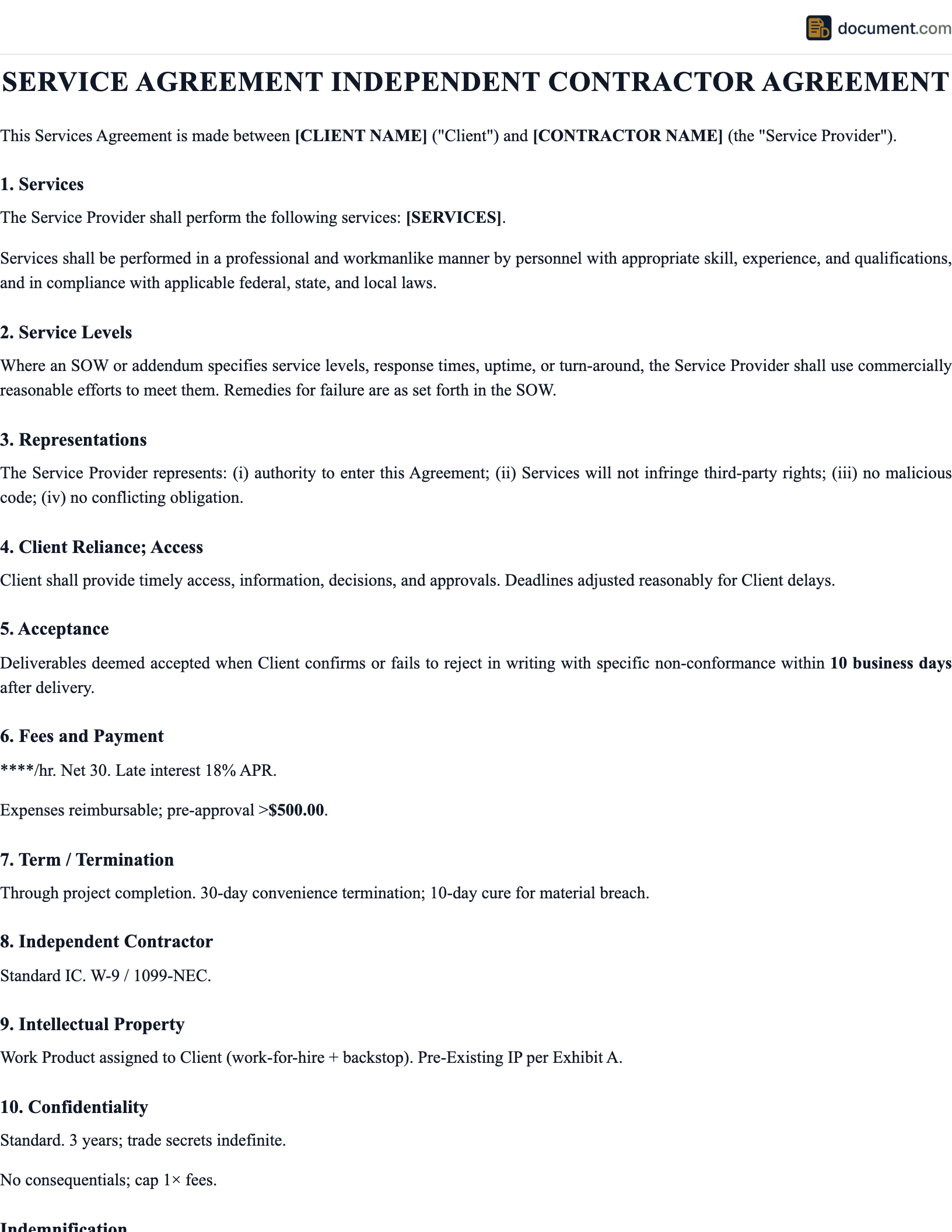
Photography Contract Form Preview
Photography Contract
Professional Photography Services
1. PARTIES
Photographer: [Photographer / Studio Name]
Client: [Client Name]
2. SESSION DETAILS
Date: [Date] | Location: [Location]
Duration: [Hours] | Type: [Wedding/Portrait/Event]
3. DELIVERABLES
Minimum [#] edited images delivered via [online gallery/USB] within [#] weeks.
4. COMPENSATION
Total Fee: $[Amount] | Retainer: $[Amount] (non-refundable) due upon signing.
Key Components of a Photography Contract
A thorough photography contract should address these elements to protect both the photographer and the client.
| Component | Purpose | Details |
|---|---|---|
| Session Details | Defines the engagement | Date, time, location, backup location, duration, type |
| Deliverables | Specifies what client receives | Number of edited images, format, resolution, delivery method, timeline |
| Copyright & Licensing | Defines image ownership and use | Photographer retains copyright; client gets usage license or assignment |
| Editing Scope | Sets post-processing expectations | Color correction, retouching, revision rounds, RAW file policy |
| Payment Terms | Structures compensation | Retainer, balance, overtime, late fees, payment methods |
| Cancellation Policy | Allocates cancellation risk | Notice periods, fee retention, rescheduling, force majeure |
| Model Release | Secures likeness rights | Portfolio use, marketing, stock licensing, opt-out option |
| Liability Limitation | Caps photographer's exposure | Liability capped at fees paid; equipment failure, image loss |
| Second Shooter | Provides backup coverage | Additional photographer for weddings and large events |
| Print & Album Rights | Governs physical products | Print release, album design, third-party printing rights |
How to Create a Photography Contract
Follow these steps to build a photography contract tailored to your specific engagement.
Define Session Scope
Specify the type of photography, the date and time, the primary and backup locations, the session duration, the number of subjects, and any special requirements (props, wardrobe changes, multiple locations). For weddings, document the timeline from preparation through reception.
Set Deliverables and Editing Terms
State the minimum number of edited images, the file format and resolution, the delivery method and timeline, the editing style, the number of retouching images included, the revision process, and the RAW file policy. Attach sample images that reflect the editing style.
Draft Copyright and Licensing Terms
Define who owns the copyright (typically the photographer), what usage license the client receives (personal, social media, commercial), whether the license is exclusive or non-exclusive, the duration of the license, and the photographer's right to use images for portfolio and marketing.
Structure Payment and Cancellation
Set the total fee, retainer amount, balance due date, overtime rate, accepted payment methods, and late-fee terms. Draft cancellation provisions with tiered consequences based on notice period. Include rescheduling and force majeure terms.
Include Liability and Model Release
Limit the photographer's liability to fees paid, address equipment failure and image loss, include a model release for portfolio use, and add indemnification for client misuse of images beyond the licensed scope.
Add Legal Provisions
Include governing law, dispute resolution (mediation, then arbitration or litigation), entire-agreement clause, amendment requirements, and signature blocks for both parties. Attach any exhibits (shot list, timeline, pricing schedule).
Frequently Asked Questions
Common questions about photography contracts, copyright, licensing, cancellation, editing, and liability.
Official Resources
Authoritative resources on photography contracts, copyright law, and professional standards.
U.S. Copyright Office
Federal copyright registration for photographs and visual works.
Professional Photographers of America
Industry standards, business resources, and contract guidance.
ASMP
American Society of Media Photographers licensing and business resources.
Copyright Circular 9
Works made for hire under U.S. copyright law.
FTC Cooling-Off Rule
Consumer cancellation rights for service contracts.
IRS Form 1099-NEC
Tax reporting for photographer compensation as independent contractor.
Create Your Photography Contract
Protect your photography business with a contract covering copyright, deliverables, payments, and cancellation.
Create DocumentNo account required. Free to create and preview.