
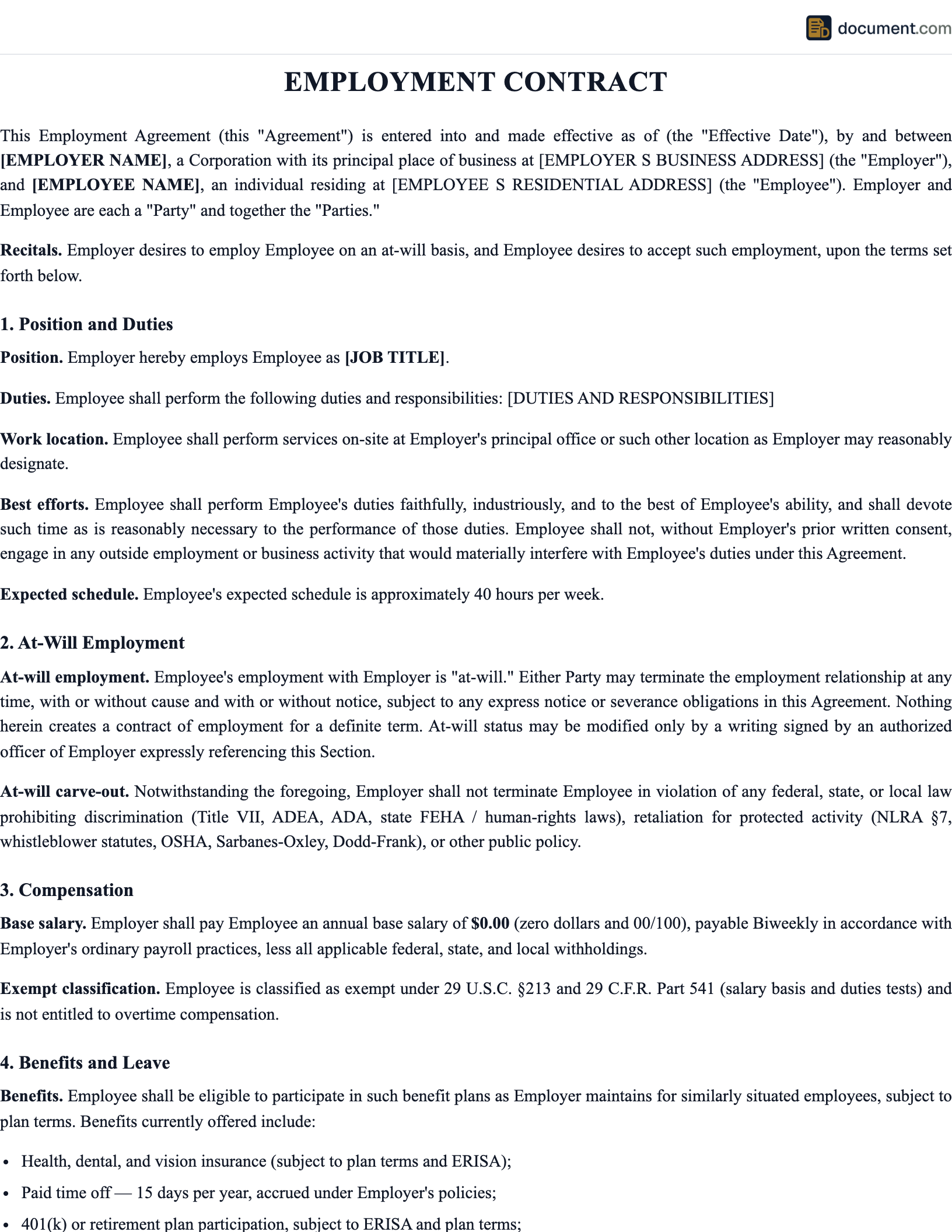



What Is an Employment Contract?
An employment contract is a written instrument that defines the working relationship between an employer and an individual worker. It states what the worker will do, what the employer will pay, how long the relationship runs, what conduct ends it, and what survives termination. Once signed it controls every term it addresses, displacing the at-will default and the gap-filling rules a court would otherwise apply. Where the contract is silent, statute governs: federal wage-and-hour rules under the Fair Labor Standards Act (29 U.S.C. § 201 et seq.), anti-discrimination protections under Title VII (42 U.S.C. § 2000e), the ADA (42 U.S.C. § 12101), the ADEA (29 U.S.C. § 621), and state wage-payment statutes.
At-will employment is the baseline in 49 states. Montana is the lone exception: under the Wrongful Discharge from Employment Act (Mont. Code Ann. § 39-2-901), an employee who completes the probationary period (default 12 months, modifiable by employer) may only be discharged for good cause. Everywhere else, either side may end the relationship at any time for any lawful reason, with or without notice. A written contract changes that default only to the extent it specifies cause grounds, notice periods, or severance entitlements. A contract that recites "at-will employment" preserves the default while still binding both sides to the compensation, IP, and confidentiality terms it contains.
Three audiences need a written contract regardless of size or seniority. Executives because the compensation is too complex for an offer letter (equity vesting, bonus formulas, change-of-control acceleration, severance triggers, 280G gross-ups). Employees with access to trade secrets or customer relationships because the employer needs enforceable confidentiality, IP assignment, and non-solicit clauses to protect those interests after departure. Visa workers because the Department of Labor requires the employer to document the wage and conditions in the Labor Condition Application (20 C.F.R. § 655.731), and an integrated employment contract is the cleanest way to do so. Most other workers can be hired with an offer letter plus separate at-will and IP-assignment acknowledgments, but a unified contract reduces the number of documents and the number of disputes.
Employment contract vs offer letter vs handbook
The three documents do different work and frequently get confused. The offer letter announces the job and is typically one to three pages: title, start date, salary, benefits eligibility, contingencies (background check, I-9, drug screen), and an at-will disclaimer. It binds the employer to the salary it states. The employee handbook sets workplace policies (PTO, conduct, dress code, complaint procedures) and applies uniformly to all employees; courts in roughly 20 states (notably Illinois under Duldulao v. Saint Mary of Nazareth Hosp.) treat handbook promises as enforceable absent a clear disclaimer. The employment contract supersedes both for the individual worker on every term it addresses, and should include an integration clause stating that no prior offer letter, handbook provision, or oral promise modifies the contract terms.
Employee vs independent contractor classification
The classification decision is not a matter of what the parties call the relationship. The IRS applies the common-law control test under Rev. Rul. 87-41 (behavioral control, financial control, type of relationship). The Department of Labor applies the economic-realities test under the March 2024 final rule (29 C.F.R. Part 795), restoring the multi-factor analysis the Trump-era rule had narrowed. California, Massachusetts, New Jersey, and Connecticut apply the stricter ABC test (Cal. Lab. Code § 2775, codifying Dynamex Operations W. v. Superior Ct.): the worker is an employee unless the hiring entity proves freedom from control, work outside the usual course of business, and engagement in an independently established trade. Misclassification exposes the employer to back overtime under FLSA, unpaid FICA and FUTA contributions, state unemployment liability, and penalties under IRC § 3509 of up to 100 percent of unpaid taxes. Use an employment contract for employees and a separate independent-contractor agreement (with no benefits, no IP-by-default, and explicit Section 1099 reporting language) for contractors.
Mutual Protection
Defines rights and obligations for both employer and employee with equal clarity
IP & Confidentiality
Protects trade secrets, proprietary information, and ensures IP created on the job belongs to the company
Clear Expectations
Eliminates ambiguity about compensation, duties, performance standards, and termination terms
Employment Contract Form Preview
Below is a visual preview of the sections and fields included in a standard employment contract. Your completed document will be fully formatted and customized for your specific employment type, compensation structure, and state requirements.
Employment Agreement
At-Will Employment Contract
Section 1: Parties
Section 2: Compensation & Benefits
Section 3: Employment Terms
Section 4: Signatures
Employer Signature
Employee Signature
Types of Employment Contracts
Pick the contract structure that matches the duration and obligations of the role. At-will is the default for hourly and salaried W-2 employees in 49 states. Fixed-term suits roles with a clear end date (12-month engagements, project-based work, parental-leave coverage) and fixes damages on early termination. Executive agreements add equity, severance, and change-of-control protection. Independent-contractor agreements must satisfy the IRS, DOL, and state ABC tests to avoid reclassification.
At-Will Employment Contract
Standard agreement where either party can terminate the relationship at any time for any lawful reason
Fixed-Term Employment Contract
Agreement for a specific duration with defined start and end dates and renewal provisions
Part-Time Employment Contract
Agreement for employees working fewer than full-time hours with proportional benefits and obligations
Executive Employment Agreement
Comprehensive agreement for C-suite and senior leadership with equity, bonuses, and severance terms
Permanent Employment Contract
Open-ended agreement with no predetermined end date, offering greater job security protections
Temporary Employment Contract
Short-term agreement for seasonal, project-based, or interim staffing needs with defined end conditions
Zero-Hour Contract
Flexible arrangement where the employer is not obligated to provide minimum hours and the worker can decline shifts
Severance Agreement
Agreement outlining compensation and benefits provided to an employee upon termination of employment
Independent Contractor Agreement
Agreement for non-employee workers who control how and when they perform services
Dentist
Employment agreement tailored for dentists joining a dental practice or clinic
Internship
Agreement defining duties, duration, and compensation for interns in paid or unpaid programs
Staffing Agency
Contract between a staffing agency and client company for placing temporary or contract workers
Employment Contract vs Offer Letter
An offer letter is short, communicates the salary, lists contingencies (background check, I-9 verification, drug screen where lawful), and disclaims any contract of employment. It binds the employer to the wage it states; nothing more. An employment contract is a complete instrument: it covers compensation in all forms, IP and confidentiality, restrictive covenants, termination procedure, severance, governing law, and dispute resolution. Use the offer letter for the bulk of W-2 hires. Use the contract whenever the employer needs enforceable post-termination protections or the employee needs specific commitments (severance, equity vesting, relocation reimbursement with clawback, sign-on bonus repayment terms).
The risk in offer letters is implied-contract creation. Statements like "we look forward to a long career together" or "you will only be terminated for cause" can convert the at-will relationship into something enforceable, particularly in states recognizing the implied-contract exception (Toussaint v. Blue Cross & Blue Shield of Mich. is the leading case). Every offer letter should include an explicit at-will disclaimer and an integration clause stating that no oral promise survives.
Employment Contract
- - Comprehensive legal agreement (8-20+ pages)
- - Detailed compensation, bonus, equity terms
- - Specific termination procedures and severance
- - Non-compete, NDA, and IP assignment clauses
- - Dispute resolution procedures
- - Unambiguously legally binding
Offer Letter
- - Brief summary document (1-3 pages)
- - Basic salary and benefits overview
- - Typically silent on termination procedures
- - May reference separate agreements
- - Usually includes at-will disclaimer
- - May or may not be binding depending on language
Best practice: Use an offer letter for standard at-will positions and a full employment contract for executives, key employees, roles with significant IP exposure, or any position where the employer wants to include enforceable restrictive covenants and specific termination terms.
How to Draft an Employment Contract: A 9-Step Guide
An employment contract has nine working parts. Get them in this order. Every clause should resolve a specific question that would otherwise default to state law, the handbook, or oral understanding. Where the answer matters to either party, write it down with numbers and dates, not adjectives.
FLSA exempt vs non-exempt classification
Before drafting, settle the exempt/non-exempt question. Non-exempt employees are entitled to overtime at 1.5 times the regular rate for hours over 40 per week (29 U.S.C. § 207). Exempt status under the executive, administrative, or professional exemptions (29 C.F.R. Part 541) requires both a duties test and a salary threshold. The DOL final rule effective July 1, 2024 raised the standard threshold to $43,888 ($844/week), with a further increase to $58,656 ($1,128/week) on January 1, 2025; the highly compensated employee threshold rose to $151,164. A federal district court vacated the rule nationwide in November 2024 (Texas v. DOL); the current threshold reverts to $35,568. State thresholds may exceed the federal floor: California uses two times the state minimum wage ($66,560 for 2024 employers of 26+), New York uses tiered thresholds ($62,400 NYC, $58,500 Long Island and Westchester, $55,341 elsewhere), Washington uses 2.5 times state minimum wage for 2024 ($67,724.80 for employers of 51+).
Required new-hire forms
Three federal forms are required for every W-2 hire: Form I-9 (employment eligibility verification under 8 U.S.C. § 1324a), completed by the employee on day one and the employer within three business days; Form W-4 (federal income-tax withholding); and the new-hire report to the state directory of new hires within 20 days under 42 U.S.C. § 653a. Many states layer on state W-4 equivalents (California DE 4, New York IT-2104), wage-theft prevention notices (California Labor Code § 2810.5, New York Labor Law § 195(1)), pamphlet delivery (California paid-sick-leave notice, sexual-harassment policy acknowledgment), and E-Verify enrollment (mandatory for state contractors and all employers in Arizona, Mississippi, North Carolina, South Carolina, Tennessee, Utah, Alabama, and Georgia for employers above defined size thresholds).
Identify the Employment Type
Settle the structural choice first: at-will W-2 employee, fixed-term W-2 employee, executive with severance and equity, or 1099 independent contractor. Fixed-term creates a damages floor on early termination (the unpaid balance of the term, subject to mitigation). Executive triggers Section 280G analysis on change of control. Independent contractor must satisfy the IRS common-law test, the DOL economic-realities test, and the ABC test in California, Massachusetts, New Jersey, and Connecticut. Pick wrong and the contract architecture is wrong throughout.
Define Compensation and Benefits
Base salary stated in annual dollars with pay frequency (bi-weekly, semi-monthly, weekly per state law). Bonus: target percentage, metrics (revenue, EBITDA, individual MBOs), discretionary vs earned (in California, an earned bonus is wages under Labor Code § 200 and cannot be forfeited at termination). Equity: type (ISOs, NSOs, RSUs), grant amount, 4-year vest with 1-year cliff (industry standard), strike price for options at fair market value to avoid IRC § 409A. Benefits eligibility (typically first of month after 30 days for medical, immediate for 401(k) under SECURE 2.0 long-term part-time rules effective 2024). Pay frequency must comply with state wage-payment law (weekly in New Hampshire and Vermont, bi-weekly minimum in California for non-exempt).
Describe Job Duties and Performance Standards
Title, reporting line, primary responsibilities written at a level that survives reorganization (avoid naming a specific manager who may leave). Work location and remote-work designation matter for tax withholding (the employee's state of residence and the employer's nexus state both apply, with reciprocity agreements between certain states like Pennsylvania and New Jersey). Specify whether the role is exempt or non-exempt and which exemption applies (executive, administrative, professional, computer professional, outside sales). For non-exempt employees, state the standard workweek and overtime authorization procedure.
Include Confidentiality and IP Assignment Provisions
Confidentiality clause must define confidential information, exclude information that is public or independently developed, and survive termination indefinitely (perpetual for trade secrets under the federal Defend Trade Secrets Act, 18 U.S.C. § 1836). Add the DTSA whistleblower notice required by 18 U.S.C. § 1833(b) or lose the right to recover exemplary damages and attorney fees in any DTSA action. IP assignment must include a present-tense assignment of all rights (avoid promise-to-assign language; see Stanford v. Roche, 563 U.S. 776 (2011)). California Labor Code § 2870, Delaware 19 Del. C. § 805, Illinois 765 ILCS 1060/2, Minnesota Minn. Stat. § 181.78, North Carolina N.C.G.S. § 66-57.1, Utah Utah Code § 34-39-3, and Washington RCW 49.44.140 require carve-outs for inventions developed entirely on personal time without employer resources and unrelated to employer business; include the statutory notice or the assignment of those inventions is void.
Draft Restrictive Covenants
Non-compete: void in California, North Dakota, Oklahoma, and Minnesota (post-July 2023 agreements). Income floors apply in Washington ($123,394 for 2024), Colorado ($123,750), Illinois ($75,000), Oregon ($113,241). Massachusetts requires garden-leave pay of 50 percent of base salary for the restricted period under M.G.L. c. 149 § 24L. Where allowed, scope (specific competitors or industry-wide), duration (6 to 24 months), and geography (tied to legitimate protectable interest) are all reviewed for reasonableness. Non-solicit of employees and customers is more widely enforceable. Non-disparagement is enforceable, but cannot prohibit reporting of unlawful conduct under the Speak Out Act (42 U.S.C. § 19401 et seq.) or whistleblower disclosures to the SEC, EEOC, or NLRB.
Establish Termination Provisions
Specify cause grounds with precision: gross misconduct, conviction of a felony or crime of moral turpitude, willful breach of material contract terms, sustained failure to perform after written warning. Without-cause termination requires the notice period stated (often 30 to 60 days, or pay in lieu). Voluntary resignation with required notice (commonly two weeks; longer for executives). Constructive termination triggers severance if material adverse changes (reduction in title, base salary cut over a defined percentage, relocation beyond a defined radius) occur without consent. Address final-pay timing under state law: California requires immediate payment on involuntary termination (Labor Code § 201) and within 72 hours on resignation (§ 202); Massachusetts requires payment on the day of termination (M.G.L. c. 149 § 148); most other states require payment by the next regular payday.
Include Severance Terms (If Applicable)
Trigger: termination without cause or constructive termination; double-trigger acceleration (termination plus change of control within 12 months) for equity. Amount: 6 to 24 months of base salary plus pro-rated target bonus, with executives commonly receiving 12 to 24 months and senior managers receiving 6 to 12. Benefits: COBRA premium reimbursement for the severance period (taxable to the employee unless paid through a qualified plan to avoid Section 105(h) discrimination rules). Conditions: signed release of claims that complies with the Older Workers Benefit Protection Act (29 U.S.C. § 626(f)) for employees age 40+ (21-day consideration period, 7-day revocation, knowing and voluntary). Section 409A compliance: pay severance within the short-term deferral window (March 15 of the year following termination) or structure as a separation pay plan exempt under Treas. Reg. § 1.409A-1(b)(9).
Add Dispute Resolution Procedures
Choose arbitration or court. Arbitration under the Federal Arbitration Act (9 U.S.C. § 1) is presumptively enforceable, but the Ending Forced Arbitration of Sexual Assault and Sexual Harassment Act of 2021 (9 U.S.C. § 402) gives employees the unilateral right to litigate sexual-misconduct claims in court regardless of any pre-dispute agreement. Specify administrator (AAA Employment Rules or JAMS), seat, governing rules, allocation of fees (employer pays all arbitrator fees beyond the equivalent court filing fee in most states; California requires this under Armendariz v. Foundation Health, 24 Cal. 4th 83 (2000)). Carve out injunctive relief to allow court enforcement of confidentiality and non-solicit clauses. Class waivers are enforceable post-Epic Systems Corp. v. Lewis, 138 S. Ct. 1612 (2018), but PAGA representative claims survive in California (Adolph v. Uber, 14 Cal. 5th 1104 (2023)).
Review and Execute the Contract
Give the employee a reasonable review period (executive contracts typically allow 7 to 21 days) and a written recommendation to consult counsel. Both parties sign and date. Use electronic signature under the federal ESIGN Act (15 U.S.C. § 7001) and state UETA equivalents; both are enforceable for employment contracts in 49 states (New York follows its own ESRA). Retain the executed contract for the longer of the limitations period in the governing-law state (3 to 6 years for written contracts in most states; 4 years under California Code of Civil Procedure § 337) or the term of any restrictive covenant. Store with the personnel file alongside I-9, W-4, benefits enrollments, and signed handbook acknowledgment.
Key Components of an Employment Contract
These sixteen components appear in nearly every enforceable employment contract. Each addresses a question that would otherwise default to state law, the employee handbook, or oral understanding. Omit any of them and you have substituted ambiguity for clear allocation.
| Component | Description |
|---|---|
| Parties | Legal names and addresses of employer (company) and employee |
| Position & Duties | Job title, reporting structure, primary responsibilities, and authority level |
| Employment Type | At-will, fixed-term, permanent, or other classification |
| Start Date & Term | Effective date, duration (if fixed-term), and renewal provisions |
| Compensation | Base salary, pay frequency, bonus structure, commission, and equity grants |
| Benefits | Health insurance, retirement plans, PTO, parental leave, and other benefits |
| Work Schedule & Location | Hours, remote/hybrid/on-site, overtime expectations, and travel requirements |
| Probationary Period | Duration, evaluation criteria, and consequences of not passing probation |
| Confidentiality / NDA | Non-disclosure obligations covering trade secrets and proprietary information |
| IP Assignment | Ownership of work product, inventions, and creative output during employment |
| Non-Compete | Post-employment restrictions on competing activities (where enforceable) |
| Non-Solicitation | Restrictions on recruiting company employees or soliciting company clients |
| Termination | Grounds for termination (cause, without cause), notice periods, and procedures |
| Severance | Compensation and benefits upon termination, release requirements |
| Dispute Resolution | Arbitration, mediation, or litigation procedures, governing law, and venue |
| Governing Law | State whose employment laws govern the contract |
Understanding At-Will Employment
At-will is the default in 49 states. Either side ends the relationship at any time, for any lawful reason, with or without notice. The doctrine traces to Wood's Master and Servant treatise (1877) and was adopted as the American baseline in Payne v. Western & Atlantic Railroad, 81 Tenn. 507 (1884). Montana is the lone holdout: under Mont. Code Ann. § 39-2-904, an employee who has completed the probationary period (default 12 months) may be discharged only for good cause. Puerto Rico effectively imposes a similar standard through Law 80 of 1976, requiring statutory severance for any termination without just cause.
At-will vs for-cause termination
A contract converts at-will to for-cause when it specifies the grounds on which termination is permitted. Courts read these clauses narrowly: if the contract lists felony conviction, gross misconduct, and material breach as cause grounds, the employer may not fire for poor performance unless poor performance falls within one of the enumerated categories. The cause definition should distinguish willful misconduct (intentional bad acts) from non-performance (failure to meet documented metrics after written warning and a defined cure period). A common drafting mistake is conflating "cause" with "any reason the employer dislikes"; that formulation defeats the protection the employee bargained for and courts will reform it.
Common-law exceptions to at-will
Statutory protections
Discharge cannot be motivated by race, color, religion, sex, or national origin (Title VII, 42 U.S.C. § 2000e-2), age 40+ (ADEA, 29 U.S.C. § 623), disability (ADA, 42 U.S.C. § 12112), pregnancy (PDA), genetic information (GINA), USERRA-protected military service (38 U.S.C. § 4311), or retaliation for protected activity (whistleblowing under Sarbanes-Oxley § 806, OSHA § 11(c), filing workers' comp). Most states add sexual orientation and gender identity (post-Bostock v. Clayton County, 590 U.S. 644 (2020), federal law also reaches these).
Implied contract from handbook
Roughly 38 states recognize that handbook provisions, oral promises, or consistent past practice may create an implied contract limiting at-will discharge. Toussaint v. Blue Cross & Blue Shield of Mich., 408 Mich. 579 (1980), is the leading case. Defeat the doctrine with a conspicuous handbook disclaimer (capital letters, near the signature line) and an at-will acknowledgment in the new-hire packet.
Public-policy exception
All but a handful of states recognize a tort claim for wrongful discharge in violation of public policy. Protected acts include refusing to commit perjury (Petermann v. Teamsters, 174 Cal. App. 2d 184 (1959)), refusing to violate antitrust law (Tameny v. Atlantic Richfield, 27 Cal. 3d 167 (1980)), reporting illegal conduct, serving on a jury (28 U.S.C. § 1875), and filing workers' comp claims. Damages include lost wages, emotional distress, and punitive damages in egregious cases.
Implied covenant of good faith
A minority of states (Alaska, California, Idaho, Massachusetts, Montana, Nevada, Wyoming) recognize that the implied covenant of good faith and fair dealing prohibits termination designed to deprive the employee of earned compensation. Fortune v. National Cash Register, 373 Mass. 96 (1977), is the seminal case (firing salesperson before commission vested). Most states confine the doctrine to denial of earned wages; California now limits it to contract damages, not tort.
Drafting note: A contract that requires 30 days written notice before termination, that lists specific cause grounds, or that ties severance to a without-cause discharge has displaced at-will to that extent. The employer who fires without honoring the contractual procedure faces breach damages equal to the unpaid severance plus the value of any accelerated equity, regardless of whether the underlying reason was lawful.
Legal Requirements for Employment Contracts
Federal statutes set the floor; state law layers on top; the contract may give the employee more than either requires but never less. A clause that conflicts with the floor is unenforceable to that extent regardless of signatures.
Federal floor
- FLSA wage and hour: Federal minimum wage is $7.25 per hour (29 U.S.C. § 206), unchanged since 2009. Overtime at 1.5 times the regular rate for hours over 40 per workweek for non-exempt employees (§ 207). Exempt status requires both the duties test (29 C.F.R. § 541.100 et seq.) and the salary threshold (currently $35,568 nationwide after Texas v. DOL vacated the 2024 increase). Recordkeeping for three years (§ 211).
- Anti-discrimination: Title VII (race, color, religion, sex, national origin), ADA (disability), ADEA (age 40+), GINA (genetic information), PDA (pregnancy), Equal Pay Act, USERRA (military service), Section 1981 (race in contracting). State and local laws extend protection to sexual orientation, gender identity, marital status, source of income, and arrest/conviction history (NYC, San Francisco, Chicago Fair Chance ordinances).
- NLRA protected concerted activity: Section 7 (29 U.S.C. § 157) protects employees, including non-union employees, who discuss wages, working conditions, or unionization. Confidentiality and non-disparagement clauses that prohibit such discussion are unlawful (McLaren Macomb, 372 NLRB No. 58 (2023)).
- FMLA leave: Employers with 50+ employees within 75 miles must provide 12 weeks unpaid job-protected leave for serious health conditions, parental leave, and military caregiver leave (29 U.S.C. § 2612). Contracts may provide more but cannot waive the right.
- ERISA preemption: Employment contracts that affect benefit plans are subject to ERISA (29 U.S.C. § 1001 et seq.), which preempts most state-law claims related to benefits. Severance plans covering multiple employees are typically ERISA welfare-benefit plans requiring SPDs and Form 5500 filings.
State-by-state non-compete enforceability
- Outright bans: California (Cal. Bus. & Prof. Code § 16600), North Dakota (N.D. Cent. Code § 9-08-06), Oklahoma (15 Okla. Stat. § 219A), Minnesota (Minn. Stat. § 181.988, agreements after July 1, 2023). California amended SB 699 effective January 1, 2024, voiding non-competes regardless of where signed if the employee works in California, with notice required to current and former employees by February 14, 2024.
- Income thresholds: Washington RCW 49.62.020 ($123,394 employees / $307,485 contractors for 2024); Colorado C.R.S. § 8-2-113 ($123,750 employees / $74,250 for non-solicit); Illinois Freedom to Work Act 820 ILCS 90 ($75,000 employees / $45,000 for non-solicit); Oregon ORS 653.295 ($113,241 for 2024); Maine Title 26 § 599-A; Maryland Lab. & Empl. § 3-716. Massachusetts requires garden-leave pay of 50 percent of base salary under M.G.L. c. 149 § 24L.
- FTC rule status: The FTC final non-compete rule (16 C.F.R. § 910), effective date September 4, 2024, would have voided most existing non-competes. The Northern District of Texas vacated the rule nationwide in Ryan LLC v. FTC (Aug. 20, 2024); the rule is on appeal at the Fifth Circuit and is not currently in force. Draft to existing state law and monitor.
Final-pay and accrued-PTO rules
- Immediate payment on involuntary termination: California (Lab. Code § 201, with waiting-time penalties of up to 30 days wages under § 203), Colorado, Hawaii (next business day), Massachusetts (day of termination), Minnesota (within 24 hours on demand).
- PTO payout required at termination: California, Colorado, Illinois, Indiana, Louisiana, Maine, Maryland, Massachusetts, Montana, Nebraska, New York (if accrued and not subject to use-it-or-lose-it), North Carolina, North Dakota. Texas, Florida, Georgia, and most other states leave it to contract.
- Earned commissions: California Labor Code § 2751 requires commission agreements in writing with the formula. Most states treat earned commissions as wages payable at termination regardless of contract language.
Sample Employment Contract
Below is a condensed preview of our at-will employment contract template. Your completed document will be fully customized for your position, compensation structure, and state requirements.
EMPLOYMENT AGREEMENT
At-Will Employment Contract
This Employment Agreement ("Agreement") is entered into as of[Effective Date], between [Company Name]("Employer") and [Employee Name]("Employee").
1. POSITION AND DUTIES
Employer agrees to employ Employee in the position of[Job Title], reporting to [Supervisor Title]. Employee shall perform such duties as are customarily associated with this position and such other duties as may be assigned from time to time...
2. COMPENSATION
Employee shall receive a base salary of $[Amount]per year, payable in accordance with Employer's standard payroll schedule. Employee shall be eligible for an annual performance bonus of up to[%] of base salary, based on achievement of performance objectives established by Employer...
3. AT-WILL EMPLOYMENT
Employee's employment with Employer is at-will. Either party may terminate this Agreement at any time, with or without cause or notice. Nothing in this Agreement shall be construed to create a guarantee of continued employment for any specific period...
4. CONFIDENTIALITY
Employee agrees to hold in strict confidence all Confidential Information of Employer, including but not limited to trade secrets, customer lists, financial data, business strategies, and proprietary technology. This obligation survives termination of employment...
Frequently Asked Questions
Find answers to common questions about employment contracts, at-will employment, non-competes, benefits, and termination procedures.
Official Resources
For additional information on employment law, worker classification, and labor standards, consult these official and reputable resources.
U.S. Department of Labor
Federal labor laws, FLSA compliance, and worker rights
EEOC - Employment Discrimination
Equal Employment Opportunity Commission guidance on workplace discrimination
IRS - Worker Classification
IRS guidance on classifying workers as employees vs independent contractors
SHRM - HR Resources
Society for Human Resource Management templates and employment law resources
FTC - Non-Compete Rule
Federal Trade Commission rule on non-compete agreements
Nolo - Employment Law Encyclopedia
Free legal information on employment contracts, termination, and worker rights
Create your Employment Contract in under 10 minutes.
Answer a few questions and download a compliant, attorney-drafted document ready for your state.