



What Is a Temporary Employment Contract?
A temporary employment contract is a written agreement that establishes a W-2 employment relationship for a defined, finite period — whether measured by calendar dates, the duration of a project, or the occurrence of a specific event such as the return of an employee from leave. Unlike an open-ended permanent role or an independent contractor engagement, a temporary employment contract sits in a middle space: the worker is unambiguously an employee for tax, withholding, wage-and-hour, and anti-discrimination purposes, but the parties have agreed in writing that the relationship is not intended to continue indefinitely.
Temporary employment is one of the fastest-growing categories of work in the United States. The Bureau of Labor Statistics tracks more than 3 million workers in the temporary help services industry alone, and millions more are hired directly by employers for seasonal peaks, fixed-term projects, parental-leave coverage, grant-funded research positions, and interim leadership roles. A clearly written contract is the single most important tool for keeping these arrangements compliant, predictable, and free of misclassification risk.
The contract should identify the parties, the start and end dates (or the triggering event that ends the engagement), the scope of duties, the rate of pay, the FLSA exemption status, the benefits the worker will and will not receive, and the conditions under which either party may terminate the engagement before the scheduled end date. Because a fixed-term contract displaces the default at-will presumption in most states, the early-termination clause is critical: without it, an employer who releases the worker before the end date can be liable for the wages the worker would have earned through the original term.
Temporary employees are covered by every major federal and state employment law from the first hour of work, including the Fair Labor Standards Act, Title VII of the Civil Rights Act, the Americans with Disabilities Act, the Family and Medical Leave Act (where the worker meets the eligibility thresholds), OSHA, and state workers' compensation and unemployment insurance regimes. Calling a worker 'temporary' does not change any of those obligations — it only changes how long the relationship is expected to last.
Defined Term
Clear start and end dates, project completion, or event-triggered termination
W-2 Status
Worker is on payroll with full tax withholding and FLSA coverage
Early-Out Clause
Preserves the right to end the engagement with notice or for cause
Form Preview
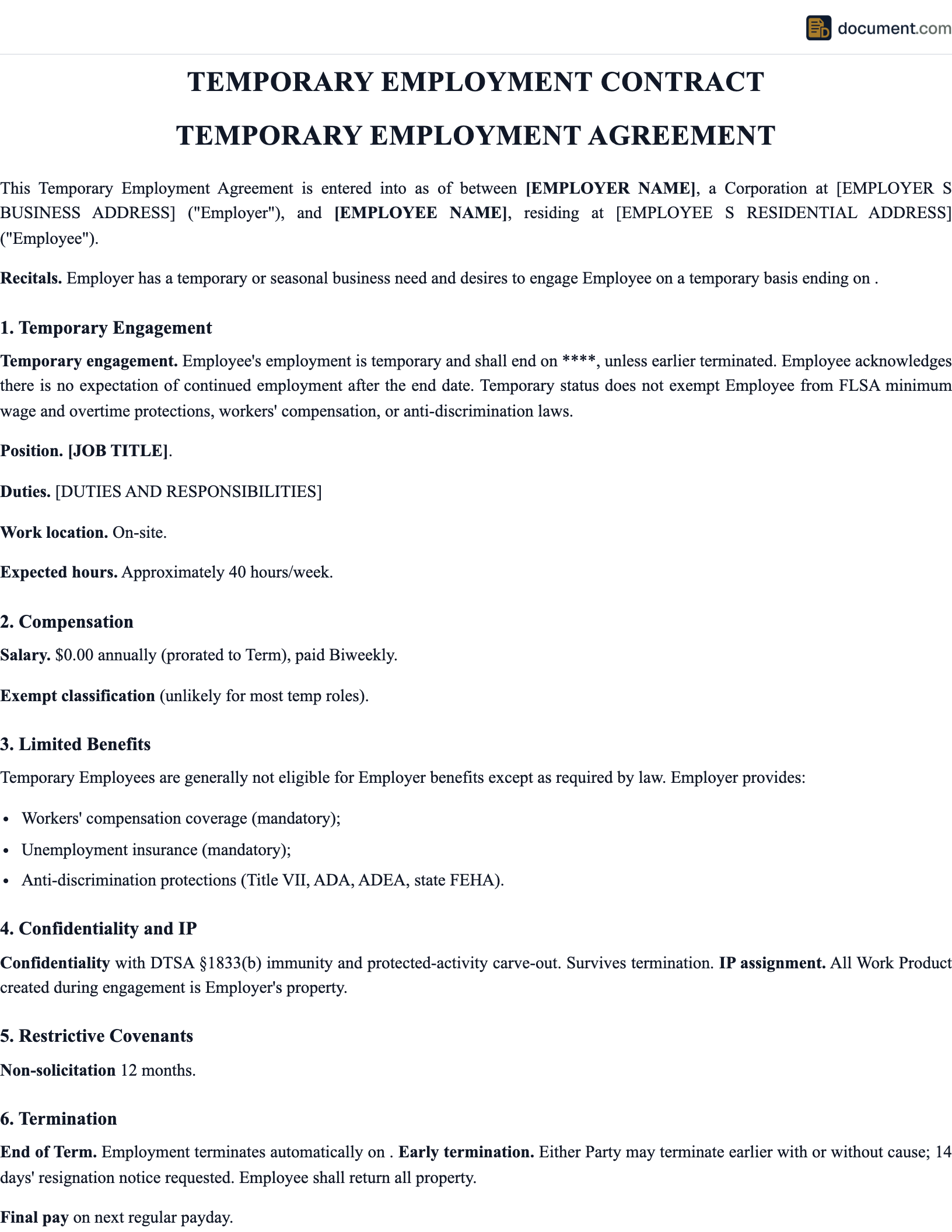
Our temporary employment contract form is delivered as both a fillable PDF and a Microsoft Word document. It includes every clause an HR or hiring manager needs to onboard a temporary worker cleanly, from compensation and schedule to confidentiality, IP assignment, and the close-out process.
Included Sections
- Parties and effective date
- Position, duties, and reporting line
- Term and end-date triggers
- Compensation and overtime treatment
- Benefits inclusion and exclusions
Also Included
- Confidentiality and IP assignment
- Early termination provisions
- Conversion to permanent option
- Return of property clause
- Governing law and signatures
Common Temporary Hiring Scenarios
Temporary employment contracts cover a wide range of situations. The right structure depends on whether you are hiring for a calendar window, a project deliverable, a leave backfill, or a trial-to-permanent role.
Seasonal Worker
Retail, hospitality, agriculture, and tax-season hires limited to a defined peak window
Project-Based Hire
Workers brought on for a single deliverable, build, launch, or implementation phase
Maternity / Leave Cover
Backfill for an employee on parental, medical, or sabbatical leave with a return date
Fixed-Term Contract
Employment with a clearly defined start and end date, common in research and grants
Temp-to-Hire
Trial employment that can convert to a permanent role if performance milestones are met
Interim Executive
Short-term leadership engagement during transitions, restructurings, or searches
Temporary vs Other Worker Classifications
Choosing the wrong classification is one of the most expensive mistakes an employer can make. Use the comparisons below to confirm that a temporary W-2 employment contract is the right tool.
Temporary Employee vs Independent Contractor
Temporary Employee (W-2)
- - Employer withholds taxes and pays FICA
- - Covered by FLSA minimum wage and overtime
- - Eligible for unemployment when term ends
- - Workers' compensation coverage required
- - Employer controls how, when, where work is done
Independent Contractor (1099)
- - Pays own self-employment tax
- - Not covered by FLSA
- - No unemployment eligibility
- - No workers' comp from hiring party
- - Sets own schedule, methods, and tools
Temporary vs Permanent At-Will Employee
Temporary (Fixed-Term)
- - Defined end date or trigger
- - Early termination requires contract right or cause
- - Often excluded from long-tail benefit plans
- - Useful for project, seasonal, or leave coverage
Permanent At-Will
- - Indefinite duration
- - Either party may end with no cause and no notice
- - Full benefits eligibility
- - Used for ongoing core roles
Direct Temporary vs Staffing Agency Worker
Direct Hire
- - You are the sole employer of record
- - Lower cost — no agency markup
- - You handle payroll, taxes, workers' comp
Agency-Placed
- - Joint-employer relationship with the agency
- - Agency handles payroll and compliance
- - 25% to 100% markup over base wage
How to Create the Contract
- 1
Define the engagement
Decide whether the term is calendar-based, project-based, or event-triggered. Write down the specific end date or completion criterion.
- 2
Set the duties and supervisor
List the position title, the essential job functions, the worksite, the schedule, and the person the worker reports to.
- 3
Determine FLSA status
Apply the duties and salary tests to classify the role as exempt or non-exempt. When in doubt, classify as non-exempt and pay overtime.
- 4
Set compensation and benefits
Specify the hourly or salaried rate, pay frequency, and any one-time bonuses or completion payments. State which benefits are included or excluded.
- 5
Add early-termination terms
Reserve the right of either party to end the contract on notice or for cause to avoid wage liability for the remaining term.
- 6
Include confidentiality and IP
Require the worker to protect confidential information and assign work-product IP to the company.
- 7
Sign and onboard
Both parties sign and date the contract. Complete I-9, W-4, state withholding forms, and direct deposit.
Key Components
Parties and effective date
Legal name of the employer and the employee, signature-ready effective date.
Term and end conditions
Specific end date, project milestone, or event trigger that ends the engagement.
Position and duties
Job title, reporting line, essential functions, schedule, and worksite.
Compensation
Pay rate, pay frequency, overtime treatment, expense reimbursement, and any completion bonus.
Benefits eligibility
Express statement of which benefits the temporary worker will and will not receive.
Confidentiality and IP
Protection of trade secrets, customer data, and assignment of work product to the company.
Early termination
Notice period, for-cause grounds, and final pay handling on early end.
Conversion option
Optional clause for temp-to-perm arrangements with defined evaluation criteria.
Return of property
Obligation to return laptops, badges, keys, and confidential materials at end of term.
Governing law and signatures
Applicable state law and signature blocks for both parties.
Wage & Hour Compliance
Temporary employees are covered by the federal Fair Labor Standards Act and every state wage-and-hour law from the first hour of the engagement. That means non-exempt temporary workers must be paid at least the federal minimum wage of $7.25 per hour (or the higher state or local minimum where applicable) and overtime at one and one-half times the regular rate for hours worked over 40 in a workweek. California, Alaska, Nevada, and Colorado also impose daily overtime requirements that apply equally to temporary staff.
Exempt status depends on the duties test and the salary basis — not on the temporary nature of the role. A worker can be a temporary exempt employee only if they perform executive, administrative, professional, computer, or outside sales duties as defined by 29 C.F.R. Part 541 and earn at least the federal salary threshold (or higher state threshold) on a guaranteed weekly basis. When in doubt, classify the role as non-exempt and track all hours worked.
Common pitfall: Paying a temporary worker a flat 'project fee' without tracking hours is a frequent FLSA violation. Even a short-term project worker who is non-exempt must be paid at least minimum wage for all hours worked and overtime for hours over 40 in a workweek.
Ending the Engagement
A temporary employment contract can end in several ways. The cleanest is the natural expiration of the term — the calendar date passes, the project deliverable is accepted, or the permanent employee returns from leave. The contract simply concludes, the employer issues final pay in accordance with state law, and any conversion or rehire decision is documented separately.
Early termination is the source of most disputes. To preserve the right to end a fixed-term contract before the scheduled end date, the contract must include an explicit early-termination clause that defines for-cause grounds (misconduct, failure to perform, violation of policy) and a without-cause notice period (commonly 7 to 14 days). Without that clause, an employer who terminates the worker early can be liable for wages owed for the remainder of the term, less mitigation.
Final-pay timing is governed by state law and varies dramatically. California requires immediate payment of all wages on the day of involuntary termination. Massachusetts requires payment on the day of termination. Many states allow payment on the next regular payday. Failure to comply with state final-pay rules can result in waiting-time penalties that often exceed the wages themselves.
Legal Requirements
In all 50 states, a temporary employment contract is enforceable when it is in writing, signed by both parties, supported by consideration (the wages and the work), and not unconscionable or contrary to public policy. Federal law layers additional requirements: Form I-9 employment eligibility verification within three business days of hire, W-4 federal tax withholding, state withholding forms, new-hire reporting to the state directory, OSHA workplace safety compliance, and workers' compensation coverage.
Several states impose additional written-disclosure requirements that apply to temporary hires. New York's Wage Theft Prevention Act requires a written notice of pay rate and pay day at hire. California requires a Notice to Employee under Labor Code section 2810.5 for non-exempt workers. Massachusetts and the District of Columbia have similar pay-transparency disclosures. Our template includes the supplemental notices needed in each state.
Sample Temporary Employment Contract
TEMPORARY EMPLOYMENT AGREEMENT
This Temporary Employment Agreement ("Agreement") is made and entered into as of [EFFECTIVE DATE] by and between [EMPLOYER NAME], a [STATE] [ENTITY TYPE] with its principal place of business at [EMPLOYER ADDRESS] ("Employer"), and [EMPLOYEE NAME], an individual residing at [EMPLOYEE ADDRESS] ("Employee").
1. Term. Employer agrees to employ Employee on a temporary basis beginning on [START DATE] and ending on [END DATE], unless terminated earlier in accordance with Section 7. Employee acknowledges that this is a fixed-term, temporary engagement and that no continuing employment relationship is created or implied beyond the End Date.
2. Position and Duties. Employee shall serve in the position of [JOB TITLE], reporting to [SUPERVISOR]. Employee shall perform the duties customarily associated with that position and any other reasonable duties assigned by Employer.
3. Compensation.Employer shall pay Employee a [hourly/weekly] rate of $[AMOUNT], payable on Employer's regular payroll schedule. Employee is classified as [exempt/non-exempt] under the Fair Labor Standards Act. If non-exempt, Employee shall receive overtime at one and one-half times the regular rate for hours worked over 40 in any workweek.
4. Benefits. Except as expressly provided in this Agreement, Employee is not eligible for paid time off, holiday pay, retirement plan participation, or other benefits offered to permanent employees of Employer.
5. Confidentiality.Employee shall hold all confidential information of Employer in strict confidence and shall not disclose or use such information except as required to perform Employee's duties under this Agreement.
6. Work Product.All work product created by Employee within the scope of this Agreement is "work made for hire" and the sole property of Employer.
7. Early Termination.Either party may terminate this Agreement before the End Date upon [NUMBER] days' written notice. Employer may terminate immediately for cause, including misconduct, insubordination, or material breach of this Agreement.
8. Governing Law. This Agreement shall be governed by the laws of the State of [STATE].
_______________________________
Employer signature / date
_______________________________
Employee signature / date
Frequently Asked Questions
Official Resources
Ready to hire your temporary employee?
Generate a customized, attorney-reviewed temporary employment contract in minutes.
Create Document