



What Is a Severance Agreement?
A severance agreement is a legally binding contract entered into at the end of an employment relationship, under which the employer agrees to provide the departing employee with consideration — typically cash severance, continued health benefits, outplacement assistance, and accelerated vesting of some equity awards — in exchange for the employee's general release of legal claims against the employer. The release is the heart of the agreement: it converts a potentially litigable dispute into a bilateral contract that delivers certainty to both parties. Severance agreements are used in individual terminations, reductions in force, executive separations, mutual departures, and plant closings, and they are the principal tool employers use to manage post- employment legal exposure.
Unlike the employment contract at the start of the relationship, the severance agreement is negotiated at a moment of maximum leverage for the employer and maximum vulnerability for the employee. For this reason, federal and state law impose a detailed procedural framework designed to protect departing workers from coercive or uninformed waivers. The centerpiece of that framework is the Older Workers Benefit Protection Act of 1990, which amended the Age Discrimination in Employment Act to require specific disclosures, consideration periods, and revocation rights for any severance agreement that includes a waiver of ADEA claims by an employee age 40 or older. Compliance with OWBPA is mandatory — failure to meet even one of its procedural requirements renders the ADEA waiver unenforceable, and a court will not blue-pencil an OWBPA defect.
Alongside OWBPA, the agreement must navigate a growing web of limitations on release scope. The Equal Employment Opportunity Commission has long held that employees cannot be required to waive the right to file a charge or cooperate with an EEOC investigation, and in 2023 the National Labor Relations Board in McLaren Macomb invalidated broad confidentiality and non-disparagement provisions in severance agreements on the ground that they chill Section 7 rights. The Speak Out Act (2022) and the Ending Forced Arbitration of Sexual Assault and Sexual Harassment Act (2021) bar pre-dispute NDAs and arbitration clauses covering sexual assault and harassment claims, and a growing number of states (notably California, New York, New Jersey, Illinois, and Washington) have enacted parallel statutes reaching other workplace claims.
The economic core of the agreement is the consideration. To be valid under OWBPA, the severance consideration must be something the employee is not already entitled to receive — meaning it cannot consist solely of accrued wages, unused vacation, vested retirement benefits, or amounts already owed under an existing severance plan. The additional consideration may be cash (typically calculated as weeks of base pay per year of service), continued health insurance coverage through COBRA subsidies, outplacement services, accelerated vesting of equity, extended exercise windows for stock options, or waiver of clawback provisions. The amount and composition should be calibrated to the strength of the employee's potential claims, the employer's litigation exposure, and market practice.
Whether you are a human-resources director managing an individual termination, general counsel overseeing a reduction in force, an in-house labor lawyer advising on a plant closing under WARN, or a small-business owner parting ways with a long-tenured employee, our attorney-reviewed severance agreement templates give you a compliant starting point. Each template includes OWBPA-compliant waiver language, EEOC-approved release scope, the 21/45/7-day procedural framework, required carve-outs for agency cooperation and non-waivable claims, §409A-compliant payment timing, and state-specific language for California Civil Code §1542 and other jurisdictional requirements.
OWBPA Compliant
21/45-day consideration, 7-day revocation, explicit ADEA waiver language, and group disclosure schedules
EEOC Approved Scope
Proper carve-outs for EEOC charges, agency cooperation, whistleblower awards, and non-waivable rights
§409A-Safe Payments
Short-term deferral and separation-pay exceptions with compliant release timing provisions
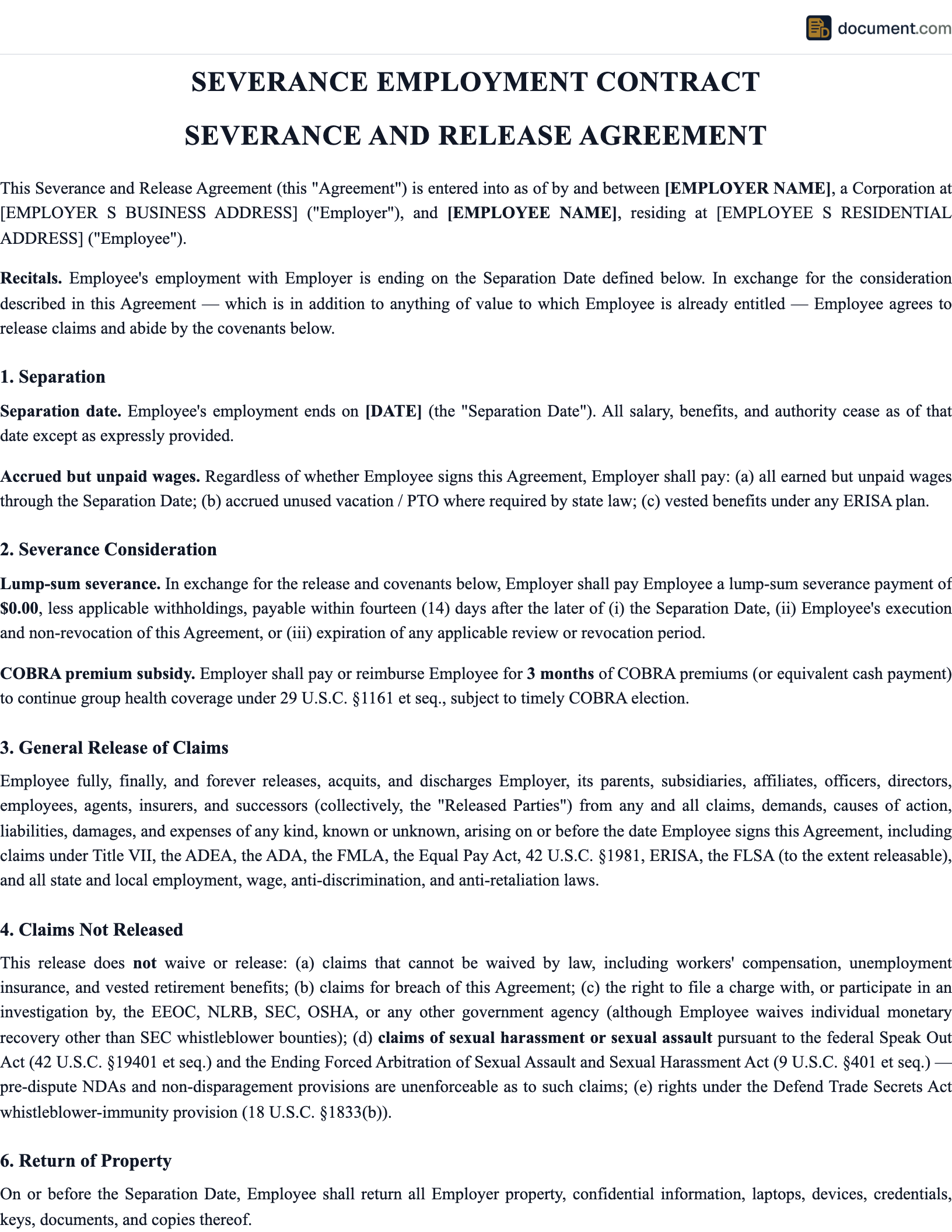
Severance Agreement Form Preview
The preview below shows the structure of a complete severance and release agreement. Each section maps directly to a requirement under federal or state law or to a commercially significant protective provision.
Severance Agreement and General Release
Individual Separation
Section 1: Parties
Section 2: Severance Consideration
Section 3: OWBPA Timeline
Section 4: Release Carve-Outs
Severance Scenarios
Different separation events trigger different legal requirements. Choose the scenario that matches your situation to start with a template pre-configured for the applicable federal and state rules.
Individual Separation
Negotiated severance for a single departing employee, including release of claims and continuation benefits
Reduction in Force (RIF)
Group layoff triggering OWBPA disclosure requirements for employees age 40 and older
Executive Separation
Senior officer exit with equity treatment, §409A compliance, and restrictive-covenant reaffirmation
Plant Closing / WARN
Mass layoff or plant closing requiring 60-day notice under the federal WARN Act
Mutual Separation
Amicable parting of ways with negotiated consideration and mutual release
Retirement Package
Enhanced early retirement window with voluntary exit incentives
OWBPA & ADEA Waivers
The Older Workers Benefit Protection Act (29 U.S.C. §626(f)) is the single most important statute governing severance agreements in the United States. Enacted in 1990 in response to widespread abuses in corporate downsizing, OWBPA sets out seven mandatory requirements that any severance agreement including a waiver of ADEA rights must satisfy. The requirements are cumulative and strict: failure to comply with any one renders the ADEA waiver invalid, and the Supreme Court in Oubre v. Entergy Operations held that a noncompliant waiver is void from the outset even if the employee has cashed the severance check.
The Seven OWBPA Requirements
- The waiver is in writing and written in a manner calculated to be understood by the employee or average eligible individual.
- The waiver specifically refers to rights or claims arising under the ADEA.
- The waiver does not apply to rights or claims arising after the date the waiver is executed.
- The waiver is in exchange for consideration in addition to anything of value to which the employee is already entitled.
- The employee is advised in writing to consult with an attorney before executing the agreement.
- The employee is given at least 21 days to consider the agreement (45 days in a group termination program).
- The employee has 7 days after signing to revoke the agreement, and the agreement does not become effective or enforceable until the revocation period has expired.
When severance is offered to a group of two or more employees in connection with an exit incentive program or other termination program, OWBPA imposes additional disclosure obligations. The employer must provide every employee age 40 or older with a written schedule describing the decisional unit, eligibility factors, time limits applicable to the program, and the job titles and ages of all individuals selected for the program as well as the ages of all individuals in the same decisional unit who were not selected. The disclosure must be accurate, complete, and delivered at the time the agreement is presented — not later. A defective disclosure voids the ADEA waiver even if the other six requirements are met.
Calculating Severance Consideration
Severance consideration must be meaningful — both to satisfy the OWBPA requirement of additional consideration and to incentivize the employee to accept the release. Market-practice formulas vary by industry, geography, role level, and tenure, but most employers use a weeks-per-year-of-service formula with floors and caps.
| Role Level | Typical Formula | Cap |
|---|---|---|
| Individual contributor | 1-2 weeks per year of service; 4-week floor | 26 weeks |
| Manager | 2 weeks per year of service; 8-week floor | 26 weeks |
| Director | 3 weeks per year of service; 12-week floor | 39 weeks |
| Vice President | 4 weeks per year of service; 26-week floor | 52 weeks |
| Senior Vice President | 1x base salary + target bonus | 12 months |
| Executive Officer / C-Suite | 2-3x base salary + target bonus | Per contract |
Beyond cash, severance packages typically include continuation of group health coverage (either through employer-paid COBRA for a defined period or a taxable cash stipend equivalent to the COBRA premium), outplacement services (career counseling, resume services, and job-search support, often from Lee Hecht Harrison or Right Management), accelerated vesting of some equity awards, extended post-termination exercise windows for vested stock options (commonly 90 days extended to 12 or 24 months), and waiver of certain contractual obligations such as signing-bonus clawbacks.
Scope of the Release
The release of claims is the core value-exchange of the severance agreement. It should be drafted as a general release with a specific list of statutes covered to satisfy the OWBPA requirement that the ADEA be "specifically" referenced. A typical release covers federal statutes including Title VII of the Civil Rights Act of 1964, the Age Discrimination in Employment Act, the Americans with Disabilities Act, the Family and Medical Leave Act, the Equal Pay Act, the Worker Adjustment and Retraining Notification Act, the Employee Retirement Income Security Act, the Genetic Information Nondiscrimination Act, the Uniformed Services Employment and Reemployment Rights Act, Section 1981, and Sections 503 and 504 of the Rehabilitation Act.
The release must also include carve-outs preserving the employee's non-waivable rights. At minimum, the carve-outs should preserve the right to file a charge with or participate in an investigation by the EEOC, NLRB, OSHA, SEC, or any other federal, state, or local agency; the right to receive a whistleblower award under the Dodd-Frank Act, the False Claims Act, the Sarbanes-Oxley Act, or similar statutes; vested retirement benefits under ERISA; workers' compensation claims; unemployment insurance; and claims that arise after the effective date of the agreement. The carve-out language should be prominent, not buried in boilerplate, to survive a McLaren Macomb challenge.
How to Create a Severance Agreement
Follow these eight steps to produce a compliant, enforceable severance agreement.
Confirm eligibility and tenure
Verify employment dates, position, age, salary rate, and any existing contractual severance entitlement. Age 40+ triggers OWBPA compliance.
Determine the scenario
Individual termination (21-day consideration), group termination (45-day consideration plus disclosures), or executive exit with contractual formula.
Calculate additional consideration
Consideration must exceed what the employee is already entitled to under policy or contract. Document the baseline to prove additional value.
Draft release scope with carve-outs
List specific federal and state statutes; include EEOC cooperation, whistleblower, and Speak Out Act carve-outs.
Include OWBPA procedural language
Written advice-of-counsel notice, 21/45-day consideration, 7-day revocation, explicit ADEA reference.
Add restrictive covenants reaffirmation
Reaffirm existing confidentiality and non-solicit obligations; update for post-McLaren Macomb language.
Address §409A payment timing
Structure payments to qualify as short-term deferral or separation-pay exception; align release-execution deadline with §409A.
Present and document
Deliver the agreement along with required disclosures, document presentation date, and preserve copies for audit and EEOC defense.
Key Components of a Severance Agreement
A complete severance agreement contains the following provisions, each tailored to the scenario and the employee's status under federal and state law.
Recitals
Identify parties, separation date, and purpose of agreement.
Severance Consideration
Cash, COBRA subsidy, outplacement, equity treatment, and tax withholding.
Payment Timing
§409A-compliant schedule, installment vs. lump sum, release-effective trigger.
General Release
Broad waiver of employment-related claims with specific statutory references.
Non-Waivable Carve-Outs
EEOC, NLRB, SEC cooperation; whistleblower awards; vested benefits.
ADEA Waiver (if age 40+)
Explicit OWBPA-compliant waiver with 21/45/7 timing.
Continuing Obligations
Reaffirmation of confidentiality, non-solicit, return of property, cooperation.
Non-Disparagement
Mutual or one-way with Speak Out Act carve-out for harassment claims.
Confidentiality of Agreement
Limited to terms; carve-out for attorney, spouse, financial advisor, tax preparer.
No Admission of Liability
Standard language confirming settlement is not admission of wrongdoing.
Governing Law
Choice of law, venue, and (where permitted) arbitration of disputes.
Entire Agreement
Integration clause, severability, and counterpart execution.
EEOC & Protected Rights
The Equal Employment Opportunity Commission has taken the consistent position that severance agreements cannot require employees to waive the right to file a charge with the EEOC or cooperate with an EEOC investigation. Language that purports to prohibit charge-filing, cooperation, or participation in agency proceedings is unenforceable and may itself constitute unlawful retaliation under Title VII, the ADEA, the ADA, and related statutes. The EEOC's Enforcement Guidance on Non-Waivable Employee Rights (1997) and more recent guidance make clear that the only portion of an EEOC right that can be waived is the right to receive personal monetary relief — not the right to file, participate, or assist in agency proceedings.
The NLRB extended this framework in McLaren Macomb (2023), holding that merely presenting an employee with a severance agreement containing overly broad non-disparagement and confidentiality provisions violates Section 8(a)(1) of the National Labor Relations Act because it tends to interfere with Section 7 rights. The decision applies to both union and non-union workplaces and covers most private-sector employers. Post-McLaren, severance agreements should include specific language preserving the right to discuss wages, working conditions, and workplace concerns with other employees, labor organizations, and agencies, and should avoid broad gag language that could chill protected activity.
Tax Treatment of Severance
Severance payments are wages for federal tax purposes. The Supreme Court confirmed this in United States v. Quality Stores, Inc. (2014), holding that supplemental unemployment benefit payments are wages subject to FICA. Severance is subject to federal income tax withholding at the supplemental wage rate (22% flat up to $1 million; 37% above), Social Security tax up to the wage base, Medicare tax including the 0.9% Additional Medicare Tax above $200,000, FUTA, and state and local income taxes. Severance is reported on Form W-2, not Form 1099, and is treated as wages even for former employees.
Section 409A of the Internal Revenue Code imposes strict timing rules on the payment of severance. To avoid §409A characterization as nonqualified deferred compensation, severance must fit within one of three exceptions: the short-term deferral exception (payment completed by March 15 of the year following the year in which the right to payment vests), the separation-pay exception for involuntary separations (payment limited to 2x the lesser of compensation or the §401(a)(17) limit and completed by the end of the second year following separation), or the separation-pay plan exception under Treas. Reg. §1.409A-1(b)(9). A release-timing problem arises when the agreement gives the employee more than one taxable year to consider and sign — the payment could span two tax years, violating §409A. Modern agreements fix the payment date at the later of the 60th day after separation or the expiration of the revocation period, which fits within §409A's permitted release-timing rules.
Sample Severance Agreement
Below is a condensed excerpt showing the key provisions of our severance and release agreement template. The full document runs 12 to 20 pages depending on scenario and selected options.
SEVERANCE AGREEMENT AND GENERAL RELEASE
This Severance Agreement and General Release (this "Agreement") is entered into by and between [Employer Name](the "Company") and [Employee Name]("Employee"), effective as of [Effective Date].
1. SEPARATION
Employee's employment with the Company will terminate effective [Separation Date]. Regardless of whether Employee signs this Agreement, Employee will receive all accrued and unpaid wages and unused vacation through the Separation Date.
2. CONSIDERATION
In exchange for Employee's execution of this Agreement and compliance with its terms, and provided that Employee does not revoke this Agreement during the Revocation Period, the Company will pay Employee a severance benefit of $[Amount], less applicable withholdings, payable in accordance with the Company's standard payroll practices.
3. GENERAL RELEASE
Employee, on behalf of Employee and Employee's heirs, executors, administrators, successors, and assigns, fully and forever releases and discharges the Company and its officers, directors, employees, agents, subsidiaries, affiliates, and successors from any and all claims, demands, causes of action, and liabilities of any kind, whether known or unknown, arising from or related to Employee's employment with the Company or the termination thereof, including but not limited to claims under Title VII of the Civil Rights Act of 1964, the Age Discrimination in Employment Act (including the OWBPA), the Americans with Disabilities Act, the Family and Medical Leave Act, the Employee Retirement Income Security Act, and all applicable state and local employment laws.
4. ADEA WAIVER
Employee specifically acknowledges and agrees that this Agreement waives Employee's rights under the Age Discrimination in Employment Act. Employee has been advised in writing to consult with an attorney before signing this Agreement. Employee has been given at least twenty-one (21) days to consider this Agreement. Employee understands that Employee has seven (7) days after signing this Agreement to revoke it, and this Agreement will not become effective until the eighth (8th) day after Employee signs it.
5. CARVE-OUTS
Nothing in this Agreement limits Employee's right to file a charge with the EEOC, NLRB, SEC, or any other federal, state, or local agency, to participate in any agency investigation or proceeding, to receive any whistleblower award, or to discuss workplace conditions with other employees. Nothing in this Agreement restricts Employee's right to disclose or discuss claims of sexual assault or sexual harassment.
Frequently Asked Questions
Common questions about severance agreements, OWBPA compliance, and release scope.
Official Resources
Authoritative federal agency resources for severance agreements and employment releases.
EEOC - Understanding Waivers
EEOC guide to understanding waivers of discrimination claims in severance agreements
EEOC - ADEA Statute
Age Discrimination in Employment Act and OWBPA statutory text
DOL - Family and Medical Leave Act
FMLA rights that cannot be waived in severance
DOL - WARN Act
Worker Adjustment and Retraining Notification Act guidance
NLRB - National Labor Relations Board
McLaren Macomb and Section 7 severance agreement decisions
IRS - Employment Taxes
Federal income and employment tax withholding on severance
SEC - Whistleblower Program
Dodd-Frank whistleblower award rights that cannot be waived
OSHA - Whistleblower Protections
OSHA-administered whistleblower statutes and severance carve-out requirements
Create your Severance Employment Contract in under 10 minutes.
Answer a few questions and download a compliant, attorney-drafted document ready for your state.