
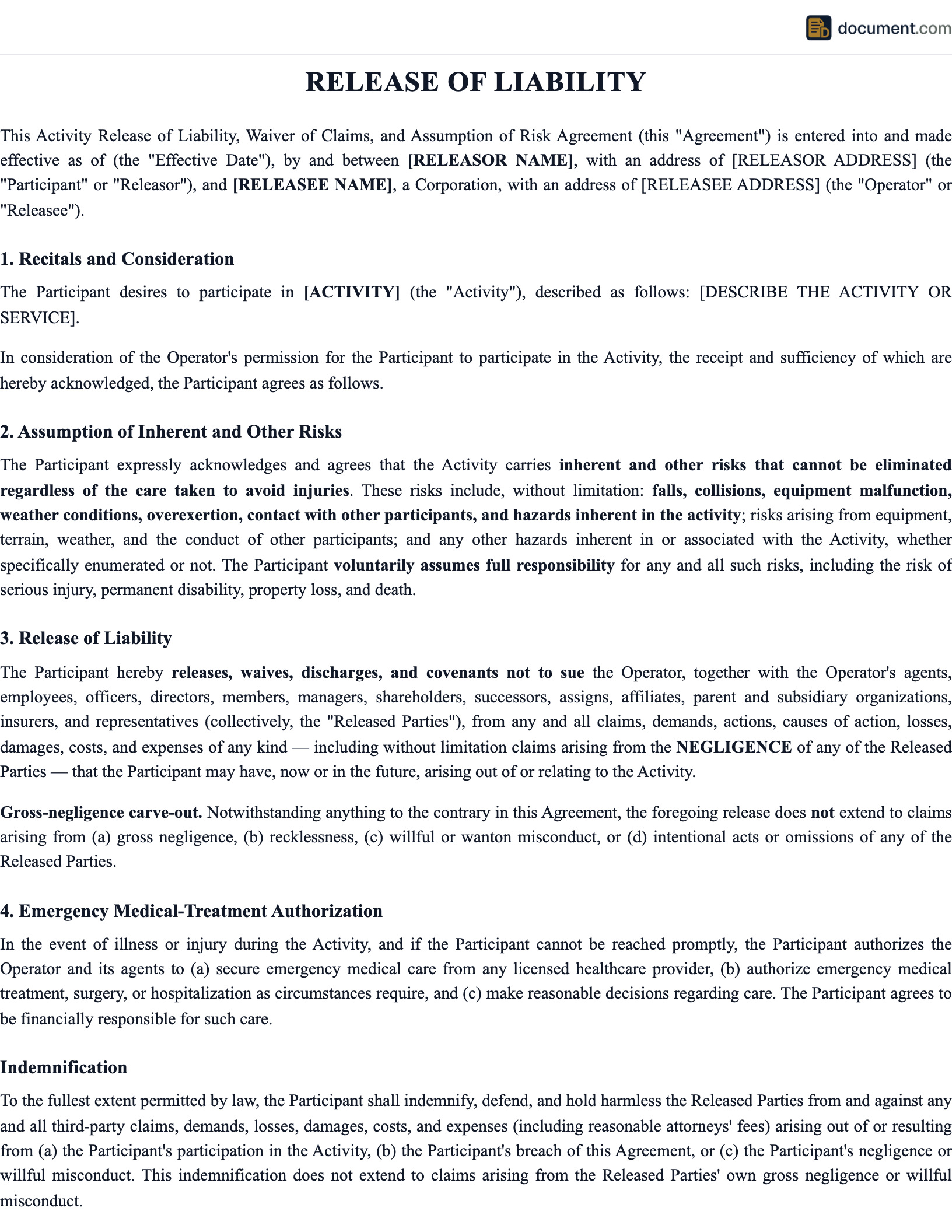



What Is a Release of Liability?
A release of liability — sometimes called a waiver, exculpatory agreement, or release and waiver of claims — is a legal document in which one person (the releasor) gives up the right to sue another person or organization (the releasee) for injury, damage, or loss arising from a defined activity or event. The release is the most direct risk-transfer tool in American contract law: it does not merely shift liability from one party to another, it extinguishes the right to bring a claim altogether. Releases are used by gyms, ski resorts, climbing centers, marathon organizers, summer camps, recreational outfitters, equestrian operators, charity events, photographers, documentarians, settlement parties, and lenders confirming the payoff of secured debts.
Releases come in two main timing variants. A pre-injury waiver (also called a prospective release or exculpatory clause) is signed before any incident has occurred and covers future injuries that may arise during a defined activity — the classic gym waiver. A post-injury release is signed after an incident and covers a specific known claim, typically as part of a settlement. Courts treat these very differently. Pre-injury waivers face heightened scrutiny because the signer cannot fully appreciate risks they have not yet experienced. Post-injury releases are more readily enforced because the signer knows exactly what they are giving up.
The legal effectiveness of any release depends on a doctrine called express assumption of risk. By signing the waiver, the releasor formally accepts the inherent dangers of the activity in exchange for being permitted to participate. To make the assumption express, the waiver must specifically identify the activity, list the hazards being accepted, and use unmistakable release language. Courts construe waivers strictly against the drafter, so vague phrases like "all liability" or "any and all risks" without specifics can fail. The strongest waivers list concrete dangers — falls from height, equipment failure, contact with other participants, animal behavior, weather conditions, traffic, water hazards — so the signer cannot later claim ignorance of what they were accepting.
Public policy imposes hard limits on what a release can cover. In every state, a waiver cannot relieve a party from liability for gross negligence, recklessness, willful misconduct, intentional torts, fraud, or criminal conduct. Some states refuse to enforce waivers in essential service contexts like medical care, public transportation, or residential housing because the consumer has no meaningful choice. A handful of states (notably Louisiana, Montana, and Virginia) significantly restrict pre-injury waivers across many contexts. Other states (Florida, Texas, Colorado, and California) generally enforce well-drafted waivers in recreational settings.
Releases also serve a different function in real estate finance. A satisfaction of mortgage or deed of reconveyancereleases the lender's security interest in real property once the underlying loan has been paid in full. These documents are not waivers in the classic sense — they release a lien rather than a personal injury claim — but they share the core legal function of formally extinguishing rights. State recording laws require these releases to be filed promptly after payoff, and lenders that fail to record can be liable for damages and statutory penalties.
Express Assumption of Risk
Participants formally accept the inherent dangers of the activity
Bars Future Lawsuits
Properly drafted waivers extinguish the right to sue for ordinary negligence
Settlement Tool
Used to finalize settlements, lien releases, and post-incident claims
Release of Liability Form Preview
Below is a preview of the structured fields included in a standard release of liability waiver. Your final document will be tailored to the specific activity, state, and parties involved.
RELEASE OF LIABILITY AND WAIVER OF CLAIMS
Express Assumption of Risk
RELEASOR (Participant)
Full Name: [Legal Name]
Address: [Street, City, State, ZIP]
Date of Birth: [MM/DD/YYYY]
Emergency Contact: [Name / Phone]
RELEASEE (Organization)
Name: [Business / Organization]
Address: [Street, City, State, ZIP]
ACTIVITY / EVENT DESCRIPTION
Activity: [Specific activity name]
Location: [Site / Address]
Date(s): [Date or date range]
SPECIFIC RISKS ACKNOWLEDGED
Risk #1: [e.g., falls from height]
Risk #2: [e.g., equipment failure]
Risk #3: [e.g., contact with other participants]
RELEASE LANGUAGE
I hereby release, waive, and discharge the Releasee from any and all claims arising out of ordinary negligence in connection with the activity described above, except to the extent caused by gross negligence, recklessness, or willful misconduct.
MINOR PARTICIPANT (if applicable)
Minor's Name: [Name]
Parent/Guardian: [Parent Name]
SIGNATURES
Participant: [Signature]
Date: [Date]
Witness: [Optional]
Types of Releases
Releases serve very different purposes depending on context. Choose the type that matches your situation.
Activity Waiver
Releases an organization from liability arising from recreational, athletic, or fitness participation
Mutual Release
Both parties release each other from any further claims, typically as part of settlement
Media Release
Permits the use of a person's name, image, or likeness in photos, video, and marketing
Deed of Reconveyance
Releases the borrower from a deed of trust once the underlying loan is paid in full
Satisfaction of Mortgage
Recorded document confirming a mortgage has been fully paid and the lien is released
Release vs Hold Harmless vs Settlement
Releases, hold harmless agreements, and settlement agreements all manage liability, but they work differently. Use this table to pick the right tool.
| Feature | Release of Liability | Hold Harmless | Settlement Release |
|---|---|---|---|
| Function | Gives up right to sue | Assumes liability for third-party claims | Resolves a known dispute |
| Timing | Pre-injury (usually) | Pre-incident | Post-injury |
| Consideration | Permission to participate | Contract itself | Money payment |
| Court approval needed? | No | No | Sometimes (minors, class actions) |
| Public policy limits | Strong | Strong (anti-indemnity laws) | Moderate |
How to Create a Waiver
An enforceable waiver requires more than generic boilerplate. Follow these steps to create one that will stand up in court.
Use a clear, unmistakable title
Title the document 'RELEASE OF LIABILITY AND WAIVER OF CLAIMS' in bold, large type. Avoid burying the release inside a longer agreement.
Identify the parties precisely
Use full legal names and addresses. Identify the releasee by exact business name and include any affiliates, employees, agents, contractors, and volunteers in the released parties.
Describe the activity specifically
Generic language like 'recreational activities' is weaker than 'rock climbing instruction at Acme Climbing Gym, including bouldering, top-rope, and lead climbing.' Specifics strengthen enforceability.
List specific risks
Identify concrete dangers the participant is accepting: falls, equipment failure, contact with other participants, environmental hazards, animal behavior, weather, traffic, etc.
Use express release language
Include the operative words 'release,' 'waive,' 'discharge,' and 'covenant not to sue.' Vague terms fail in many courts.
Carve out gross negligence
Expressly exclude gross negligence, recklessness, willful misconduct, and intentional acts. This protects the rest of the waiver from being voided.
Add an assumption of risk paragraph
Include a separate acknowledgment that the participant has been informed of and accepts the inherent risks of the activity.
Include a severability clause
If a court strikes down one provision, the rest of the waiver should remain enforceable.
Make it conspicuous
Use legible font (at least 10pt), plain English, and visual emphasis on the release language. Avoid hiding the release in fine print.
Get a knowing signature
Have the participant sign in person whenever possible, with photo ID verification for high-risk activities. Digital signatures are valid but should capture timestamp and IP address.
Key Components
These provisions appear in nearly every enforceable release of liability waiver.
Identification of parties
Releasor and all released parties named with specificity.
Activity description
Specific identification of the activity covered by the release.
Risk acknowledgment
Concrete list of inherent dangers being accepted.
Express release language
Operative 'release, waive, and discharge' wording.
Public policy carve-outs
Exclusion for gross negligence and willful misconduct.
Medical authorization
Permission for emergency medical treatment if needed.
Severability clause
Preserves the rest of the waiver if one part is voided.
Governing law
Identifies which state's law applies.
Enforceability and Public Policy
Courts apply heightened scrutiny to liability waivers because they take away a fundamental right — the right to sue when wronged. Whether a particular waiver is enforceable depends on a multi-factor analysis that varies by state but generally weighs the same considerations.
The clearest hostile jurisdictions are Louisiana, which by statute generally voids pre-injury releases for personal injury, Montana, which similarly restricts pre-injury waivers, and Virginia, where courts have long disfavored exculpatory clauses for personal injury. Connecticut, New York, and Hawaii apply heightened scrutiny in recreational contexts. Florida, Texas, Colorado, and California are generally waiver-friendly when the document is clearly drafted and the activity is genuinely recreational.
Even in friendly jurisdictions, courts look for several red flags: ambiguous or legalistic language, fine print, lack of specific risk disclosure, attempts to cover essential services, and one-sided contracts of adhesion. Any of these can result in the waiver being struck down. The single best protection is to draft the waiver clearly, use plain English, and identify the activity and risks with concrete specificity.
Waivers for Minors
Whether a parent can sign a pre-injury waiver on behalf of a minor child is one of the most contested questions in waiver law, and the answer varies dramatically by state. The legal issue is that the right to sue for personal injury belongs to the child, not the parent, and a parent generally cannot extinguish that right by contract.
States that generally enforce parental waivers include California (for some non-profit youth sports), Colorado, Florida, North Dakota, Ohio, Massachusetts, Minnesota, and Wisconsin. States that generally refuse to enforce parental waivers include Connecticut, Hawaii, Illinois, Maine, New Jersey, Pennsylvania, Texas (for non-profit settings), Utah, and Washington. Many other states have not squarely decided the question, leaving organizations to guess at enforceability.
Best practice for organizations serving minors is to use a parental waiver that combines release language with express assumption of risk and an acknowledgment of the inherent hazards of the activity. Even where pre-injury waivers are unenforceable, the acknowledgment can support an assumption of risk defense at trial. Most importantly, organizations serving minors should pair waivers with strong safety practices, appropriate adult-to-child ratios, qualified instructors, and adequate liability insurance — because the waiver may not actually bar a future suit.
Legal Requirements
In addition to the basic elements of contract formation, releases must satisfy several waiver-specific requirements.
Clear and unambiguous
Plain English. Vague phrases are construed against the drafter.
Conspicuous
Not hidden in fine print or boilerplate.
Voluntary
Signed without coercion. No 'sign or no service' for essential needs.
Specific to activity
Identifies the activity and specific risks, not just 'all risks.'
Capacity to sign
Signer must be an adult of sound mind. Minor waivers face special rules.
Public policy compliant
Cannot waive gross negligence, willful misconduct, or essential services.
Sample Release of Liability
Below is the operative language of a representative release. Your final document will include state-specific provisions and the activity-specific details required for enforceability.
RELEASE OF LIABILITY AND WAIVER OF CLAIMS
I, [PARTICIPANT NAME], in consideration of being permitted to participate in [ACTIVITY] conducted by [ORGANIZATION NAME]("Releasee"), do hereby agree as follows:
1. ASSUMPTION OF RISK. I understand and acknowledge that the activity involves inherent risks, including but not limited to: falls, collisions, equipment failure, environmental hazards, contact with other participants, and physical exertion. I voluntarily and freely assume all such risks, both known and unknown.
2. RELEASE AND WAIVER.I hereby RELEASE, WAIVE, DISCHARGE, AND COVENANT NOT TO SUE the Releasee, its officers, directors, employees, agents, volunteers, and contractors from any and all liability, claims, demands, actions, and causes of action whatsoever arising out of or related to any loss, damage, or injury that may be sustained while participating in the activity, except to the extent caused by the Releasee's gross negligence, willful misconduct, or intentional acts.
3. INDEMNIFICATION. I agree to indemnify and hold the Releasee harmless from any loss or liability incurred as a result of any claim brought by me or on my behalf arising out of my participation in the activity.
4. MEDICAL AUTHORIZATION. I authorize the Releasee to provide or arrange emergency medical treatment in the event of injury, and I assume responsibility for the cost of such treatment.
5. SEVERABILITY. If any provision of this Release is held to be unenforceable, the remaining provisions shall remain in full force and effect.
6. GOVERNING LAW. This Release shall be governed by the laws of the State of [STATE].
I HAVE READ THIS RELEASE OF LIABILITY AND WAIVER, FULLY UNDERSTAND ITS TERMS, AND SIGN IT VOLUNTARILY.
Participant Signature
Name: _______________
Date: _______________
Witness Signature
Name: _______________
Date: _______________
Frequently Asked Questions
Common questions about waivers, enforceability, public policy, minors, and assumption of risk.
Official Resources
Trusted resources for additional information on liability waivers, consumer protection, and risk management.
FTC Consumer Information
Federal consumer protection guidance and contract resources
U.S. Consumer Product Safety Commission
Recreational product safety information and recall data
ABA Tort Trial and Insurance Practice
Tort law and liability waiver resources from the American Bar Association
National Association of Insurance Commissioners
Insurance regulation and liability coverage guidance
Create your Release of Liability Waiver in under 10 minutes.
Answer a few questions and download a compliant, attorney-drafted document ready for your state.