



What Is a Mutual Release of Liability?
A mutual release of liability — sometimes called a bilateral release, reciprocal release, or mutual general release — is a contract in which two or more parties agree to release each other from legal claims. Unlike a one-way release, where only one party gives up rights against the other, a mutual release is fully reciprocal: Party A releases Party B, and Party B simultaneously releases Party A. The mutual nature of the release distinguishes it from other release documents and makes it the preferred instrument for resolving disputes in which both sides have (or might have) claims against each other.
Mutual releases are a cornerstone of settlement practice. When parties negotiate the end of a dispute — whether in active litigation, mediation, or pre-suit negotiation — they typically exchange mutual releases as part of the settlement so that neither side can later reassert the same or related claims. But mutual releases are not limited to formal settlements. They are routinely used in business contexts whenever parties are ending a relationship and want to foreclose the possibility of future claims: at the end of a partnership or joint venture, upon termination of a long-term supply contract, when a commercial tenant vacates a leased space, during the dissolution of a close corporation, and when an employee receives severance in exchange for a mutual release of employment claims.
The legal mechanism of a mutual release is straightforward: each party's promise to release the other constitutes consideration for the other party's release. This "mutual consideration" doctrine means the release itself can stand on its own without additional payment or performance, though most mutual releases include additional consideration (money, property, performance) reflecting the relative strength of the claims being released and the parties' bargaining positions. The scope of the release — which claims are released, which are carved out, whether unknown claims are included, and the temporal reach — is negotiated carefully because once signed, the release generally cannot be reopened.
A well-drafted mutual release addresses several critical issues. It identifies the parties with precision, including their affiliates, agents, officers, directors, successors, and assigns. It describes the claims being released with enough specificity to create clear boundaries, while using language broad enough to capture related claims the parties may not have anticipated. It expressly addresses unknown claims, with a Section 1542 waiver (in California) or equivalent language in other states. It lists any carve-outs — claims that are not being released, such as indemnification rights, ongoing obligations under the underlying contract, or claims for breach of the release itself. It includes a confidentiality provision where appropriate, a non-disparagement clause where the parties want to protect their reputations, and representations that each party has had the opportunity to consult counsel.
Our attorney-reviewed mutual release template provides the flexibility to cover a wide range of situations. It includes options for general releases, specific-claim releases, and hybrid releases with carve-outs; supports confidentiality and non-disparagement provisions; incorporates state-specific unknown-claim waiver language; and includes representation-by-counsel recitals that maximize enforceability. Whether you are resolving a contract dispute, ending a business relationship, or finalizing a litigation settlement, our template provides the legal infrastructure for clean, enforceable, bilateral legal peace.
Bilateral Peace
Each party releases the other, giving both sides certainty and closure
Dispute Resolution
Resolves active or potential claims without admission of liability
Unknown Claims
Section 1542 waiver language extends the release to unknown claims
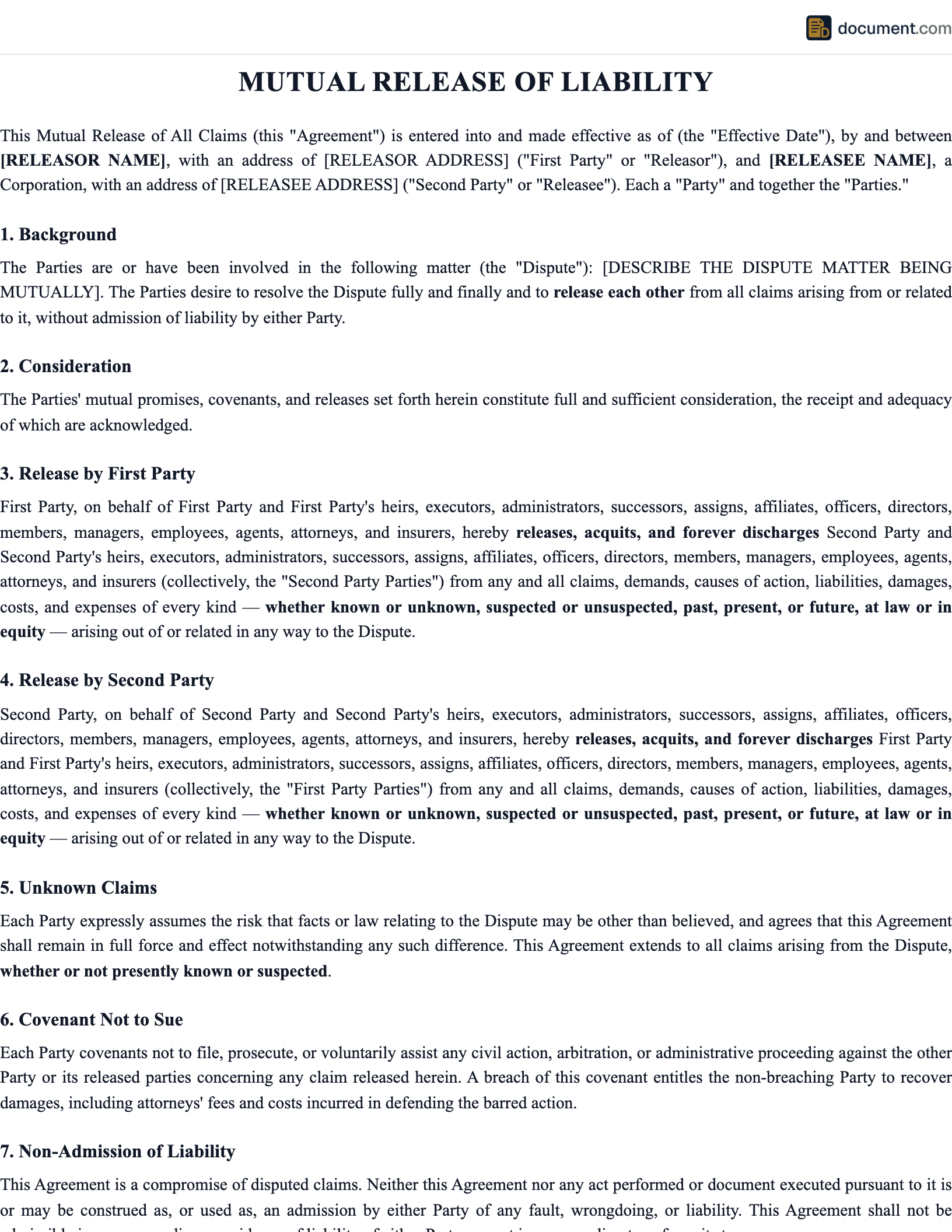
Mutual Release Form Preview
Mutual Release of Claims
Section 1: Party A
Section 2: Party B
Section 3: Description of Dispute
Section 4: Consideration
When to Use a Mutual Release
Mutual releases are appropriate whenever two parties want to foreclose claims against each other. The most common situations include:
Contract Disputes
Settling disagreements over contract performance, breach, or interpretation where each side has claims and counterclaims.
Business Dissolution
Winding down a partnership, LLC, or joint venture where each party may have claims against the other.
Employment Separations
Severance agreements in which employer and employee release claims arising from the employment relationship.
Litigation Settlement
Resolving active lawsuits by exchanging mutual releases and dismissing all claims with prejudice.
Real Estate Disputes
Resolving boundary disputes, construction defect claims, neighbor disputes, or lease terminations.
Commercial Relationships
Ending supply agreements, distribution arrangements, or licensing deals with claims on both sides.
Mutual Release vs One-Way Release
The choice between mutual and one-way releases depends on who has claims and who needs protection.
Mutual Release
- - Both parties release each other
- - Mutual consideration built in
- - Used when both sides have claims
- - Provides bilateral peace
- - Common in settlements and dissolutions
One-Way Release
- - Only one party releases claims
- - Requires separate consideration
- - Used when only one side has claims
- - Common in activity waivers and simple releases
- - Does not protect the releasing party
How to Create a Mutual Release
Identify the Parties
Name each party with precision, including any affiliates, subsidiaries, agents, officers, directors, employees, insurers, successors, and assigns that should be bound by or benefit from the release.
Describe the Underlying Dispute
Briefly describe the facts, transaction, or relationship from which the claims arise. This is important both for scope and for interpretation if the release is later challenged.
Define the Scope of Claims
Specify which claims are being released — general release of all claims arising from the dispute, or a narrower list of specific claims. Consider including language about 'known or unknown, suspected or unsuspected' claims.
Address Unknown Claims
If the intent is to release unknown claims, include an express waiver of California Civil Code Section 1542 (if California law applies) or equivalent language. Without this, unknown claims may survive the release.
Identify Carve-Outs
List any claims or rights that are NOT being released — for example, claims for breach of the release itself, indemnification rights, ongoing obligations under the underlying contract, or claims that cannot be released by law.
Specify Consideration
State the consideration each party is receiving — the mutual release itself, any payment, any performance, or any other benefit. Clearly identify amounts and timing of payment.
Add Confidentiality if Needed
If the parties want confidentiality, include a carefully drafted provision that complies with state and federal restrictions on non-disclosure (e.g., the federal Speak Out Act on sexual harassment).
Include Non-Disparagement
Consider a non-disparagement clause if reputation protection is important. Keep it mutual and reasonable to avoid enforceability issues.
Add Representation by Counsel Recital
Include a recital that each party has had the opportunity to consult with counsel, had adequate time to review the release, and is signing voluntarily. This strengthens enforceability.
Execute with Formalities
Have both parties sign. Notarization is not required but can be helpful. Exchange signed originals and store them securely.
Key Components of a Mutual Release
| Component | Description |
|---|---|
| Party Identification | Full names, addresses, and affiliated persons/entities bound by the release |
| Recitals / Background | Description of the dispute, transaction, or relationship giving rise to the claims |
| Mutual Release Clause | Express mutual release of specified claims |
| Scope of Claims | Definition of the claims being released — general or specific |
| Unknown Claims Waiver | Express waiver of Civil Code Section 1542 or equivalent |
| Carve-Outs | Claims specifically not released — breach of release, indemnification, etc. |
| Consideration | Payments, performance, or other value exchanged between the parties |
| Confidentiality | Optional provision restricting disclosure of settlement terms |
| Non-Disparagement | Optional clause prohibiting negative statements about the other party |
| No Admission of Liability | Recital that the release does not constitute admission of wrongdoing |
| Representation by Counsel | Each party acknowledges opportunity to consult with attorney |
| Voluntary Execution | Statement that parties are signing voluntarily without duress |
| Governing Law | State whose law governs interpretation and enforcement |
| Severability | Clause preserving the rest of the release if any provision is invalid |
| Entire Agreement | Release constitutes the complete agreement between the parties |
| Signatures | Both parties sign, dated, with witness signatures where required |
Scope of Released Claims
The scope of a mutual release determines which claims are foreclosed and which survive. Drafters should be deliberate about how broadly or narrowly the release is written.
General Release
Releases all claims of every kind, known or unknown, arising from the beginning of time through the date of the release. This is the broadest form and provides maximum finality.
Limited Release
Releases only claims arising from a specific dispute, contract, or transaction. Other claims between the parties remain actionable.
Hybrid Release
Combines a general release with specific carve-outs — for example, general release of all claims except for claims arising under an ongoing supply contract or indemnification provisions.
Unknown Claims and Section 1542
California Civil Code Section 1542 is one of the most important statutes in release drafting. It provides: "A general release does not extend to claims that the creditor or releasing party does not know or suspect to exist in his or her favor at the time of executing the release and that, if known by him or her, would have materially affected his or her settlement with the debtor or released party."
In plain terms: if you don't know about a claim when you sign a general release, you haven't released it — unless you expressly waive Section 1542 and acknowledge that you might be giving up unknown claims.
Practical Impact: Every mutual release that is intended to provide final peace should include an express Section 1542 waiver (for California) or equivalent language for other states. Without it, the release may not prevent later lawsuits based on facts the parties did not know at the time.
Consideration Requirements
Like any contract, a mutual release requires consideration to be enforceable. In a mutual release, the consideration can take several forms:
- Mutual Consideration: Each party's release of claims serves as consideration for the other's release. This is sufficient in principle, though it may not be adequate if the claims are grossly unequal.
- Monetary Consideration: A payment from one party to the other reflects the relative strength of the claims and creates clear, fungible consideration.
- Performance Consideration: An agreement to perform or refrain from performing an action, such as transferring property, completing repairs, or dismissing litigation.
- Relationship Consideration: Continued employment, continued business relationship, or reference — common in severance releases.
Sample Mutual Release Language
MUTUAL RELEASE OF CLAIMS
This Mutual Release of Claims (this "Release") is entered into as of [Effective Date] by and between [Party A] ("Party A") and [Party B] ("Party B").
RECITALS
WHEREAS, disputes have arisen between the parties relating to [Description of Dispute] (the "Dispute"); and WHEREAS, the parties desire to resolve and settle all claims between them arising out of or related to the Dispute without admission of liability by either party; NOW THEREFORE, in consideration of the mutual promises contained herein, the parties agree as follows:
1. MUTUAL RELEASE
Party A, on behalf of itself and its successors, assigns, affiliates, officers, directors, employees, and agents, hereby releases and forever discharges Party B and its successors, assigns, affiliates, officers, directors, employees, and agents from any and all claims, demands, causes of action, damages, costs, and expenses of every kind and nature, whether known or unknown, suspected or unsuspected, arising out of or related to the Dispute. Party B hereby releases Party A in the same terms and to the same extent.
2. WAIVER OF UNKNOWN CLAIMS (CALIFORNIA CIVIL CODE 1542)
Each party acknowledges that it has been advised of and understands the provisions of California Civil Code Section 1542, which states: "A GENERAL RELEASE DOES NOT EXTEND TO CLAIMS THAT THE CREDITOR OR RELEASING PARTY DOES NOT KNOW OR SUSPECT TO EXIST IN HIS OR HER FAVOR AT THE TIME OF EXECUTING THE RELEASE AND THAT, IF KNOWN BY HIM OR HER, WOULD HAVE MATERIALLY AFFECTED HIS OR HER SETTLEMENT WITH THE DEBTOR OR RELEASED PARTY." Each party expressly waives the provisions of Section 1542 and any similar provisions of law of any other jurisdiction.
3. NO ADMISSION OF LIABILITY
This Release is a compromise of disputed claims and shall not be construed as an admission of liability or wrongdoing by either party.
4. REPRESENTATION BY COUNSEL
Each party acknowledges that it has had the opportunity to consult with counsel of its choice, has read and understands this Release, and is executing it voluntarily.
5. GOVERNING LAW
This Release shall be governed by the laws of the State of [State].
Frequently Asked Questions
Official Resources
California Civil Code 1542
Statutory provision governing unknown claims in general releases
EEOC - ADEA and OWBPA
Federal age discrimination release requirements under the OWBPA
U.S. Courts - Settlement
Federal court resources on settlement and release of claims
DOL Wage and Hour Division
Federal restrictions on releasing wage and hour claims
Create your Mutual Release of Liability Waiver in under 10 minutes.
Answer a few questions and download a compliant, attorney-drafted document ready for your state.