
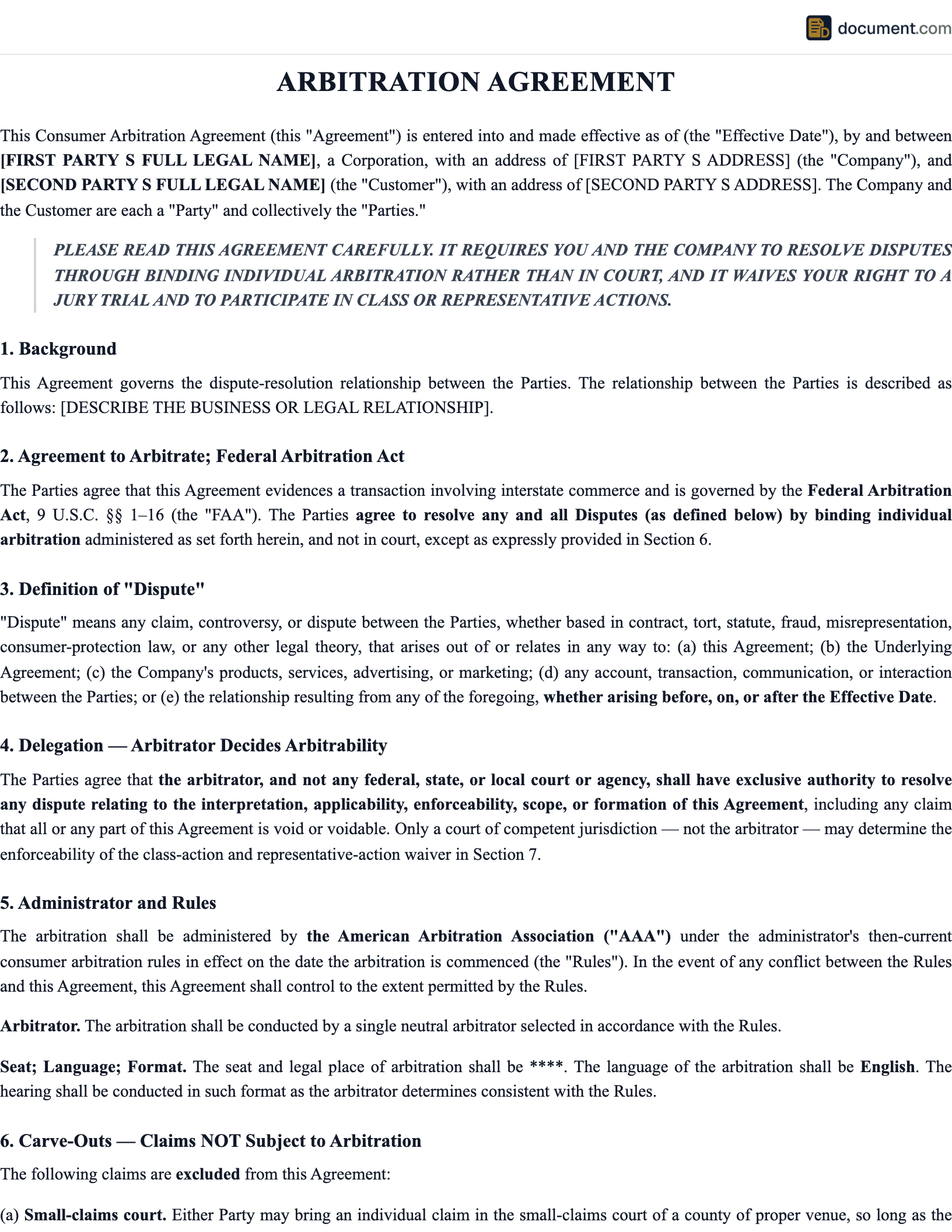



What Is an Arbitration Agreement?
An arbitration agreement is a written contract — or contract clause — in which two or more parties agree to resolve any disputes that arise between them through private arbitration rather than through the public court system. When the parties later have a disagreement, they take the dispute to one or more neutral arbitrators who hear the evidence, apply the relevant law and contract terms, and issue a binding decision called an award. Once entered, the award can be enforced in court just like a judgment, and it is exceptionally difficult to overturn on appeal. Arbitration agreements have become one of the most powerful and widely used dispute-resolution tools in American business law.
Arbitration agreements come in two structural varieties. A standalone arbitration agreement is a separate document signed by the parties for the specific purpose of binding them to arbitrate. An arbitration clause is a single provision embedded inside a larger contract — an employment agreement, a vendor contract, a consumer terms of service, a construction contract — that says any dispute arising under the broader contract must go to arbitration. Both forms are enforceable under the Federal Arbitration Act, and both can include the same key features: arbitrator selection rules, governing institutional rules (AAA, JAMS, ICDR), choice of seat and law, class action waivers, delegation of arbitrability, confidentiality, and remedy limitations.
The reason businesses use arbitration agreements is straightforward. Arbitration is almost always faster than litigation (typically 9 to 18 months from demand to final award versus 2 to 5 years in court), more confidential (hearings are private and awards are usually not published), more flexible procedurally (parties can choose the rules, the location, the language, and the qualifications of the arbitrator), and far less exposed to runaway jury verdicts. Combined with class action waivers, arbitration agreements also dramatically limit a company's exposure to mass litigation by forcing each consumer or employee to bring their claim individually rather than as part of a class. The U.S. Supreme Court has consistently upheld these features over the past two decades, and federal arbitration policy now strongly favors enforcement.
Arbitration is not without trade-offs. Discovery is much more limited than in court, which can hurt the side that needs information from the other party to prove its case. Arbitrators do not have to follow precedent the way judges do, which makes outcomes somewhat less predictable. There is essentially no right of appeal — under Section 10 of the FAA, courts can vacate an award only for a tiny set of procedural defects like corruption or arbitrator misconduct, not for legal or factual mistakes. And for high-stakes disputes, the up-front filing fees and arbitrator hourly rates can run into the tens or hundreds of thousands of dollars. These trade-offs are why some categories of claims (sexual harassment under the 2022 federal statute, certain consumer claims in some states) are now legislatively carved out of mandatory pre-dispute arbitration.
Whether you are a business adopting a company-wide dispute resolution policy, an employer rolling out a new arbitration program for employees, a service provider papering a vendor relationship, or two parties trying to resolve a single existing dispute privately, our attorney-reviewed templates give you a defensible starting point with the standard provisions arbitration courts have repeatedly upheld and the flexibility to customize the scope, the rules, the seat, and the carve-outs for your specific situation.
Faster Resolution
Typical commercial arbitrations resolve in 9-18 months versus years for litigation
Confidential Process
Hearings are private and awards are typically not published in the public record
Final and Binding
Awards are enforceable in court and almost impossible to overturn on appeal
Arbitration Agreement Form Preview
Below is a visual preview of the sections and fields included in a standard arbitration agreement. Your completed document will be customized for the type of disputes covered, the institutional rules selected, and your jurisdiction.
Arbitration Agreement
Binding Dispute Resolution
Section 1: Parties
Section 2: Scope of Arbitration
Section 3: Rules and Provider
Section 4: Class Action Waiver
Section 5: Delegation
Section 6: Execution
Party A Signature
Party B Signature
Types of Arbitration Agreements
Arbitration agreements take several forms depending on the relationship, the industry, and whether they are signed before or after a dispute arises.
Standalone Arbitration Agreement
A separate, signed document binding parties to arbitrate any future disputes
Arbitration Clause (Embedded)
An arbitration provision included as a clause in a broader contract
Employment Arbitration Agreement
Used between employers and employees, often signed at hiring
Consumer Arbitration Agreement
Used in B2C terms of service, EULAs, and purchase agreements
Commercial Arbitration Agreement
Used between businesses in vendor, partnership, or services contracts
Class Action Waiver
Waives the right to participate in class or collective actions
Mandatory Arbitration Agreement
Required as a condition of doing business or accepting employment
Voluntary Arbitration Agreement
Entered into after a dispute arises, by mutual choice of the parties
International Arbitration Agreement
Cross-border disputes governed by the New York Convention and similar treaties
Arbitration vs Litigation
The choice between arbitration and litigation has major consequences for cost, speed, privacy, and finality. The table below summarizes the key differences.
| Feature | Arbitration | Litigation |
|---|---|---|
| Decision-maker | Private arbitrator(s) chosen by parties | Judge and/or jury assigned by court |
| Privacy | Confidential proceedings and awards | Public docket and hearings |
| Discovery | Limited; arbitrator-controlled | Broad under FRCP/state rules |
| Speed | 9-18 months typical | 2-5 years typical |
| Appeal | Almost none (FAA Sec. 10 only) | Full appellate review available |
| Class actions | Usually waived | Available under Rule 23 |
| Cost structure | Filing + arbitrator hourly rates | Court fees + attorney time |
| Enforcement | Confirmed as judgment under FAA | Direct judgment of the court |
How to Create an Arbitration Agreement
Drafting an enforceable arbitration agreement is a seven-step process. Each step matters because courts will look closely at any ambiguity if a party later challenges enforcement.
Define the scope of disputes covered
Use broad language ('any dispute arising from or related to') to capture all foreseeable claims, and explicitly list any carve-outs such as IP injunctions, small claims court, or sexual harassment claims now exempted by federal law.
Choose the arbitration provider and rules
Select AAA, JAMS, ICDR, or another respected provider, and incorporate their rules by reference. Each provider publishes specialized rules for commercial, employment, consumer, and international disputes.
Specify the seat and governing law
The seat (legal home) of the arbitration determines which courts have supervisory jurisdiction. The governing law clause picks the substantive law that the arbitrator will apply to the merits.
Decide on arbitrator selection
Single arbitrator (cheaper, faster) or three-arbitrator panel (often used for higher-value disputes). Specify any qualifications, such as legal training or industry experience.
Add a class action waiver and delegation clause
A class waiver requires individual rather than class arbitration. A delegation clause sends all questions of arbitrability to the arbitrator, not the court. Both have been upheld by the Supreme Court.
Allocate costs and address remedies
For consumer and employment agreements, courts will scrutinize cost-shifting that makes arbitration prohibitively expensive. AAA Consumer Rules cap consumer fees at $200.
Execute and provide an opt-out (consumer/employment)
Have both parties sign or click-accept. For consumer and employment agreements, providing a 30-day opt-out window dramatically strengthens enforceability.
Key Components
A well-drafted arbitration agreement contains the following building blocks.
Scope clause
Defines which disputes the agreement covers and any explicit carve-outs
Rules incorporation
Reference to AAA, JAMS, or other institutional rules
Seat and venue
Legal seat of arbitration and physical location of hearings
Governing law
Substantive law the arbitrator will apply to the merits
Arbitrator selection
Number, qualifications, and selection process for arbitrators
Class action waiver
Prohibits class, collective, and representative actions
Delegation clause
Reserves arbitrability questions to the arbitrator
Cost allocation
Filing fees, arbitrator compensation, and fee shifting
Confidentiality
Restrictions on disclosing the proceedings or award
Severability
Ensures invalid provisions do not destroy the entire agreement
The Federal Arbitration Act
The Federal Arbitration Act (9 U.S.C. §§ 1-16) is the cornerstone of American arbitration law. Enacted in 1925 to overcome historical judicial hostility to arbitration, the FAA establishes a strong federal policy favoring arbitration and preempts most state laws that single out arbitration agreements for disfavored treatment.
- Section 2: Makes written arbitration agreements valid, irrevocable, and enforceable
- Section 3: Requires courts to stay litigation when claims are subject to arbitration
- Section 4: Authorizes courts to compel arbitration on motion of either party
- Section 9: Provides for confirmation of arbitration awards as court judgments
- Section 10: Lists the narrow grounds on which an award may be vacated
- Section 11: Lists the narrow grounds on which an award may be modified
AAA, JAMS & Other Providers
Most arbitration agreements incorporate the rules of an established provider rather than inventing procedure from scratch. The major U.S. and international providers each have specialized rule sets you can reference by name in your agreement.
American Arbitration Association (AAA)
Largest U.S. provider. Specialized rules for Commercial, Employment, Consumer, Construction, and Labor disputes.
JAMS
Premium provider with a roster heavy on retired judges. Comprehensive Arbitration Rules and specialized streamlined rules.
ICDR
International Centre for Dispute Resolution; AAA's international arm. Used for cross-border commercial disputes.
CPR Institute
Nonprofit ADR provider with rules optimized for sophisticated commercial parties.
FINRA Dispute Resolution
Mandatory provider for most disputes between brokerage firms, registered representatives, and customers.
ICC International Court of Arbitration
Leading international arbitration body, used for cross-border commercial disputes worldwide.
Legal Requirements
Arbitration agreements must satisfy general contract law and federal arbitration policy. The following requirements apply in nearly every jurisdiction.
- Written form (FAA Section 2 requires the agreement to be in writing)
- Mutual assent — both parties must clearly agree to arbitrate
- Consideration — typically the mutual promise to arbitrate is sufficient
- Conscionable terms — neither procedurally nor substantively oppressive
- Compliance with the Ending Forced Arbitration of Sexual Assault and Sexual Harassment Act of 2022
- Compliance with state-specific notice requirements (e.g., California disclosure rules)
- Clear identification of the disputes subject to arbitration
- Reasonable cost allocation that does not block the weaker party from accessing the forum
Sample Arbitration Agreement
Below is a condensed preview of our standard arbitration agreement template. Your final document will be customized for your relationship type, provider, and jurisdiction.
ARBITRATION AGREEMENT
Binding Dispute Resolution
This Arbitration Agreement ("Agreement") is entered into between[Party A]and [Party B]as of [Date].
1. AGREEMENT TO ARBITRATE
The parties agree that any and all disputes, claims, or controversies arising out of or relating to this Agreement, the breach thereof, or the parties' relationship (whether based in contract, tort, statute, or otherwise) shall be resolved exclusively by binding arbitration administered by the American Arbitration Association under its Commercial Arbitration Rules.
2. ARBITRATOR AND SEAT
The arbitration shall be conducted by a single arbitrator before the AAA in[City, State]. The arbitrator shall apply the substantive law of the State of[State].
3. CLASS ACTION WAIVER
The parties agree that all disputes shall be brought solely in their individual capacity. Neither party may bring a claim as a plaintiff or class member in any purported class, collective, consolidated, or representative proceeding.
4. DELEGATION
The arbitrator shall have exclusive authority to resolve any dispute concerning the formation, scope, applicability, interpretation, or enforceability of this Agreement or this delegation clause.
5. CONFIDENTIALITY
The arbitration proceedings, all evidence submitted, and the final award shall be treated as confidential and shall not be disclosed to any third party except as required by law or to enforce or vacate the award.
6. CARVE-OUTS
Notwithstanding the foregoing, either party may seek injunctive or other equitable relief from a court of competent jurisdiction to protect intellectual property rights, and either party may bring an individual action in small claims court for claims within the court's jurisdictional limit.
7. FEES AND COSTS
Each party shall bear its own attorneys' fees and shall split AAA filing fees and arbitrator compensation equally, except that the arbitrator shall award fees and costs as permitted by the applicable substantive law.
8. AWARD AND ENFORCEMENT
The arbitrator's award shall be final and binding. Judgment on the award may be entered in any court of competent jurisdiction in accordance with the Federal Arbitration Act.
Frequently Asked Questions
Find answers to common questions about arbitration vs litigation, the FAA, AAA and JAMS, class waivers, employment arbitration, enforceability, and costs.
Official Resources
For additional information on arbitration law, providers, and dispute resolution best practices, consult these official and reputable resources.
American Arbitration Association
AAA homepage with rules, fee schedules, and arbitrator roster
JAMS
JAMS rules, neutrals, and resources for commercial and employment arbitration
Federal Arbitration Act (9 U.S.C.)
Full text of the FAA codified at Title 9 of the U.S. Code
ABA Section of Dispute Resolution
American Bar Association resources on arbitration and ADR
EEOC
Equal Employment Opportunity Commission guidance on employment arbitration
UNCITRAL
United Nations Commission on International Trade Law - international arbitration rules
Create your Arbitration Agreement in under 10 minutes.
Answer a few questions and download a compliant, attorney-drafted document ready for your state.