



What Is a Business Contract?
A business contract is a legally binding agreement between two or more parties that creates enforceable rights and obligations relating to a commercial transaction. At its core, every contract is a private law that the parties write for themselves: it sets the expectations for what each side will do, what each side will receive in return, what happens if something goes wrong, and how any dispute will be resolved. Whether the transaction is the sale of a single laptop, the engagement of a marketing consultant for three months, or a multi-year supply relationship between a manufacturer and a distributor, the underlying logic is the same — and the same handful of legal building blocks must be present for the agreement to be enforceable.
Every legally binding contract requires five elements: an offer by one party, acceptance by the other, consideration (something of value exchanged by each side), mutual assent (a meeting of the minds about the same essential terms), and legal capacity for a lawful purpose. If any of these elements is missing or defective, the contract may be void, voidable, or simply unenforceable in court. Most contract disputes ultimately turn on whether one of these elements was actually present at the moment of formation — and that is why careful drafting at the front end is so much cheaper than litigation at the back.
Beyond the bare minimum required for enforceability, a well-drafted business contract addresses a long list of practical matters: clear identification of the parties, a precise description of the goods or services being exchanged, payment terms and timing, performance standards and acceptance criteria, term and termination, confidentiality obligations, intellectual property ownership, warranties and disclaimers, limitation of liability, indemnification, force majeure, choice of law, dispute resolution, and signature blocks. Each of these clauses exists because experienced lawyers have watched a contract that lacked it produce an avoidable lawsuit.
Business contracts are governed primarily by state common law, which means the rules vary somewhat from one jurisdiction to another. The Uniform Commercial Code (UCC), which has been adopted with minor variations by all 50 states, governs contracts for the sale of goods and provides a fairly uniform set of default rules. Contracts for services are generally governed by common law and are more state-specific. Federal law plays a role in narrow areas — electronic signatures, certain regulated industries, and contracts with the federal government — but the bulk of business contract law is state law.
Whether you are formalizing a handshake agreement with a long-time vendor, sending a service contract to a new client, or papering an enterprise relationship between two companies, our attorney-reviewed templates give you a complete, defensible starting point. Each template includes the essential clauses, the right state-specific provisions, and clear placeholders so that you can customize the document for your specific transaction without missing anything important.
Legally Enforceable
Includes the offer, acceptance, consideration, and mutual assent required by law
Risk Allocation
Clear language for warranties, liability caps, indemnification, and force majeure
Dispute Resolution
Choice-of-law, forum-selection, and arbitration clauses tailored to your state
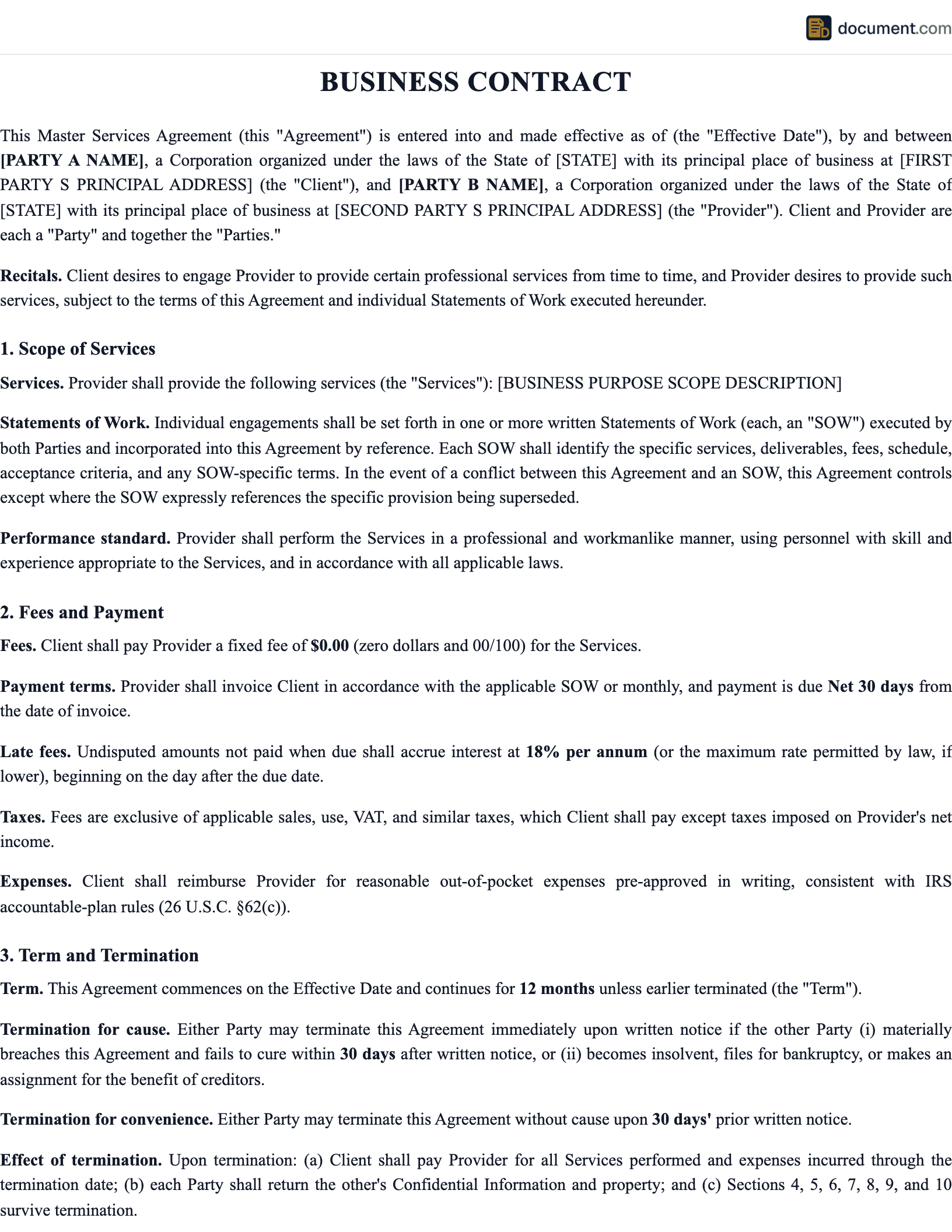
Business Contract Form Preview
Below is a preview of the structure of our business contract template. Your completed contract will be a fully formatted, professionally drafted document with the right clauses for your specific transaction type and state.
Business Contract
Service Agreement Format
Section 1: Parties
Section 2: Scope of Services
Section 3: Compensation
Section 4: Term & Termination
Section 5: Standard Clauses
Section 6: Signatures
Party A — Authorized Signature
Party B — Authorized Signature
Types of Business Contracts
"Business contract" is an umbrella term that covers many specific contract formats. Choose the type that fits your transaction — services, sales of goods, supply, licensing, distribution, joint ventures, or master agreements.
Essential Contract Elements
Every legally enforceable contract — regardless of type, length, or industry — requires the following five elements. Missing any of them puts the entire agreement at risk.
1. Offer
A clear and definite proposal of terms by one party, communicated to the other party with the intent to create a binding agreement upon acceptance.
2. Acceptance
Unambiguous agreement to the offer's terms by the offeree, communicated back to the offeror in the manner permitted by the offer.
3. Consideration
Something of value exchanged by each party — money, goods, services, a promise, or even forbearance from doing something they had a right to do.
4. Mutual Assent
A "meeting of the minds" — both parties understand and agree to the same essential terms with no material misunderstanding.
5. Legal Capacity & Lawful Purpose
Both parties must be competent adults (or properly authorized entities) and the subject matter of the contract must be legal.
Bonus: Writing (When Required)
Certain contracts must be in writing under the statute of frauds — sale of goods over $500, real estate, contracts not performable within one year, and others.
Business Contract vs Other Documents
Business contracts overlap with several adjacent document types. Here is how they differ in legal effect and purpose.
| Document | Binding? | Primary Purpose |
|---|---|---|
| Business Contract | Yes | Create enforceable rights and obligations |
| Letter of Intent (LOI) | Usually no (mixed) | Outline preliminary terms before full contract |
| Memorandum of Understanding | Usually no | Record cooperative intentions |
| Term Sheet | Usually no | Summarize commercial deal points |
| Purchase Order | Yes (when accepted) | Order specific goods at specific prices |
| Quote / Proposal | Offer only | Invitation to enter into a contract |
How to Create a Business Contract
Drafting a strong business contract is a methodical process. Follow these eight steps to produce a document that protects both parties and stands up to scrutiny if a dispute ever arises.
Identify the Parties Precisely
Use full legal names, entity types (LLC, Inc., partnership), state of formation, and principal business addresses. Vague party identification is a leading cause of enforceability problems.
Define the Subject Matter Clearly
Describe the goods or services being exchanged with enough specificity that a stranger reading the contract could verify performance. Vague scopes produce vague disputes.
Specify Consideration and Payment Terms
State the price, the payment schedule, the method of payment, and any conditions on payment (such as acceptance criteria or holdbacks).
Set the Term and Termination Rights
Define when the contract takes effect, how long it lasts, and the circumstances under which either party can terminate — both for cause and for convenience.
Add Risk-Allocation Clauses
Include warranties, disclaimers, limitation of liability, indemnification, insurance requirements, and force majeure tailored to your industry and risk profile.
Address Intellectual Property and Confidentiality
Specify who owns work product, what happens to pre-existing IP, and what information is confidential. These clauses are routinely litigated when omitted or vague.
Choose Law, Forum, and Dispute Resolution
Pick the state law that will govern, the courts that will hear disputes, and whether arbitration is required. These choices have enormous practical consequences.
Sign Properly and Keep Records
Both parties should sign through authorized representatives. Keep an executed original (or e-signature audit trail) and store it for the full statute of limitations period plus a margin.
Key Clauses Explained
The following clauses appear in nearly every well-drafted business contract. Understanding what each one does — and how it can be negotiated — is the difference between a contract that protects you and one that does not.
Force Majeure
Excuses performance when extraordinary events outside the parties' control — natural disasters, war, pandemic, government action — make performance impossible. Should specifically enumerate covered events and define notice requirements.
Limitation of Liability
Caps the total dollar amount one party can recover from the other for breach. Often combined with a waiver of consequential and incidental damages. Heavily negotiated in commercial contracts.
Indemnification
A promise by one party to defend, hold harmless, and pay for losses suffered by the other arising from specified events. Shifts risk between the parties and is one of the most heavily negotiated clauses in any contract.
Choice of Law and Forum
Specifies which state's law governs and which courts will hear disputes. Without these clauses, a court will apply conflict-of-laws rules to figure it out — often with surprising results.
Confidentiality
Protects sensitive business information shared during the contract. Often supplemented or replaced by a separate NDA when the information is highly sensitive or shared before the main contract is signed.
Entire Agreement / Merger
States that the written contract is the complete agreement between the parties, superseding any prior negotiations or agreements. Limits the ability of either side to argue that an unwritten side deal exists.
Breach and Remedies
A breach of contract occurs when one party fails to perform an obligation that the contract requires. Breaches range from minor (a payment a few days late) to material (failure to deliver core goods or services), with the severity determining the available remedies. Courts distinguish between minor breaches, which entitle the non-breaching party to damages but not termination, and material breaches, which allow the non-breaching party to terminate the contract and pursue all remedies.
The most common remedy for breach is monetary damages — compensatory damages designed to put the injured party in the position they would have been in if the contract had been performed. Other remedies include consequential damages (foreseeable indirect losses), liquidated damages (a pre-agreed amount), specific performance (a court order requiring performance, used mainly for unique goods or real estate), and rescission (cancellation of the contract). The non-breaching party generally has a duty to mitigate — to take reasonable steps to limit the damage caused by the breach.
Statute of Frauds
The statute of frauds is a body of state law requiring certain types of contracts to be in writing and signed by the party against whom enforcement is sought. The categories are largely uniform across the 50 states and include: contracts for the sale of goods priced at $500 or more (under UCC §2-201), contracts for the sale or transfer of real property, contracts that by their terms cannot be performed within one year, contracts to pay the debt of another person, contracts in consideration of marriage, and contracts by an executor to pay estate debts from personal funds.
A contract within the statute of frauds that is not in writing is generally unenforceable, although there are limited exceptions such as part performance, promissory estoppel, and the merchant's confirmation rule under the UCC. The statute does not require a formal contract — a signed memorandum, an exchange of emails, or even a series of text messages may satisfy the writing requirement, provided the essential terms and a signature are present. When in doubt, put it in writing.
Sample Business Contract
Below is a condensed preview of a service-format business contract. Use it as a reference for the structure and language you can expect in our attorney-reviewed templates.
BUSINESS SERVICES AGREEMENT
This Business Services Agreement (the "Agreement") is entered into as of [Effective Date] by and between [Provider Name], a [State] [Entity Type] ("Provider"), and [Client Name], a [State] [Entity Type] ("Client"). Provider and Client are referred to individually as a "Party" and collectively as the "Parties."
1. SERVICES
Provider shall perform the services described in Exhibit A attached hereto and incorporated by reference (the "Services"). Provider shall perform the Services in a professional and workmanlike manner consistent with industry standards...
2. COMPENSATION
In consideration of the Services, Client shall pay Provider the fees set forth in Exhibit B. Invoices are due net thirty (30) days from receipt. Late payments shall accrue interest at the rate of 1.5% per month or the maximum rate permitted by law, whichever is less...
3. TERM AND TERMINATION
This Agreement shall commence on the Effective Date and continue until the Services are completed, unless earlier terminated. Either Party may terminate this Agreement for material breach upon thirty (30) days' written notice if such breach is not cured within the notice period...
4. CONFIDENTIALITY
Each Party acknowledges that it may receive confidential information from the other. Each Party agrees to hold all such information in strict confidence and not to disclose it to any third party without the disclosing Party's prior written consent...
5. INTELLECTUAL PROPERTY
All deliverables created by Provider specifically for Client under this Agreement shall be owned by Client upon full payment of the applicable fees. Provider retains ownership of all pre-existing tools, methodologies, and materials...
6. WARRANTIES AND DISCLAIMERS
Provider warrants that the Services will be performed in a professional manner. EXCEPT AS EXPRESSLY SET FORTH HEREIN, PROVIDER DISCLAIMS ALL OTHER WARRANTIES, WHETHER EXPRESS OR IMPLIED, INCLUDING THE IMPLIED WARRANTIES OF MERCHANTABILITY AND FITNESS FOR A PARTICULAR PURPOSE...
7. LIMITATION OF LIABILITY
IN NO EVENT SHALL EITHER PARTY'S TOTAL LIABILITY UNDER THIS AGREEMENT EXCEED THE TOTAL FEES PAID OR PAYABLE UNDER THIS AGREEMENT. NEITHER PARTY SHALL BE LIABLE FOR ANY INDIRECT, CONSEQUENTIAL, OR PUNITIVE DAMAGES...
8. INDEMNIFICATION
Each Party shall indemnify, defend, and hold harmless the other from any third-party claims arising from the indemnifying Party's breach of this Agreement, negligence, or willful misconduct...
9. FORCE MAJEURE
Neither Party shall be liable for any failure or delay in performance due to causes beyond its reasonable control, including acts of God, war, terrorism, pandemic, government action, or labor disputes...
10. GOVERNING LAW AND DISPUTE RESOLUTION
This Agreement shall be governed by the laws of the State of [State], without regard to its conflict-of-laws principles. Any disputes shall be resolved exclusively in the state or federal courts located in [County, State]...
Frequently Asked Questions
Answers to the most common questions about business contracts, contract elements, breach remedies, and dispute resolution.
Official Resources
For authoritative information on contract law, the UCC, electronic signatures, and dispute resolution, consult these resources.
Cornell - Uniform Commercial Code
Full text of the UCC governing contracts for the sale of goods
ABA Business Law Section
American Bar Association resources on commercial contracts
Uniform Law Commission
Source for UETA, UCC amendments, and other uniform commercial laws
FTC - Business Guidance
Federal Trade Commission compliance resources for businesses
American Arbitration Association
Commercial arbitration rules and dispute resolution services
GSA - Federal Acquisition
Federal government contracting policy and Federal Acquisition Regulation
SBA - Contracts
Small Business Administration guide to business contracts
FDIC - E-SIGN Act
Federal Electronic Signatures in Global and National Commerce Act
Create your Business Contract in under 10 minutes.
Answer a few questions and download a compliant, attorney-drafted document ready for your state.