
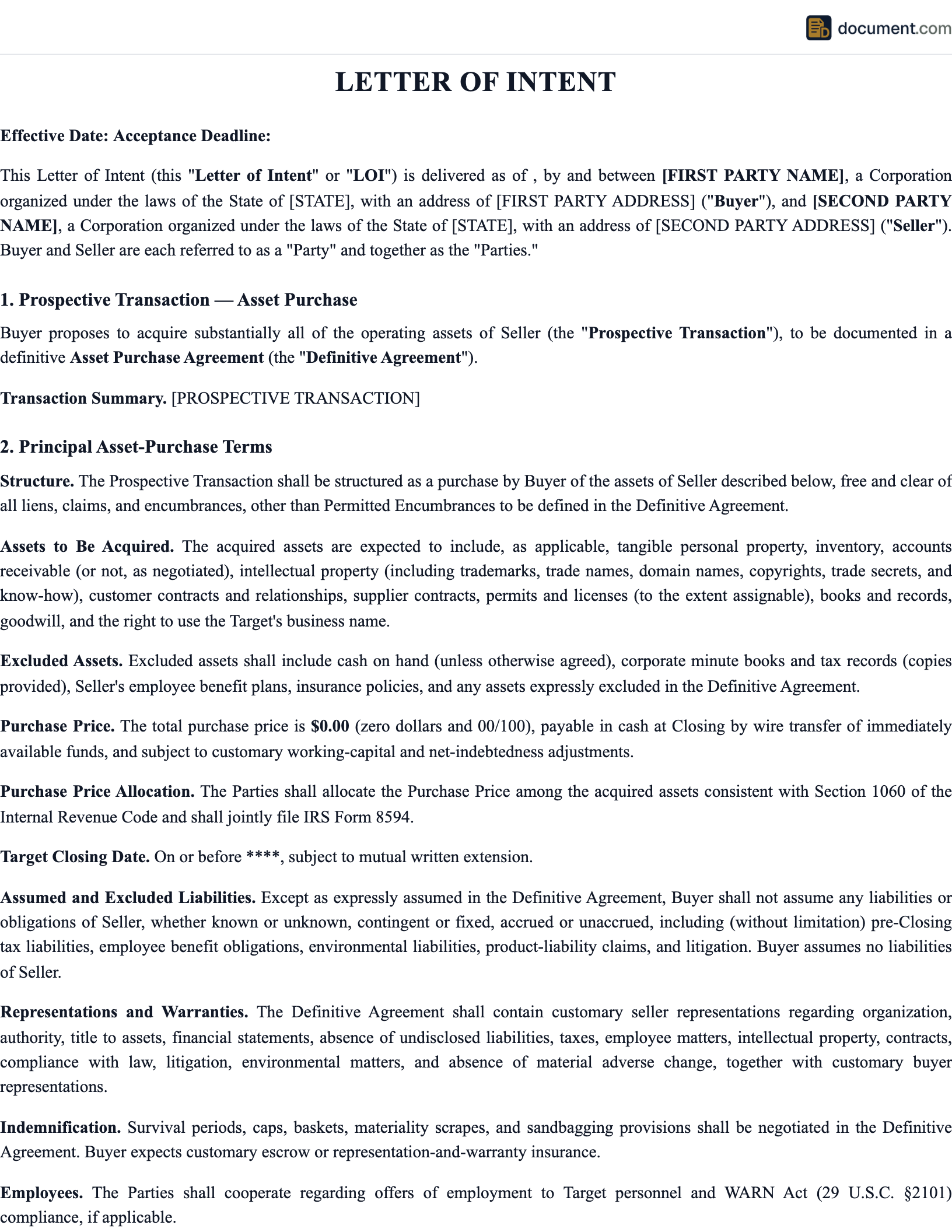



What Is a Letter of Intent?
A letter of intent (LOI) is a preliminary written document that outlines the key terms of a proposed transaction or relationship before the parties commit to a full, definitive contract. It is most commonly used in business acquisitions, commercial real estate leases and sales, investment rounds, and major partnership negotiations, but it also appears in job offers, academic admissions, and internships. The core purpose is the same in every context: to confirm that both sides are aligned on the major terms so they can invest the time and money required to finalize the deal.
A properly drafted LOI walks a careful line. Most of the document is intentionally non-binding — the price, structure, closing date, and contingencies are expressions of intent that do not yet obligate either party to perform. A few provisions, however, are almost always fully binding: confidentiality, exclusivity (no-shop), expense allocation, and the choice of governing law. Clearly identifying which sections are binding and which are not is one of the most important drafting decisions in the entire document, because courts will interpret the language as written if a dispute arises later.
Our templates give you a clean starting point for each common LOI scenario, with the right binding/non-binding language, industry-standard clauses, and fill-in prompts for the deal terms. Pick the scenario that matches your situation, customize the terms, and deliver a letter that both sides can sign with confidence.
Align on Terms
Confirm both sides agree on the big picture before investing in legal drafting
Lock Exclusivity
Protect your diligence investment with a no-shop period the seller must honor
Clear Obligations
Spell out which clauses are binding and which are not so no one is surprised later
Letter of Intent Preview
A typical LOI runs two to five pages and is structured as a business letter. Here is the header, parties section, and deal summary for a business purchase example.
April 6, 2026
Michael Torres
Owner, Torres Auto Repair, Inc.
4120 W. Cactus Rd, Phoenix, AZ 85029
Re: Non-Binding Letter of Intent — Acquisition of Torres Auto Repair, Inc.
Dear Mr. Torres,
This letter outlines the proposed terms under which Desert Mesa Holdings, LLC (the "Buyer") would acquire substantially all of the assets of Torres Auto Repair, Inc. (the "Seller"). This letter is intended to express our mutual interest and serve as the framework for negotiating a definitive purchase agreement.
Except for Sections 5 (Confidentiality), 6 (Exclusivity), 8 (Expenses), and 10 (Governing Law), this letter is not intended to create legally binding obligations on either party...
Types of Letters of Intent
LOIs are used across a range of transactions and relationships. Choose the template that matches your situation.
Business Purchase LOI
Outline proposed terms for acquiring a business, including price, structure, and due diligence period
Real Estate LOI
Signal serious intent to purchase or lease commercial or residential property
Job Letter of Intent
Express formal interest in a position and summarize qualifications for the employer
School Letter of Intent
Declare intent to enroll in a university, graduate program, or specialized school
Investment LOI
Outline proposed investment terms between a startup and a potential funder
Internship LOI
State intent to apply for or accept an internship role and summarize fit
Donate
Declare intent to donate funds, property, or assets to a charity or nonprofit organization
Homeschool
Notify a school district of intent to homeschool a child under state homeschool laws
National
NCAA National Letter of Intent committing a student-athlete to a specific college athletic program
Purchase
State preliminary intent to purchase real estate, equipment, or goods before a formal contract
Purchase Stock
Outline preliminary terms for acquiring shares of stock in a company prior to a definitive agreement
Subcontractor
Declare intent to engage a subcontractor on a construction or service project before signing
To Marry
Formal written declaration of intent to marry, sometimes required for immigration or religious purposes
To Sue With Settlement Demand
Notify a party of intent to file a lawsuit while offering a final settlement demand to resolve the dispute
How to Write a Letter of Intent
Most LOIs take 15 to 30 minutes to draft once you have agreed on the major terms in conversation. Follow these steps.
- 1
Identify the parties
Full legal names of both the buyer and seller (or sender and recipient), with the correct business entity type and address.
- 2
Describe the transaction
State the core deal in one or two sentences — what is being sold, leased, invested in, or offered.
- 3
State the economic terms
Purchase price, payment structure, earnest deposit, financing, rent, or compensation. Use a specific number rather than a range.
- 4
List contingencies and due diligence
Financing contingency, satisfactory due diligence, board approval, regulatory approval, and any third-party consents.
- 5
Define the timeline
Due diligence period, target signing date, and target closing date with enough realism to avoid re-trading later.
- 6
Lock in the binding clauses
Confidentiality, exclusivity, expenses, and choice of law — and clearly state these are binding while the rest is not.
- 7
Close and sign
Request written acknowledgment from the other side and leave signature blocks for both parties.
Key Components
Every LOI should include these sections. Missing or vague clauses are the most common source of disputes later.
Parties and contact info
Full legal names and addresses of both sides
Transaction summary
What is being bought, sold, leased, or offered
Purchase price or terms
Firm number and payment structure
Due diligence period
Duration and scope of the diligence review
Contingencies
Financing, regulatory, board, and third-party approvals
Exclusivity (no-shop)
Binding period in which seller cannot negotiate with others
Confidentiality
Binding protection for non-public information shared
Expenses
Who pays legal, diligence, and professional fees
Governing law and jurisdiction
Which state's law applies and where disputes are resolved
Binding vs non-binding language
Explicit statement of which sections bind the parties
Binding vs Non-Binding Provisions
The distinction between binding and non-binding provisions is the most important legal issue in any LOI. A carelessly worded letter can accidentally create a full contract even when the parties thought they were only expressing interest. Courts look at the language and the parties' conduct, not just the title at the top of the document.
Typically non-binding: purchase price, deal structure, closing date, contingencies, representations and warranties, and post-closing covenants. These are expressions of intent that will be finalized in the definitive agreement.
Typically binding: confidentiality, exclusivity/no-shop, expense allocation, standstill provisions, choice of law, dispute resolution, and the explicit statement of binding vs non-binding sections. Our templates mark these sections clearly so nothing is accidentally ambiguous.
Sample Letter of Intent
Below is a condensed LOI for a business purchase. Your finished document will be fully formatted and customized for your transaction type.
[Date]
[Recipient Name]
[Title]
[Company]
[Address]
Re: Non-Binding Letter of Intent — [Transaction Description]
Dear [Name],
This letter sets forth the basic terms and conditions under which [Buyer/Lessee/Investor] proposes to [acquire/lease/invest in] [Target] (the "Transaction").
1. Parties
Buyer: [Full legal name and address]. Seller: [Full legal name and address].
2. Transaction
[Describe what is being sold, leased, or invested in, including any excluded assets or reserved rights.]
3. Purchase Price
[$Amount], payable as follows: [$earnest deposit] upon execution of the definitive agreement, with the balance at closing. Price is subject to customary working capital and other adjustments.
4. Due Diligence
Buyer shall have [30/45/60] days from the date of this letter to conduct financial, legal, operational, and environmental due diligence, during which Seller agrees to provide reasonable access to books, records, contracts, and personnel.
5. Confidentiality (Binding)
Each party agrees to keep this letter and all non-public information exchanged strictly confidential and to use such information only in connection with evaluating the Transaction.
6. Exclusivity (Binding)
For a period of [60] days from the date of this letter, Seller shall not solicit, negotiate, or accept any competing offers for the sale of the business.
7. Definitive Agreement
The parties intend to negotiate and execute a definitive purchase agreement on or before [date], containing customary representations, warranties, covenants, and indemnities.
8. Expenses (Binding)
Each party shall bear its own legal, diligence, and professional fees regardless of whether the Transaction closes.
9. Non-Binding Nature
Except for Sections 5, 6, 8, and 10, this letter is not intended to create legally binding obligations on either party. The parties' respective obligations shall be governed solely by a definitive written agreement, if and when executed.
10. Governing Law (Binding)
This letter shall be governed by the laws of the State of [State].
Sincerely,
[Buyer Name], [Title]
Acknowledged and agreed:
[Seller Name], [Title]
Frequently Asked Questions
Common questions about LOI binding nature, exclusivity, due diligence, and the path to a definitive agreement.
Official Resources
For more on letters of intent, deal structuring, and due diligence standards, consult these reputable sources.
ABA - Business Law Section
American Bar Association resources on M&A and transactional practice
SEC - EDGAR Filings
Search public company LOIs and deal filings for reference language
SBA - Buy an Existing Business
Small Business Administration guide to acquisition basics
ULC - Uniform Law Commission
Model laws covering commercial transactions and contract formation
FTC - Mergers and Competition
Federal Trade Commission rules on pre-merger notification and antitrust
Nolo - Letter of Intent Guide
Plain-English explanations of LOI provisions and drafting tips
Create your Letter of Intent in under 10 minutes.
Answer a few questions and download a compliant, attorney-drafted document ready for your state.