



What Is a Real Estate Letter of Intent?
A real estate letter of intent is a preliminary agreement that memorializes the key terms under which a buyer proposes to purchase, or a tenant proposes to lease, real property. The LOI sits at a critical juncture in the transaction process: it follows initial property evaluation and preliminary discussions but precedes the substantial expense of title searches, environmental assessments, surveys, appraisals, legal drafting, and financing applications. For the property owner, the LOI represents a serious expression of interest that justifies taking the property off the market or dedicating negotiation resources. For the buyer or tenant, it secures a negotiating position and, through the exclusivity clause, prevents the owner from entertaining competing offers during the due diligence period.
In commercial real estate, the LOI is a deeply entrenched part of deal-making culture. Brokers, principals, and attorneys all expect an LOI to precede definitive documentation, and the LOI negotiation itself serves as a litmus test for whether the parties can reach agreement on fundamental business terms. Major commercial real estate firms, institutional investors, and REITs have standardized LOI processes that require internal approval before an LOI can be issued, treating the LOI as a formal commitment of organizational resources to a potential transaction. In residential real estate, the LOI is less universally used — many residential transactions move directly from verbal offer to purchase agreement — but LOIs are increasingly common in high-value residential deals, off-market transactions, and situations where the buyer wants to establish terms before engaging attorneys.
The legal treatment of real estate LOIs varies by jurisdiction and depends heavily on the document's language. Because real property transactions are governed by the Statute of Frauds in every state — requiring contracts for the sale of land to be in writing and signed by the party to be charged — a real estate LOI must be carefully drafted to avoid being construed as a binding contract to convey property. Courts analyze factors including the definitiveness of the terms, whether the parties intended to be bound, whether there has been partial performance, and whether the agreement is sufficiently complete to be enforced. Explicit non-binding language and clear identification of the LOI as a preliminary document are essential safeguards.
Due Diligence Framework
Establishes the scope and timeline for property inspections, title review, and environmental assessments.
Financial Terms
Defines purchase price or rental rate, deposits, financing contingencies, and payment structure.
Transaction Structure
Clarifies lease vs. purchase, binding vs. non-binding provisions, and conditions precedent.
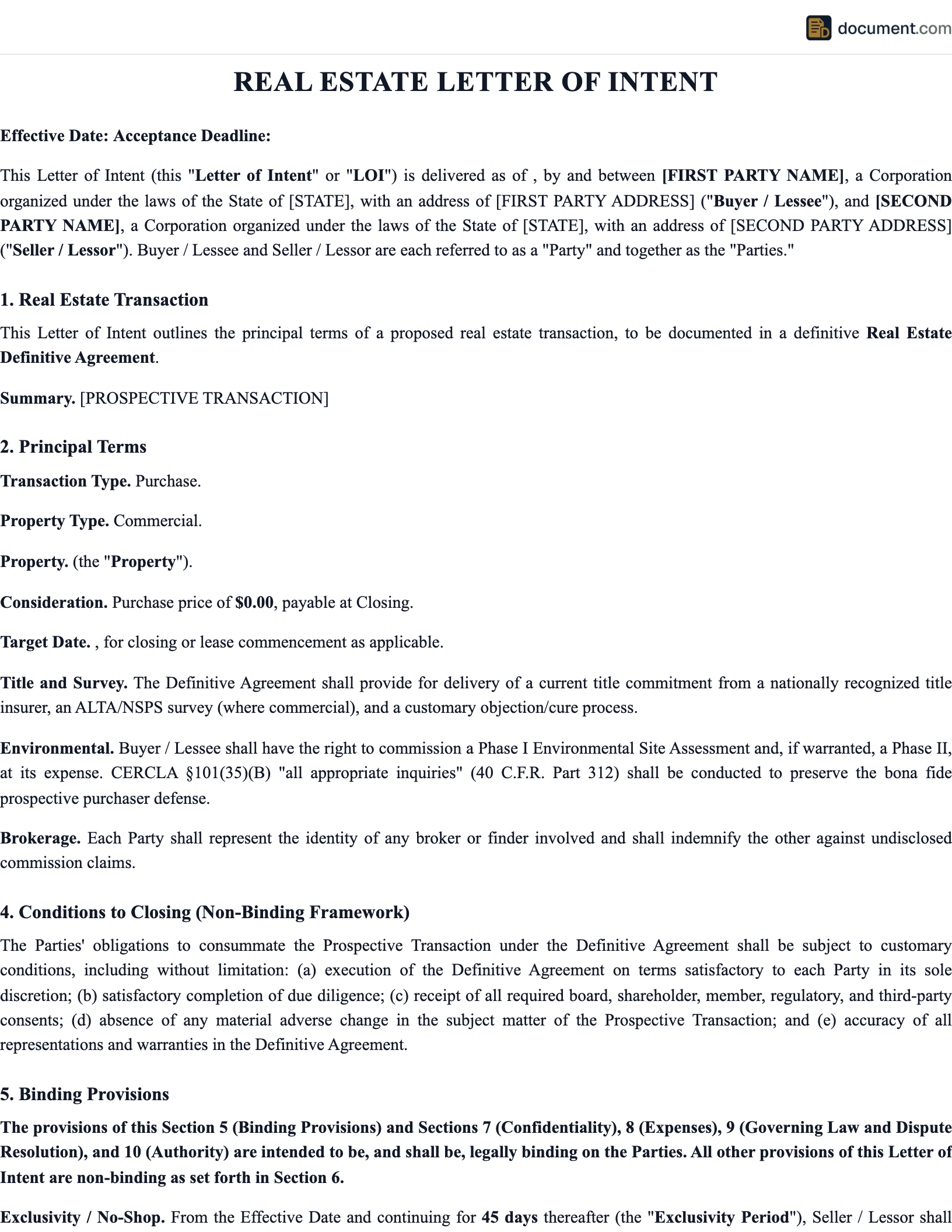
Real Estate LOI Form Preview
Letter of Intent
Real Estate Transaction
1. PROPERTY AND PARTIES
This Letter of Intent sets forth the principal terms under which ("Buyer/Tenant") proposes to the property located at from ("Seller/Landlord").
2. PROPOSED TERMS
Purchase price / base rent: . Due diligence period: days. Earnest money / security deposit: $ .
3. NON-BINDING NATURE
This LOI is non-binding except for the exclusivity, confidentiality, and expense allocation provisions set forth herein.
BUYER / TENANT
SELLER / LANDLORD
Types of Real Estate Letters of Intent
Real estate LOIs vary significantly depending on whether the transaction involves a purchase or lease and whether the property is commercial or residential. Each type addresses different legal requirements, market conventions, and risk allocation considerations.
Commercial Lease LOI
Propose lease terms for commercial office, retail, industrial, or warehouse space before formal lease negotiation
Commercial Purchase LOI
Outline terms for acquiring commercial property including due diligence, financing contingencies, and closing conditions
Residential Lease LOI
Propose rental terms for residential property including rent, deposit, lease duration, and occupancy terms
Residential Purchase LOI
Present an offer framework for purchasing residential property with price, inspection periods, and financing terms
Key Components
A comprehensive real estate LOI addresses these critical elements to create a productive framework for negotiating the definitive purchase agreement or lease:
| Component | Purpose | Key Details |
|---|---|---|
| Property Description | Identifies the subject property | Legal address, parcel number, square footage, acreage, building specifications, zoning |
| Financial Terms | Establishes the economic framework | Purchase price or rent, earnest money, security deposit, CAM charges, tenant improvement allowance |
| Due Diligence Period | Enables property investigation | Timeline (30-60 days), title review, survey, environmental assessment, inspections, zoning review |
| Financing Contingency | Protects buyer's financing position | Loan amount, LTV ratio, interest rate parameters, commitment letter deadline |
| Exclusivity Period | Secures negotiating position | No-shop duration, prohibited activities, break-up fee, termination triggers |
| Closing / Commencement | Establishes transaction timeline | Target closing date, lease commencement, rent commencement, build-out timeline |
| Conditions Precedent | Identifies closing requirements | Clear title, satisfactory environmental, regulatory approvals, estoppel certificates (multi-tenant) |
| Binding Provisions | Creates enforceable obligations | Confidentiality, exclusivity, expense allocation, governing law, dispute resolution |
How to Create a Real Estate Letter of Intent
Identify the Property and Transaction Type
Begin by clearly identifying the property using its legal address, and specify whether the LOI concerns a purchase or lease. For purchases, state whether the acquisition involves fee simple ownership, a ground lease, or a condominium unit. For leases, identify the specific space within the building (suite number, floor, square footage), whether the lease is gross, modified gross, or triple net (NNN), and the intended use of the premises. Include the parcel identification number, legal description if available, and any relevant zoning classification. Accurate property identification prevents disputes about the scope of the transaction.
Propose Financial Terms
For purchases, state the proposed purchase price, earnest money deposit amount and escrow terms, and payment structure (all-cash, financed with specified LTV, seller financing, or assumption of existing debt). For leases, state the base rent per square foot per year, lease term and renewal options, rent escalation schedule, tenant improvement allowance, free rent periods, and operating expense structure (base year, expense stop, or NNN). Include any purchase price adjustments (working capital, prorations) or lease concessions (parking, signage rights, exclusivity clauses for retail) that are material to the economics.
Establish the Due Diligence Framework
Define the due diligence period (typically 30-60 days for purchases, 15-30 days for leases) and specify the investigations the buyer or tenant will conduct: title examination, ALTA survey, Phase I environmental site assessment, property condition report, roof and structural inspection, HVAC evaluation, review of existing leases (for investment properties), zoning compliance verification, and review of property tax assessments. State the buyer's right to terminate without penalty if due diligence reveals material issues and the seller's obligation to provide reasonable access to the property and records.
Address Financing and Contingencies
For financed purchases, describe the anticipated financing structure: loan amount, loan-to-value ratio, target interest rate range, loan term, and deadline for obtaining a financing commitment letter. Identify any other contingencies: board or partner approval, regulatory permits, environmental remediation requirements, or lease-up thresholds (for investment properties). Each contingency should have a deadline after which it either lapses or gives the other party the right to terminate. For lease transactions, address the tenant's credit requirements and any personal guaranty or letter of credit the landlord may require.
Draft Exclusivity and Confidentiality Provisions
Include a binding exclusivity clause preventing the property owner from marketing the property, soliciting offers, or negotiating with other parties for a specified period (typically 30-90 days). Draft the confidentiality provision to protect financial information, property records, and negotiation terms shared during the due diligence and drafting process. These provisions should be clearly designated as binding and should survive the termination or expiration of the LOI. Specify consequences for breach of exclusivity — expense reimbursement or a break-up fee — to give the provision teeth.
Establish the Transaction Timeline
Set target dates for key milestones: due diligence completion, financing commitment, definitive agreement execution, closing (for purchases) or lease commencement (for leases). For lease transactions, also establish the tenant improvement build-out timeline, rent commencement date (which may differ from lease commencement if a build-out period is required), and any early access period for the tenant to begin improvements before the lease term officially begins. Realistic timelines prevent unnecessary pressure and reduce the risk of deal fatigue.
Designate Binding and Non-Binding Provisions
Explicitly label which provisions are binding and which are non-binding. The deal terms — price, rent, due diligence scope, closing conditions — should be clearly stated as non-binding expressions of intent. The procedural provisions — exclusivity, confidentiality, expense allocation, governing law, dispute resolution, and LOI expiration — should be designated as binding obligations enforceable by either party. Include a clear statement that the non-binding provisions do not create an obligation to complete the transaction and that the definitive agreement will supersede the LOI in all respects.
Commercial vs Residential Real Estate LOIs
While commercial and residential real estate LOIs share the same fundamental purpose — establishing preliminary terms before committing to definitive documentation — they differ meaningfully in complexity, market conventions, legal requirements, and the level of detail expected. Understanding these differences ensures your LOI meets the expectations of the counterparty and their advisors.
Commercial real estate LOIs are generally more detailed because commercial transactions involve greater financial complexity and more extensive due diligence. A commercial purchase LOI may address environmental liability allocation, tenant estoppel certificates, service contract assumptions, property management transitions, and 1031 exchange accommodation language. A commercial lease LOI typically addresses operating expense structures (NNN, modified gross, or full-service), tenant improvement allowances and construction management, HVAC supplementation for server rooms, signage rights, exclusivity provisions (particularly in retail), and renewal and expansion options. Residential LOIs tend to be shorter and simpler, focusing primarily on price, earnest money, inspection period, financing contingency, and closing date.
Statute of Frauds Compliance
Every state requires contracts for the sale of real property to be in writing and signed by the party to be charged. While a non-binding LOI is not itself a contract for the sale of land, a poorly drafted LOI that contains all essential terms and is signed by both parties could be construed as satisfying the Statute of Frauds, creating an enforceable obligation to convey the property. This is why explicit non-binding language and a clear statement that a separate definitive agreement is required are critical in every real estate LOI.
Frequently Asked Questions
Official Resources
Authoritative resources on real estate transactions, property law, and commercial leasing standards.
NAR - Research and Statistics
National Association of Realtors data on real estate market conditions, transaction volumes, and pricing trends across commercial and residential sectors.
ALTA - Title Insurance Resources
American Land Title Association guidance on title searches, title insurance policies, and ALTA survey requirements for real estate transactions.
EPA - Brownfields Program
Environmental Protection Agency resources on environmental site assessments, Phase I and Phase II investigations, and contaminated property due diligence.
IRS Publication 544 - Sales and Dispositions
IRS guidance on tax treatment of real property sales, including capital gains, depreciation recapture, and 1031 exchange qualification.
ICSC - International Council of Shopping Centers
Industry resources on commercial retail leasing, including standard lease forms, market data, and deal-making best practices.
BOMA International
Building Owners and Managers Association resources on commercial building standards, measurement methods, and operating expense classification.
Create Your Real Estate LOI
Draft a professional letter of intent for commercial leases, commercial purchases, residential leases, or residential purchases with comprehensive deal terms and proper legal structure.
Create DocumentNo account required. Free to create and preview.