
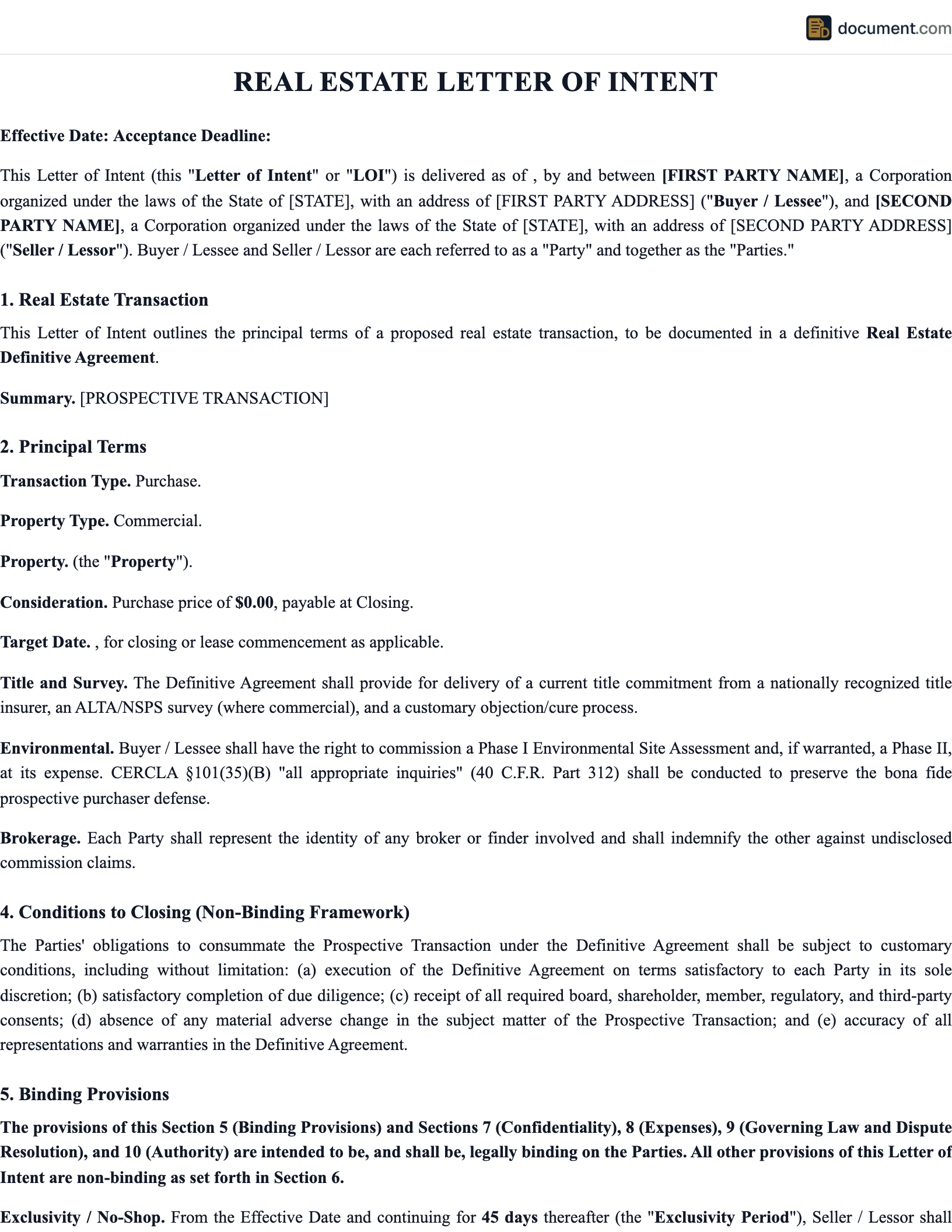



What Is a Residential Lease Letter of Intent?
A residential lease letter of intent is a preliminary written document in which a prospective tenant formally expresses their desire to rent a residential property and proposes the essential terms of the tenancy. While less common than commercial lease LOIs, residential LOIs are becoming increasingly prevalent in competitive housing markets where qualified tenants need to distinguish themselves from numerous applicants. The LOI demonstrates the tenant's professionalism and commitment, provides the landlord with a clear understanding of the tenant's expectations, and creates a written record of agreed-upon terms that informs the preparation of the formal lease agreement.
The residential lease LOI serves several practical functions beyond expressing interest. It allows the tenant to propose terms that differ from the landlord's listing — a lower rent amount, a longer lease term, a different move-in date, or specific accommodations for pets, home offices, or roommates — in a structured format that facilitates negotiation. For landlords managing multiple inquiries, the LOI provides a standardized way to compare proposals from different applicants on the basis of both financial qualifications and desired terms. In markets where desirable properties receive dozens of applications, a well-crafted LOI can be the differentiating factor that secures the property.
State landlord-tenant laws significantly affect residential lease terms, and the LOI should reflect an awareness of applicable regulations. Security deposit maximums vary dramatically by state — from one month in California to unlimited in many states. Some jurisdictions restrict application fees, limit late charges, require specific lease addenda (lead paint disclosure, mold disclosure, bed bug history), or impose rent control and just-cause eviction protections. A knowledgeable tenant who addresses these requirements in the LOI signals to the landlord that the eventual lease negotiation will proceed smoothly and in compliance with applicable law.
Rent Terms
Proposes monthly rent, payment schedule, and any concessions or adjustments.
Move-In Timeline
Establishes desired start date, lease duration, and renewal preferences.
Tenant Commitments
Outlines deposit readiness, insurance, and occupancy details upfront.
Residential Lease LOI Form Preview
Letter of Intent
Proposed Residential Lease
1. PROPERTY AND TENANT
This Letter of Intent sets forth the terms under which ("Prospective Tenant") proposes to lease the property located at from ("Landlord").
2. LEASE TERM AND RENT
The proposed lease term is months beginning . Monthly rent shall be $ payable on the first of each month.
3. SECURITY DEPOSIT
Tenant shall provide a security deposit of $ upon lease execution, to be held and returned in accordance with applicable state law.
PROSPECTIVE TENANT
LANDLORD
Key Components
A residential lease LOI should address these essential terms to guide preparation of the formal lease agreement:
| Component | Purpose | Key Details |
|---|---|---|
| Monthly Rent | Establishes primary financial obligation | Proposed amount, due date, payment method, late fee structure, grace period |
| Lease Term | Defines occupancy period | Start date, duration (6/12/24 months), renewal options, month-to-month conversion |
| Security Deposit | Protects landlord against damages | Amount (subject to state caps), refund timeline, allowable deductions, interest requirements |
| Occupants | Identifies who will reside in property | Named occupants, guest policies, subletting restrictions, roommate additions |
| Pets | Addresses animal occupancy | Type, breed, weight, pet deposit/fee, ESA/service animal accommodations |
| Utilities | Allocates utility costs | Included vs. tenant-paid utilities, account transfer process, average cost estimates |
| Maintenance | Defines repair responsibilities | Landlord vs. tenant obligations, emergency repair process, yard/exterior care |
How to Draft a Residential Lease Letter of Intent
Identify the Property and Parties
Provide the complete address of the rental property, including unit or apartment number, and identify yourself as the prospective tenant with your full legal name and current address. If you are applying with a co-tenant, roommate, or spouse, include their information as well. Identify the landlord or property management company by name and provide any listing reference number or property identification code. Briefly introduce yourself and describe your current living situation, employment, and the reason for your interest in the property.
Propose Rent and Financial Terms
State the monthly rent you are proposing — either the listed amount to confirm acceptance or a different amount if you are negotiating. Include your preferred payment method (check, electronic transfer, online portal), the payment due date, and your understanding of the late fee structure. If you are requesting any rent concessions (free first month, reduced rate for a longer lease term, or inclusion of parking or storage at no extra charge), state them clearly. Mention your financial qualifications briefly — stable employment, sufficient income (typically 2.5-3x monthly rent), strong credit history, and positive landlord references.
Establish Lease Term and Move-In Date
Specify your desired lease start date and lease duration. Standard residential leases are 12 months, but you may propose a shorter term (6 months) with a higher rent or a longer term (18-24 months) at a discounted rate. Indicate your flexibility on the start date if applicable. Address what happens at the end of the initial lease term — whether you prefer automatic renewal for successive terms, conversion to month-to-month, or a new lease negotiation. If you need early access for cleaning or minor preparations before the lease officially begins, mention this.
Address Security Deposit and Move-In Costs
Confirm your willingness to pay the required security deposit and identify any state-specific limitations that apply (maximum amounts, interest accrual requirements, separate escrow accounts). List all anticipated move-in costs: first month's rent, last month's rent (if required), security deposit, pet deposit or fee, key/access card deposit, and any move-in administrative fees. Confirm that you will obtain renter's insurance with the minimum coverage required by the landlord, naming the landlord as an additional insured if requested.
Disclose Occupants, Pets, and Special Needs
List all individuals who will occupy the property, including their relationship to you and whether they are adults or minors. Describe any pets with specifics on species, breed, weight, age, and behavioral history. If you have an emotional support animal or service animal, note the applicable Fair Housing Act protections that prohibit pet deposits and breed restrictions for qualifying animals. Mention any special requirements: home office needs, parking for multiple vehicles, accessibility accommodations, or the need for property modifications (installing shelving, painting, adding a deadbolt).
Include Non-Binding Language and Next Steps
Explicitly state that the LOI is non-binding and intended as a basis for negotiation. Confirm that no lease obligation arises until a formal lease agreement is executed by both parties. Propose a timeline for next steps: scheduling a walk-through inspection, submitting a formal rental application with supporting documents, reviewing and negotiating the lease agreement, and executing the lease. Provide your contact information and express your availability for discussion. If you are attaching any supporting documents (proof of income, reference letters, pet resume), list them.
Tenant Rights and Protections
Understanding your rights as a prospective tenant is essential when drafting a residential lease LOI. Federal, state, and local laws provide numerous protections that affect lease terms, application processes, and landlord-tenant relationships. A well-informed tenant can draft an LOI that respects these protections and avoids proposing terms that would be unenforceable or illegal.
The Fair Housing Act prohibits discrimination in housing based on race, color, national origin, religion, sex, familial status, and disability. Many state and local laws extend these protections to additional categories including sexual orientation, gender identity, source of income, and immigration status. The LOI should not include information that could be used for discriminatory screening — age, marital status, or family planning intentions — but should focus on financial qualifications and proposed lease terms. If you require a reasonable accommodation due to a disability, you have the right to request it at any point in the leasing process, including in the LOI.
Security deposit laws vary significantly by state and directly affect the financial terms proposed in the LOI. Some states cap security deposits at one month's rent for unfurnished units, while others have no statutory limit. Many states require landlords to hold deposits in separate escrow accounts, pay interest on deposits, and provide itemized deduction statements within specified timeframes after move-out. Some jurisdictions prohibit non-refundable deposits entirely or limit the types of deductions landlords can take. Understanding these rules before drafting the LOI helps you propose terms that comply with applicable law and protects your financial interests throughout the tenancy.
Fair Housing Protections
Under the Fair Housing Act and applicable state laws, landlords cannot discriminate against applicants based on protected characteristics including race, color, religion, national origin, sex, familial status, or disability. If you have a disability that requires a reasonable accommodation (such as an assistance animal or physical modification to the property), you have the right to request the accommodation and the landlord must engage in an interactive process to evaluate the request. It is illegal for a landlord to charge a pet deposit or fee for a qualifying service animal or emotional support animal.
Frequently Asked Questions
Official Resources
Authoritative resources on residential leasing, tenant rights, and fair housing protections.
HUD - Rental Assistance
U.S. Department of Housing and Urban Development resources on renter rights, fair housing, and rental assistance programs.
CFPB - Housing Resources
Consumer Financial Protection Bureau guidance on renter protections, security deposits, and housing discrimination.
Nolo - Renters' Rights
Comprehensive legal information on state-specific tenant rights, lease terms, and landlord obligations.
HUD - Fair Housing
Federal fair housing enforcement, discrimination complaints, and reasonable accommodation guidance.
IRS Publication 527 - Residential Rental Property
Tax guidance relevant to both landlords and tenants on rental income, deductions, and depreciation.
ABA Real Property Section
American Bar Association resources on residential leasing, landlord-tenant law, and real estate transactions.
Create your Real Estate Residential Lease Letter of Intent in under 10 minutes.
Answer a few questions and download a compliant, attorney-drafted document ready for your state.