
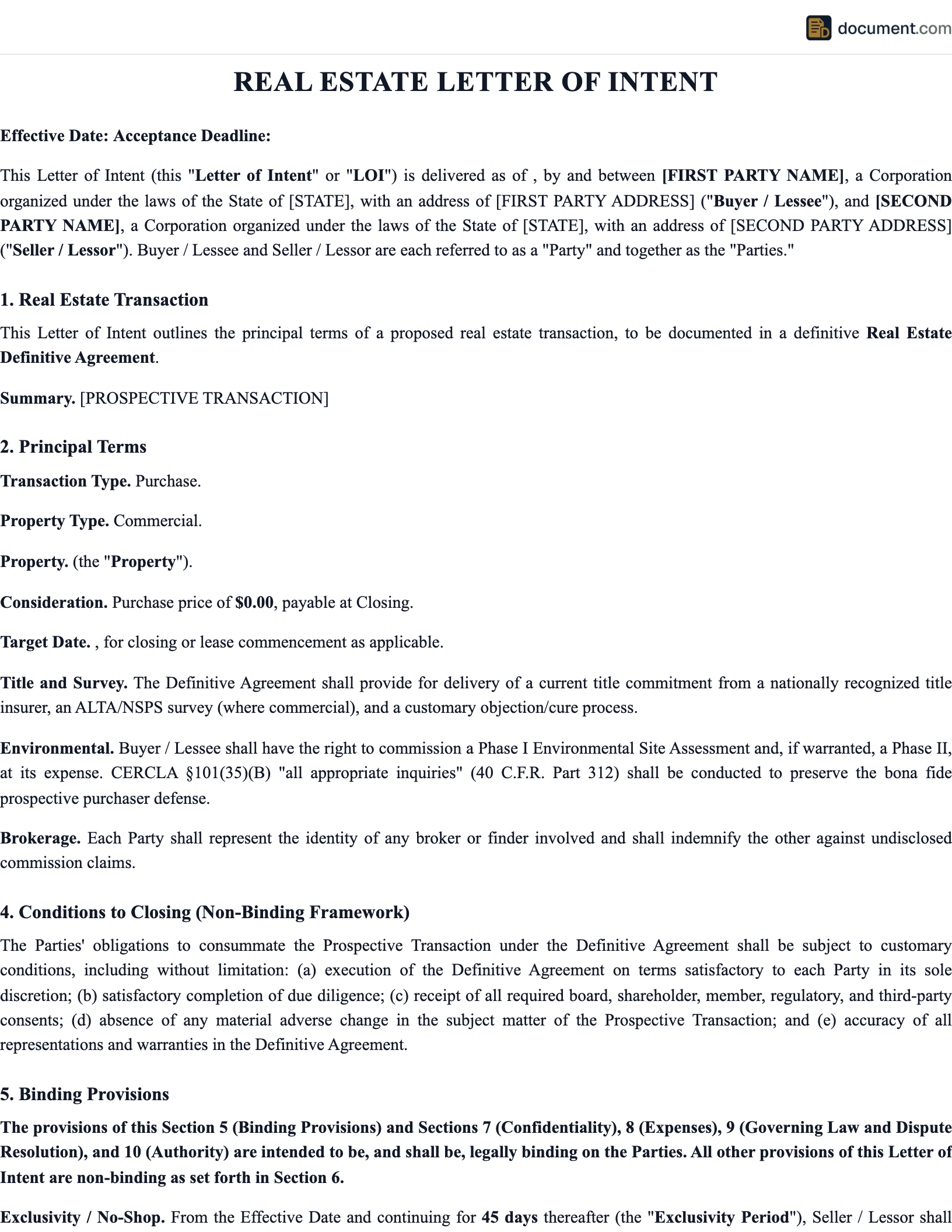



What Is a Commercial Lease Letter of Intent?
A commercial lease letter of intent is a preliminary document that memorializes the principal economic and business terms under which a prospective tenant proposes to lease commercial real estate from a landlord. The LOI occupies a critical position in the commercial leasing process: it comes after the tenant has identified suitable space and completed initial property tours, but before either party commits the substantial time and legal expense required to negotiate and draft a full commercial lease agreement. For the landlord, the LOI demonstrates tenant seriousness and creditworthiness before taking space off the market. For the tenant, it secures the landlord's attention and, through an exclusivity provision, prevents the landlord from leasing the space to a competitor during active negotiations.
Commercial lease negotiations involve significantly more complexity than residential leases because the economic structure encompasses not just base rent but tenant improvement allowances, operating expense pass-throughs, common area maintenance charges, percentage rent provisions for retail tenants, and various options and contingencies that can span decades of occupancy. The LOI distills these complex negotiations into their essential terms, allowing both parties to reach conceptual agreement before investing in expensive legal drafting. Many lease negotiations fail at the LOI stage when the parties discover fundamental disagreements on rent expectations, build-out responsibilities, or lease term — saving both sides the cost of negotiating a full lease document.
The commercial real estate industry has developed standardized LOI practices that vary by property type. Office lease LOIs typically focus on base rent, TI allowances, expense stops, and parking ratios. Retail lease LOIs emphasize percentage rent, co-tenancy clauses, exclusive use provisions, and hours of operation. Industrial lease LOIs prioritize clear-height specifications, dock configurations, yard storage rights, and environmental compliance. Regardless of property type, the LOI must balance sufficient specificity to guide lease drafting with enough flexibility to accommodate evolving business needs during the negotiation process.
Rent Structure
Defines base rent, escalations, and NNN vs. gross lease economics for the tenancy.
Tenant Improvements
Establishes TI allowance, build-out scope, and construction timeline responsibilities.
Lease Options
Covers renewal, expansion, contraction, and early termination rights upfront.
Commercial Lease LOI Form Preview
Letter of Intent
Proposed Commercial Lease
1. PREMISES AND PARTIES
This Letter of Intent sets forth the principal terms under which ("Tenant") proposes to lease approximately rentable square feet located at from ("Landlord").
2. LEASE TERM AND RENT
The initial lease term shall be years commencing on . Base rent shall be $ per rentable square foot per annum, payable monthly.
3. TENANT IMPROVEMENT ALLOWANCE
Landlord shall provide a tenant improvement allowance of $ per rentable square foot for Tenant's build-out of the Premises.
TENANT
LANDLORD
Key Components
A commercial lease LOI must address these essential terms to create a productive framework for negotiating the definitive lease agreement:
| Component | Purpose | Key Details |
|---|---|---|
| Base Rent | Establishes the core economic obligation | Per-RSF rate, annual escalations (fixed or CPI), free rent periods, percentage rent for retail |
| Lease Term | Defines the occupancy period | Initial term length, commencement date, rent commencement date, renewal option periods |
| TI Allowance | Funds tenant build-out | Dollar-per-RSF amount, disbursement schedule, landlord vs. tenant-managed construction |
| Operating Expenses | Allocates building costs | NNN, modified gross, or full-service; base year or expense stop; CAM caps; audit rights |
| Permitted Use | Defines business operations scope | Specific use clause, exclusive use rights, zoning compliance, prohibited uses |
| Security Deposit | Protects landlord against default | Amount (typically 1-3 months rent), letter of credit option, burn-down provisions |
| Assignment and Subletting | Addresses future flexibility | Consent requirements, profit-sharing, recapture rights, affiliate transfer exceptions |
How to Draft a Commercial Lease Letter of Intent
Identify the Premises and Parties
Clearly describe the leased premises including the street address, suite or unit number, floor location, approximate rentable and usable square footage, and the building name if applicable. Identify the landlord entity (or its authorized property management representative) and the tenant entity, including the state of incorporation and principal business activity. If the tenant is a newly formed entity, the landlord may require a personal guaranty from the principals, which should be addressed in the LOI.
Establish Rent Structure and Escalations
Propose the base rent expressed as a per-rentable-square-foot annual rate, specify the payment frequency (typically monthly in advance), and outline the rent escalation schedule. Common escalation structures include fixed annual increases (2-3%), CPI-based adjustments with a floor and cap, or fair market value resets at specified intervals. For retail tenants, address percentage rent above a natural breakpoint and define gross sales for percentage rent purposes. Specify any free rent or abated rent periods and whether those periods apply to base rent only or also to operating expenses.
Define Tenant Improvement Terms
Specify the landlord's tenant improvement allowance in dollars per rentable square foot, the process for submitting and approving construction plans, whether the landlord or tenant manages construction, the timeline for completing improvements, and how the rent commencement date relates to substantial completion of the build-out. Address whether unused TI allowance can be applied as a rent credit, and establish the treatment of cost overruns above the TI allowance. For second-generation space, clarify the condition of existing improvements and any demolition or restoration responsibilities.
Outline Operating Expense Structure
Specify the lease type (triple-net, modified gross, or full-service gross) and the methodology for calculating the tenant's proportionate share of operating expenses. For NNN leases, identify the specific expense categories passed through to the tenant and any caps on controllable expenses. For gross leases, establish the base year and clarify which expenses are included versus excluded. Address the tenant's right to audit the landlord's expense records and the process for reconciling estimated versus actual expenses at year-end.
Include Options and Contingencies
Outline renewal options (number of periods, duration, rent determination method, notice requirements), expansion options and rights of first refusal on adjacent space, contraction rights, and early termination provisions. Include any contingencies that must be satisfied before the lease becomes binding: board approval, financing, zoning or permit approvals, environmental assessment, and co-tenancy requirements for retail locations. Each contingency should have a defined timeline and specify whether the contingency is waivable by the tenant.
Address Parking, Signage, and Common Areas
Specify the tenant's parking allocation (reserved and unreserved spaces per 1,000 RSF), parking rates (if applicable), signage rights (monument, building directory, suite entry, and any restrictions from architectural guidelines or CC&Rs), access to loading docks and freight elevators, storage space, and common area amenities. For retail tenants, address storefront design requirements, hours of operation, and common area maintenance responsibilities.
Designate Binding and Non-Binding Provisions
Explicitly state that the substantive lease terms are non-binding and that no lease obligation exists until a formal lease agreement is executed and delivered by both parties. Designate any binding provisions: exclusivity period, confidentiality, expense allocation, and governing law. Include a termination provision specifying when the LOI expires if a definitive lease is not executed (typically 60-90 days) and clarify that either party can withdraw from negotiations at any time prior to lease execution without liability for the non-binding terms.
Negotiation Strategies for Commercial Lease LOIs
Effective commercial lease negotiation begins at the LOI stage, where the tenant and landlord establish the economic framework that will govern the definitive lease. Tenants should approach the LOI strategically, recognizing that terms established at this stage become the starting point for lease drafting and are difficult to renegotiate later in the process.
Market leverage plays a central role in LOI negotiations. In a tenant-favorable market with high vacancy rates, tenants can negotiate more aggressively on concessions — higher TI allowances, longer free rent periods, lower base rent, and more flexible termination rights. In a landlord-favorable market with low vacancy, tenants may need to compromise on economic terms but should still protect key operational provisions like permitted use, exclusive use rights, and assignment flexibility. Engaging a tenant representation broker who understands current market conditions and comparable transactions provides critical leverage during LOI negotiations.
One of the most important tenant strategies is to negotiate the total cost of occupancy rather than focusing solely on base rent. A lease with lower base rent but high operating expense pass-throughs and no expense caps can be more expensive over the term than a higher base rent with an all-inclusive gross structure. Tenants should request historical operating expense data for the building, analyze the expense trends, and model the total occupancy cost across the full lease term including renewal periods. This analysis often reveals that the lease with the highest headline rent actually provides the lowest total cost.
Personal Guaranty Exposure
Landlords frequently require personal guarantees from small business tenants or tenants with limited operating history. The LOI should address the scope of any personal guaranty — whether it covers the full lease term or burns down over time, whether it is limited to a specified dollar amount (a "good-guy guaranty"), and whether it terminates upon the tenant achieving specified financial benchmarks. Failing to address the guaranty at the LOI stage often results in contentious negotiations during lease drafting that can derail the deal.
Frequently Asked Questions
Official Resources
Authoritative resources on commercial leasing, tenant rights, and real estate transactions.
SBA - Leasing Commercial Space
Small Business Administration guide covering commercial lease terms, negotiation strategies, and tenant rights.
IRS Publication 535 - Business Expenses
IRS guidance on deductibility of rent, leasehold improvements, and other occupancy-related business expenses.
NAIOP - Commercial Real Estate Research
National Association of Industrial and Office Properties research on market trends, lease structures, and best practices.
ICSC - International Council of Shopping Centers
Industry resources on retail leasing, percentage rent structures, and tenant mix considerations.
BOMA International
Building Owners and Managers Association standards for measuring rentable area and operating expense classifications.
ABA Real Property Section
American Bar Association resources on commercial lease drafting, tenant improvements, and real estate transactions.
Create Your Commercial Lease LOI
Structure your commercial lease negotiations with a professionally drafted letter of intent covering rent, tenant improvements, operating expenses, and lease options.
Create DocumentNo account required. Free to create and preview.