
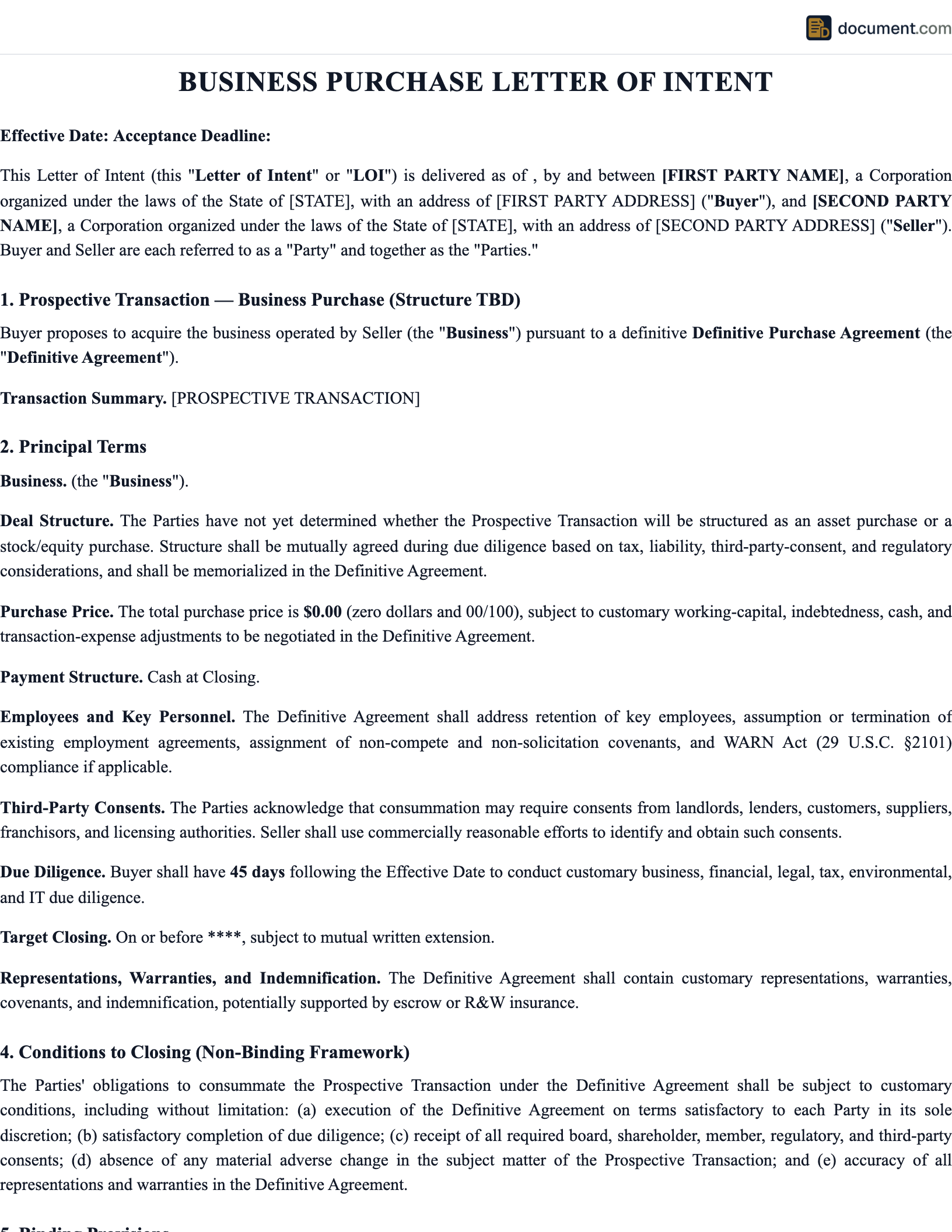



What Is a Business Purchase Letter of Intent?
A business purchase letter of intent is a preliminary agreement that memorializes the key terms under which a buyer proposes to acquire a business, establishing a framework for due diligence and negotiation of a definitive purchase agreement. The LOI sits at a critical juncture in the acquisition process: it comes after the buyer has conducted preliminary analysis and initial discussions with the seller, but before the buyer commits the substantial time and expense required for comprehensive due diligence, legal documentation, and financing. For the seller, the LOI represents a serious expression of intent that justifies opening their books to detailed buyer scrutiny. For the buyer, it secures a negotiating position and, through the exclusivity clause, prevents the seller from shopping the deal to competitors.
The strategic value of the LOI extends beyond its legal function. It forces both parties to address fundamental deal issues early — purchase price, payment structure, deal type (asset or stock), key contingencies, and timeline — before either side incurs significant transaction costs. Many potential deal-breakers surface during LOI negotiations: the buyer discovers the seller has unrealistic price expectations; the seller learns the buyer cannot secure adequate financing; or the parties cannot agree on basic liability allocation. By resolving these issues at the LOI stage, when transaction costs are still relatively low, both parties save substantial time and money compared to discovering irreconcilable differences during definitive agreement negotiations after months of expensive due diligence.
The legal character of a business purchase LOI requires careful drafting. Courts in several jurisdictions have enforced LOIs as binding contracts where the language was insufficiently clear about which terms were non-binding. The landmark case Texaco v. Pennzoil resulted in a $10.53 billion jury verdict based partly on an agreement in principle that the parties treated as preliminary. More recently, courts have analyzed factors like the definitiveness of the terms, whether there has been partial performance, whether all essential terms are agreed upon, and the complexity of the transaction to determine whether an LOI creates binding obligations. This means the drafter must be explicit about which provisions are binding (typically exclusivity, confidentiality, expenses, and governing law) and which are non-binding (purchase price, deal structure, representations and warranties, closing conditions).
Due Diligence Framework
Establishes scope, timeline, and access rights for comprehensive buyer investigation.
Exclusivity Protection
Prevents the seller from shopping the deal while the buyer invests in diligence.
Deal Structure Clarity
Defines asset vs. stock, price, payment terms, and key conditions upfront.
Business Purchase LOI Form Preview
Letter of Intent
Proposed Acquisition of Business
1. PARTIES AND TRANSACTION OVERVIEW
This Letter of Intent sets forth the principal terms under which ("Buyer") proposes to acquire ("the Business") from ("Seller").
2. PURCHASE PRICE AND STRUCTURE
Buyer proposes to acquire the Business for a total purchase price of $ structured as an purchase, subject to customary adjustments.
3. DUE DILIGENCE PERIOD
Buyer shall have days from execution to complete due diligence. Seller shall provide reasonable access to books, records, and facilities.
BUYER
SELLER
Key Components
A business purchase LOI must address these essential deal elements to create a productive framework for negotiating the definitive agreement:
| Component | Purpose | Key Details |
|---|---|---|
| Purchase Price | Establishes valuation framework | Total price, valuation methodology, working capital adjustments, earnout provisions, escrow holdbacks |
| Deal Structure | Defines tax and liability treatment | Asset purchase vs. stock purchase, included/excluded assets, assumed liabilities |
| Due Diligence Period | Enables buyer investigation | Timeline (30-90 days), scope of access, data room, site inspections, employee interviews |
| Exclusivity Period | Protects buyer's investment in diligence | No-shop duration (60-120 days), prohibited activities, break-up fee, fiduciary out |
| Earnest Money | Demonstrates buyer commitment | Deposit amount (1-5% of price), escrow terms, refundability conditions, credit toward purchase |
| Conditions Precedent | Identifies closing requirements | Financing approval, regulatory clearances, landlord consents, key employee retention, third-party approvals |
| Seller Transition Support | Ensures operational continuity | Transition period, consulting agreement, non-compete/non-solicit, training obligations |
| Binding Provisions | Creates enforceable obligations | Confidentiality, exclusivity, expenses, governing law, dispute resolution, termination |
How to Create a Business Purchase Letter of Intent
Identify the Target and Structure
Clearly identify the business being acquired (legal entity name, jurisdiction, principal business activities) and specify whether the proposed transaction is an asset purchase or stock/equity purchase. For asset purchases, list the major asset categories to be acquired (tangible assets, intellectual property, contracts, permits, goodwill) and any assets specifically excluded. For stock purchases, identify the ownership interests being acquired and any minority interest considerations.
Propose the Purchase Price and Payment Terms
State the total proposed purchase price and break down the payment structure: cash at closing, seller financing (promissory note terms including interest rate, term, and security), earnout provisions tied to post-closing performance milestones, and any escrow holdback for indemnification claims. Specify the valuation methodology (multiple of EBITDA, discounted cash flow, asset-based) and identify any anticipated working capital adjustments or inventory true-ups at closing.
Establish the Due Diligence Framework
Define the due diligence period (typically 30-90 days from LOI execution), the categories of information the buyer will review (financial, tax, legal, operational, environmental, employment, IP, regulatory), the seller's cooperation obligations, and the buyer's right to terminate without penalty based on diligence findings. Specify whether the buyer will conduct a quality of earnings analysis and whether the seller will provide audited or reviewed financial statements.
Draft the Exclusivity and Confidentiality Provisions
Include a binding no-shop clause preventing the seller from soliciting or negotiating with competing buyers for a specified period (60-120 days). Draft the confidentiality provision to protect both parties' proprietary information shared during negotiations and due diligence. These provisions should be explicitly designated as binding and should survive termination of the LOI.
Outline Conditions Precedent and Timeline
List the conditions that must be satisfied before closing: satisfactory completion of due diligence, financing commitments, regulatory approvals (HSR Act filing if applicable, industry-specific licenses), landlord consents for lease assignments, key employee commitments, third-party contract consents, and absence of material adverse change. Establish a target closing date and identify which conditions can be waived by which party.
Address Post-Closing Obligations
Outline the seller's expected post-closing commitments: transition consulting period (typically 3-12 months), non-competition agreement (geographic scope, duration, restricted activities), non-solicitation of employees and customers, and cooperation with post-closing accounting and tax matters. Specify whether the seller will be compensated for transition services and the general terms of any employment or consulting arrangement.
Designate Binding and Non-Binding Provisions
Explicitly label which sections are binding and which are non-binding. Non-binding provisions typically include purchase price, deal structure, representations and warranties scope, and closing conditions. Binding provisions include exclusivity, confidentiality, expense allocation, governing law, dispute resolution, and termination. Include a clear statement that the non-binding provisions do not create an obligation to consummate the transaction and that the definitive agreement will supersede the LOI.
Asset Purchase vs Stock Purchase
The choice between an asset purchase and a stock purchase is one of the most consequential decisions in any business acquisition, affecting tax treatment, liability exposure, contract assignments, and operational transition. The LOI should clearly state the proposed structure because it fundamentally shapes every other term in the deal.
In an asset purchase, the buyer selects which assets to acquire and which liabilities to assume, providing a clean slate that excludes unknown or contingent liabilities. The buyer gets a stepped-up tax basis in the acquired assets, enabling higher depreciation and amortization deductions going forward. However, asset purchases can be more complex operationally because each asset and contract must be individually transferred, and some contracts may have anti-assignment clauses requiring third-party consent. In a stock purchase, the buyer acquires the entity itself, including all assets, liabilities, contracts, and legal history — which is operationally simpler but exposes the buyer to the entity's full liability history, including undisclosed obligations, pending litigation, and environmental contamination.
Bulk Sale Laws
Many states still maintain bulk sale or bulk transfer statutes (derived from Article 6 of the UCC) that impose notice requirements when a business sells a substantial portion of its assets outside the ordinary course. While most states have repealed Article 6, notable exceptions include California, Maryland, and New Jersey, which maintain bulk sale notice requirements that must be satisfied before closing an asset purchase. Failure to comply can make the buyer liable for the seller's debts to the extent of the purchase price.
Frequently Asked Questions
Official Resources
Authoritative resources on business acquisitions, due diligence, and transaction structuring.
SBA - Buying an Existing Business
Small Business Administration guide covering the acquisition process, financing options, and due diligence for business purchases.
IRS - Sale of a Business
IRS guidance on tax treatment of business sales including asset allocation, installment sales, and capital gains reporting.
FTC - Guide to Antitrust Laws: Mergers
Federal Trade Commission guidance on premerger notification (HSR Act), antitrust review, and reportable transaction thresholds.
Uniform Commercial Code - Article 2A
Legal Information Institute resource on UCC provisions relevant to asset transfers and lease assignments in business acquisitions.
SCORE - Buying a Business
Mentor-based guidance from SCORE on the business acquisition process, valuation methods, and negotiation strategies.
ABA Business Law Today
American Bar Association resources on M&A transaction structuring, due diligence best practices, and acquisition agreement drafting.
Create Your Business Purchase LOI
Structure your acquisition with a professionally drafted letter of intent covering deal terms, due diligence, exclusivity, and transition planning.
Create DocumentNo account required. Free to create and preview.