



What Is an LLC Operating Agreement?
An LLC operating agreement is the foundational governance document for a limited liability company. It establishes the internal rules that control how the business is owned, managed, and operated. While articles of organization create the LLC as a legal entity with the state, the operating agreement is the private contract among the members that defines their rights, responsibilities, and financial relationships. Every LLC — from a single-owner freelance business to a multi-million-dollar venture with dozens of investors — should have a carefully drafted operating agreement that reflects the members' actual intentions for how the company will function.
The operating agreement covers the most consequential aspects of the business relationship: how much each member has invested and what percentage of the company they own, how profits and losses are allocated (which can differ from ownership percentages under IRC Section 704(b)), who has authority to make decisions and bind the company in contracts, what happens when a member wants to sell their interest or leave the company, how disputes between members are resolved, and under what circumstances the LLC will be dissolved. Without an operating agreement, all of these critical issues default to state statute — and the default rules rarely match what the members actually intend.
One of the most important functions of an operating agreement is reinforcing the legal wall between the LLC and its members' personal assets. This separation — known as the "corporate veil" or "LLC veil" — is what gives limited liability companies their primary advantage. When a court considers whether to "pierce the veil" and hold members personally liable for the LLC's debts, it examines whether the LLC was operated as a genuine, separate business entity. Having a written operating agreement that documents governance procedures, capitalization, and the separation of business and personal finances is one of the strongest pieces of evidence that the LLC was treated as a legitimate entity. Courts in states including Florida, Texas, Colorado, and Nevada have specifically cited the absence of an operating agreement as a factor supporting veil-piercing.
For multi-member LLCs, the operating agreement is especially critical because it functions as the partnership agreement between the owners. It prevents misunderstandings by putting the members' arrangements in writing before disputes arise. Without it, members may have very different expectations about profit sharing, decision-making authority, capital contribution obligations, and exit rights — differences that only surface during a crisis, when they are hardest to resolve. A well-drafted operating agreement anticipates these issues and provides clear rules that protect all members.
Our attorney-reviewed operating agreement templates are customized for each state's LLC statute, including states that have adopted the Revised Uniform Limited Liability Company Act (RULLCA). Each template includes provisions for capital contributions, profit and loss allocation, management structure, voting procedures, transfer restrictions, dissolution triggers, and dispute resolution — all drafted to comply with your state's specific requirements while giving you the flexibility to customize the agreement to your business's unique needs.
Asset Protection
Strengthen the legal separation between your personal assets and business liabilities
Clear Governance
Define management roles, voting rights, and decision-making authority for every member
Dispute Prevention
Prevent member conflicts with clear profit-sharing, transfer, and exit provisions
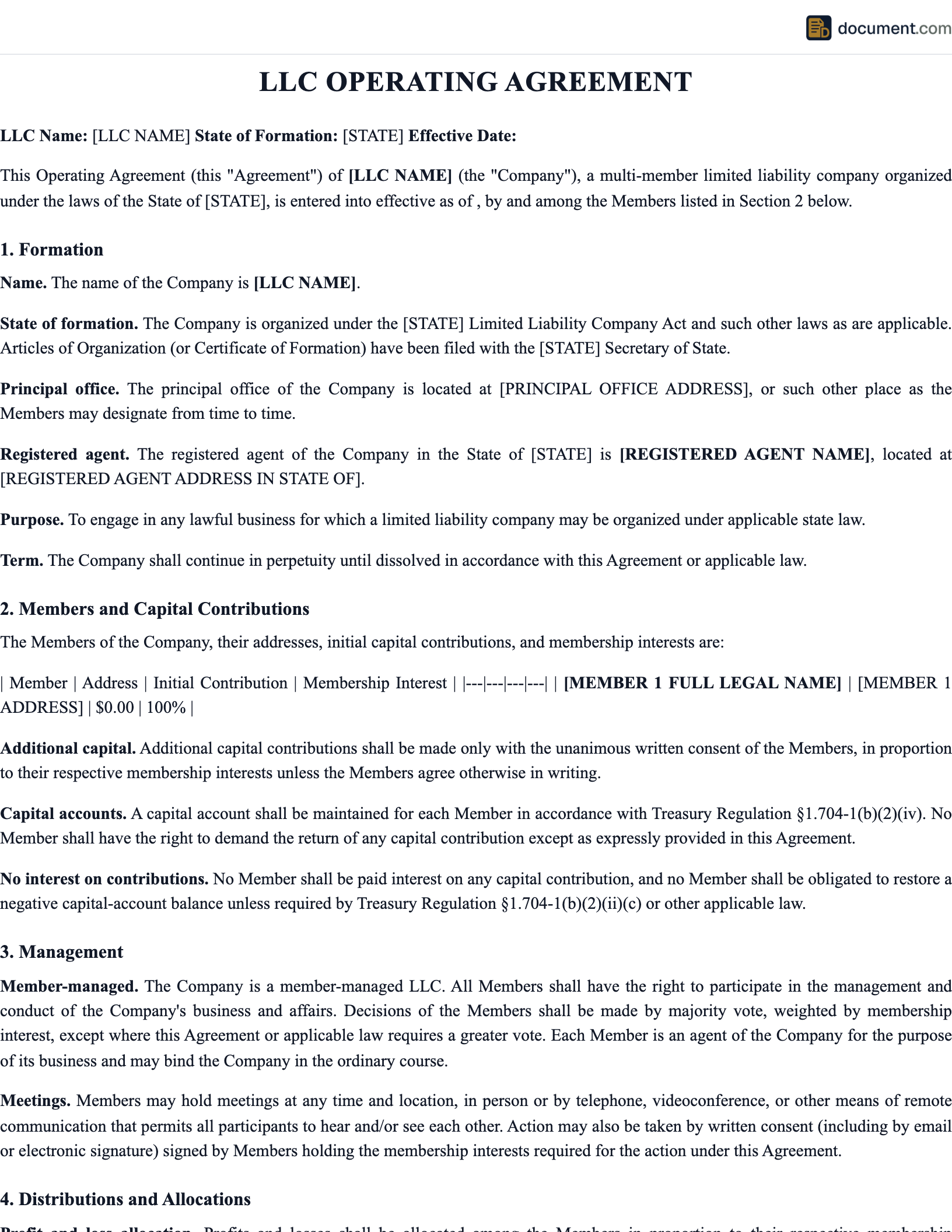
Operating Agreement Form Preview
Below is a visual preview of the key sections and fields included in a standard LLC operating agreement. This mockup illustrates the structure our templates provide. Your completed document will be fully formatted, professionally styled, and customized for your LLC type and state.
Operating Agreement
of a Limited Liability Company
Article I: Organization
Article II: Members & Capital Contributions
Member 1
Member 2
Article III: Management
Article IV: Allocations & Distributions
Signatures
Member Signature
Member Signature
Types of LLC Operating Agreements
The structure of your operating agreement depends on how many members your LLC has, how management authority is distributed, and whether you need specialized provisions such as a series structure. Each type addresses different business needs, ownership configurations, and management philosophies.
Single-Member LLC Operating Agreement
For LLCs with one owner — establishes separation between personal and business assets
Multi-Member LLC Operating Agreement
For LLCs with two or more members — defines ownership percentages, voting rights, and profit sharing
Amendment
Amend an existing LLC operating agreement to update ownership, management, or terms
Single-Member Operating Agreement
A single-member operating agreement is designed for LLCs with one owner. Despite having no co-owners to negotiate with, this document is essential for establishing the LLC as a separate legal entity. It documents the member's capital contribution, the company's management structure, and provisions for what happens if the member becomes incapacitated or dies. Banks, investors, and landlords frequently require a copy of the operating agreement before doing business with an LLC. The IRS treats a single-member LLC as a "disregarded entity" by default, meaning income flows through to the member's personal return on Schedule C, though the LLC can elect corporate taxation.
Multi-Member Operating Agreement
A multi-member operating agreement governs LLCs with two or more owners and is the most complex type. It must address ownership percentages, capital contribution obligations, profit and loss allocations (which may differ from ownership percentages), voting rights for ordinary and extraordinary decisions, management authority and delegation, transfer restrictions (including rights of first refusal), admission of new members, withdrawal and expulsion of members, buyout mechanisms with valuation formulas, dissolution triggers, and dispute resolution. The IRS treats multi-member LLCs as partnerships by default, requiring the LLC to file Form 1065 and issue Schedule K-1s to each member.
Manager-Managed Operating Agreement
In a manager-managed LLC, one or more designated managers (who may or may not be members) handle daily operations while non-manager members act as passive investors. This structure is common in real estate investment LLCs, venture-backed companies, and family holding companies where some members lack the expertise or desire to participate in management. The operating agreement must clearly define the managers' authority, compensation, removal procedures, and the decisions that require member approval despite management delegation. Under SEC guidance, membership interests in manager-managed LLCs may be treated as securities, which has implications for fundraising and compliance.
Series LLC Operating Agreement
A series LLC is a specialized structure available in states including Delaware, Illinois, Texas, Nevada, Utah, and Iowa that allows the creation of separate "series" within a single LLC. Each series can have its own assets, liabilities, members, and managers, and the liabilities of one series are generally shielded from the others. This structure is particularly popular for real estate investors who want to hold each property in a separate series for liability protection without forming a separate LLC for each property. The operating agreement for a series LLC must include a master agreement governing the overall LLC plus individual series supplements for each series, documenting the assets, members, and management of each series.
Operating Agreement vs Other Business Documents
An operating agreement is sometimes confused with other formation and governance documents. Understanding the distinctions is critical for choosing the right documents for your business structure.
Operating Agreement vs Articles of Organization
Operating Agreement
- - Private internal document, not filed with the state
- - Contains detailed governance rules and member rights
- - Covers profit sharing, voting, transfers, dissolution
- - Can be amended by member vote
- - Governs the relationship between members
Articles of Organization
- - Public document filed with the Secretary of State
- - Contains basic formation information only
- - Covers LLC name, agent, address, management type
- - Amendment requires a new state filing
- - Establishes the LLC's legal existence
Key takeaway:You need both documents. The articles of organization create the LLC under state law. The operating agreement governs how it functions internally. Without articles of organization, the LLC does not legally exist. Without an operating agreement, the LLC is governed by default state rules that may not serve the members' interests.
Operating Agreement vs Corporate Bylaws
LLC Operating Agreement
- - Governs a limited liability company
- - Members own the LLC
- - Maximum flexibility in structure and allocations
- - Can create custom profit-sharing arrangements
- - Default taxation as partnership or disregarded entity
Corporate Bylaws
- - Governs a corporation (C-Corp or S-Corp)
- - Shareholders own the corporation
- - More rigid structure required by corporate law
- - Profits distributed as dividends per share
- - Default double taxation (C-Corp) or pass-through (S-Corp)
Key difference: An LLC with an operating agreement offers far more flexibility than a corporation with bylaws. LLC members can customize profit allocations, create different classes of interests with different rights, and structure management however they choose. Corporations must follow more rigid statutory requirements regarding board structure, officer roles, and shareholder rights.
Operating Agreement vs Partnership Agreement
LLC Operating Agreement
- - Members have limited liability
- - LLC is a separate legal entity
- - Requires state filing (articles of organization)
- - Offers more structural flexibility
- - Members' personal assets are protected
Partnership Agreement
- - General partners have unlimited personal liability
- - Partnership may or may not be a separate entity
- - Can be formed without a state filing
- - Simpler but riskier for partners
- - Partners' personal assets are exposed
Why it matters: A multi-member LLC with an operating agreement provides similar flexibility to a partnership but with the crucial addition of limited liability protection. Most business attorneys recommend forming an LLC rather than a general partnership precisely because of this protection. A limited partnership offers some liability protection for limited partners but still exposes general partners to unlimited liability.
How to Create an LLC Operating Agreement: A Step-by-Step Guide
Creating a thorough operating agreement requires careful consideration of your business structure, member relationships, financial arrangements, and long-term goals. Follow these steps to build an agreement that protects all members and sets your LLC up for success.
Confirm Your LLC Is Properly Formed
Before drafting an operating agreement, ensure that your LLC's articles of organization have been filed with and accepted by your state's Secretary of State. The operating agreement should reference the exact legal name of the LLC as it appears on the articles, the state of formation, and the date the articles were filed. If you have not yet formed the LLC, you can draft the operating agreement in advance but it should not be executed until after the state has accepted your filing.
Determine Your Management Structure
Decide whether your LLC will be member-managed (all members participate in management) or manager-managed (designated managers run the business). This decision affects authority to bind the LLC, the members' day-to-day roles, and potentially whether membership interests are classified as securities. If any member will be a passive investor without management authority, you likely need a manager-managed structure.
Tip: Your articles of organization may already specify whether the LLC is member-managed or manager-managed. The operating agreement should be consistent with the articles.
Define Capital Contributions and Ownership
Document each member's initial capital contribution (cash, property, or services), their resulting ownership percentage, and any obligations for future capital contributions. If members are contributing property or services instead of cash, document the agreed-upon fair market value. Specify whether additional capital contributions are mandatory (capital calls) and what happens if a member fails to meet a capital call (such as dilution of their interest or conversion to a loan).
Establish Profit and Loss Allocation Rules
Specify how profits and losses will be allocated among members. The simplest approach is pro rata allocation based on ownership percentages, but LLCs have the flexibility to create special allocations (such as preferred returns, guaranteed payments, or disproportionate allocations for members who contribute more labor). Any special allocations must meet the IRS's "substantial economic effect" test under Treasury Regulation Section 1.704-1(b) to be respected for tax purposes. Also specify the timing and frequency of distributions — quarterly, annually, or as determined by a vote of the members.
Set Voting Rules and Decision-Making Procedures
Define what decisions require a simple majority vote, what decisions require a supermajority (such as 66.7% or 75%), and what decisions require unanimous consent. Common categories include: day-to-day operations (manager or simple majority), significant contracts above a dollar threshold (supermajority), admission of new members (unanimous), amendment of the operating agreement (supermajority), sale of substantially all assets (supermajority or unanimous), and dissolution (supermajority). Also specify meeting requirements, notice periods, quorum rules, and whether proxy voting is permitted.
Draft Transfer Restrictions and Buy-Sell Provisions
Include provisions that restrict the transfer of membership interests to protect existing members from unwanted co-owners. At minimum, include a right of first refusal, consent requirements for transfers, permitted transfer exceptions (such as transfers to family trusts), and a buy-sell mechanism that establishes how interests are valued when a member wants to exit. Common valuation methods include book value, fair market value as determined by an independent appraiser, a formula based on a multiple of revenue or earnings, or a fixed price agreed upon annually by the members.
Include Dissolution and Winding-Up Provisions
Specify the events that will trigger dissolution (vote of members, expiration of the LLC's term, judicial order), the process for winding up the business, and the priority of distributions during liquidation. The standard priority is: (1) debts and obligations to third-party creditors, (2) debts owed to members (such as loans from members), (3) return of capital contributions, and (4) distribution of remaining assets according to profit-sharing ratios. Also address what happens to contracts, employees, and intellectual property during dissolution.
Execute the Agreement Properly
All members should sign and date the operating agreement. While most states do not require notarization of an operating agreement, having signatures notarized adds a layer of authentication that can be valuable if the agreement is ever disputed. Each member should receive a signed copy, and the LLC should maintain the original in its records along with other formation documents. If new members are admitted later, they should sign a joinder agreement acknowledging they are bound by the terms of the operating agreement.
Key Components of an LLC Operating Agreement
A comprehensive operating agreement addresses every major aspect of the LLC's governance and operations. Here are the essential provisions that should be included in every operating agreement.
Company Formation
- - LLC name and principal office address
- - State of formation and filing date
- - Registered agent designation
- - Business purpose and duration
- - Fiscal year designation
- - Tax classification election (partnership, S-Corp, or C-Corp)
Capital & Ownership
- - Initial capital contributions (cash, property, services)
- - Ownership percentages and membership interests
- - Capital account maintenance rules
- - Additional capital contribution obligations
- - Capital call procedures and default consequences
- - Return of capital upon withdrawal
Management & Voting
- - Member-managed or manager-managed designation
- - Manager selection, removal, and compensation
- - Voting thresholds for different decision categories
- - Meeting requirements and notice periods
- - Quorum rules and proxy voting
- - Authority to bind the LLC in contracts
Allocations & Distributions
- - Profit and loss allocation formulas
- - Special allocations and preferred returns
- - Guaranteed payments to members
- - Distribution timing, frequency, and procedures
- - Tax distribution provisions (to cover members' tax liability)
- - Restrictions on distributions (minimum cash reserves)
Transfer Restrictions
- - Right of first refusal for existing members
- - Consent requirements for transfers
- - Permitted transfers (family, trusts, entities)
- - Drag-along and tag-along rights
- - Valuation methods for buyouts
- - Payment terms for buy-sell transactions
Dissolution & Disputes
- - Dissolution triggering events
- - Winding-up procedures and asset liquidation
- - Liquidation distribution priority
- - Mediation and arbitration clauses
- - Deadlock resolution mechanisms
- - Governing law and jurisdiction
Legal Requirements for LLC Operating Agreements
LLC operating agreements are governed by state LLC statutes, which vary significantly across jurisdictions. Understanding your state's specific requirements ensures that your operating agreement is enforceable and that you are not inadvertently subjecting your LLC to default rules that do not serve your interests.
Revised Uniform Limited Liability Company Act (RULLCA)
The Revised Uniform Limited Liability Company Act (RULLCA), promulgated by the Uniform Law Commission in 2006 and amended in 2013, provides a model framework for state LLC statutes. It has been adopted in whole or in part by approximately 24 states and the District of Columbia as of 2025. RULLCA establishes important default rules regarding the operating agreement, including that the operating agreement governs the internal affairs of the LLC and the relationships among members, that the operating agreement can modify many (but not all) default statutory provisions, and that certain protections (such as the duty of loyalty and the covenant of good faith and fair dealing) cannot be eliminated entirely by the operating agreement. Our templates comply with RULLCA principles in adopting states while incorporating state-specific variations.
States That Require an Operating Agreement
While most states strongly encourage but do not legally mandate an operating agreement, a few states explicitly require one. New York is the most notable, requiring all LLCs to adopt a written operating agreement within 90 days of filing articles of organization under Section 417 of the New York Limited Liability Company Law. California requires LLCs to have an operating agreement under Corporations Code Section 17701.10, though it can be oral (written is strongly recommended). Missouri requires an operating agreement under Section 347.081 RSMo. Maine requires an operating agreement under its adoption of RULLCA. Delaware, while not requiring one, gives extraordinary deference to the terms of the operating agreement under the Delaware Limited Liability Company Act (6 Del. C. Section 18-1101), making it the most important governance document for Delaware LLCs.
Non-Waivable Provisions
While operating agreements offer broad flexibility to customize the LLC's governance, most state statutes identify certain provisions that cannot be waived or eliminated by the operating agreement. Under RULLCA, these non-waivable provisions include: the duty of loyalty and care (though they can be modified to some extent), the obligation of good faith and fair dealing, the right to access company records, the power of a court to decree dissolution, and certain protections for third parties. Your operating agreement should not attempt to eliminate these protections, as doing so could render specific provisions — or potentially the entire agreement — unenforceable.
Key State Variations
- Delaware: Maximum flexibility. Delaware courts give near-absolute deference to the operating agreement, allowing members to modify or eliminate fiduciary duties (with limited exceptions). Delaware also permits series LLCs and allows LLCs to have perpetual existence without specifying it.
- California: Requires an operating agreement and imposes specific rules regarding manager liability, member inspection rights, and distribution restrictions. California does not permit series LLCs and has specific franchise tax obligations ($800 minimum annual tax).
- New York: Requires a written operating agreement within 90 days of formation. Also requires publication of the LLC's formation in two newspapers in the county of the LLC's office for six consecutive weeks. New York follows RULLCA's approach to fiduciary duties.
- Texas: Permits series LLCs and provides significant flexibility for operating agreements. Texas Business Organizations Code allows the operating agreement to expand or restrict manager and member authority, modify fiduciary duties (within limits), and establish custom governance procedures.
- Florida: Adopted a revised LLC act in 2014 (Chapter 605) that closely follows RULLCA. Florida permits oral operating agreements but strongly favors written ones. Florida's statute imposes a duty of loyalty and care that can be modified but not eliminated by the operating agreement.
Sample LLC Operating Agreement
Below is a condensed preview of our multi-member LLC operating agreement template. This sample shows the structure, language, and key provisions included in our attorney-reviewed documents. Your completed agreement will be fully customized for your specific LLC type, state, and member arrangements.
OPERATING AGREEMENT
of Brightpath Ventures LLC, a Texas Limited Liability Company
This Operating Agreement (the "Agreement") of [LLC Name], a limited liability company organized under the laws of the State of [State], is entered into as of [Date] by and among the Members identified herein.
ARTICLE I: FORMATION AND PURPOSE
1.1 Formation. The Company was formed as a limited liability company by filing Articles of Organization with the Secretary of State of [State] on[Date]. The rights and obligations of the Members shall be governed by this Agreement and, to the extent not superseded by this Agreement, by the[State] Limited Liability Company Act...
SCHEDULE A: MEMBERS
| Member Name | Contribution | Ownership % |
|---|---|---|
| [Member 1 Name] | $[Amount] | [__]% |
| [Member 2 Name] | $[Amount] | [__]% |
ARTICLE III: MANAGEMENT
3.1 Management by Members. The Company shall be managed by its Members. Each Member shall have the authority to act on behalf of the Company in the ordinary course of business. The following decisions shall require the approval of Members holding at least [__]% of the Membership Interests: (a) incurring debt exceeding $[Amount]; (b) entering into contracts exceeding $[Amount]; (c) acquiring or disposing of real property; (d) admitting a new Member...
ARTICLE V: ALLOCATIONS AND DISTRIBUTIONS
5.1 Allocations. Net profits and net losses shall be allocated among the Members in proportion to their respective Membership Interests, unless otherwise provided in this Agreement...
5.3 Tax Distributions. Notwithstanding any other provision, the Company shall distribute to each Member, no later than [date]of each year, an amount equal to each Member's estimated tax liability arising from the Company's income allocated to such Member, calculated at the highest marginal individual income tax rate...
ARTICLE VII: TRANSFER RESTRICTIONS
7.1 Right of First Refusal.No Member shall transfer all or any portion of such Member's Membership Interest without first offering the interest to the remaining Members on the same terms and conditions as the proposed transfer...
Frequently Asked Questions
Find answers to common questions about LLC operating agreements, member rights, management structures, and how these documents protect your business and personal assets.
Official Resources
For additional information on LLC formation, operating agreements, and business entity governance, consult these official and reputable resources.
SBA - Business Structure Guide
U.S. Small Business Administration guide to choosing and forming a business entity
IRS - LLC Tax Guide
IRS guidance on LLC tax classification, filing requirements, and employment taxes
ULC - Revised Uniform LLC Act
Uniform Law Commission information on RULLCA and state adoption status
Nolo - LLC Legal Encyclopedia
Comprehensive free legal information on LLC formation and operating agreements
SCORE - Operating Agreement Guide
Free mentoring and resources for small business formation and governance
ABA - Business Law Section
American Bar Association resources on business entity law and governance
Create your Llc Operating Agreement in under 10 minutes.
Answer a few questions and download a compliant, attorney-drafted document ready for your state.