



What Are LLC Articles of Organization?
Articles of organization are the official formation document filed with a state's Secretary of State (or equivalent filing office) to legally establish a limited liability company. This document is the single most important step in the LLC formation process — without it, the LLC does not exist as a recognized legal entity, and the owners cannot claim the liability protections, tax benefits, or operational advantages that the LLC structure provides. The moment the state accepts your articles of organization and stamps them as filed, your LLC comes into legal existence as an entity separate from its owners.
The terminology varies by state. In most states, the document is called "articles of organization." In Delaware and Texas, it is called a "certificate of formation." In some states, such as Washington and Oregon, it is called a "certificate of organization." Pennsylvania uses the term "certificate of organization" as well, while Nevada refers to it as "articles of organization." Regardless of the name, the purpose and effect are the same: the filing creates the LLC under state law and establishes its basic identifying information as a matter of public record.
Unlike an operating agreement — which is a private document governing the internal affairs of the LLC — articles of organization are filed with the state and become a public record. This means that anyone can search the Secretary of State's database and find your LLC's articles, including the company name, registered agent, principal office address, and (in some states) the names of members or organizers. For this reason, members who value privacy should carefully consider which information is required versus optional in their state's filing, and may choose to form in a state with minimal disclosure requirements.
The articles of organization typically contain only the information required by the state's LLC statute — the LLC's legal name, registered agent and registered office address, principal business address, whether the LLC is member-managed or manager-managed, the name and address of the organizer, and in some states, the LLC's duration and purpose. Some states allow you to include optional provisions, such as specific powers of the LLC, indemnification clauses, or restrictions on authority. However, most detailed governance provisions belong in the operating agreement, not the articles.
Our state-specific articles of organization templates include every field required by your state's Secretary of State, formatted to comply with that office's requirements for acceptance. Each template comes with step-by-step filing instructions, current filing fee information, and guidance on the post-formation steps you need to complete after your articles are accepted.
Official Formation
The legal act that creates your LLC as a recognized business entity under state law
Liability Protection
Establishes the legal separation that protects your personal assets from business debts
Public Record
Creates an official public record of your LLC's existence and basic information
Articles of Organization Form Preview
Below is a visual preview of the sections and fields included in typical articles of organization. This mockup illustrates the structure our templates provide. Your completed document will be formatted to match your specific state's filing requirements.
Articles of Organization
Limited Liability Company
Article 1: Company Name
Article 2: Registered Agent
Article 3: Principal Office
Article 4: Management Structure
Article 5: Organizer
Execution
Organizer Signature
Registered Agent Acceptance
What to Include in Articles of Organization
While the specific requirements vary by state, most states require a standard set of information in the articles of organization. Here is a comprehensive breakdown of each required and commonly included element.
LLC Name
The full legal name of the LLC, which must include an approved designator such as "LLC," "L.L.C.," or "Limited Liability Company." The name must be distinguishable from any other business entity registered in the state. Before filing, search your state's business entity database to confirm availability. Some states also allow you to reserve a name for a period (typically 60-120 days) while you prepare your filing.
Registered Agent and Registered Office
Every state requires the LLC to designate a registered agent — a person or authorized entity with a physical address in the state who is available during business hours to accept legal documents and government correspondence on behalf of the LLC. The registered office must be a physical street address (not a P.O. box) in the state of formation. You can name yourself, another member, or a professional registered agent service. If you later change your registered agent, you must file a change of registered agent form with the state.
Principal Office Address
Most states require the address of the LLC's principal place of business. This can be the same as or different from the registered office address. If you operate from a home office, you can use your home address, though this becomes part of the public record. Some states allow a mailing address that differs from the street address.
Management Structure
Most states require you to specify whether the LLC will be member-managed or manager-managed. In a member-managed LLC, all members have authority to participate in management and bind the company. In a manager-managed LLC, designated managers run the business while other members are passive. This designation is important because it affects who has apparent authority to enter into contracts on behalf of the LLC, and third parties are entitled to rely on this public filing when determining who they can deal with.
Organizer Information
The organizer is the person who files the articles of organization with the state. The organizer does not have to be a member of the LLC — many people use their attorney, accountant, or a formation service as the organizer. Most states require the organizer's name, address, and signature. After the LLC is formed, the organizer typically has no further role unless they are also a member or manager of the LLC.
Purpose and Duration
Some states require or allow you to state the LLC's business purpose. Most LLCs use a broad purpose statement such as "any lawful business activity" to maintain maximum flexibility. Regarding duration, most states default to perpetual existence, but you can specify a specific dissolution date if desired. A limited-duration LLC might be appropriate for a specific project, joint venture, or investment with a defined timeline.
Articles of Organization vs Other Formation Documents
Understanding how articles of organization compare to other business formation documents helps you choose the right entity structure and understand what each document accomplishes.
Articles of Organization vs Articles of Incorporation
Articles of Organization (LLC)
- - Creates a limited liability company
- - Owners are called "members"
- - Flexible management (member or manager)
- - No stock issuance required
- - Pass-through taxation by default
- - Simpler formation requirements
Articles of Incorporation (Corp)
- - Creates a corporation
- - Owners are called "shareholders"
- - Requires board of directors and officers
- - Must authorize and issue stock
- - Double taxation by default (C-Corp)
- - More complex formation requirements
Key takeaway: An LLC offers more flexibility in management and taxation with simpler formation requirements. A corporation is better suited for businesses that plan to raise venture capital, issue stock options to employees, or eventually go public.
Articles of Organization vs DBA (Doing Business As)
Articles of Organization
- - Creates a new legal entity
- - Provides limited liability protection
- - Separates business and personal assets
- - Filed with the Secretary of State
- - Establishes the entity for tax purposes
DBA / Fictitious Name
- - Does not create a legal entity
- - Provides no liability protection
- - Simply registers a trade name
- - Filed with county or state (varies)
- - No impact on tax status
Important distinction: A DBA (also called a fictitious business name or trade name) simply allows an existing person or entity to do business under a different name. It does not create a separate legal entity or provide any liability protection. If you want liability protection, you need to form an LLC or corporation — a DBA alone is not sufficient.
How to File LLC Articles of Organization
Filing articles of organization is a straightforward process, but each step must be completed correctly to avoid delays, rejections, or compliance issues. Follow this guide to file successfully on your first attempt.
Choose Your State of Formation
Most small businesses should form in the state where they physically operate. Forming in a different state (such as Delaware or Wyoming) adds complexity because you will need to also register as a "foreign LLC" in your home state. Out-of-state formation primarily benefits businesses with multi-state operations, complex capital structures, or specific legal needs that a particular state's LLC act addresses better than their home state's.
Search for Name Availability
Search your state's business entity database (available on the Secretary of State's website) to confirm that your desired LLC name is available. The name must be distinguishable from existing registered entities. If the name is available, consider reserving it while you prepare your filing — most states offer name reservations for $10-$50, valid for 60-120 days. Also check the USPTO trademark database (tmsearch.uspto.gov) to avoid potential trademark conflicts.
Designate a Registered Agent
Select a registered agent with a physical address in your state of formation. You can serve as your own registered agent, name another individual, or hire a professional registered agent service ($50-$300 per year). A professional service provides privacy (their address appears on the public filing instead of yours), reliability (they ensure someone is always available during business hours), and compliance alerts (they notify you of important filings and deadlines). The registered agent must consent to the appointment before you file.
Complete and File the Articles
Complete the articles of organization form with all required information. Most states offer online filing through the Secretary of State's website, which is typically faster and may cost less than paper filing. Pay the filing fee (ranging from $40 to $500 depending on the state). If filing by mail, include a check or money order and a self-addressed stamped envelope for the certified copy. Double-check all information before submitting — errors can cause delays or rejections.
Complete Post-Formation Steps
After the state accepts your articles, obtain your EIN from the IRS (free, online at irs.gov), draft and execute an operating agreement, open a business bank account, comply with any state-specific requirements (publication in New York and Arizona, initial reports in some states), register for state and local taxes, and obtain any required business licenses or permits. Keeping your formation documents organized from the start establishes good compliance habits that protect your LLC's limited liability status.
State Filing Fees for Articles of Organization
Filing fees for LLC articles of organization vary significantly by state. Below is a representative overview of filing costs in selected states. Fees are subject to change — always confirm the current fee on your state's Secretary of State website before filing.
| State | Filing Fee | Online Filing | Processing Time |
|---|---|---|---|
| California | $70 | Yes | 3-5 business days |
| Delaware | $90 | Yes | Same day (online) |
| Florida | $125 | Yes | 1-2 business days |
| Illinois | $150 | Yes | 5-10 business days |
| Massachusetts | $500 | Yes | 1-2 business days |
| New York | $200 | Yes | 5-7 business days |
| Texas | $300 | Yes | 2-3 business days |
| Wyoming | $100 | Yes | 1-3 business days |
| Nevada | $75 + $150 list | Yes | 1-2 business days |
| Kentucky | $40 | Yes | 2-4 business days |
Note: Filing fees shown are for standard processing. Most states offer expedited processing for an additional fee ranging from $25 to $1,000+ depending on the turnaround time. Some states charge additional fees for certified copies, name reservations, or initial reports.
Legal Requirements for Articles of Organization
Each state has its own LLC statute that dictates what must be included in the articles of organization, how the filing is processed, and what ongoing compliance obligations the LLC must meet after formation. Understanding these requirements prevents filing rejections and ensures your LLC starts on solid legal footing.
Publication Requirements
Two states — New York and Arizona — have notable publication requirements for newly formed LLCs. New York (Section 206 of the NY LLC Law) requires the LLC to publish a copy of its articles of organization (or a notice of formation) in two newspapers designated by the county clerk in the county of the LLC's office, once a week for six consecutive weeks, and then file an affidavit of publication with the Department of State. Publication costs vary dramatically by county — from under $200 in some upstate counties to $1,500+ in New York County (Manhattan). Arizona requires publication within 60 days of filing in a newspaper of general circulation in the county of the known place of business. Failure to comply with publication requirements can result in suspension of the LLC's authority to conduct business.
Ongoing Compliance After Formation
- Annual Reports: Most states require LLCs to file an annual or biennial report with the Secretary of State to maintain good standing. These reports update the state on the LLC's current registered agent, office address, and members/managers. Fees range from $0 (some states have no fee) to $800+ (California's annual franchise tax). Failure to file results in penalties and can lead to administrative dissolution.
- Franchise Tax: Several states impose annual franchise taxes on LLCs in addition to (or instead of) annual report fees. California charges an $800 minimum annual franchise tax. Delaware charges a flat $300 annual tax. Texas charges a franchise tax based on revenue (with a no-tax-due threshold for small businesses). These taxes are separate from income taxes and must be paid to keep the LLC in good standing.
- Registered Agent Maintenance: The LLC must maintain a registered agent at all times. If the registered agent resigns or the address changes, the LLC must promptly file an update with the state. Operating without a registered agent can result in the LLC being unable to receive service of process, potentially leading to default judgments in lawsuits.
- Foreign Qualification: If the LLC conducts business in states other than its state of formation, it must register as a foreign LLC in each additional state. This involves filing a foreign LLC application, paying a filing fee, designating a registered agent in that state, and filing annual reports and paying fees in each state where registered.
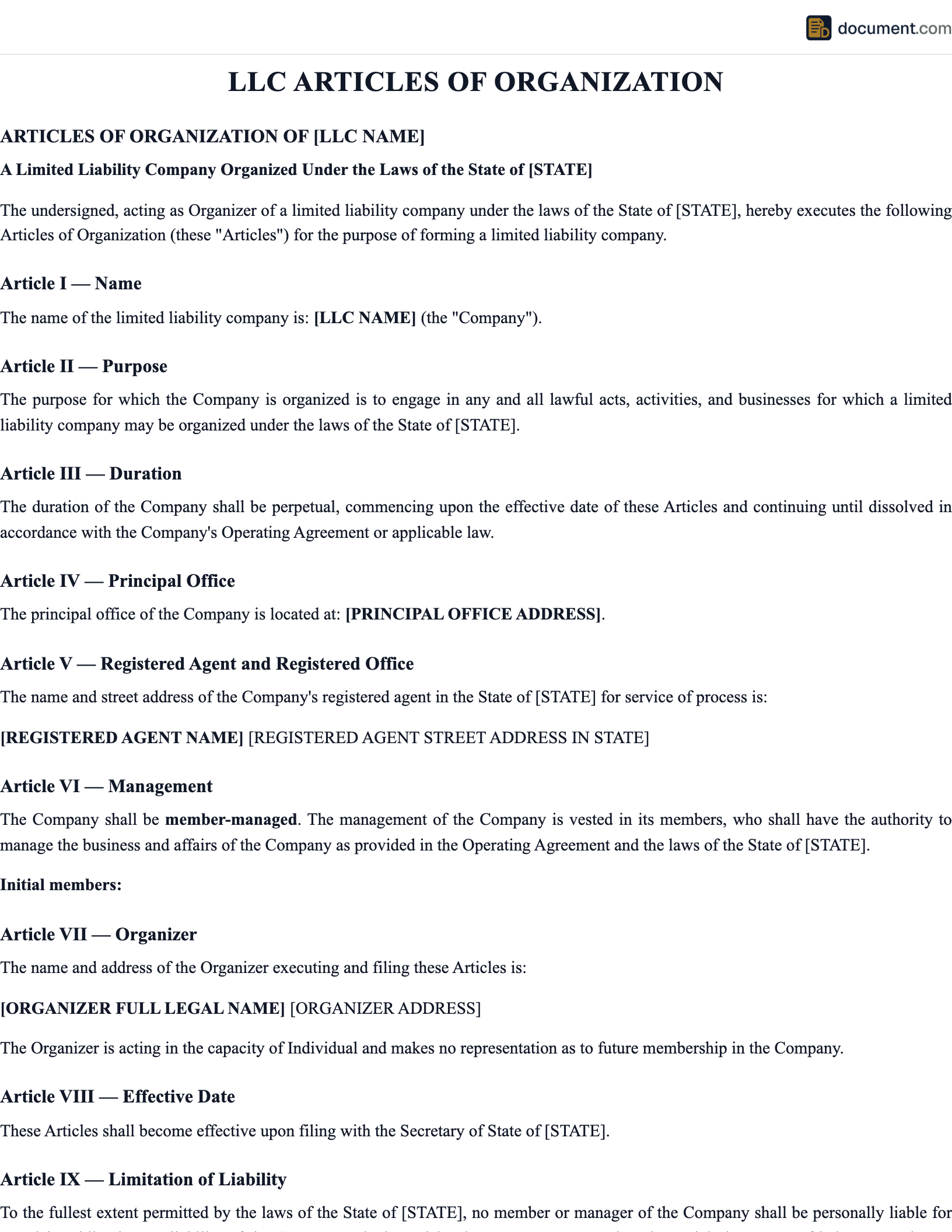
Sample Articles of Organization
Below is a condensed preview of a typical articles of organization filing. This sample shows the structure and language used in our attorney-reviewed templates. Your completed document will be customized for your specific state's filing requirements.
ARTICLES OF ORGANIZATION
of a Limited Liability Company
Pursuant to [State LLC Act Citation]
ARTICLE I — NAME
The name of the limited liability company is: [LLC Name], LLC.
ARTICLE II — REGISTERED AGENT AND OFFICE
The name of the registered agent is [Agent Name]. The address of the registered office is [Street Address, City, State, ZIP]. The registered agent has consented to the appointment.
ARTICLE III — PRINCIPAL OFFICE
The address of the principal office of the LLC is:[Principal Office Address].
ARTICLE IV — MANAGEMENT
The LLC shall be managed by its [Members / Manager(s)]. The name(s) and address(es) of the initial [members / managers] are:
Name: [Name]
Address: [Address]
ARTICLE V — PURPOSE
The purpose of the LLC is to engage in any lawful act or activity for which limited liability companies may be organized under the [State] Limited Liability Company Act.
ARTICLE VI — DURATION
The LLC shall have perpetual existence unless dissolved in accordance with the operating agreement or by operation of law.
ORGANIZER
The undersigned organizer, being a natural person at least 18 years of age, hereby executes these Articles of Organization.
Name: [Organizer Name]
Date: [Date]
Frequently Asked Questions
Find answers to common questions about LLC articles of organization, filing procedures, state requirements, and the formation process.
Official Resources
For additional information on LLC formation, filing requirements, and business entity registration, consult these official resources.
SBA - Register Your Business
U.S. Small Business Administration guide to business registration and formation
IRS - EIN Application
Apply for your Employer Identification Number online for free
NASS - Secretary of State Directory
National Association of Secretaries of State directory of filing offices
ULC - Revised Uniform LLC Act
Uniform Law Commission information on RULLCA and state adoption
Nolo - How to Form an LLC
Step-by-step guide to LLC formation with state-specific information
SCORE - How to Start an LLC
Free mentoring and resources for starting your business entity
Create your Llc Articles of Organization in under 10 minutes.
Answer a few questions and download a compliant, attorney-drafted document ready for your state.