



What Is a Founders' Agreement?
A founders' agreement is a legally binding contract between the co-founders of a startup that establishes the fundamental terms of their business relationship before or shortly after the company is formed. It serves as the constitutional document of the founding team, addressing how equity is divided, how decisions are made, what each founder contributes, and what happens when circumstances change — such as a founder leaving, a new partner joining, or the company being acquired. Unlike corporate bylaws or an LLC operating agreement, which govern the entity itself, a founders' agreement governs the relationship between the people behind the company.
The importance of a founders' agreement cannot be overstated. According to research from Harvard Business School, co-founder conflict is one of the leading causes of startup failure, and the vast majority of these conflicts stem from issues that a well-drafted founders' agreement would have addressed: unclear equity expectations, misaligned roles, disagreements about strategy, and disputes over intellectual property ownership. A study by Noam Wasserman published in "The Founder's Dilemmas" found that 65% of startup failures are attributable to problems within the founding team — not to market conditions, competition, or product failures.
A founders' agreement is distinct from a partnership agreement in several important ways. While both govern relationships between business participants, a founders' agreement is specifically designed for the startup context and addresses issues unique to early-stage ventures: vesting of equity over time, assignment of intellectual property to the company, provisions for future fundraising and dilution, and mechanisms for handling a founder's departure during the fragile early period when the loss of a single team member can threaten the company's survival. A general partnership agreement does not typically address these startup-specific concerns.
The founders' agreement should be drafted and signed as early as possible — ideally before the founders begin substantive work on the business. Once significant value has been created or tensions have emerged, negotiating equitable terms becomes exponentially more difficult. Early-stage founders are typically aligned and optimistic, making this the ideal time to discuss difficult scenarios like departure, underperformance, or strategic disagreements. The agreement can and should be updated as the company evolves, but having the foundational framework in place from the beginning prevents the most common and destructive co-founder conflicts.
Our attorney-reviewed founders' agreement templates are designed for startups at every stage — from two co-founders sketching ideas on a napkin to established teams preparing for their first round of institutional funding. Each template is customized for your state's contract law, includes provisions that investors and accelerators expect to see, and covers every critical area from equity allocation and vesting to IP assignment, confidentiality, non-compete obligations, and dispute resolution.
Equity Protection
Define clear ownership stakes with vesting schedules that protect all founders
IP Security
Ensure all intellectual property belongs to the company, not individual founders
Dispute Prevention
Establish decision-making frameworks and deadlock resolution mechanisms upfront
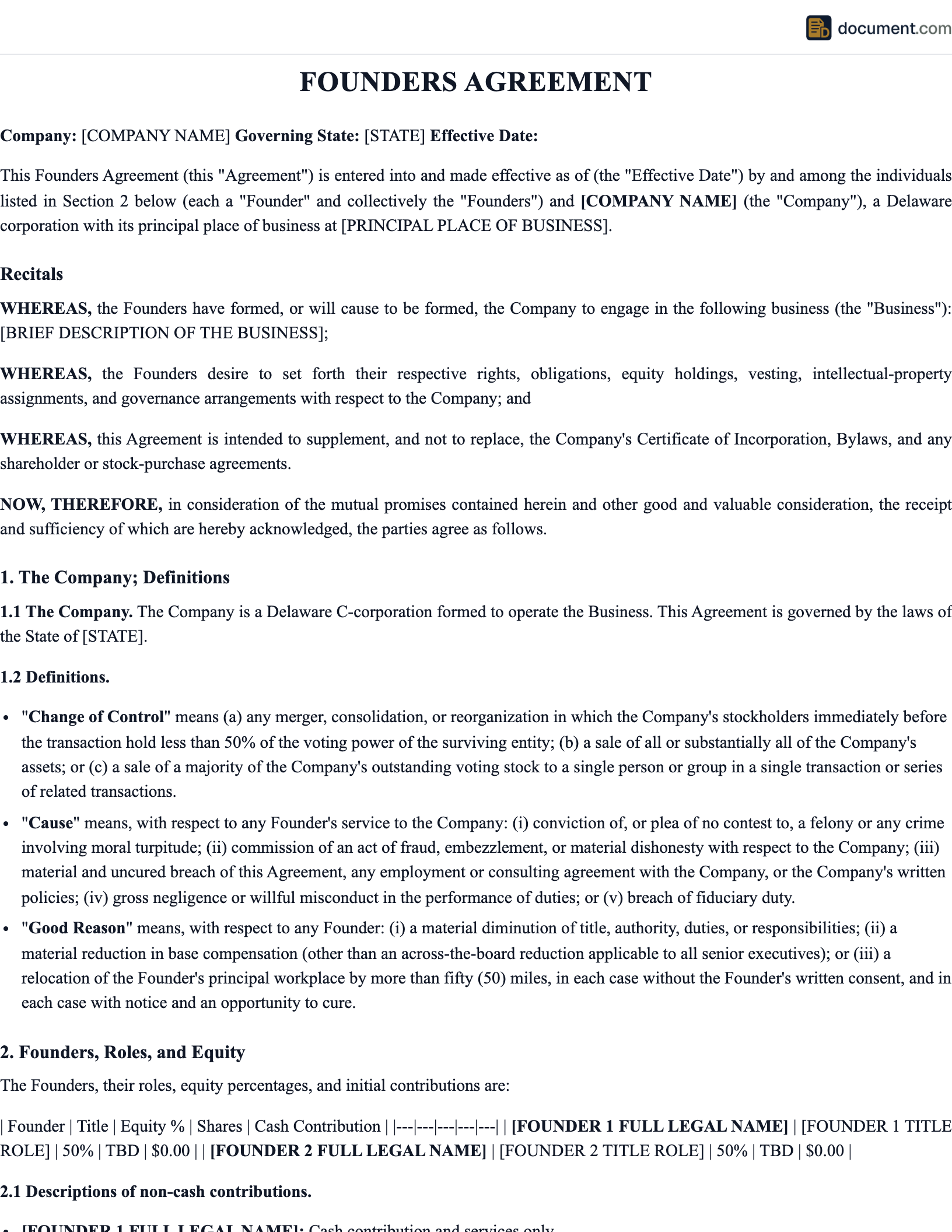
Founders' Agreement Form Preview
Below is a visual preview of the sections and fields included in a comprehensive founders' agreement. This mockup shows the structure and level of detail our templates provide. Your completed document will be fully formatted, professionally styled, and customized for your founding team's specific needs and state requirements.
Founders' Agreement
Startup Co-Founder Agreement
Section 1: Company Information
Section 2: Founders
Founder 1 (CEO)
Founder 2 (CTO)
Founder 3 (COO)
Section 3: Vesting Schedule
Section 4: Intellectual Property Assignment
Section 5: Execution
Founder 1 Signature
Founder 2 Signature
Why Every Startup Needs a Founders' Agreement
Startups fail for many reasons, but co-founder disputes are among the most preventable causes. A founders' agreement forces the founding team to have difficult conversations early — before money, stress, and ego make those conversations impossible. Here are the critical risks a founders' agreement mitigates.
The Free-Rider Problem
Without vesting, a co-founder who receives equity upfront can leave after a few months with a full ownership stake. This means the remaining founders do all the work while the departed founder benefits from their efforts. A four-year vesting schedule with a one-year cliff ensures each founder earns their equity through sustained contribution.
IP Ownership Disputes
If a technical co-founder writes the core codebase without an IP assignment clause, they could argue they personally own the code — even if the company paid them, provided resources, or the code was developed specifically for the business. This becomes catastrophic if the founder leaves and takes the technology with them, or if the ambiguity scares away investors during due diligence.
Decision-Making Paralysis
Equal co-founders without a decision-making framework can become permanently deadlocked on critical issues — from product direction to hiring to fundraising terms. Startups move fast, and even a two-week deadlock on a key decision can cost the company a critical opportunity. The founders' agreement should designate decision-making authority and include deadlock-breaking mechanisms.
Investor Red Flags
Experienced investors and accelerators (including Y Combinator, Techstars, and most institutional VCs) require or strongly prefer startups that have a founders' agreement in place. The absence of one signals to investors that the founding team has not thought through basic governance, creating legal risk that could jeopardize their investment. Clean corporate governance is a prerequisite for institutional capital.
Founders' Agreement vs Other Documents
Several legal documents govern the structure and relationships within a startup. Understanding how a founders' agreement differs from — and complements — these other documents is essential for building a comprehensive legal framework.
Founders' Agreement vs Operating Agreement / Bylaws
Founders' Agreement
- - Governs the co-founder relationship
- - Addresses equity splits, vesting, IP assignment
- - Covers founder departure and buyback rights
- - Includes non-compete and confidentiality terms
- - Created before or at company formation
Operating Agreement / Bylaws
- - Governs the company entity
- - Defines management structure and voting rights
- - Covers profit distributions and capital calls
- - Addresses member/shareholder admission and withdrawal
- - Required or recommended after entity formation
Best practice:Use both documents. The founders' agreement covers the interpersonal dynamics and co-founder-specific provisions, while the operating agreement or bylaws handle formal corporate governance. They should be consistent and complementary.
Founders' Agreement vs Shareholder Agreement
Founders' Agreement
- - Between founding team members only
- - Focus on early-stage startup dynamics
- - Covers vesting, IP, roles, departure
- - Typically precedes investor involvement
Shareholder Agreement
- - Between all shareholders (founders + investors)
- - Focus on shareholder rights and protections
- - Covers transfer restrictions, drag-along, tag-along
- - Typically created during first funding round
Key distinction:A shareholder agreement involves investors and addresses their specific rights (liquidation preferences, anti-dilution, board seats), while the founders' agreement is exclusively between co-founders and may be superseded or supplemented by the shareholder agreement once external investors join.
Founders' Agreement vs Vesting Agreement
Founders' Agreement
- - Comprehensive document covering all founder terms
- - Includes vesting as one of many provisions
- - Governs the overall co-founder relationship
- - Signed by all founders simultaneously
Vesting Agreement
- - Standalone document focused solely on vesting
- - Details schedule, cliff, acceleration triggers
- - May be individual (one per founder)
- - Often a component of a stock purchase agreement
How to Create a Founders' Agreement: An 8-Step Guide
A founders' agreement should be thorough yet practical. Follow these eight steps to create a document that protects every co-founder and positions your startup for growth, fundraising, and long-term success.
Identify All Founders and Their Contributions
List every person who qualifies as a co-founder and document what each brings to the venture. Contributions fall into several categories: capital (cash invested), intellectual property (code, designs, patents, business plans), industry expertise, operational skills, customer relationships, and time commitment. Be specific — vague descriptions lead to disputes later when founders disagree about who contributed what.
This step also requires the difficult conversation about whether everyone at the table is truly a co-founder or whether some participants are better classified as early employees, advisors, or contractors. Co-founder status carries significant equity, governance rights, and reputational association — it should be reserved for individuals whose contributions are foundational and whose commitment is full-time or near full-time.
Negotiate and Document the Equity Split
Determine each founder's ownership percentage based on their contributions, expected future involvement, and the relative importance of each role to the business. Consider using a structured framework rather than gut feel — tools like the Slicing Pie model or a weighted scoring system can help quantify contributions and arrive at a split that feels fair to everyone. Document the rationale for the split so there is a record of how the decision was made.
Tip: Leave an unallocated equity pool (typically 10-20%) for future employees, advisors, and option grants. This prevents diluting founders excessively when you need to attract top talent.
Establish Vesting Schedules
Apply vesting to all founder equity — no exceptions. The industry standard is a four-year vesting schedule with a one-year cliff. After the cliff, 25% of the shares vest, and the remaining 75% vest monthly or quarterly over the next three years. Consider whether to include acceleration provisions: single-trigger acceleration (full vesting upon a change of control) or double-trigger acceleration (full vesting only if the founder is terminated without cause within 12 months after a change of control). Double-trigger is more investor-friendly and is the default in most VC-backed startups.
Define Roles, Responsibilities, and Time Commitments
Assign clear titles and functional areas to each founder. Specify who is the CEO, CTO, COO, or other designated leader, and define what each role encompasses. Address time commitment explicitly — is each founder expected to work full-time? Can founders maintain side projects or other employment? If a founder is not yet full-time, when must they transition? Ambiguity about time commitment is one of the most common sources of co-founder resentment and conflict.
Draft IP Assignment and Confidentiality Provisions
Include comprehensive intellectual property assignment clauses that transfer all business-related IP from individual founders to the company. This should cover code, designs, inventions, trade secrets, business plans, customer lists, marketing materials, domain names, and any other IP created for the business. Add confidentiality obligations that survive the agreement and restrict each founder from disclosing proprietary information. Consider requiring each founder to sign a separate Proprietary Information and Inventions Assignment (PIIA) agreement for additional protection.
Create Decision-Making and Governance Rules
Specify which decisions each founder can make unilaterally within their functional area, which require majority founder approval, and which require unanimous consent. Typically, day-to-day operational decisions fall under each founder's domain, while major decisions — taking on debt, issuing new equity, entering material contracts, pivoting the business model, or making acquisitions — require collective approval. Include a deadlock resolution mechanism such as mediation, arbitration, a shotgun buy-sell clause, or the appointment of an independent tie-breaking advisor.
Address Founder Departure and Equity Buyback
Define what happens when a founder leaves — voluntarily, involuntarily, for cause, or due to death or disability. Specify that unvested equity is forfeited and that the company or remaining founders have the right to repurchase vested shares at a predetermined formula (fair market value, book value, or a negotiated discount). Address whether the departing founder retains any board representation or advisory role, and include non-compete and non-solicitation restrictions that apply post-departure. Distinguish between "good leaver" scenarios (departure for health, family, or agreed-upon reasons) and "bad leaver" scenarios (termination for cause, breach of agreement) with different buyback terms for each.
Execute the Agreement Properly
All founders must sign the agreement. While notarization is not legally required for a founders' agreement in most states, having signatures witnessed or notarized adds an extra layer of authenticity. Each founder should retain a signed copy. If the company entity has already been formed, the agreement should be signed both by the founders individually and acknowledged by the company. File the agreement with the company's corporate records and make it available to legal counsel and, when appropriate, to prospective investors during due diligence.
Key Components of a Founders' Agreement
A comprehensive founders' agreement addresses every aspect of the co-founder relationship. Missing critical components creates gaps that can lead to disputes, investor concerns, or legal exposure. The table below outlines the essential elements every founders' agreement should include.
| Component | Description |
|---|---|
| Founder Identification | Full legal names, addresses, and contact information for each co-founder |
| Company Description | Entity name, type (LLC, C-Corp, S-Corp), state of formation, and business purpose |
| Equity Allocation | Percentage ownership for each founder, total authorized shares, and any reserved option pool |
| Vesting Schedule | Vesting period, cliff, post-cliff schedule, and acceleration triggers (single or double) |
| Capital Contributions | Initial cash, IP, or services contributed by each founder and the agreed valuation |
| Roles & Responsibilities | Titles, functional areas, time commitment, and reporting relationships for each founder |
| IP Assignment | Transfer of all business-related intellectual property from founders to the company |
| Confidentiality | Non-disclosure obligations that survive the agreement and protect proprietary information |
| Non-Compete / Non-Solicit | Restrictions on competing activities and solicitation of employees or customers after departure |
| Decision-Making | Voting procedures, approval thresholds, and deadlock resolution mechanisms |
| Compensation | Initial salaries (if any), salary adjustment procedures, expense reimbursement, and benefits |
| Departure Provisions | Procedures for voluntary departure, involuntary removal, death, disability, and equity buyback |
| Dispute Resolution | Mediation, arbitration, or litigation procedures, choice of venue, and attorney fee provisions |
| Amendment Process | Requirements for modifying the agreement (typically requires written consent of all founders) |
| Governing Law | The state whose laws govern interpretation and enforcement of the agreement |
Equity Splits & Vesting Explained
Equity allocation is the single most consequential decision in a founders' agreement. It determines each founder's ownership stake, voting power, economic interest, and — in many ways — their perceived status within the company. Getting this right requires honest assessment of each founder's contributions, both past and expected future.
Common Equity Split Models
Equal Split
Each founder gets an equal share (50/50, 33/33/33, etc.). Simple and signals mutual respect, but can create deadlocks and may not reflect unequal contributions. Works best when founders bring genuinely comparable value and commitment.
Common for: two-person teams with similar backgrounds
Negotiated Split
Equity is allocated based on a negotiation that considers each founder's capital, IP, expertise, opportunity cost, and expected role. More accurate but can feel contentious. Use objective criteria and frameworks to keep the conversation productive.
Common for: teams with varying contribution levels
Dynamic / Slicing Pie
Equity adjusts over time based on the fair market value of each founder's ongoing contributions (cash, time, IP, equipment). Equitable in theory but complex to administer and can create uncertainty about ownership until the company stabilizes.
Common for: pre-revenue ventures with uncertain commitments
Milestone-Based
Founders receive additional equity upon achieving specific milestones — launching the MVP, closing the first customer, reaching revenue targets, or securing funding. This ties equity to measurable outcomes and rewards execution over promises.
Common for: teams where one founder has yet to prove their value
Standard Vesting Schedule
4 years
Total vesting period
1 year
Cliff period
25%
Vests at cliff
Monthly
Post-cliff vesting
This is the standard vesting schedule used by Y Combinator, most accelerators, and the majority of VC-backed startups. Founders who depart before the cliff forfeit 100% of their equity.
Warning: Never grant unvested equity to co-founders. Without vesting, a founder who leaves after three months keeps a full ownership stake — potentially blocking future fundraising, creating cap table problems, and leaving the remaining founders to build the company while the departed founder benefits from their work. Every major startup law firm and investor will tell you the same thing: vesting is non-negotiable.
Legal Considerations for Founders' Agreements
While founders' agreements are governed by general contract law principles, several state-specific and industry-specific legal considerations affect how provisions should be drafted to maximize enforceability and protect all parties.
State of Formation vs State of Residence
Many startups incorporate in Delaware (for its well-developed corporate law and business-friendly courts) even though the founders live and operate in another state. The founders' agreement should specify which state's law governs the agreement — typically the state of incorporation for corporate governance issues and the state where the founders reside for employment-related provisions like non-competes. If founders are in different states, the agreement should address potential conflicts of law.
Non-Compete Enforceability
Non-compete clauses are one of the most variable provisions across state lines. California (Bus. & Prof. Code Section 16600), North Dakota, Oklahoma, and Minnesota have largely banned non-compete agreements, meaning a non-compete provision in a founders' agreement governed by these states' laws would be unenforceable. Other states — including Massachusetts, Washington, Oregon, and Colorado — have enacted recent legislation that limits non-competes to certain income thresholds, durations, or circumstances. Even in states where non-competes are generally enforceable, courts will scrutinize them for reasonableness in scope, duration, and geographic area.
FTC Non-Compete Rule
The Federal Trade Commission issued a final rule in 2024 that would broadly ban non-compete agreements nationwide, with limited exceptions for existing agreements with senior executives. The rule has faced legal challenges and its enforcement status may vary. Founders' agreements should be drafted with awareness of this evolving regulatory landscape. Even if non-compete clauses become unenforceable, non-solicitation and confidentiality provisions remain viable alternatives for protecting the company's interests.
83(b) Elections
When founders receive restricted stock subject to vesting, they should strongly consider filing an 83(b) election with the IRS within 30 days of receiving the stock. This election allows the founder to pay income tax on the value of the stock at the time of grant (when the company is worth very little and the tax bill is minimal) rather than paying tax on each vesting event (when the stock may be worth substantially more). Missing the 30-day deadline is irrevocable and can result in significant tax liability. The founders' agreement should reference the 83(b) election and remind founders of the filing requirement and deadline.
- Statute of Frauds: While founders' agreements are generally not required to be in writing under the statute of frauds, any agreement that cannot be performed within one year, or that involves the transfer of an interest in real property or IP, should be in writing to be enforceable. Always put your founders' agreement in writing.
- Fiduciary Duties: In many states, co-founders who are also directors or officers owe fiduciary duties to the company and to each other. The founders' agreement should acknowledge these duties and specify how conflicts of interest will be handled.
- Securities Law: The issuance of equity to founders may be subject to federal and state securities laws. Most founder equity issuances qualify for exemptions (such as SEC Rule 701 or Regulation D), but the founders' agreement should include appropriate representations and legends.
- Community Property: In community property states (Arizona, California, Idaho, Louisiana, Nevada, New Mexico, Texas, Washington, Wisconsin), a founder's spouse may have a community property interest in founder equity. The agreement should address spousal consent or waiver requirements.
Sample Founders' Agreement
Below is a condensed preview of our founders' agreement template. This sample shows the structure, language, and sections included in our attorney-reviewed documents. Your completed agreement will be fully customized for your founding team, equity structure, and state requirements.
FOUNDERS' AGREEMENT
Co-Founder Agreement for Startup Ventures
This Founders' Agreement ("Agreement") is entered into as of[Date], by and among the following individuals (each a "Founder" and collectively the "Founders"):
FOUNDERS:
1. [Founder 1 Name], of [Address]
2. [Founder 2 Name], of [Address]
3. [Founder 3 Name], of [Address]
1. COMPANY
The Founders intend to form [Company Name], a [Entity Type] organized under the laws of the State of [State], for the purpose of[Business Description].
2. EQUITY ALLOCATION
The total authorized equity of the Company shall be divided among the Founders as follows: Founder 1: [%]; Founder 2: [%]; Founder 3: [%]. An additional [%] shall be reserved for the employee option pool.
3. VESTING
All Founder equity shall be subject to vesting over a period of[4] years, with a[1] year cliff. Upon the cliff date, [25]% of each Founder's equity shall vest, with the remainder vesting[monthly/quarterly]over the remaining vesting period...
4. INTELLECTUAL PROPERTY
Each Founder hereby irrevocably assigns to the Company all right, title, and interest in and to any and all intellectual property created, conceived, or developed by such Founder in connection with the Company's business, whether before or after the date of this Agreement. Each Founder represents that Schedule A accurately lists all pre-existing IP contributed to the Company...
5. DEPARTURE
Upon a Founder's departure from the Company for any reason, all unvested equity shall be immediately forfeited. The Company shall have the right to repurchase the departing Founder's vested equity at fair market value as determined by[valuation method]...
Frequently Asked Questions
Find answers to common questions about founders' agreements, equity splits, vesting, IP assignment, and co-founder legal protections.
Official Resources
For additional information on startup formation, co-founder agreements, and equity structuring, consult these reputable resources.
Y Combinator Startup Library
Essential resources for startup founders including formation documents
SBA - Business Structure Guide
U.S. Small Business Administration guide to entity types and formation
SEC - Exempt Offerings
Securities and Exchange Commission guidance on equity issuance exemptions
IRS - 83(b) Election Information
Official IRS guidance on Section 83(b) elections for restricted stock
Cooley GO - Startup Documents
Free startup legal document generator from Cooley LLP
Nolo - Corporation Formation
Free legal encyclopedia for business formation and corporate law
Create your Founders Agreement in under 10 minutes.
Answer a few questions and download a compliant, attorney-drafted document ready for your state.